
And it’s day three in Kruger, heading to a new place to sleep, but doing so very, very slowly, watching the roadside all day. As always, we got up before sunrise because there’s something ineffably lovely about the sun rising in the bush, with the only sound the chirping of local birds. And you know that dawn means that all Ceiling Cat’s creatures will be stirring—at least the crepuscular and diurnal ones.

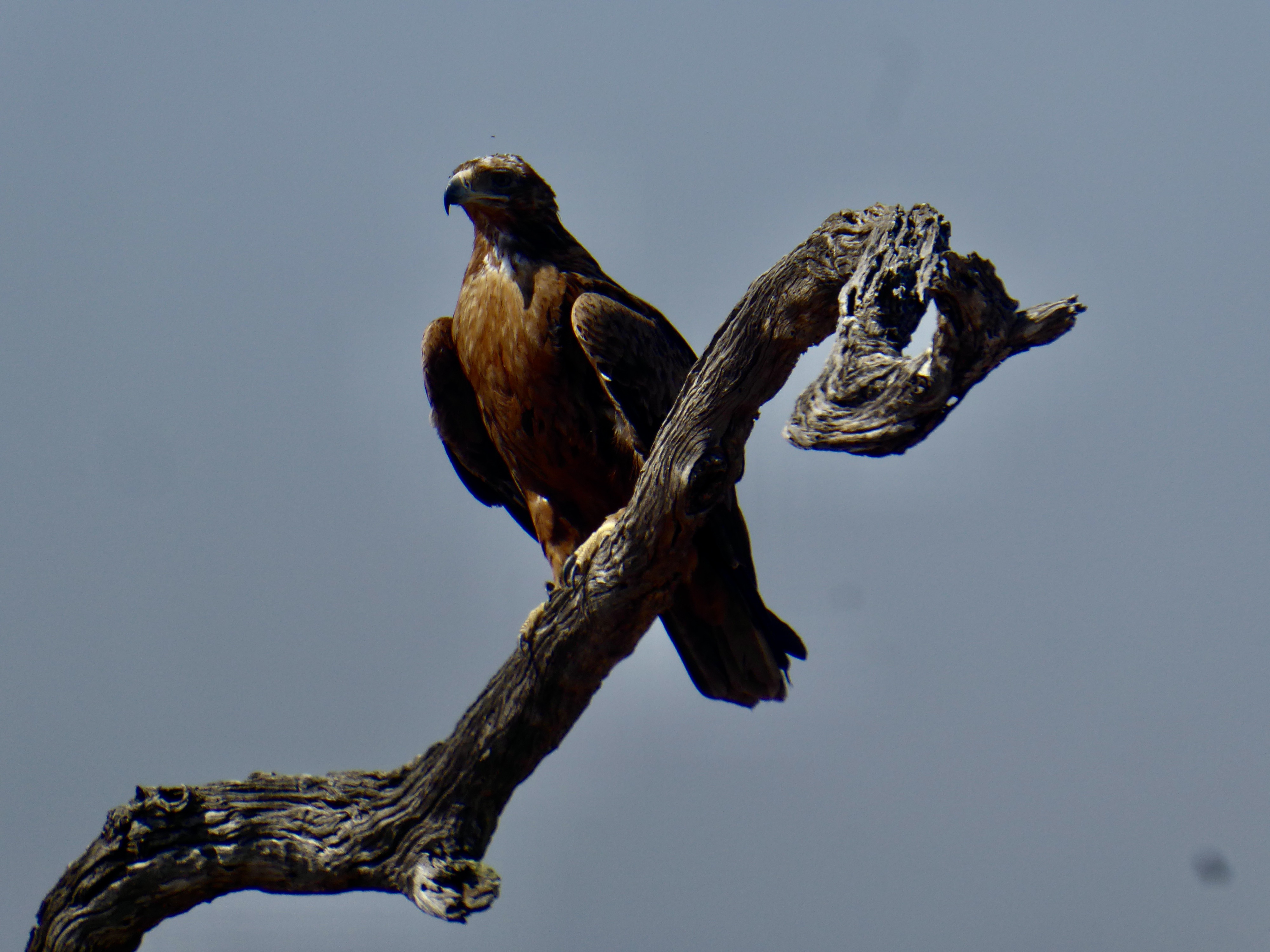
I’m lousy at identifying raptors (except for a mature bald eagle), but Isaac informed us that the one below is a booted eagle (Hieraaetus pennatus, also classified as Aquila pennata), which is actuallya Palearctic species but overwinters in places in Africa. Perhaps I’ve got the wrong ID, for the booted eagle appears to be very rare in Kruger:
The Booted Eagle is a summer migrant rarely seen in Kruger as it prefers the drier, mountainous habitats of the western Cape where there is a breeding population. The very few Booted Eagles that have been seen in Kruger are most likely northern hemisphere migrants that breed in north Africa and southern Eurasia.
They arrive in southern Africa usually during the course of November and depart in February before the end of the rainy season.
Birders—especially those with African expertise—should weigh in.
There’s no doubt, however, that the bird below is an African Grey Hornbill (Lophoceros nasutus epirhinus). It has an interesting behavior shared by some other hornbills:
The female lays two to four white eggs in a tree hollow, which is blocked off during incubation with a cement made of mud, droppings and fruit pulp. There is only one narrow aperture, just large enough for the male to transfer food to the mother and the chicks. When the chicks and female outgrow the nest, the mother breaks out and rebuilds the wall, after which both parents feed the chicks.
If the father dies while the female and chicks are walled in, the family is doomed, for the sealed-in mother undergoes a rapid molt of her flight and tail feathers (and therefore couldn’t fly even if she pecked down the wall) and thus depends on dad to supply the food. If he dies or leaves for some reason, there’s no food for anyone in the nest.

This is the remains of a (gulp) dagga boy, a lonely African buffalo expelled from the herd, making him vulnerable to predation. This one met that fate: he was taken down by lions, and we saw a male and female lion nearby on the next day (pictures tomorrow). They were hanging about saving the rest of the buffalo for a second meal of ribs.

Sightings of the common ostrich—Struthio camelus; there are two ostrich species in Africa—weren’t common in Kruger, but we saw enough to learn that it’s easy to tell the male from the female (as in all animals, ostriches come in only two sexes). Females are brown and males are black. Ergo, here we have a female:

- Ostriches are the largest birds in the world, standing up to 9 feet (2.8 meters) tall and weighing as much as 320 pounds (145 kg).
- They are flightless but can run at speeds up to 45 mph (72 km/h), using their powerful legs to escape predators.
- Ostriches lay the largest eggs of any living land animal, with each egg weighing about 3 pounds (1.4 kg).
And from National Geographic:
An ostrich’s powerful, long legs can cover 10 to 16 feet in a single stride. These legs can also be formidable weapons. Ostrich kicks can kill a human or a potential predator like a lion. Each two-toed foot has a long, sharp claw.
Finally, from an article in The Annals of Medicine and Surgery (I had to know):
In one study of ostrich attacks, it was estimated that two to three attacks that result in serious injury or death occur each year in South Africa, where a large number of ostrich farms abut against both feral and wild ostrich populations.
And their mating behavior is bizarre; here’s an Attenborough video showing how rigorously a female sizes up a potential mate:
A common tsessebe antelope which we’ve seen before, but we didn’t spot many of them.

Termite mounds, which can become huge, abound in the park. Here are two:

The ecology of these mounds is fascinating, involving cultivation of a fungus garden (like leafcutter ants), a complex cooling system, and a queen who can live up to fifty years. You can read more about them here.

Oh, I crossed the Tropic of Capricorn again, and so you get another photo:

I love zebras because they’re gorgeous, and I always remember that their stripes are likely an adaptation to deter biting flies that can carry disease. But because they’re not one of the Big Five, and because they’re common, they are underappreciated. Look at these lovely Burchell’s zebras!
Notice the lazy zebra on the left, who’s resting its head on the butf of the middle one.


Below spotted hyena (Crocuta crocuta) near some zebra, all seeking access to a water tank (Kruger has built tanks and ponds to provide water, especially in this dry season.
There’s only one species of hyena, and gender activists love them because they think that the female’s “pseudopenis” means that they don’t really have two sexes. Those who make that claim are ideologically deranged. Here are the facts:
The spotted hyena is the largest extant member of the Hyaenidae, and is further physically distinguished from other species by its vaguely bear-like build, rounded ears, less prominent mane, spotted pelt, more dual-purposed dentition. fewer nipples, and pseudo-penis. It is the only placental mammalian species where females have a pseudo-penis and lack an external vaginal opening.
Note well: the FEMALES have a pseudopenis. They are females, not some sort of third sex. (You didn’t think this recounting would be free of ideology, did you?)

A white rhino; the only one we saw in the park. It’s a rare spot, and do note that this one has had both of its horns sawed off by rangers to prevent poaching. The act, which is necessary to save the species, is a calculated compromise to save the animals’s life while reducing its ability to defend itself:

One of the loveliest places I saw in Kruger. Like the one I showed the other day with a bunch of elephants digging wells, this shot was taken on a bridge over a river (this one has water in it), and it’s in a place where you can get out and take photos. This one has elephants, a hippo, and a heron of unknown identity in it. See them all? This scene will remain in my mind as epitomizing the African bush:

The hippo was out of the water as it wasn’t too hot, and the heron was nearby looking for fish.
Note the two oxpeckers on the hippo below:

Reader Divy and her reptilophilic partner Ivan had a look at this turtle I photographed right under the bridge. Their ID: “it is most likely a Serrated hinged terrapin (Pelusios sinuatus). Terrapin is mostly a regional term for certain turtles that live in brackish water, such as Diamondback Terrapins, or Red-eared sliders.” This water is certainly not brackish, but neither is Botany Pond, where red-eared sliders were common.

The water was clear and shallow enough (hippos can’t swim and have to walk on the bottom) that we could get a good view of them while submerged. This one seems to have a baby with it, though the baby is not that small:

Here is a herd of hippos (another word for a grouping is a “thunder of hippos”):

We also visited a fascinating Elephant Hall at the Letaba Rest Camp, devoted entirely to the African bush pachyderm. Here is a group of school kids about to enter it as we were leaving.

Isaac came in with me, and photographed me next to the life-sized skeleton of an elephant. You can see how large they are:

I was fascinated to learn that, as this picture (and the video below) shows, elephants walk on their tiptoes, not on the soles of their feet. But it looks as if they’re walking on their soles because of the thick pads of flesh and fat under their toes:

Not only that, but each foot is planted separately from the others; no two feet hit the ground at the same time, as you can see in the video below (it also says that “the elephant is the only mammal that never lifts all four feet off the ground at the same time”). Note as well that they also walk relatively silently, and there’s doubt whether they can “run”, as opposed to just walking fast:
Elephant males battle for dominance, and they can kill each other with their tusks and heads. This is a skull of a male that was apparently killed by the tusk of another male piercing its head (the tusk shown below is added to show what probably happened):

Here’s Isaac showing the size of the tusks of one “tusker” male named Mafunyane. The tusks are larger than he is, and he isn’t small!
Mafunyane was one of the “Magnificent Seven” big-tusked bulls who lived in Kruger in the 1960’s; their skulls are in this hall and are described at the link just above. (They all died natural deaths; elephants tend to live about fifty to seventy years.)
Facts about this bull:
Mafunyane was the best-known member of the Magnificent Seven. His Tsonga name meant “the irritated one”, based on his temper and impatience with people. He avoided the major tourist routes. Mafunyane’s long, straight tusks dragged on the ground as he moved. He was a small elephant, however (only 327 cm high at the shoulder), and his tusks were shorter than most of the other Magnificent Seven’s. the tusks had an oval circumference, making them look heavier than they really were. The most unique characteristic of Mafunyane was the 10-cm-wide, 40-cm-deep gap in his skull. The hole stretched into his nostril, and he could therefore breathe and consumer rainwater through it. The origin of the gash is unknown, but it is believed to have been sustained during a fight with another bull whose tusk pierced the Mafunyane’s skull. Mafunyane died in 1983 of natural causes, around 57 years old.

And below you’ll see the skull of Shawu, who bore the longest tusks on record in a South African elephant. Shawu lived to be about sixty, dying of natural causes in 1986.


It was hot that day, and every beast took advantage of either water or shade. Here are two separate groups of impala, all clustered together in the shade of trees:

But of course I must show several pictures (not that different, to be sure), of my favorite African bird, the lilac-breasted roller.


What a beaut!

And, as the day drew to a close, we finally came upon a goal we failed to meet on an earlier trip to Timbavati with Kyle and Carrie: a sighting of the Southern Ground Hornbill (Bucorvus leadbeateri). All of a sudden several of these fantastic birds appeared by the roadside, and weren’t the least spooked by our car (Isaac always turned off the engine when we took photos).
You can read all about this bird at either of the two links just above. Our sighting consisted of watching these hornbills pecking vigorously at the ground, trying to scare up a tidbit or two. They’re carnivores, but their habit of foraging on the ground gives them their name. From Wikipedia:
They forage on the ground, where they feed on reptiles, frogs, snails, insects and mammals up to the size of hares. Southern ground hornbills rarely drink.
So, ladies and gentlemen, brothers and sisters, and comrades, I close by giving you seven pictures of Southern ground hornbills in diverse poses:

x


Hippos, Ostriches, and Elephants, and now I have “Dance of the Hours” going through my head. (IYKYK) 😉
Great stuff, Jerry!
What can I say today?
Gorgeous!…
And is there a clue to find out what HOLO means?
Amazing pictures and commentary. What an adventure!
Interesting factoid about elephants: they are unique in having four knees.
Interesting fact about elephants: the above factoid is clearly wrong as PCC(E) demonstrates standing elbow to elbow with an elephant skeleton. The alleged front knees are really part of the wrist (it looks like).
If the discussion is about Ostrich mating habits it’s always worth adding Zefrank’s particular take on it.
Possibly NSFW. As Zefrank says “not appropriate for children nor for adults who don’t act like children”
https://youtu.be/wmbEtgw9Pf4?si=74ArUdocA_3dELzH
I must say that I am really enjoying this series of photos from South Africa… Thank you for sharing them all!
Excellent stuff.
The picture taken from the bridge overlooking the river is gorgeous. Looking at it makes me feel like I’m really there.
Question: Is that a second hippo in the water to the left with its nose poked out?
You did finally get a poser zebra. They are amazing works of art. I forgot to comment on the “rump shot” of yesterday showing the detail around the tail… amazing. I don’t want this adventure to end. This had been such a joy!
I thought the healed scar on the left side of the zebra rump from yesterday was interesting in the way the stripes no longer lined up.
Yes! S/he looked like a punk rocker.
Great pictures and commentary, thanks!
What a great series of photos and information.
I loved the ostrich video of Attenborough and the mating dance. Ostriches looks so clumsy and awkward running. I don’t expect them to be able to run.
But the mating dance they have the grace of swans. The male doing the wing and neck performance was like a ballerina. The wings moving so beautifully.
I really loved watching his graceful neck.
Thank you and what a place to go!
Fantastic! The elephant skeleton is a bit wrong in the feet. They stand higher up on their toes. https://www.researchgate.net/figure/Lateral-view-of-the-full-structure-of-an-Asian-elephant-foot-The-side-toes-are-often_fig1_360938306
Good find! They’re even more tippy-toed than I thought!
They made a mistake in Shawu’s tusk information. While the left tusk info appears correct 317 cm = 10 feet 5 inches, they put the wrong symbol for the right tusk, where they accidentally say 305 cm = 10 INCHES instead of 10 feet (” instead of ‘).
Good spot!
Great WEIT digital safari “Buffalo Jerry” 😁
The sunrise!
Great time of the day.
‘Terrapin’ is one of those vernacular terms that is useless taxonomically.
Diamondback terrapins do inhabit brackish water of estuaries on the east coast of North America. Red-eared sliders do not.
But in Oklahoma ‘terrapin’ means a box turtle.
The African species in the picture isn’t even in the same suborder, being a pleurodire, or side-necked turtle.
Great pictures and the videos are good too. What a wonderful trip.
“Ostriches lay the largest eggs of any living land animal.” Odd phrasing. Is there a living sea animal that lays larger eggs?
Meanwhile, in the Northern Hemisphere, Valdimir the Whale has been found dead in Norwegian waters