
Good morning at the tail o’ the week: Friday, June 7, 2024, and National Chocolate Ice Cream Day. The best brand I’ve found, including premium varieties like Haagen-Dazs (I refuse to use the umlauts), happens to be Trader Joe’s Super Premium Ultra Chocolate Ice Cream, available in quarts for four bucks and change (their coffee ice cream is also good, but this one is spectacular). Here’s a review of that variety, along with vanilla and mint chocolate chip (I’d avoid those; they’re okay but not up to the par of the chocolate). Eat it slightly softened. I’m not generally a fan of chocolate ice cream, but this is what I keep in my freezer. To avoid weight gain, I eat it out of the carton, taking only five largish spoonfuls as a serving.
It is a very dark and chocolate-y flavored, as this video shows. The woman in the video suggests topping it with maple syrup. It sounds weird, but I may try it! (This video recommends the ultra chocolate as Trader Joe’s best flavor at 11:38, with the the mango sorbet close behind.)
It’s also Hug an Atheist Day, National Doughnut Day, National Fish and Chip Day in the UK, National Gun Violence Awareness Day (in the U.S.) and Tourette Syndrome Awareness Day.
Readers are welcome to mark notable events, births, or deaths on this day by consulting the June 7 Wikipedia page.
Da Nooz:
*In a NYT op-ed, Frank Bruni lays out “The absolute worst argument for why Trump won’t win.” Here’s the argument in one paragraph”.
Americans won’t be that reckless with the country’s future and won’t stoop that crudely and cruelly low. When it’s finally time to cast ballots — when the full weight of that decision hits them — they’ll realize that whatever their disappointment in the current president, it’s no match for the disgust that the former one elicits. They’ll recognize, however grudgingly, that Trump is an unserious person, unfit for a serious country.
Why is it so bad? Bruni says because “It’s a dangerous reprise of the (greater) confidence that Democrats felt about Hillary Clinton back in 2016. And look how that turned out.” Here’s why we should be worrying that Trump could win (as if I need another dose of tsuris!):
I’d point out that when he lost in 2020, we were mid-pandemic — that surely hurt him — and Biden was the one who represented change. Now, weirdly, Trump does.
I’d point out that to go by opinion polls, more voters have reservations about Biden’s age (81) than about Trump’s (77 until next week). And those reservations are deep.
I’d point out that while Biden received roughly seven million more votes than Trump did four years ago, about 45,000 votes in Georgia, Arizona and Wisconsin were the difference between Biden’s victory in the Electoral College and a tie with Trump. Those states — along with Pennsylvania, Nevada and a few others — could be decided as closely this time around.
Last, I’d point out that many of the voters who will give Biden or Trump his margin of victory aren’t attuned to the scariest and most negative details about Trump that I’ve just laid out. And in a fragmented and chaotic news environment, they may be supping on information entirely different from what the crowd who cannot envision Trump’s election consumes.
These shallowly and sporadically engaged voters might just gasp at the prices of groceries and houses, dismiss the verbal crossfire between Biden and Trump as a more intense version of familiar political warfare and choose Trump. Not acknowledging the very real possibility of that is dangerously complacent, and it fails to recognize how forcefully Biden and his supporters need to make the argument for him. The case against Trump is indisputably damning — but it may not be enough.

*Former Trump advisor Steve Bannon is going to jail, though for only four months and on a contempt of Congress charge.
A federal judge Thursday ordered Steve Bannon to surrender by July 1 to serve a four-month prison sentence for defying the House committee that investigated the Jan. 6, 2021, Capitol attack and former President Donald Trump’s efforts to overturn the 2020 election.
The former Trump adviser was found guilty in July 2022 of contempt of Congress and sentenced in October of that year, but U.S. District Judge Carl Nichols in Washington allowed him to remain free while he appealed.
In a unanimous decision last month, a three-judge appeals-court panel rejected Bannon’s arguments that his conviction wasn’t valid because he was following his lawyer’s advice when he refused to comply with a House subpoena demanding documents and testimony. The panel said Bannon’s advice-of- counsel defense wasn’t valid in contempt-of-Congress cases and would impede the legislature’s investigative authority.
Though Bannon plans to continue to press his arguments, Nichols, a Trump appointee, said at a hearing Thursday that the time had come for Bannon to serve his sentence. “I can no longer conclude that his appeal raises substantial questions of law,” the judge said.
I don’t like this dude even though I did back his right to speak at the University of Chicago (they tried to deplatform him and I defended him in a Chicago Tribune op-ed, but he never showed up).
*In contrast to the long NYT profile of Ibram X. Kendi that was in the NYT (I wrote about it in yesterday’s Nooz), the National Review has a much more critical piece called “The Lies and Fall of Ibram X. Kendi” (it’s archived here; h/t Rosemary). It’s a snarky piece that begins by dissing Nikole Hannah-Jones and Robin DiAngelo, then goes on to Kendi, getting in a few licks at the New York Times piece at the end:
But nobody impressed me more than the Cut Creator, Ibram X. Kendi. If people like DiAngelo and Rao were paler Joan the Baptists, then the experience of Kendi (born Henry Rogers in Philadelphia, name changed at age 32) was like witnessing the advent of the anti-racist messiah himself. Why, it was even right there in the title of his book. How to Be an Antiracist — which came out in mid 2019 to significant (and retrospectively ominous) plaudits among the “woke set” but complete indifference among the world at large — was one obscure black academic’s solution to all the textbook American racial oppression he had read about as a child but never quite suffered during his middle-class upbringing yet felt he should have. And once George Floyd died at the hands of Officer Derek Chauvin, its fantasy narratives might as well have been placed in advance and doused in gasoline, merely awaiting a lit match.
What is racism, per Kendi? Anything that oppresses minorities but most especially African Americans. What is “antiracism”? Anything that promotes their social, economic, or physical well-being. How to be “antiracist”? It’s simple: Question literally every single decision you make in life on a granular level. Does voting for this candidate or referendum advance “antiracism”? How about reading this book? Wearing these clothes? Boycotting this show? Not boycotting this show? (How about this hummus? It’s made by Zionists!) The logic wasn’t even particularly compelling, merely ironclad in its suffocatingly recursive and intentionally ill-defined way. “There is no neutrality in the racial struggle,” warned Kendi, and the book (and his subsequent lectures on it — which might have cost you $20,000 a pop, provided you were an institutional sponsor) made it clear: Every single choice we make marks us like Cain as “racist” or — hopefully, the way Calvinists reckon with future salvation — as “antiracist.”
Future generations will barely believe it, but this stuff had its moment. Kendi became a multi-millionaire off the Floyd agonistes among liberal and corporate America, as I noted a year ago. The man had hustle and an easy way with conversational patter, as well as the willingness to fearlessly reductio his thesis all the way to absurdum. It captured a certain zeitgeist. No wonder he was showered with $55 million for his Boston University “antiracism center,” and no wonder he fumbled it all. It all collapsed when we shuddered ourselves out of the 2020–21 punch-drunk daze. Being surprised at the fact of Kendi’s mismanagement is like being surprised that you can’t really promote Eddie Murphy from street hustler to floor trader in the span of a month.
Strangely enough, I end with today’s “news hook” instead of beginning with it: The New York Times Magazine is out this week with an autopsy on the rise and fall (to date) of Kendi. The piece is of course written with all due sympathy — in this narrative, the audience is assumed to understand that Kendi is a well-meaning crusader beset by the cruelties of academic expectations — and for once I don’t particularly recommend it to you. It treats the entire phenomenon of Kendi-ism as the unique travail of one put-upon college administrator unused to disbursing large amounts of cash. (Ray Stantz once warned Peter Venkman that the harsh realities of the private sector would make him long for the cushiness of academia, but apparently academia has raised its game as well.) Great pains are made to distinguish his theories from Robin DiAngelo’s: For her, racism is a state of inexpiable white original sin that one must constantly apologize for. For Kendi, it is merely something you oppose by micro-interrogating every single action you take on a relentless second-by-second basis. The Times wants you to understand that his is the more sensible way to reckon with your failures.
I choose neither. But I lament the twilight of the fanaticism that gave us such brief phenomena as Ibram X. Kendi, if only from a detached, aesthetic, “may you live in interesting times” perspective. This man gave America the simplest, most easily applicable binary solution to all of our racial problems. It didn’t matter that it was stupid, at least not from the perspective of his personal enrichment. For a while, it sold. Now that it doesn’t? It’s time for the think pieces. What we lived through in 2020, during the Floyd meltdown and its aftermath, was a onetime necrotic bloom during which the first carrion-feeders on the scene were able to fatten themselves up to spectacular proportions on the collapsed body of American progressive racial and political angst. The first-mover advantage went to the Kendis and DiAngelos of the world, already lean and hungry from years of preparation — and if you, like me, have grown to appreciate the majestic adeptness of cynical operators, then why not salute how quickly they denuded our national carcass, leaving us with the bones? Why not, unless you care about the future of American civil society?
Well, it’s pretty much true, even if it does sound like it was written by H. L. Mencken (imagine what he would do with Kendi). And I don’t have much to say except that there is a place for the NYT’s generally laudatory piece but also a place for the National Review’s snark. Overall, I think Kendi’s pretty much done as a national figure now. As one of his friends said in the NYT piece, ““I don’t know of anybody more ill suited for fame than Ibram Kendi.”
*Colin Wright has challenged a critic of the Kass Review to a Debate, constantly upping the amount that the critic would get donated to his favorite children’s hospital. No dice! Read or hear about it in “Eager to Affirm Yet Unwilling to Debate“. The text is below, and the audio at the link is a 12-minute podcast of Colin reading his Quillette essay on this cowardly doctor (link below). I myself avoid debates, but if I had been a vocal critic of the Kass Report like O’Brien, I sure as hell would debate, especially to get that much money donated to a children’s hospital. Some text from the link.
Some of you will already know, based on recent articles I’ve published here, that my Manhattan Institute colleague Leor Sapir and I have been doing our best to encourage a particularly aggressive gender-affirming pediatrician named Dr. Michael O’Brien, to participate in a debate on the UK’s Cass Review and so-called gender-affirming care more broadly.
Our offer to have him engage with Dr Sapir came after O’Brien had publicly responded to Do No Harm senior fellow January Littlejohn on X, where he claimed the Cass Review was “a sham at best, and you’d know that if you were at all qualified.”
Long story short, we decided to test the limits of the gender activists’ “no debate” policy by starting a GoFundMe to raise money for a children’s hospital of Dr. O’Brien’s choice if he agreed to participate in a good-faith scientific debate on the topic.
We ended up raising over $30,000, and still he refused to debate. So I think we did a good job exposing the level of absurdity we’re dealing with here. It’s impossible to maintain the moral high ground on “no debate” when failing to engage effectively blocks $30,000 from sick and injured kids. It’s logically and morally indefensible.
But I won’t give too much away, since that’s the point of this episode. A couple days ago I published an overview of the entire thing in a Quillette essay titled “Eager to Affirm, Yet Unwilling to Debate.”
This episode is the audio of me reading that essay.
And you can find the essay on Quillette here.
*From Tablet we have an article about being Jewish at Harvard this year: “Harvard’s golden age turns to mud.” The first sentence, emitted by the commencement speaker, stuns me.
“I was called antisemitic by power and money because they want power and money.”
Thus said Harvard’s 2024 commencement speaker, Maria Ressa. Fittingly, her deployment of antisemitic tropes in front of tens of thousands of students, professors, and families at graduation last week encapsulated the absolute chaos that has engulfed Harvard University for the last year.
THEY want power and money? Who are “they”? You know the answer, of course, it’s those pesky Zionists. That this person has not been called out for bigotry stuns me. But let’s look at other bits of the piece:
After all, just the week prior, dozens of students and faculty gathered by the gates of Harvard to gleefully exclaim “intifada, intifada, coming to America.”
This of course followed an almost monthlong illegal encampment of students and professors in the center of Harvard Yard demanding a complete and total divestment from “the Zionist entity.” Although the participants used bolt cutters in an attempt to break open Harvard’s gates, depicted our Jewish President as a devil replete with horns and a tail, violated all time, place, and manner restrictions, called for the violent destruction of the Jewish state, and established a self-appointed security system that monitored and recorded Jews like me on our way to class, they were handsomely rewarded.
In exchange for packing up their foul-smelling tents and open-air laundry, all graduate and almost all undergraduate students had their suspensions revoked. The encampment leaders will meet with senior university officials to discuss a Palestinian studies department, and the Harvard Management Corporation, which oversees Harvard’s $50 billion endowment, will invite them for a seat at the table to discuss divestment, and President Garber personally asked for reinstatements and an expeditious disciplinary process.
That same week, the Harvard antisemitism task force, led by a professor who has repeatedly labeled antisemitism at Harvard as “exaggerated,” quietly updated their timeline. Rather than submit recommendations to combat Jew-hatred during the spring semester as promised, the task force now has a revised date of fall 2024.
. . .Despite countless op-eds and interviews, seldom are the personal experiences and stories of the students themselves highlighted. As a result, too often Harvard professors themselves belittle the plight of Jewish students and publicly denounce not the antisemitism, but the mere accusations of antisemitism, on campus.
As a Jewish student at Harvard University, I have had my learning interrupted by students calling for the globalization of the intifada, sat directly next to classmates who praised the terrorist groups Hamas, Hezbollah, and the Houthis, listened to 34 student groups blame the largest massacre of Jews since the Holocaust on Jews themselves, been exposed to countless death threats, and perhaps most infamously, had a university president who described calls for Jewish genocide to be “context-dependent.”
And there are plenty of other stories about the plight of Jewish students. In this case, yes, data is the plural of “anecdotes”. And Harvard continues to lose Jewish students. Want more? Here’s one more point:
Earlier in the year, close to 100 Harvard faculty and staff published a cartoon depicting the hand of a Jew, imprinted with the Star of David and the dollar sign, holding nooses around the necks of an Arab and a Black man.
Please, sir, can I have some more?
In early April, Harvard deployed 24/7 private security to stand guard in front of the Palestine Solidarity Committee’s “Apartheid Wall.” The wall was replete with offensive Holocaust imagery and a quote from the U.S.-designated terrorist group Popular Front for the Liberation of Palestine. However, when it came to Chabad installing a menorah during Chanukah, not only did Harvard not provide any security, but also instructed that it be removed each night.
That’s heinous. These are grounds for a Title VI lawsuit, and if I’m not wrong such a suit has indeed been filed against Harvard.
Meanwhile in Dobrzyn, Hili is being very sneaky!:
Hili: And I thought I had gained the trust of a sparrow.A: And what happened?Hili: It had doubts about my sincerity.

Hili: Już myślałam, że zdobyłam zaufanie wróbelka.Ja: I co?Hili: Zwątpił w moje przyjazne intencje.
*******************
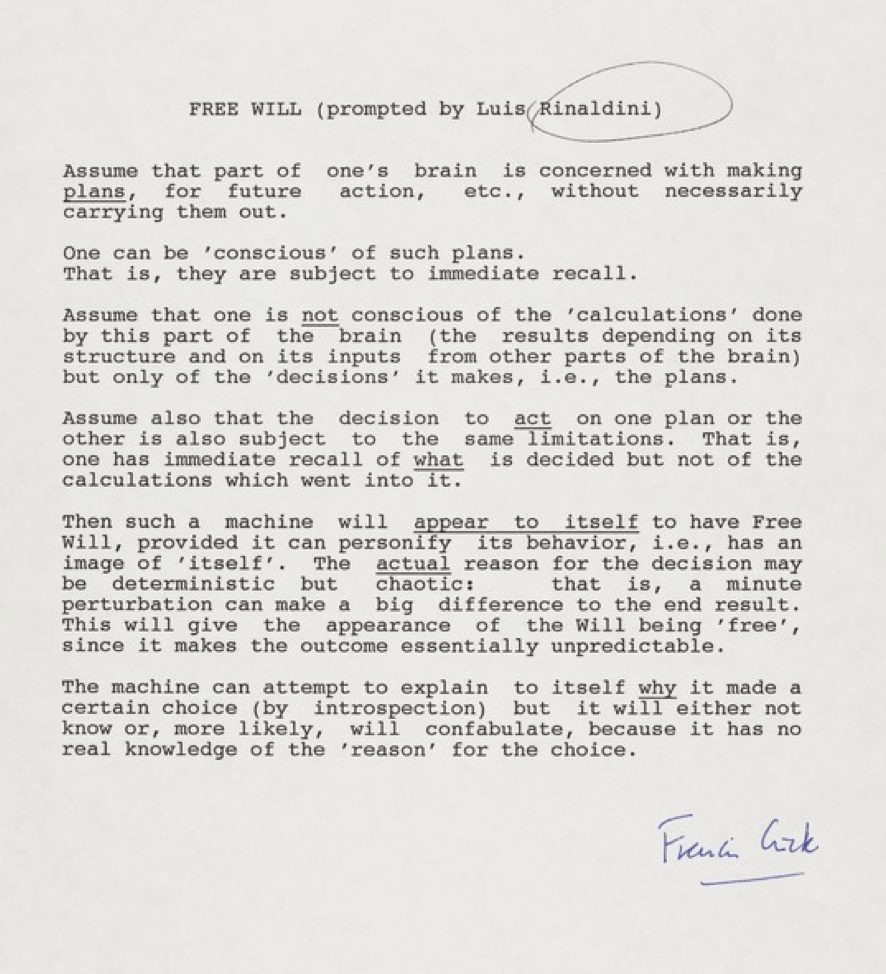
This came from Matthew; I don’t know where he got it. It’s a compilation of notes on free will from Francis Crick. Matthew found it while writing Crick’s bio. Click to enlarge. Note that Crick is a determinist, and even knows that “chaos” is deterministic. He was a smart man.
From Barry, again with the source unknown:
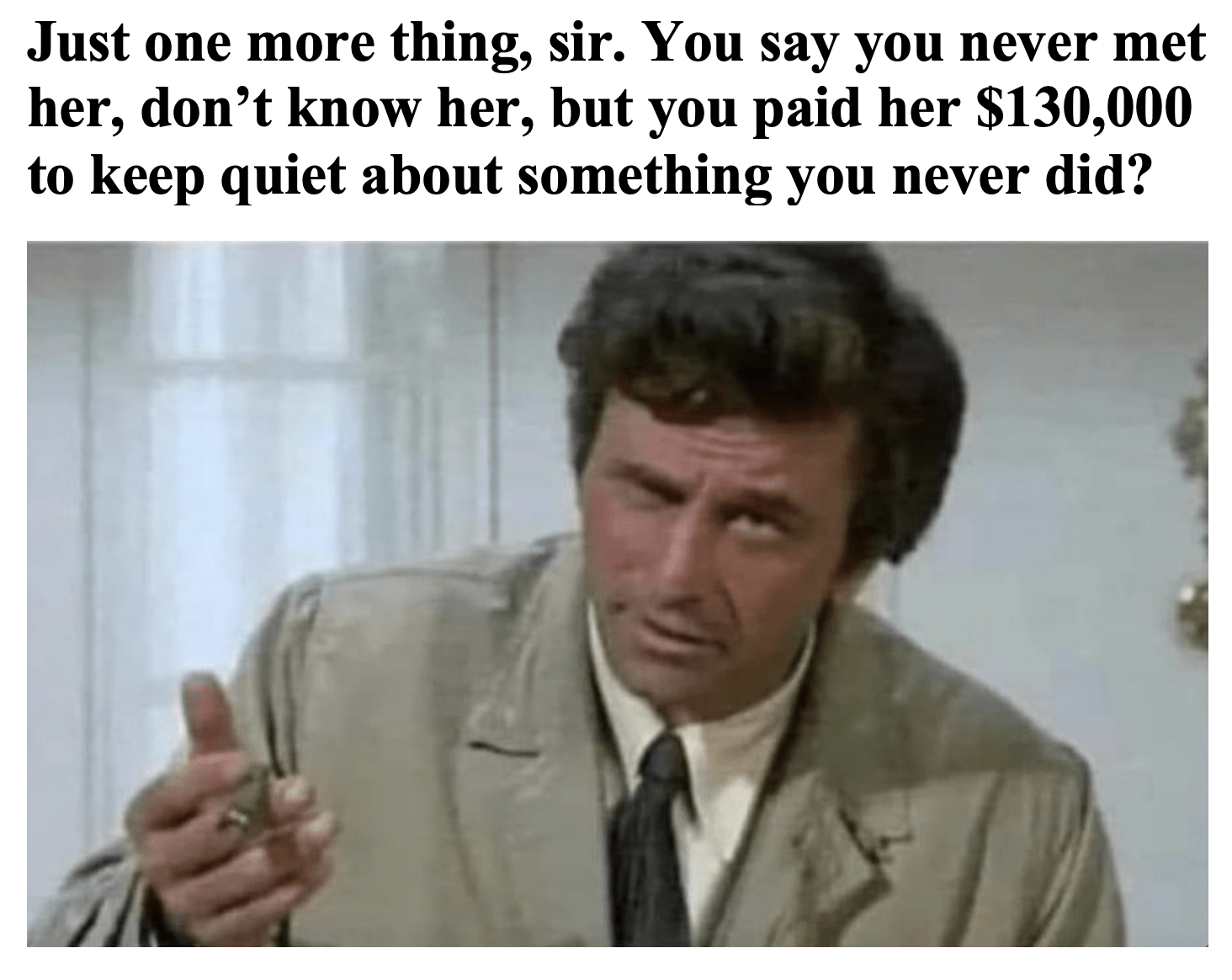
From America’s Cultural Decline into Idiocy:

From Masih, who introduces those shot up by Iranian police for protesting:
I had the honor of introducing my heroes—Iranian protesters who lost eyes and arms after Mahsa Amini’s murder. Their sacrifices challenge the #GenderApartheid regime. Hear their powerful testimonies and dream of freedom and democracy.@OsloFF pic.twitter.com/Y5Mgyna7KL
— Masih Alinejad 🏳️ (@AlinejadMasih) June 5, 2024
From Colin Wright; now even the anatomists have got into the act:
“Despite recognition that sex is a spectrum…” 😵💫
“…perpetuating the stereotype of sexual dimorphism as a norm…” 😵💫😵💫 pic.twitter.com/W2U0jiPzmM
— Colin Wright (@SwipeWright) June 5, 2024
From Barry: a cat resistant table. This has got to be frustrating for moggies!
Cat-resistent table.. 😂 pic.twitter.com/YO7LULY99W
— Buitengebieden (@buitengebieden) June 5, 2024
From Simon. I wonder if this is true right now, or depends on the outcome of an appeal. If true, it means The Donald can’t visit his golf course in Scotland.
It’s now safe to move about the world https://t.co/k1JFdZteGO pic.twitter.com/DLctcMvmMj
— George Conway (@gtconway3d) May 31, 2024
From Malcolm; the cat doesn’t want walkies!
car needs to refuel pic.twitter.com/0mmQoo8KvE
— Punch Cat (@PunchingCat) April 26, 2024
From the Auschwitz Memorial; one that I posted.
Mother and daughter probably gassed to death upon arrival. The daughter was seven. https://t.co/7RC7IaorQj
— Jerry Coyne (@Evolutionistrue) June 7, 2024
Two tweets from Dr. Cobb. I might have posted the first one before. If so, here it is again:
If someone wrote a novel about a president on trial for paying off a porn star and the first witness was named “Pecker,” you’d hand that back for a rewrite.
— Harlan Coben (@HarlanCoben) April 22, 2024
How many babies does this hen need to look after?
To the parents with their hands full: we see you ❤️#Springwatch @BBCSpringwatch pic.twitter.com/r9HfY30MyE
— WWT (@WWTworldwide) May 28, 2024
On the proliferation of “Just Graduated” messages : I’m pretty sure at this point the the misspelling of “Graduated” is is deliberete.
[ as reader Debi noted to me yesterday, “no s*it Sherlock”. ]
[ … well played. ]
The National Review piece on Kendi is simply brilliant 👏🏽. NYT ( among other things ) has -also- lost its sense of humor. NR lands closer to the truth on this subject. Kendi, like Di Angelo caused ( and continue to cause) significant damage; this needs to be underlined.
In other news, Candace Owens doubts the existence of dinosaurs, and gets applause from the lunatic right.
But best of all. From Pirate Wires:
Well, looks we are going to Mars. USA! 😇
===========
Mike Solana:
Yeah we’re definitely going to Mars.
Yesterday, SpaceX launched its 4th Starship — a rocket taller than the Statue of Liberty — which went to space, came back, flipped over, and landed right side up on the Indian Ocean. An incredible success: SpaceX has basically demonstrated it can re-use the biggest rocket in history (i.e., we’re going to Mars, guys). But the AP’s take was different: “SpaceX’s mega rocket completes test flight without exploding,” in apparent self-reference to its own dishonest reporting on the prior three launches. Frustrating, but perfectly inline with the MSM’s habit of blatantly misinforming readers about anything Elon-related, and — in the case of SpaceX — pretending not to understand rocketry’s iterative nature. But whatever, it’s not worth getting mad about. We have a choice: keep giving doomer news the attention (keeping it on life support), or ignore it, and let it finally die. I know what I’m going to do, and I’ll start right after finishing this take (promise).
=============
An incredible technological achievement. Go Elon!
+1. But also I would remind everyone that humans in space is still very challenging if not dangerous business. We are going to lose some of these brave people over the years, but they have made the benefit/risk calculation.
True.
> But whatever, it’s not worth getting mad about. We have a choice: keep giving doomer news the attention (keeping it on life support), or ignore it, and let it finally die. I know what I’m going to do, and I’ll start right after finishing this take…”
#MeToo! Right after just one more little thing… 😀
+1
#MeToo
Go (engineers, scientists, technicians, craftsmen who work for) Elon.
Go Fillippo!
Now this is good writing:
… pretty much summing up woke “anti-racism” in one sentence.
+1
Top rated reader comment on the NYT Kendi article:
“I’ve read a couple of his books and came away shocked that people found his ideas interesting or important. Half of the country will believe anything and champion anyone as long as they use the right buzzwords.
Some of his radical ideas permeated public elementary schools and the country is worse off for it.”
Trump can’t visit other countries? Not a problem, they will have to come to him. And maybe make any funding from the US contingent on it. The Far Left® continues to do an incredible job of boosting his standing among the faithful while fueling his enormous ego.
+1
Yes
Amazing isn’t it?
Canada’s federal Minister of Justice can permit the entry of any person to Canada if it is in the public interest regardless of circumstances that would otherwise make him legally inadmissible. (He can prohibit any person also.). If Canada needs to welcome a foreign head of state in an official capacity to prevent a diplomatic catastrophe involving our most important trading partner and military ally befalling us, the drawbridge will be lowered and the red carpet will roll out as always.
From the you’re not paranoid if they are really after you department: in considering all the shade thrown on uncle Joe in the media for this, that, and the other, think about possible subtle sources. I recommend Anne Applebaum’s piece, “The New Propaganda War”) in the current June hardcopy of The Atlantic (should be free at https://www.anneapplebaum.com/2024/06/04/the-new-propaganda-war/ ). Along with Douglas Murray’s “War on the West”, Coleman Hughes and John McWhorter calling out the neo-racists such as Kendi, Bari Weiss on illiberal antisemitism, and most recently the many “pop-up” encampments at elite universities with their coordinated messages, and finally tRump and MAGA attacks on the judicial system, and I think the November choice is clear …. If we still want the nation we learned about in our US k-12 schools. Thanks for allowing me to get that off my chest this Friday morning.
Oh and on the positive side of life, I loved Hili this morning…what, me worry?
“To state baldly what is happening: The Republican Party’s right wing is actively harassing legitimate, good-faith efforts to track the production and dissemination of autocratic disinformation here in the United States.”
The Applebaum article is fascinating and frightening – thanks much for providing the link!
Yep. Her piece is excellent, and scary.
Yep. And it explains a lot about the ubiquity of the craziness….there exists a huge, well-resourced womb.
The Applebaum piece was interesting from the point of view of the progression of the argument to get to the payoff of the last sentence that says that Trump is a danger to democracy, the current Democrat talking point.
This also sets up an interesting dynamic to come in November if Mr. Trump wins: she’s laying the groundwork for Democrats to claim that the election was illegitimate.
Sorry Jim, I’m missing your point about how Murray, Weiss, Hughes, McWhorter, Encampments are important reasons to elect Biden (I assume that’s your choice given the signaling you use when typing tRump).
The writers you selected are known for calling out the far-left agenda, and that agenda is driving policy decisions. Democrats have also called out the judicial system (remember the outcry after Roe v Wade was overturned, also the plan to increase the size of the court to lessen influence of conservative justices).
Republicans in Congress championed the pro-Israel / pro-Jewish student point of view far more than the Democrats did, and many Democrats have been in favor of the protests.
Therefore I don’t understand your logic, so an explanation would be helpful.
The other thing is that I wonder about: if these foreign actors are sowing dissent by getting anti-Democrat material into social media, then wouldn’t they also want to sow anti-Republican controversy as well? In other words, shouldn’t people who proclaim “TRUMP IS A THREAT TO DEMOCRACY!” also be questioned as being Russian or China puppets who are trying to damage the credibility of a potential Trump administration?
(Of course I know the comeback: no they’re not puppets or brainwashed because I believe that Trump really is a threat to Democracy based on what so many people have told me!) Haha.
Yes Darryl,
These writers explain many of the themes that grab far left/woke/progressive dems to the point of leaving them unhappy with a middle left candidate such as Biden. Don’t know if it is 8% or 15% of the Dem electorate but certainly enough to throw the election to trump…if it were a traditional center right republican, I would not be bothered but I truly believe Anne Applebaum’s analysis as to trump’s bed partners around the world. Hope that helps.
A year or so ago I heard Anne Applebaum on a podcast (Christopher Lydon’s “Open Source,” if memory serves me), in response to the host’s mentioning George Kennan (“X”) stating to the effect that the eastward expansion of NATO would be a great mistake. She (as if the Oracle of Delphi) perfunctorily replied, “George Kennan was wrong. George Kennan was wrong about many things,” as if that statement constituted an argument, with not one word to support her assertion. QED, apparently (in her mind). (Re: The Hitch: “Assertions made without evidence may be dismissed without evidence.”) That’s not to say that she is wrong in the referenced article, as I have yet to read it.
I just got around to reading this. Thanks for sharing the link.
Scary stuff.
(This was grammatically ‘cleaned up’ by AI tho the original sentiment remains)
Greetings, fellow inhabitants of the simulation. I initially hesitated to comment on determinism, but the fundamental laws of physics compel me to do so. If we assume determinism to be true, then everything is unfolding according to a predetermined plan, making this the best of all possible worlds.
I want to clarify that I am not an advocate of Intelligent Design. Regardless of how the universe’s structure came to be, it clearly supports the emergence of intelligence and consciousness. An advocate of scientism would naturally support determinism, as it allows for the universe to be described mechanistically through rigorous mathematics and probabilities. This is akin to how a Gödel sentence relies on a sufficiently powerful and consistent formal deductive logic system.
This perspective might explain why Dan Dennett is a staunch determinist: it’s a convenient narrative for those committed to scientism. Although we don’t know everything yet, continued research and funding will eventually uncover the answers. It was all destined to be from the very beginning.
First, Dan Dennett died, so he no longer “is”.
Second, determinism does not say that “everything unfolds in the same way with the same starting point.” If quantum indeterminacy be true (and we’re not sure if it is, but it might well be), then even given the same starting point, you’ll eventually have different outcomes.
It seems to me that even those quantum effects we know by observation to be true prevent a deterministic universe from unfolding the same way a second time around. In the Shroedinger’s Cat thought experiment, the only controversy is about the state of the cat — awake, temporarily but lightly drugged, or neither — before you open the box. It is I think universally accepted that the decay (or not) of the isotope that triggers (or doesn’t) the release of the safe, pleasantly anesthetizing gas is entirely unpredictable except by statistical likelihood of p(> 0 decay in 12 hours) = 0.5 specified in the initial conditions. You wouldn’t expect to see the same effect on the cat if you re-ran the universe again, and indeed the more times you did, the less likely would you get the same outcome in all runs.
Even at larger scales of molecules of stable isotopes that don’t decay, the interaction of their electron probability clouds and the proportion of molecules that possess sufficiently high activation energy to react are stochastic processes. If a reaction between methane and oxygen in a marsh had to occur precisely at such and such an instant (by lightning, say) for some next step and chain of deterministic steps to occur, it wouldn’t be reliably duplicated exactly. Whether a given molecule does react with another depends on the density of the electron probability clouds at the region of contact, which is inherently not predictable with arbitrary certainty by deterministic analysis of billiard balls.
None of this argues for free will, of course, because random processes by definition can’t transmit information to the decision-making machine. It does support the argument that a deterministic universe is not predictable even according to what is currently known.
The problem with Kendi’s ideology is it’s one sided. He does have good and valuable insight. But just as systematic racism (yes, it does exist) is a convenient vehicle for white guilt justification, Kendi’s assertion that minorities are blameless for chronic under-achievement is a crutch for not putting in the work.
As we all know, but never express, equity and fairness are myths…myths that those like DeAngelo have exploited for self-enrichment.
Instead of bemoaning the obvious obstacles minorities face, overcoming those obstacles is the best path forward. And that is best done on the individual level…which leads to societal change and acceptance.
Put another way, let’s ask and answer questions like: Why does one rarely see an Asian homeless person…or why do Indian students always win spelling bees? The point is emulating success produces much better results than bemoaning injustice.
Speaking of injustice, I self-identify as a major league baseball player and am outraged I wasn’t born with the requisite athletic skills. Not fair Ohtani!
I’ll bite. What obvious obstacles do minorities face in the US these days?
Low expectation racism is probably the worst. Many education programs designed to help minorities give them short shrift by not holding to the same standards as the majority. That may get them through school, but puts them at a disadvantage in the real world. Ignoring the societal deficit a single parent household places on children is another, although academia has done numerous and excellent studies detailing this obvious, if ignored, fact. Ignorance is another racist factor. Whites tend to have a monolithic view of minorities. A Hispanic is a Hispanic is a Hispanic. Not so. For example, I heard on Fox News that Marco Rubio would help Trump appeal to Hispanics. There is nothing uniquely Hispanic about Rubio outside of his name. His Cuban heritage is not really relatable to many of us Mexican Americans here in the Southwest, but to white America, he’s labeled as being a magnet for Hispanic votes.
To your larger point, the racism I’ve encountered is far less significant than what my father faced and, thankfully, the racism faced by my daughter is substantially less than what I dealt with.
So the most-damaging form of racism today (in the US) is what John McWhorter called “woke racism”? Which is being promoted by the woke as a supposed remedy for “systemic racism”.
“What obvious obstacles do minorities face in the US these days?”
That’s a reasonable question, but it might not be the core issue in perspectives such as Critical Race Theory, which explores how racism (systemic or otherwise) in the past has lingering effects in the present. For example, one of the great engines of economic mobility over the past century was the GI Bill that allowed thousands of veterans at the end of WWII to get a college education and a low-interest mortgage. The expansion of the middle class in American is widely attributed to that set of policies and opportunities.
But note that Black veterans were largely excluded from the benefits of the GI bill, and discriminatory housing policies such as redlining, restrictive housing covenants, and racist mortgage practices robbed Black veterans and their families of the possibilities offered to White citizens.
Over the next couple of decades — I’m keeping it simple — the equity in decent real estate allowed White families to pay for college educations for their children, and ultimately were a source of modest wealth in inheritance (not for everyone, of course — my S.O. and I inherited about $1.5 million in property when our parents died), while discrimination in housing persisted, along side of segregated schools, etc.
An end to such discriminatory practices did not instantly and magically transform poor people into middle class success stories, but the sociological dilemma is to sort out what aspects of current socioeconomic status are the lingering effects of past racism, and what aspects are attributable to other factors? One of my neighbors identifies as Black, but his mother was a White woman with a PhD and his father was a Harvard grad student from Kenya — he has always identified as Black, but attended an elite private prep school, graduated from an Ivy League College and Harvard Law School, and had a successful and lucrative career here in D.C. Presumably you could argue that, without the anchor of a history of racist practices that would have left his parents relatively poor, his success was at least in part a function of growing up in a middle class household with adequate resources, opportunities and great expectations.
Goodness! Apologies for the long ramble.
You’re right that a legacy of past injustices would mean less inheritance of wealth among black families. But then, the lower half (economically) of whites don’t get significant inheritances either (an inheritance of $1M puts you in the top few percent).
And the large numbers of Asian Americans whose families have immigrated in recent decades also started with little (China is still a poor country by US standards). And most of the Hispanic population haven’t had large inheritances either (again, many such families have come from relatively poor central-American countries in recent decades).
Also, the effects of the GI bill and red-lining are usually exaggerated. For example, more whites than blacks were redlined (though a higher fraction of blacks were); and many of those red-lined would not have got loans anyhow. For the GI bill see here.
Anyhow, if we’re trying to understand the major issues today, namely the wildly disparate crime rates and rates of educational achievement between youths of different racial groups, then family socio-economic status does little to explain them. Socio-economic status is easy to quantify and thus control for in studies. And the gaps are still there and just as big when one does that.
Thanks for your reply. At risk of sounding like I’m advocating for a position on all of this, rather than simply trying to clarify a bit, I’ll add a couple of additional points.
“the lower half (economically) of whites don’t get significant inheritances either ”
The issue was the role of racial discrimination in creating that situation for Black citizens. There will always be a lower half, but the relatively large percentage of Black families that are poor or low income is the problem to be explained.
Recent “Asian Americans” are simply not discriminated against in the way that Black folks were for more than 200 years, and they are a heterogenous group anyway — Vietnamese are wildly successful, Hmong are not, for example. China towns were full of low income Chinese Americans for decades, and it’s the more recent immigrants who have created the notion of the ‘model minority’ (Chinese, Korean, Japanese). If anything, the stereotypes work in their favor: rather than assuming that Asian-Americans will be slow learners but sexually aggressive, we assume the opposite about Asian immigrants.
The Prescod article reinforces my point, so thanks for linking to it. As he notes “There is no question that black GIs were largely unable to take advantage of the GI Bill’s home loan benefits.” And the problem with educational benefits was that Black veterans had poor educational experiences prior to WWII, so were not poised to simply convert a GI benefit into a college degree. Those that could take advantage of those educational benefits did…. well, benefit, but at a rate that was a fraction of White veterans (and the high use of benefits by Black veterans refers to medical care through VA services…..)
You might be interested in this review
https://www.alliedacademies.org/articles/the-impact-of-socioeconomic-factors-on-crime-rates-26135.
Again, thanks for prompting some additional discussion of these issues. I have no definitive answers, simply the point that perspectives such as Critical Race Theory is about how the past might affect the present.
(A quick footnote — my cardiologist husband makes more in a year than we inherited, so I did not regard our inheritances as significant. My own law school faculty salary is excellent, but those physicians can make the big bucks!)
Good talk between Dawkins and McWhorter today:
https://www.youtube.com/watch?v=HJW74fS2OkA&t=661s
How wonderful we have access to such minds anytime, from home, for free!
Consider and appreciate that.
D.A.
NYC
Thanks for the heads up David.