
Today’s Jesus and Mo strip, called “scare,” once again shows Mo unable to think clearly about his Islamism. (While banning speech is not a good deterrent, a good deterrent is banning anti-Islamic crimes like attacking Muslims. I’m still conflicted about whether I think that there should be extra punishment for “hate crimes.)
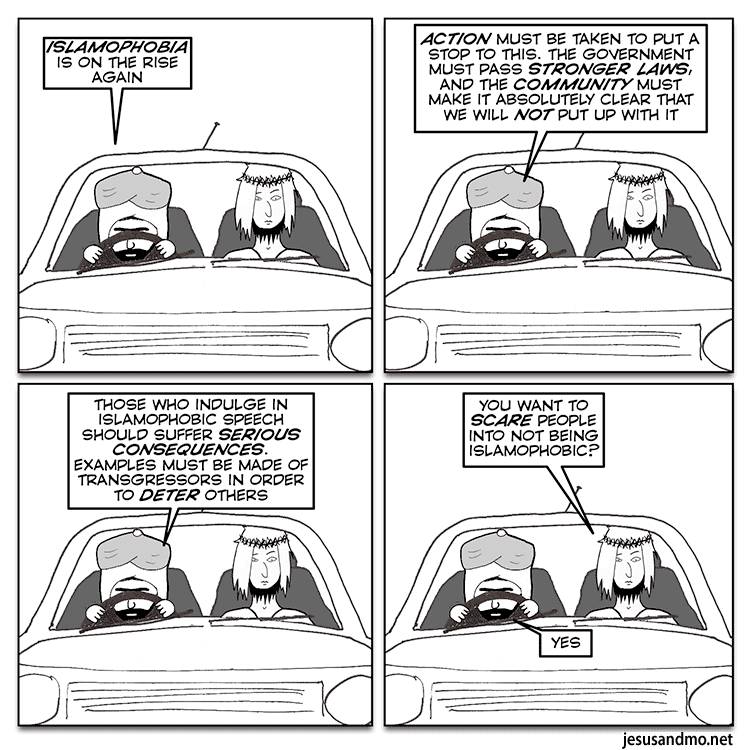
That cartoon is timely for us in Canada.
If Muslims scare people with the threat of retaliatory violence into not being Islamophobic, that is not a good look for Muslims. If the government does it by scaring people with the threat of long prison sentences, that is simply respecting multiculturalism in a pluralistic and perpetually Liberal society. That is the tack being taken by the Canadian government with its just-introduced on-line harms bill. Even now, hate speech (or anything else) can be prosecuted as a hate crime if the Crown attorney is told to do so by her managers. The slope really does get slipperier once you make the first tilt.
I trust that Mo is no less inclined to hold forth on Islamofascism.
“Death to those who say Islam is violent!”
Good one!
I haven’t previously actively wondered where they are based. But in this one, they have a right-hand-drive car.
Mo is always right? Islam in action!
Shouldn’t the car be a Mustang or a Bronco with some wings painted on the hood?
I also am undecided about “hate crimes”. I’d be interested in hearing a really good debate on the topic.The debate I have in my own head seems wishy-washy and I’d like to be convinced by someone whose opinion I respect.
To concentrate the debate I suggest being clear what you mean by “hate crimes.”
“Hate speech” (often lumped in with hate crimes in general) is specifically speech or expression short of violence that incites hate, hate being defined in some way in the statute. The United States Constitution makes laws against hate speech unenforceable as violating the First Amendment as it has been robustly interpreted. But most countries don’t have that protection against state zeal.
“Hate crimes” represent ordinary crimes of action that the prosecution wants the judge to mete out extra heavy sentences for because the crime was motivated by hate. I thought you pretty well had to hate someone to murder him with malice aforethought (except for money) but apparently not. If you hate someone and killed him not because he was an asshole but for all the assholes he represented, you get a harder sentence.
There is a case right now where a man who was married to a woman was having a sexual affair with another man (who presents as a woman.) He is accused of murdering him. That part seems straightforward. But the prosecution is trying to prove the murder was motivated not merely by the deceased’s threats to expose the affair to the man’s wife but because the deceased was trans. The latter is what would make it a hate crime (if that motive was proved.)
This case would make an excellent one for debate because the murder itself is straightforward. The prosecution alleges hate as a motive but the defendant is saying, “Sure I killed him but it was only for the usual reasons people kill people, to avoid facing a vengeful wife. If he’d been a regular woman, it wouldn’t be a hate crime. It’s only because he’s trans that you are trying to make it into a hate crime. But I have nothing against trans people. I was having an affair with one!”
And suppose the whodunit of the murder itself was unclear. How would the defendant dispute the hate-crime allegation without confessing to the murder in the process of arguing that his motive wasn’t hate?
I had a feeling you’d chime in on this. I was referring to the crime and not simply the speech. The case you bring up is interesting and, though I’m no expert and certainly not a debater (I have neither the skills nor the stamina for such things), my immediate reaction to the case you bring up is NO! Absolutely not! I can’t technically back up my opinion, though. I’m never comfortable with outsiders intuiting what a perpetrator was thinking when they committed a crime. This is all so fraught today in our environment of over-the-top woke crap. Ugh! I’m bowing out now.
Immediately upon posting my comment I thought of Sam Harris and ran a quick search. I don’t see that he’s specifically addressed this on “Making Sense” or elsewhere. I’d love to hear him discuss it.
As one commenter above said, we have no way of knowing the inner psychological of a killer at the time of a murder. There are numerous possible motives and emotional states possible so any definition of a hate crime is completely arbitrary and there is no objective means of society agreeing on what a killer was thinking at the time. Murder is murder. The loss of life is what demands justice, not some vague kind of social compensation or extra punishment.
For some reason I’m reminded of a line from Johnny Cash’s song, “Folsom Prison Blues”: “I shot a man in Reno, just to watch him die.”
Ha! I love that. A little levity is needed here today.