
Welcome to the beginning of the work week: Monday, February 5, 2024, and World Nutella Day. Peanut butter is healthier than Nutella since the latter contains more sugar and fat, as well as the dreaded palm oil, but, as always, remember that food isn’t medicine. I quite enjoy an occasional breakfast of two pieces of toast with Nutella (or with a European equivalent) along with my latter: the Breakfast of Champions.

It’s also California Western Monarch Day, National Fart Day (?), Disaster Day (Pompeii is said to have experienced an earthquake on this day in 62 AD, perhaps a harbinger of the volcanic eruption 17 years later), and National Chocolate Fondue Day, another excellent comestible.
Readers are welcome to mark notable events, births, or deaths on this by consulting the February 5 Wikipedia page.
Da Nooz:
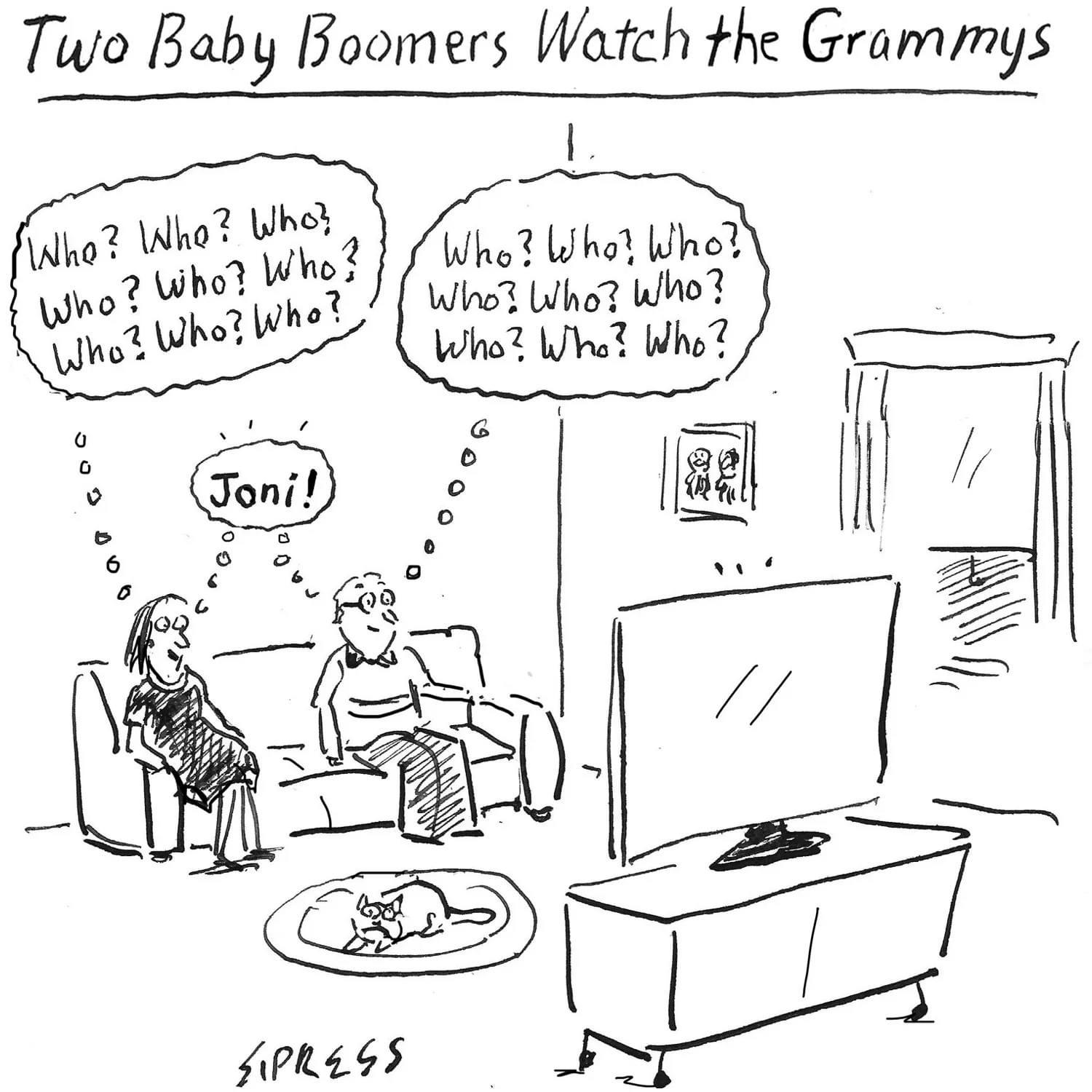
*Joni Mitchell, now 80, performed her iconic song “Both Sides Now” at the Grammys after winning her 20th Grammy Award for her 2023 LP “Joni Mitchell at Newport [Live]”. Here’s the performance, and for some reason it brings tears to my eyes. How did the woman I was so smitten with get so old? Of course I did, too. I mourn for us all. But we’re still kicking!
Apropos, reader Susan sent this cartoon:
*I’m not sure why this is such a big NYT headline given that it’s going to happen again and again: “U.S. says it hit a Houhti cruise missile that threatened Red Sea ships.” And one of them will probably get by the defenses some day. In the meantime, we continue our attacks on Iranian back terrorist groups:
The United States said on Sunday that it had targeted Iranian-backed armed groups in the Middle East for a third straight day, destroying an anti-ship cruise missile belonging to the Houthi militia in Yemen, which had vowed to respond to earlier strikes by the U.S. and its allies.
The strike came a day after the United States, Britain and a handful of allies said they had hit 36 Houthi targets in 13 locations in northern Yemen in the latest salvo aimed at deterring the group from attacking ships in the Red Sea. A Houthi military spokesman, Yahya Sarea, said on Sunday that targets in at least six regions of Yemen were hit, though his statement did not say how much damage the strikes had caused. He said the attacks would not go unpunished.
Soon after the statement was posted, the U.S. military announced its latest strike, saying it had destroyed a Houthi anti-ship cruise missile that had posed “an imminent threat to U.S. Navy ships and merchant vessels in the region.”
The Houthis, a militia that controls large swaths of Yemen, have launched dozens of attacks on ships traversing the Red Sea in recent months, in what the group has described as acts of solidarity with Palestinians under Israeli bombardment in Gaza. Their attacks have roiled the commercial shipping industry, forcing many vessels to take long detours around the southern tip of Africa.
At least both the U.S., by not attacking Iran, and Iran itself, by signaling it doesn’t want a wider war, are backing off a direct confrontation. We’ll see how it goes when Iran finally gets its nukes. And it’s quite a feat to shoot down a cruise missile. But where there’s one, there’s more.
*From the Wall Street Journal, “In the battle over early algebra, parents are winning.” The battle, as you can probably guess, involves whether students will be allowed to take algebra early so they can move on to early calculus, something that helps them get into college. DEI advocates, trying to ensure that nobody gets ahead in the merit race, don’t favor stuff like AP classes or students trying to learn stuff before other students.
San Francisco’s public school district set off a yearslong fight with parents when it decided to prevent students from taking algebra until high school, an attempt to combat racial inequities in math by waiting until more students were ready.
Parents in favor of letting students start in middle school launched petitions, a ballot measure and a lawsuit, sparring with school officials over questions of equity and privilege.
Now, it appears the parents who are pushing for eighth-grade algebra are winning.
The San Francisco Unified School District said Friday that it would reverse its decade-old policy, a move that comes after a similar recent change by the school system in Cambridge, Mass., home to Harvard University.
When to start students on algebra is a contentious topic because the subject is the gateway to a series of math classes culminating in calculus, which many see as crucial for STEM careers and selective college admissions. Students aspiring to take calculus before graduating have traditionally begun this sequence in eighth grade.
“A lot of the attention to eighth-grade algebra is based upon the feeling that that’s the point at which the race is won,” said Thurston Domina, an education professor at the University of North Carolina.
In San Francisco, the district long argued that the policy of restricting algebra to high school wasn’t done to hold children back, but to reduce the inequities that result from sorting students by math ability at too young an age.
That last bit, of course, is a half-lie, for letting students who can master algebra be bored and lose the chance to advance in their aspirations is the same thing as “sorting students by math ability”. I took calculus in high school and was enthralled with it, as it’s so theoretically cool, and also helps you solve a number of problems. What we have here is the classic battle between merit and “equity,” and in this case merit won. Note that “equal opportunity” is compatible with allowing students to go as far as their abilities allow.
*A library in a liberal and wealthy town in Maine has got its knickers in a twist because the library has accepted a verboten book, the infamous Irreversible Damage: The Transgender Craze Seducing Our Daughters,” by Abigail Shrier. BTW, it is a good book, and Shrier has been unjustly demonized for it (h/t Greg). It was briefly taken off sale by Target and of course Chase Strangio of the ACLU called for it to be banned.
Rich Boulet, the director of the Blue Hill Public Library, was working in his office when a regular patron stopped by to ask how to donate a book to the library. “You just hand it over,” Mr. Boulet said.
The book was “Irreversible Damage: The Transgender Craze Seducing Our Daughters,” by the journalist Abigail Shrier. The book posits that gender dysphoria is a “diagnostic craze” fueled by adolescent confusion, social media and peer influence, and that teenagers are too young to undergo potentially irreversible gender transition surgery.
Many transgender people and their advocates say the book is harmful to trans youth, and some have tried to suppress its distribution.
“If I’m being totally honest, my heart sank when I saw it,” Mr. Boulet recalled.
“Irreversible Damage” did not reflect Mr. Boulet’s personal views, nor those of his staff. But because “I want the library to be there for everybody, not just people who share my voting record,” Mr. Boulet said he gave the book the same consideration he would any other, and concluded it should be on the shelves.
Voting record? What is that all about. If you’re a Democrat, as Boulet presumably is, there are plenty of us who are sensible people and not mindless gender activists. Pamela Paul is another.
“I felt like it filled a hole in our collection of a lot of materials on that subject matter,” he said. His staff supported the decision.
You can guess what happened next:
Less than a week after the book went on display, the parent of a transgender adult told Mr. Boulet that she found it harmful.
“She and I have known each other for years, and we talked about it calmly,” he recalled. The patron filled out a reconsideration request, asking that the book be kept “under the desk,” available only by request.
The library’s collections committee voted unanimously to keep the book in circulation. “But I knew it wasn’t over,” Mr. Boulet said.
Residents who objected to the book confronted him, library staffers and board members in the grocery store, post office and the library itself.
And get this:
Mr. Boulet appealed to the American Library Association for a public letter of support, which it offers to libraries undergoing censorship efforts. “They ghosted me,” he said.
Mr. Boulet wrote an open letter in the local newspaper stressing that the library welcomes everyone, “not just your or my slice of the community.”
“The presence of an item in the library is not an endorsement of the ideas contained therein,” he added.
Why can’t people understand that? And why are they afraid of a book like this? Are they afraid that it will make gender-dysphoric children change their minds about transitioning?
* Newsweek reports that North Korea is somewhat involved in the Mideast war, supplying weapons to terrorists (of course), which the Hermit Kingdom has done for some time.
When President George W. Bush delivered his State of the Union address months after the 9/11 attacks, and identified Saddam Hussein’s Iraq, the Islamic Republic of Iran, and the Democratic People’s Republic of Korea as an Axis of Evil, he made a point to say, “North Korea is a regime arming with missiles and weapons of mass destruction while starving its citizens.” That description eerily applies to what Hamas has done in Gaza. It should therefore come as no surprise that the Hermit Kingdom and the fundamentalist Islamic terror group have become dangerous and clandestine allies who together have set the Middle East on fire.
The Pyongyang-Gaza nexus is not new. In 2009, authorities in Thailand grounded a North Korean cargo plane carrying 35 tons of small arms, rockets, and antitank rocket-propelled grenades that were destined for Hamas in Gaza via Tehran. Over the years, especially after the 2014 Protective Edge war in Gaza, North Korea ramped up its support of Hamas, providing the terror group with a vast arsenal of small arms, rockets, missile technology, explosives, and millions of rounds of ammunition. The Israeli military could not help but notice that the two most ubiquitous weapons used to kill 1,200 Israelis and wound thousands more on Oct. 7 were the Type 58 7.62mm assault rifle, a North Korean knockoff of the Soviet-era AK-47, and the F-7, a lethal and modified North Korean copy of the Soviet RPG-7 shoulder-fired antitank rocket. The NIS, South Korea’s National Intelligence Service, confirmed that Hamas used North Korean-made weapons in the attack on Israel.
North Korea produces inexpensive battle-ready weapons. Rogue nations like Iran have the money to pay for these tools of war and need to supply their proxy armies in Lebanon, Yemen, and Gaza. The underground arms trade skirts international embargoes and legal scrutiny, and enriches a small cabal of Kim Dynasty insiders, Revolutionary Guardsmen, smugglers, and middlemen at the expense of thousands of innocent lives murdered, injured, and abducted. The F-7s, and other North Korean-made weapons, were shipped to Iran, and then transported to North Africa or Lebanon and the Sinai Desert to be smuggled by ship or via underground tunnels into the hands of Hamas and the Palestinian Islamic Jihad.
That’s all ye need to know. Has North Korea ever done anything to improve the world? Invented one good thing, helped any other country in a positive way, or taken a moral stand? If so, I don’t know of it. And I weep for its captive and propagandized citizens, many of whom think they’re living the best life in the world.
*Gossip corner: Should Taylor Swift, probably the most popular person in America, endorse Joe Biden? She’s surely a Democrat, but of course she’ll alienate a lot of her fans if she goes public on the issue. But she endorsed him before:
The women belong to the Hill Swifties, a group chat of congressional worker bees who adore the pop star and who occasionally let their fandom out at work by sneaking Swift references into their bosses’ press releases — or, conversely, talking those bosses out of posting cringeworthy Taylor content. After all, it’s easy to appropriate Swiftisms poorly in Washington. The State Department’s ‘Eras Tour’-themed checklist for international travel? That was good. The FBI’s tip line tweet cloaked in the aesthetics of Swift’s album “Speak Now,” encouraging citizens who “have information about a federal crime” to “speak now?” Not so good.
It’s an especially heady time for Swifties in Washington. Her latest appearance at one of Kelce’s games — a playoff win that sent his team to the Super Bowl — coincided with murmurs that President Biden’s campaign may be courting her support. The developments had kicked off a multiday frenzy over what, if anything, Swift could mean to the politics of 2024.
The women belong to the Hill Swifties, a group chat of congressional worker bees who adore the pop star and who occasionally let their fandom out at work by sneaking Swift references into their bosses’ press releases — or, conversely, talking those bossesout of posting cringeworthy Taylor content. After all, it’s easy to appropriate Swiftisms poorly in Washington. The State Department’s ‘Eras Tour’-themed checklist for international travel? That was good. The FBI’s tip line tweet cloaked in the aesthetics of Swift’s album “Speak Now,” encouraging citizens who “have information about a federal crime” to “speak now?” Not so good.
On the left: open thirsting for Swift, a vocal advocate for women’s andLGBTQ+ rights whose known views generally align with the Democrats, to enter her Dark Brandon Era. On the right: speculation that Swift and her “vaccine shill boyfriend” — a reference to Kelce’s advertisements for the coronavirus vaccine — are a “psyop” (spy-world shorthand for a psychological operation) to throw the election to Biden.
Swift, meanwhile, has very much excluded herself from the narrative: She has not weighed in publicly on the endorsement chatter, and a publicist for Swift did not respond to a request for comment.
Team Biden is playing any Swift strategy close to the vest: A campaign and White House spokesperson both declined to comment on Swift-specific outreach. “I have no idea if Taylor Swift would actively offer herself or not, but of course, he’d love to have her endorsement,” said Mitch Landrieu, a co-chair of the Biden reelection campaign who said he loves Swift and also Beyoncé.
However, Swift endorsed two Tennessee Democrats running for office previous, and Biden in the previous election:
. . . Swift similarly surprised the Biden campaign in 2020 when she posted an emphatic “YES” in response to then-Sen. Kamala Harris’s announcement that she’d been chosen as Biden’s running mate. Swift would later formally endorse, sharing a photo with cookies frosted with the Biden-Harris campaign logo. She also gave Rep. Eric Swalwell (D-Calif.) permission to use her song “Only the Young” in a pro-Bidensuper PAC advertisement that year, according to Variety. How Swalwell got Swift’s cooperation, he’ll never tell: “You’re asking Colonel Sanders the recipe for the chicken,” Swalwell said when asked.
Here’s the tweet. Maybe she’s waiting for Trump to accept the nomination before she issues an endorsement. After all, this one was in October of 2020. On the other hand, Biden is the only viable Democratic candidate, and La Swift ain’t gonna vote against him.
I spoke to @vmagazine about why I’ll be voting for Joe Biden for president. So apt that it’s come out on the night of the VP debate. Gonna be watching and supporting @KamalaHarris by yelling at the tv a lot. And I also have custom cookies 🍪💪😘
📷 @inezandvinoodh pic.twitter.com/DByvIgKocr
— Taylor Swift (@taylorswift13) October 7, 2020
Meanwhile in Dobrzyn, the staff is not obeying:
Szaron: They are not listening to us.
Hili: Exactly, and I don’t know how top control them.

Szaron: Oni nas nie sluchają.Hili: No właśnie, nie wiem jak ich zdyscyplinować.*******************
From Barry, and I can’t find the cartoonist, even with a Google image search:

From Instagram: Cats versus mirrors (I forgot who sent this to me, apologies):
From Science Humor, for the 8 year old in you:

Masi squabbles with a pornstar who goes to Iran, covers herself, and says “Obey the law and you’ll be all right.” But that’s not Masih’s goal!
American porn star Whitney Wright is in Iran, my birth country, where women are killed for simply showing their hair and being true to themselves.
Whitney has published several photos on herself completely covered up on Instagram. On her post she called me a warmonger and tells… pic.twitter.com/MwBBsVorBJ— Masih Alinejad 🏳️ (@AlinejadMasih) February 4, 2024
From Simon. Mother ducks are the BEST!
One of these ducklings falls from elevation, & mother duck says, ''One for all, all for one.'' ❤️ pic.twitter.com/EdXctn5n80
— Hakan Kapucu (@1hakankapucu) February 2, 2024
Another duck from Merilee. This is a “call duck“, a miniature domestic duck, so named because their vociferous quacks were used to lure wild mallards into places where they could be shot. Once living decoys, now they simply pets.
His name is Donald.. 😂
Sound on pic.twitter.com/ygGZVZzBdO
— Buitengebieden (@buitengebieden) February 1, 2024
From Luana; Luai Ahmed is a Yemeni Muslim worth following unless you’re pro-Palestinian.
Did they call the death of 377,000+ Yemenis a ”genocide”? Nope
Did they call the death of 236,000+ Afghans a ”genocide”? Nein
Did they call the death of 5,400,000+ Congolese a ”genocide”? Nej
Did they call the death of 500,000+ Sudanese a ”genocide”? Nee
Did they call the death…— Luai Ahmed (@JustLuai) December 15, 2023
From Malcolm: a cat brings home a live baby fox. I hope the fox was taken care of!
My cat used to bring home the craziest stuff but not a live fox. pic.twitter.com/MkmRN5rqOA
— Big Fish (@BigFish3000) February 1, 2024
From the Auschwitz Memorial, a 60-year-old woman gassed upon arrival:
5 February 1894 | A Czech Jewish woman, Irma Abelesová, was born in Řehlovice.
She was deported to #Auschwitz from the #Theresienstadt ghetto on 23 October 1944. After selection she was murdered in a gas chamber. pic.twitter.com/44fUUeI8od
— Auschwitz Memorial (@AuschwitzMuseum) February 5, 2024
Two tweets from Dr. Cobb: first, “a great moment”, when two high-jumpers decide to take a tie at the Olympics. The story is here.
One of the best moments in Olympic history pic.twitter.com/Ey2CeuK10M
— Historic Vids (@historyinmemes) February 4, 2024
Here’s a video about it; it’s a wonderful story:
Look at this wonderful sketch, 3500 years old:
Artist’s sketch of a sparrow. From Deir el-Bahri, Thebes, Egypt, c. 1479–1458 BC.
Artists have always loved to sketch. In ancient Egypt, some 3,500 years ago, they used flakes of limestone as sketch pads rather than paper.
Photo: The Met https://t.co/zRoLZE2yjH#Archaeology pic.twitter.com/irDJy92ayM
— Alison Fisk (@AlisonFisk) January 3, 2024
Food is medicine.
And, medicine is not food
Just to develop your idea.
Perhaps a corollary is:
food is not only medicine…?
[ covers head ]
+1
Or…
“Food can be medicine…”
Quiet – PCC(E) can hear us!
😁
You can’t find the artist on that cartoon because it’s been swiped from a photograph used for a meme with the same idea, a bunch of them.
thanks. it looks like bittersweet did that version but i have found two zoomed out photos (which i have seen before i now realize) which date back to at least late 2019 but my comment this morning with links was rejected.
I had found one cartoonist who uses the name ‘bittersweet’ but, there’s nothing in his collection that even resembles the one posted.
It isn’t just Boomers, if that helps.
[I wrote a Titania-style misgenerationing comment, but I think we get the idea]
“the Breakfast of Champions.”
LCDs are the best BoCs of all time : https://youtu.be/CxCUHjx7U7Y?si=c1q8JD9ZIQuHivkK
… just be sure to use the ashtray.
Algebra:
Yep. Queer Theory though, ASAP.
Irreversible Damage (A. Shrier)
Yep. Queer Theory though, ASAP.
Potentially Anything
Yep. Queer Theory though, ASAP.
[ sigh… ]
BTW Queer Theory is also a practice, or praxis.
Edit deadline passed :
I think Jacob Collier was on piano.
On this day:
1597 – A group of early Japanese Christians are killed by the new government of Japan for being seen as a threat to Japanese society.
1852 – The New Hermitage Museum in Saint Petersburg, Russia, one of the largest and oldest museums in the world, opens to the public.
1869 – The largest alluvial gold nugget in history, called the “Welcome Stranger”, is found in Moliagul, Victoria, Australia.
1885 – King Leopold II of Belgium establishes the Congo as a personal possession. [Colonialism on steroids…]
1907 – Belgian chemist Leo Baekeland announces the creation of Bakelite, the world’s first synthetic plastic.
1913 – Greek military aviators, Michael Moutoussis and Aristeidis Moraitinis perform the first naval air mission in history, with a Farman MF.7 hydroplane.
1913 – Claudio Monteverdi’s last opera L’incoronazione di Poppea was performed theatrically for the first time in more than 250 years.
1917 – The Congress of the United States passes the Immigration Act of 1917 over President Woodrow Wilson’s veto.
1918 – Stephen W. Thompson shoots down a German airplane; this is the first aerial victory by the U.S. military.
1918 – SS Tuscania is torpedoed off the coast of Ireland; it is the first ship carrying American troops to Europe to be torpedoed and sunk.
1919 – Charlie Chaplin, Mary Pickford, Douglas Fairbanks, and D. W. Griffith launch United Artists.
1924 – The Royal Greenwich Observatory begins broadcasting the hourly time signals known as the Greenwich Time Signal.
1939 – Generalísimo Francisco Franco becomes the 68th “Caudillo de España”, or Leader of Spain.
1958 – A hydrogen bomb known as the Tybee Bomb is lost by the US Air Force off the coast of Savannah, Georgia, never to be recovered.
1962 – French President Charles de Gaulle calls for Algeria to be granted independence.
1963 – The European Court of Justice’s ruling in Van Gend en Loos v Nederlandse Administratie der Belastingen establishes the principle of direct effect, one of the most important, if not the most important, decisions in the development of European Union law.
1971 – Astronauts land on the Moon in the Apollo 14 mission.
1981 – Operation Soap: The Metropolitan Toronto Police Force raids four gay bathhouses in Toronto, Ontario, Canada, arresting just under 300, triggering mass protest and rallies.
1985 – Ugo Vetere, then the mayor of Rome, and Chedli Klibi, then the mayor of Carthage, meet in Tunis to sign a treaty of friendship officially ending the Third Punic War which lasted 2,131 years.
1988 – Manuel Noriega is indicted on drug smuggling and money laundering charges.
1994 – Byron De La Beckwith is convicted of the 1963 murder of civil rights leader Medgar Evers.
1997 – The so-called Big Three banks in Switzerland announce the creation of a $71 million fund to aid Holocaust survivors and their families.
2000 – Russian forces massacre at least 60 civilians in the Novye Aldi suburb of Grozny, Chechnya.
2020 – United States President Donald Trump is acquitted by the United States Senate in his first impeachment trial.
Births:
1788 – Robert Peel, English lieutenant and politician, Prime Minister of the United Kingdom (d. 1850). [Created the (London) Metropolitan Police Service. He was also one of the founders of the modern Conservative Party.]
1804 – Johan Ludvig Runeberg, Finnish poet and hymn-writer (d. 1877). [Confusingly, although he is considered a national poet of Finland he wrote exclusively in Swedish.]
1840 – John Boyd Dunlop, Scottish businessman, co-founded Dunlop Rubber (d. 1921).
1840 – Hiram Maxim, American engineer, invented the Maxim gun (d. 1916).
1878 – André Citroën, French engineer and businessman, founded Citroën (d. 1935).
1892 – Elizabeth Ryan, American tennis player (d. 1979). [Born in California, she spent most of her adult life in the UK. She won 26 Grand Slam titles, 19 in women’s doubles and mixed doubles at Wimbledon, an all-time record for those two events. During a 19 year run Ryan amassed a total of 659 titles in singles, doubles and mixed doubles.]
1903 – Joan Whitney Payson, American businesswoman and philanthropist (d. 1975). [Co-founder and majority owner of Major League Baseball’s New York Mets baseball franchise, she was the first woman to own a major league team in North America without inheriting it.]
1914 – William S. Burroughs, American novelist, short story writer, and essayist (d. 1997).
1914 – Alan Lloyd Hodgkin, English physiologist, biophysicist, and academic, Nobel Prize laureate (d. 1998).
1919 – Red Buttons, American actor (d. 2006).
1929 – Hal Blaine, American session drummer (d. 2019).
1933 – B. S. Johnson, English author, poet, and critic (d. 1973).
1935 – Alex Harvey, Scottish singer-songwriter and guitarist (d. 1982). [We had the anniversary of his death just yesterday.]
1941 – Barrett Strong, American soul singer-songwriter and pianist (d. 2023). [His recording of “Money (That’s What I Want)”, which was the first hit single for the Motown record label, was mentioned in a WEIT post about money in music just the other day. He co-wrote “I Heard It Through the Grapevine”, “War”, “Just My Imagination (Running Away with Me)”, and “Papa Was a Rollin’ Stone”.]
1944 – Al Kooper, American singer-songwriter and producer.
1946 – Charlotte Rampling, English actress.
1947 – Mary L. Cleave, American engineer and astronaut.
1948 – Christopher Guest, American actor and director.
1948 – Barbara Hershey, American actress.
1948 – Tom Wilkinson, English actor (d. 2023).
1962 – Jennifer Jason Leigh, American actress, screenwriter, producer and director.
1964 – Duff McKagan, American singer-songwriter, bass player, and producer.
1969 – Michael Sheen, Welsh actor and director.
1972 – Queen Mary of Denmark. [Born in Australia, she became queen consort when her mother-in-law, Queen Margrethe II, abdicated last month.]
1985 – Cristiano Ronaldo, Portuguese footballer. [Considered to be the world’s greatest footballer – by himself…!]
Our birth is nothing but our death begun, As tapers waste the moment they take fire. (Edward Young):
1881 – Thomas Carlyle, Scottish philosopher, historian, and academic (b. 1795).
1892 – Emilie Flygare-Carlén, Swedish author (b. 1807).
1922 – Slavoljub Eduard Penkala, Croatian engineer, invented the mechanical pencil (b. 1871).
1941 – Banjo Paterson, Australian journalist, author, and poet (b. 1864).
1952 – Adela Verne, English pianist and composer (b. 1877). [Today’s Woman of the Day, see next post below.]
1972 – Marianne Moore, American poet, author, critic, and translator (b. 1887).
1983 – Margaret Oakley Dayhoff, American chemist and academic (b. 1925).
1993 – Joseph L. Mankiewicz, American director, producer, and screenwriter (b. 1909). [Won both the Academy Award for Best Director and the Academy Award for Best Adapted Screenplay in consecutive years for A Letter to Three Wives (1949) and All About Eve (1950), the latter of which was nominated for 14 Academy Awards and won six.]
1997 – Pamela Harriman, English-American diplomat, 58th United States Ambassador to France (b. 1920).
2011 – Brian Jacques, English author and radio host (b. 1939). [Aged ten, assigned to write an animal story, he wrote about a bird that cleaned a crocodile’s teeth. His teacher could not believe that a ten-year-old wrote it, and caned him for refusing to admit copying the story.]
2020 – Kirk Douglas, American actor (b. 1916).
2021 – Christopher Plummer, Canadian actor (b. 1929).
Woman of the Day:
[Text from Wikipedia]
Adela Verne (born 27 February 1877, died on this day in 1952) was a distinguished English pianist of German descent, born in Southampton. She was considered the greatest woman pianist of her era, ranked alongside the male keyboard giants of the time. She toured with great success in many parts of the world. She composed a Military March dedicated to Queen Elizabeth, later the Queen Mother; her sister Mathilde’s pupil.
She was born as Adela Würm (later anglicised to Verne) into a musical family. Three of her sisters (of her nine older siblings) were also notable pianists or composers: Mathilde and Alice both also adopted the surname Verne, but Mary returned to Germany, retained the family name Würm, and enjoyed great success as a pianist and composer.
Clara Schumann heard Adela play when she was a small girl. She was so impressed that she wanted to take her to Frankfurt for study, as she had done with Mathilde, however her parents would not permit this. Instead, she was taught by Mathilde and Alice, and later by Clara Schumann’s daughter Marie Schumann.
At age 13 she created a sensation when she played Tchaikovsky’s Concerto No.1 in B-flat minor (then a relatively new work), conducted by Sir August Manns at the Crystal Palace. Tchaikovsky himself heard of this astonishing young prodigy and wanted to meet her. The following year she was introduced to Ignacy Jan Paderewski. He was so impressed with her playing that he predicted a great future for her. Later she became close friends with Paderewski, accepted as one of his family, and frequented his home in Morges in Switzerland. She worked on many pieces with him, including Chopin, as well as most of his own works, including the Sonata in E-flat minor, the Polish Fantasy and the Concerto in A minor, the work with which she made her orchestral debut in New York City.
Adela Verne was hailed as the successor to Teresa Carreño. She was equally praised by North and South American, Australian, European and British audiences and critics as the greatest living woman pianist, ranked alongside the great male artists of the time. In Vienna, after hearing her play four concertos in one evening, Theodor Leschetizky gave her the rare honour of asking her to give a recital to his own pupils.
Her wide repertoire included a large amount from the 18th and 19th centuries, but also much from the 20th century, including works that were very modern for their day. She often appeared in chamber music recitals at the St James’s Hall concerts, alongside artists such as the violinist Joseph Joachim and the cellist Alfredo Piatti.
She toured Australia with Dame Nellie Melba, and was associated on stage with other singers such as Luisa Tetrazzini, Amelita Galli-Curci and John McCormack, and violinists such as Mischa Elman, Eugène Ysaÿe and others. She appeared regularly at the Proms, and was the first British artist to give a solo recital at the Royal Albert Hall.
Her premiere performances were many: she gave the first performance in Australia of Tchaikovsky’s B-flat minor Piano Concerto (1898), the first performance in Australia of Saint-Saëns’s G minor Piano Concerto (1898), the first performance in the United Kingdom of César Franck’s Symphonic Variations, the first performance at the Prom Concerts of Brahms’s B-flat Concerto (and the first woman to play this concerto at all in the UK), and the first television performance of Mozart’s Concerto for 2 Pianos (given with her son John Vallier, also a famed concert pianist).
At the request of the BBC, in early 1952 she broadcast a special programme of works by Paderewski. Her last public appearance was at the special Jubilee Concerts celebrating the Wigmore Hall. She was preparing for her first recital at London’s new Royal Festival Hall, when she died, on 5 February 1952, aged 74.
https://en.m.wikipedia.org/wiki/Adela_Verne
The Attagirls went with this brave woman: https://twitter.com/TheAttagirls/status/1754406631264166211
👏
Related to Jez’s first entry, I believe some relics of those murdered Japanese Christians were secreted to Macau, where they reside in this museum. In any case, this museum is well worth a visit if you find yourself in Macau.
https://www.macaumuseum.gov.mo/en/visit/museum-sacred-art-crypt
Algebra in eighth grade an issue? In my city schools algebra has been offered in sixth grade for many years. This treats algebra as the gateway to much additional math AND science such as physics and chemistry…a gateWAY rather than a closed gate barrier. Early offerings of these serially-learned courses in public schools allows kids from all socio-economic sectors the opportunity to move ahead rather than be constrained.
+1 and IMHO a side-benefit of the study of mathematics is the ability to evaluate ideas or see patterns – inside complexity – with a clarity that the English language, frankly, cannot usually achieve.
I’m thinking of Orwell’s Politics and the English Language, which I’m reading again just now, as it happens.
Is that a mistake, or by design of critical pedagogy?
That is part of my theory which, of course, is mine.
Here in the UK, I started learning algebra at age 11, in my first year at grammar school, when I was taught maths by Miss Warton. I didn’t encounter calculus until age 15, mainly because the maths curriculum at my school was very focussed on Euclidean geometric constructions and proofs. There were a lot of similar triangles and quadrilaterals inscribed within circles. And darn it, I could construct a right angle or bisect a line using only a straight edge and a compass with the best of them! I went on to study maths at university, eventually getting a Ph.D. in the subject and spending several years as a professional astronomer. I never once needed all of that Euclidean geometry, but I used calculus every day.
We had a year of Euclidean geometry required here in the U.S. back in the early 60’s and 70’s when I taught high school math and physics for a few years. My emphasis in geometry class was on the formal logic of proofs and building a system of math, rather than on the technical content of geometry. Just like in algebra, where I emphasized the process of solving “word problems” over the mechanics of technically solving various systems of equations. We did both areas certainly, but I wanted the qualitative thinking to be held over the long term by students, figuring that they could always refresh themselves on the mechanics if necessary in the future if they could just get to that point.
When I was in 8th grade, I had an 8th grader acquaintance in another city. She was taking geometry and obviously very well knew her way around the basics of the subject. (In my more rural/small town area I did not take geometry until 11th grade, taking Algebra I and II in 9th and 10th grade.)
It was from her that I first heard of Pi. I wish I could remember how the subject came up. Perhaps I asked her what she was studying in math. (I remember Greatest Common Factor and Least Common Multiple as the farthest we got in 8th grade math.) She showed me A=Pi(r)^2. I asked, “What is Pi?” She responded, “It is three and fourteen-sixteen ten-thousandths.” Well, it was fine with me to be informed of that. (Of course, the value of Pi is not EXACTLY that, which I did not know at the time.)
I asked her again and she repeated her answer at least twice. (I perceived that she was getting a bit frustrated with me. Well, I was getting a bit frustrated with her.) Of course, I would have phrased the question better had I known just a wee bit more about the subject. I should have asked, “What does Pi REPRESENT?” And then it might have occurred to her to tell me that it was a letter from the Greek alphabet representing the ratio of the circumference of a circle to its diameter, but that that ratio could not be stated exactly as the ratio of two whole numbers, and that expressed as a decimal it goes on forever. Surely her teacher had stated what Pi represents, and therefore she could have told me. But, maybe the teacher did not so say.
I have thoughts about (the questionable quality of) calculus (instruction by certain math graduate students years ago). But I will mercifully not bore readers. Suffice it to say, in my older age, I am taking my time and renewing my acquaintance with it and am thoroughly enjoying it. (It’s nice not to be distracted by several other subjects demanding my time and attention.)
Do you think it’s a good way of introducing children to the idea of formal proof?
Yep
Certainly!
Regarding the algebra kerfuffle, the stupidity of the DEI advocates who were behind not offering early algebra is breathtaking. Surely they knew that parents of means and high educational values would simply go out and sign their kids up for programs like Kumon or hire private tutors. Which of course would make the gap much worse!
“Banning algebra” is simply a desperation move for people who are entirely ill-equipped to solve the problems laid before them. The gap in performance in math and academics in general between different racial and ethnic groups is a valuable piece of data about a complex problem. It’s almost like they think that if we eliminate these indicators of the problem, we eliminate the problem.
It would be like your doctor, upon realizing that you have high blood pressure, advocating that we no longer test your blood pressure…
Nutella! Yay! Nutella is awesome! Not healthy, but awesome… and if people are allowed to drink alcohol and smoke weed, then a spoonful of Nutella every now and then should not be an issue.
Re. preventing math topics in the name of equity, I keep thinking of the Rush song “The Trees”. It ends
“Now there’s no more oak oppression
For they passed a noble law
And the trees are all kept equal
By hatchet, axe, and saw”
(This is from 1978, btw.. Nothing is ever new under the sun.)
How cool that you thought of that. Surely sums it up, doesn’t it? And so artfully.
Why? I don’t eat it and it does not look like the kind of thing I would try out. But I didn’t know it was bad for one’s health.
I suppose it’s the sugar. Homemade peanut butter doesn’t need to have sugar in it. But the proportion of one’s monthly sugar consumption accounted for by Nutella must be very small. Whether peanut oil is better for you than palm oil I don’t know. I just happen not to like many things that have palm oil in them (including Nutella) so not a question I pay much attention to. We bake our own cookies with butter.
Two fun facts about peanuts.
1) The Ontario counties along the north shore of Lake Erie used to grow tobacco. Now they are in peanuts. We have an abundance of peanuts. There is even a thriving chain of stores that sells peanuts (and imported other nuts) and not much else.
2) Nutella as a spread is popular in Europe because peanut butter isn’t. In a really big grocery store like E. Leclerc in France you might find some in the etranger section but otherwise no. Not that I would put PB on a croissant but by 5 or 6 days out we used to pine for it nonetheless. It would be just the ticket with a sliced baguette. But alas, no.
FWIW, four-panel cat cartoon from Bittersweet’s “About” section says “You may like to know… We are a original design brand base in US.Texas established by a team of illustrator & Cat lover. US.shipping only (so far) We use different manufacturers to produce our products”
Regarding the story of the Maine library, I applaud the actions of Director Boulet, his board, and his staff. The story has a happy ending for us advocates of the freedom to read. In Jerry’s excerpt, Boulet mentions that the American Library Association ghosted him. If you read the whole article, you will find out that the ALA eventually responded to him and supported his library’s decision to keep Shrier’s book in the circulating collection.
I see Jerry’s point in flagging Boulet’s term “voting record.” I see this term as awkward and unfortunate. He could have made his valid point better with clearer language, e.g., “The public library is politically and ideologically neutral.”
To emphasize what I wrote in this forum a few days ago, that the vast majority of book challenges and bans come from the political right, I call attention to another piece in today’s NYT. And please, friends, don’t start with me about Emily Drabinski, whose political philosophy is her own and irrelevant to her service as the ALA’s president. Drabinski’s year of service is almost up, and she’s done a good job as president, having concentrated on fighting censorship and book banning. https://www.nytimes.com/live/2024/01/30/opinion/thepoint?unlocked_article_code=1.TE0.Q0nE.ewOFtWL9Q-56&bgrp=t&smid=url-share
Thank you, Stephen.
🙏
“that the vast majority of book challenges and bans come from the political right . . .”
Let’s accept this as a given, for now. But there are many ways, Stephen, to keep a book off a shelf. You can refuse to publish it, refuse to market it, refuse to recommend it, refuse to buy it, refuse to keep what was previously bought, refuse to allow it to circulate broadly, or you can demand it be removed from the shelf. Politics being what it is, the media focuses on the last one.
A report by the ALA said that in the first eight months of 2023 that there had been nearly 700 attempts in the United States to censor library materials and challenges to 1915 individual titles. There were likely more, as this is what was reported to ALA, but these 700 recorded incidents amount to fewer than two attempts per month per state. (As an aside, is it the case that some of the more sexualized books were, indeed, inappropriate for some school library shelves? We aren’t told.) Now, let’s return to the librarian who decided to stock Abigail Shrier’s book. Credit to him. But how many librarians, whether public or school, decided NOT to stock either that book or others, like those of John McWhorter or Douglas Murray, that challenge the totems of the political left? Do we count every individual refusal to carry such books as a “book ban” or a “challenge” or an “attempt to censor” library materials? Of course not. But why not?
We could go on. How many of them chose to favor history books with an explicit partisan slant? How many chose to promote biographies of heroes of the left rather than of the right? How many chose to promote social “science” books, the analyses of which operate under left-wing assumptions and promote left-wing solutions? I don’t know. I’m curious, do you? Do we have enough data to say whether it is the right or the left that is more active in “shaping” the book inventory on the shelves? That it is only one side that tries to control what our children might read? I would love to see a nonpartisan analysis of public, but particularly K-12, library acquisitions and inventory reductions over the last decade and across an array of jurisdictions to see whether there has been an ideological slant imposed—whether by publishers, reviewers, or librarians—and against which the right is reacting, or whether this is just another cycle in America’s periodic bouts of book fright.
Dialectical Political Warfare, developed by Mao Zedong, was used to contrast political friend from enemy, over a contradiction, to advance, of course, the Revolution – by struggling enemy into friend, or eliminating the enemy.
The dialectic has proven to be the worst model for societies to develop and flourish so it needs to be shown when it is manipulating thought and action. Any of the individual objects of immediate concern of will be of least concern after the Revolution.
Doug, the analysis you’d love to see may yield some useful data, but it would present a Herculean task in that it would be difficult to isolate the desired variable, “ideological slant imposed.” Briefly, libraries select materials and develop their collections according to policies adopted by their governing boards. K–12 and indeed all academic libraries are obligated to select materials in support of their curricula. Public libraries are obligated to select materials to meet popular demand. Thus, for example, if you sampled a public library’s collection and discovered that Hillary Clinton’s books outnumber Anne Coulter’s three to one, this “imbalance” most likely results not from any bias on the part of the selectors but simply from a response to public demand.
Thanks, Stephen. Your point about public demand in each locale is well taken. And in an increasingly polarized country, it suggests that both right and left will be crying censorship or indoctrination–depending on where they live.
“And so the dialectic progresses.”
-Delgado and Stefancic
Critical Race Theory – An Introduction
2017
Thanks for unlocking that, Stephen. I audited a couple library/information science courses while in grad school. At that time, Madonna had released her “Sex” book which, you’ll remember, had both feminists and conservatives (typically at odds with one another) up in arms. The professor used it as a topic of discussion while lecturing about censorship. She asked students whether or not it should be made available at public libraries. The class was about equally divided but those who said no claimed to take that opinion based on it being a poor expenditure of precious library dollars. I don’t use the word “precious” sarcastically. We all know the struggle public libraries face with respect to funding. Wasn’t that one of the most commonly stolen books in public libraries that chose to circulate it?
Yes, Debi, Madonna’s book “Sex” was stolen often when it was in the browsing circulating collection. This was why many libraries opted to keep the book behind the circulation desk for checkout, similar to what many libraries do today with video games, which are now the most stolen items.
How can someone oppose algebra? It’s crazy! I don’t explicitly remember having algebra in junior high, but I had it early in high school and took calculus as well. Calculus is an eye opener, as it taught me how to solve problems that I could only imagine as a kid—problems I could picture a solution for and knew could be solved, but problems I didn’t know how to solve myself. Some of these were about the trajectory of a baseball; others were about planets and stars. It’s awful that students are held back from achieving their full potential. Is that really what we want?
They aren’t opposing algebra as much as attempting to address a problem of racial disparity, as in black and brown kids on average don’t do as well at math as white and Asian kids.
Unfortunately, the powers that be are not particularly talented or courageous, so their “solution” to the disparity is to simply eliminate the math instruction that makes the disparity so obvious.
Wait! What is a(n American?) porn star doing in Iran? That seems strange. I’ve nothing against them, in fact I wrote an article about NY legalizing prostitution once and had some as clients (as a criminal defense attorney).
They got off (the charges). hehhehe. I kill me.
But travelling to Iran is difficult for Americans, legally, you’ve really got to want to go there. Visas are expensive and hasstlesome and there’s the risk you’ll be “nabbed”. Don’t visit countries that nab and jail Americans for no reason is good advice.
I imagine there aren’t many porn-con conferences in Tehran….
D.A.
NYC
Reader “mirandaga” has asked me to post this comment for him:
That passage is poetic. It could easily be put into stanzas to form a poem, and even has a rhyme of old and mould. 🙂
Though today is February, 5th…?
That is excellent. Makes me want to go and read some Dickens too.
Joni Mitchell’s performance brought tears to my eyes, too. She is my hero. When Bob and I were at W&M, he worked for Schmidt’s florist. One day he pulled the ticket to deliver a dozen roses to W&M hall, knowing that Joni Mitchell was going to be performing there (she always had roses on her piano). He picked me up on the way because he was supposed to hand-deliver them to her. Unfortunately, just before we got to her dressing room, a security guard intercepted them! So close…….!