
Today’s series, which is about the dangers caused by outdoor cats, comes from Athayde Tonhasca Júnior. His narrative is indented, and you can enlarge the photos by clicking on them.
The killer within
Walter Rothschild (1868-1937), an aristocratic banker turned zoologist, must have been delighted to see his paper published in the December 1894 edition of the Bulletin of the British Ornithologists’ Club. The paper presented to the world the Stephens Island wren from New Zealand, a new species from a new genus – a momentous scientific discovery. Baron Rothschild named the novelty Traversia lyalli to honour Henry Travers, a dealer of animal skins who procured specimens for him, and David Lyall, an assistant lighthouse keeper who first brought the bird to the attention of ornithologists. Rothschild had another reason for feeling smug: he had knowingly scooped Kiwi lawyer and eminent ornithologist Sir Walter Buller (1838-1906), who learned about the hitherto unknown wren before Rothschild and had his own description in the pipeline for publication. Buller, understandably, was not happy with Rothschild’s ungentlemanly behaviour, and the men bickered for years afterwards (Galbreath & Brown, 2004). [JAC note: The Stephens Island wren is now known as Lyall’s Wren, Traversia lyalli]
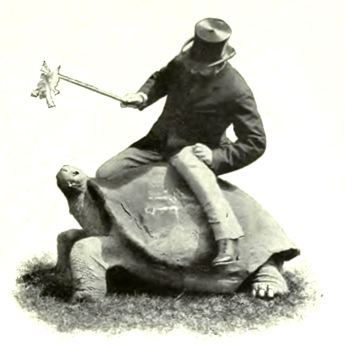
Baron Rothschild pestering Rotumah, a Galapagos tortoise taken to Australia © C. J Cornish, 1902. Wikimedia Commons:

The race between the two men of science from almost opposite corners of the planet to have the honour of naming a new species was possible because both had bird skins to examine: they were shipped to England by Henry Travers (Rothschild had deep pockets) and given to Buller by David Lyall. But Travers and Lyall did not acquired those specimens: Tibbles, a domestic cat (Felis catus), did.
Stephens Island, a speck of land (1.5 km2) between the two main islands of New Zealand, was an ideal spot for a lighthouse. One was built in 1894 and manned by three keepers, their families, and Tibbles. The cat would go off on hunting expeditions around the island and often bring the bounty to one of the keeper’s house. David Lyall, an amateur naturalist, skinned and saved the most interesting corpses, and noticed they included the ‘rock wren’, as he called it, a flightless, shy little bird rarely glimpsed at night ‘running around the rocks like a mouse and so quick in its movements that he could not get near enough to hit it with a stick or stone’. An earth-bound bird, no matter how skittish, was no match for Tibbles, who gifted Lyall with all the specimens of rock wren (Stephens Island wren as we know it today) that ended up in Rothschild’s and Buller’s hands.
The lighthouse on the Stephens Island’s summit was home to keepers, their families and Tibbles the bird slayer © Herewhy, Wikimedia Commons:


The Stephens Island wren was widespread throughout New Zealand until the arrival of rats, who accompanied the Maori settlers. Stephens Island was the bird’s last haven until catastrophe befell it in the form of Tibbles and its descendants, the island’s first mammalian predators. The little bird was hunted to extinction by cats shortly after Rothschild and Buller squabbled about the priority of naming it.
One of the fewer than 20 known specimens of Stephens Island wren, most of them collected by cats © Museum of New Zealand:

We may lament the demise of the Stephens Island wren and assume it was an unfortunate consequence of geographical isolation. Cats have caused or contributed to the extinction of the Socorro dove (Zenaida graysoni), the little Swan Island hutia (Geocapromys thoracatus) and some 31 other bird, mammal and reptile insular species, according to the International Union for Conservation of Nature (IUCN). Alas, moggies’ threats to wildlife are much more far-reaching and worrying than these documented Robinson Crusoe scenarios.
Peter Churcher and John Lawton were among the first to raise the alarm. They convinced the owners of 78 out of 80 house cats living in the English village of Felmersham to gather their pets’ booty for a whole year. The final tally was 1,094 corpses or bodily remains, 64% of which comprised wood mice, voles, shrews and the odd rabbit, weasel and bat. The remaining 36% were from birds, mostly house sparrows, thrushes, blackbirds and robins. Based on published data and some calculations, Churcher & Lawton (1987) estimated that cats killed at least 30% of the sparrows in the village. Their distinguished colleague Robert May extrapolated the study’s figures to suggest that every year 6 million cats in Britain killed about 100 million birds and small mammals, an unimaginable carnage.
The feline killing fields of Felmersham © David Kemp, Wikimedia Commons:


These studies lobbed scat against the fan: angry cat lovers rubbished the papers arguing the premisses were wrong, the conclusions were misleading, the extrapolations unwarranted, or that lovely Mr Whiskers wouldn’t hurt a fly. Besides, cat advocates claimed, their pets did a valuable service by killing rodents. In reality, cats are opportunistic, indiscriminate hunters. They will prey on rats and mice if they are readily available, which usually happens in urban settings. In natural or semi-natural habitats, wild birds and mammals such as wood mice, shrews, voles, squirrels and rabbits are their most likely targets. Worldwide, 2,084 species, including 9% of all known birds and 6% of all mammals, are killed by cats; 347 (16.6%) of them are of conservation concern (Lepczyk et al., 2023).
Cat’s diet based on a review of global studies © Lepczyk et al., 2023:

Subsequent data set upon data set support the Felmersham study. In Canada, domestic cats (pets and ferals) are estimated to kill 100 to 350 million birds/yr.; For Australia, figures are 377 million birds/yr., or ~1 million birds/day – adding to the bag 649 million reptiles/yr. from 258 species. Studies in the UK, The Netherlands and other European countries show similar patterns (reviewed by Trouwborst et al., 2020). But these figures pale in comparison to those from the U.S., a country with 60-62 million pet cats and 50-80 million feral cats (American Veterinary Medical Association). The estimated tallies for moggies’ killings in the contiguous states are ~1 to 4 billion birds, 6 to 22 billion mammals, 230 to 870 million reptiles and 86 to 320 million amphibians/yr. Most prey are despatched by stray and feral cats, but pets’ contributions are not negligible: they are responsible for about a third of the kills (Loss et al., 2013).
A bird, probably a great tit (Parus major) leaving this world in a cat’s maw © dr_relling, Wikimedia Commons:


Despite these industrial scale butcheries, the impact of cats on wild populations is poorly understood. Cats may be only hoovering up sickened or old individuals that would not reproduce or would die soon anyway. An unequivocal link between prey populations and cat predation would require experimental settings of impractical, unfeasible scales. Yet, much circumstantial smoke is coming out of this factual gun. In northwest Bristol (UK), predation by pet cats wiped out 80–90% of the breeding productivity (an estimate of annual offspring output) of house sparrows (Passer domesticus), dunnocks (Prunella modularis) and robins (Erithacus rubecula) (Baker et al., 2005). Cats have been implicated in the extinction of at least 63 species – 40 birds, 21 mammals and two reptiles – figures that represent 26% of all known recent extinctions in these species groups (Doherty et al., 2016). In a ranking of invasive species threatening the largest numbers of vertebrates worldwide, the domestic cat came in third – only rats (Rattus spp.) and Batrachochytrium dendrobatidis (the fungus that is wiping out amphibians around the world), do more damage (Bellard et al., 2016). Cats don’t have to kill to supress wildlife: fear alone would do. The mere presence of a tabby nearby increases stress in birds, reducing their fecundity. Songbird abundance may drop by 95% even when cat-induced mortality is lower than 1% (Beckerman et al., 2007).
Adding to the file the risk of diseases transmitted by cats to wildlife and humans – toxoplasmosis being the more notorious – and setting aside the nuisance factor (crapped lawns and vegetable gardens, nocturnal racket, urine stench), many conservationists argue there is a solid case for adopting the precautionary principle towards free-roaming cats, that is, acting even if evidence is incomplete because the stakes are right. In other words, implementing ‘better safe than sorry’ policies. That would entail not allowing pet cats outdoors and culling feral and other unowned cats.
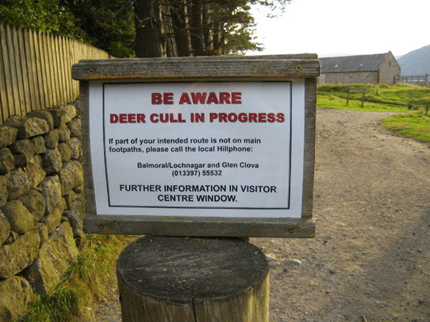
Deer and wild pigs are regularly culled to reduce their damage to the environment. People don’t like these wet jobs, but usually accept them once they are explained the reasons © Nigel Corby, Wikimedia Commons:

Well, good luck to those conservationists, because perceived cat-hate is guaranteed to unleash a fleet of cognitive dissonance flying monkeys: cat owners in general disagree with the statement that cats are harmful to wildlife and are against any control option except neutering (Mcdonald et al., 2015). Some cat activists strengthen their case with misinformation, obfuscation, slander and political lobbying (Loss et al., 2018). And they are effective. Besides Australia, which started a culling programme, countries are not making much effort to address the possible risk posed by cats despite being required to do so by the Convention on Biological Diversity, Convention on the Conservation of Migratory Species, and the European Union Habitats Directive, among other international laws (Trouwborst et al., 2020). In Britain, The Royal Society for the Protection of Birds (RSPB), a powerful lobby with over one million members, stands by the anaemic position – which is not upfront on their site – that “while we know that cats do kill large numbers of birds in UK gardens, there’s no evidence this is affecting decline in the same way [emphasis added] that these other issues [global warming, intensive agriculture and expanding towns and cities] are”. One would expect a bird conservation organisation to pay heed to the precautionary principle advocated by researchers. But many a bird-loving paying member and many a cat lover are one and the same, and RSPB knows which side its bread is buttered on. So it goes.
‘A man with a conviction is a hard man to change. Tell him you disagree and he turns away. Show him facts or figures and he questions your sources. Appeal to logic and he fails to see your point.’ Leon Festinger (1919-1989), A Theory of Cognitive Dissonance:

Needed to be said – thank you. We don’t have an overrun of feral cats in our neighborhood because of coyotes and owls. But – few rabbits either.
Coyotes are adapting quite well to urban/semi-urban environments in the US, so one hopes they will make a nation-wide difference in keeping the feral cat population down.
Thank you for taking the time to present such a fascinating and detailed account.
“…unleash a fleet of cognitive dissonance flying monkeys!”
Unfortunately sounds like current political strategy.
Thank you, this is a marvelous essay, on many levels.
Wow, that’s a lot of carnage. Thanks for another fun and fascinating post.
I’ll stick with dogs. 🙂
What a fantastic and education set. That was so well done!
I am a cat lover and a bird lover…
The New Yorker has a long article about outdoor cats, with several headlines and descriptions.
How the “No Kill” Movement Betrays Its Name.
https://www.newyorker.com/magazine/2024/01/01/how-the-no-kill-movement-betrays-its-name
Online date December 25, 2023 (paywalled).
Print issue January 1 & 8, 2024 — “The Cats of L.A.”
https://www.magzter.com/stories/Culture/The-New-Yorker/The-Cats-of-LA
https://twitter.com/NewYorker/status/1739340057998164258
“Jonathan Franzen, a noted birder, reports on how the ‘No Kill’ movement, championed by animal-welfare groups, has made it possible for cats to rule the streets of Los Angeles—with troubling consequences for shelters, city residents, and local wildlife.”
“By keeping cats outdoors, trap-neuter-release policies have troubling consequences for city residents, local wildlife—and even the cats themselves.“
The Rothschilds were well into natural history and zoology. Lionel’s brother Charles ( who became the 2nd Baron Rothschild) collected and then donated to the Nat Hist in London an enormous collection of (wait for it) 200,000 fleas!
Charles’s daughter was Miriam Rothschild FRS who became a distinguished zoologist and also another expert on fleas!
The 3rd Baron Rothschild was also a zoologist and worked at Cambridge.
Photo of Stephens Island wren fascinating. Was the tail lost on this specimen? The feet are quite large for the size of its body. At least by my observations of NE Illinois birds.
A story worth concisely retelling.
I lived on a military base on a small, remote island. Feral cats were common there, from a century or so of previous habitation and trade.
A government biologist visited, and decided that the cats were responsible for endangering native bird species.
The cats were culled, to the last one.
It turns out, the cats had been doing a great job controlling the rat population. I personally had never seen a rat there. Apparently nobody else had either, because we soon found that the storage, work, and living spaces were not rat-proof. The rats proliferated, and got into everything.
Not only that, the rats were much harder on the birds than the cats had ever been.
The equilibrium that had been reached was no doubt a different one than that which prevailed before the island was populated. But it is folly to assume that such things are simple, and that changes will have easily predicted results.
Populated areas usually lack the sorts of natural predators that keep vermin under control.
I would never bring a cat to a place where flightless or ground-breeding birds live without predation. But I would also be very careful about removing them from an environment where they had been established.
+1
The suburban neighborhood in New Jersey where I grew up seemed to be a similar situation, although I don’t know of any detailed studies about what might have been happening there.
In my childhood neighborhood, humans had eliminated most of the original predators that hunted mice, and mice (or more exactly, ticks carried by mice) were the main vectors of lyme disease. Some areas near where I lived had outbreaks of the disease where nearly every wild mammal became infected, and the disease also sometimes spread to humans who spent a lot of time outside. Our neighborhood didn’t have feral cats, but most of our neighbors owned cats that were allowed to wander free outside, and it seemed to us that they were the main thing keeping the population of mice under control and limiting the spread of the disease. Lyme disease was less of a problem in areas with lots out outdoor cats than in areas that didn’t have any.
Great post! For some reason I didn’t see it earlier in the day. Thank you!
Incidentally, our beloved cats (Oscar, Abelard, Smokey, and Tobi, all long gone but never forgotten) were 100% indoor felines. Safer that way for everybody.