Temple to cat god found in Egypt

The temple was filled with statues of Bastet, a once fearsome lion-headed goddess whose image changed over time to a domesticated cat.
h/t: Greg Mayer
Why Evolution is True is a blog written by Jerry Coyne, centered on evolution and biology but also dealing with diverse topics like politics, culture, and cats.

Temple to cat god found in Egypt
The temple was filled with statues of Bastet, a once fearsome lion-headed goddess whose image changed over time to a domesticated cat.
h/t: Greg Mayer
Over at Metamagician and the Hellfire Club, Russell Blackford weighs in on Robert Wright’s The Evolution of God (also reviewed recently by Allen Orr in The New York Review of Books). Blackford’s verdict: an absorbing history of religion (here I disagree with him, for I think Wright’s “history” is a tendentious one), but one that fails in its goals to show that a) there has been an inevitable evolution of religion toward morality, and b) that evolution can be construed as evidence for God, or at least for a “higher force” propelling social change:
. . . a history of religion up to a certain historical point, the book is interesting, thought-provoking, helpfully structured, rich in information, and highly readable. If it pretended to be no more than that, I could stop here and simply recommend it highly.
. . . But even assuming that all this is correct, I see no reason to go further and postulate a more abstract law, such as that religion inevitably arises then evolves through a series of transactions that are mutually beneficial for those involved (such as the citizens of different states with different gods). That might sometimes happen, but sometimes it might not, and there certainly seems to be no reason to postulate a law that religions inevitably become more “moral” over time (in the sense of more willing to expand the circle of human beings who are regarded as moral equals). . .
In all, I am totally unpersuaded that any kind of deep, abstract law applies to the development of religions. It is possible that attitudes and manners tend to be softened when (some) people gain a certain amount of leisure, and are free from the everyday struggle just to survive. Perhaps, too, as Hume thought, we do develop better understandings over time of what social arrangments are beneficial, so morality becomes less harsh. Those, however, are different points; they may suggest the possibility of (limited?) moral progress, but they do not entail a logic or principle that drives the evolution of religion.
I am even less attracted to the thesis that the history of religion is evidence for some kind of divinity acting in time to lead humankind (or, I suppose, other intelligent creatures in the universe) to higher and higher levels of morality.
Do read the whole thing. As usual, Russell produces a thoughtful and rant-free analysis.
by Greg Mayer
Jerry’s back, but still overcoming the inevitable feelings of despair and hopelessness that come from arriving in Chicago in January after cruising among tropical islands (just kidding– Chicago’s my kind of town this time of year!), so he asked me to post the following link to a post by Dan Dennett in the Washington Post’s On Faith blog answering the question, “Is there widespread media bias against Christianity?” Money quote:
The double standard that exempts religious activities from almost all standards of accountability should be dismantled once and for all. I don’t see bankers or stockbrokers wringing their hands because the media is biased against them; they know that their recent activities have earned them an unwanted place in the spotlight of public attention and criticism, and they get no free pass, especially given their power. Religious leaders and apologists should accept that since their institutions are so influential in American life, we have the right to hold their every move up to the light. If they detect that the media are giving them a harder time today than in the past, that is because the bias that protected religion from scrutiny is beginning to dissolve.
A huge thank-you to Matthew and Greg for taking over the website in my absence. I’ve just returned from the Galápagos, and haven’t yet fully absorbed the experience, which exceeded all expectations. I’ll be posting about it over the next week or so, but in the meantime here are a few iconic animals that I snapped (more on these species later). Note: I do not have a zoom lens.


by Matthew Cobb
There has been a lot of argument about how to classify primates, and on what basis. Molecular data have shown that the “haplorhines” (tarsiers, New World monkeys, Old World monkeys and hominoids) are monophyletic – we all share a common ancestor which did not give rise to the remaining primates, the “strepsirhines” (lemurs and lorises). Those of you with a classical training will have guessed that the “rhine” business suggests this classification is to do with the shape of the nose in these animals. Furthermore, haplorhines generally have acute colour vision (they are mostly diurnal), while strepsirhines, which are generally nocturnal, do not.
This has led to the suggestion that, during primate evolution, vision and the sense of smell have been traded, in particular in the human lineage. As we grew to be increasingly visual animals, we came to rely less on our sense of smell. This can be seen, it is claimed, in the number of “dead” olfactory receptor genes (“pseudogenes”) to be found in the human genome compared to that in New World Monkeys, a direct result of our acquisition of full trichromatic vision. But is this actually true? Was there a “trade-off” of one sense against another?
A study by a group of Japanese researchers (Atsushi Matsui, Yasuhiro Ho and Yoshihito Niimura), about to appear in Molecular Biology and Evolution [subscription needed], looks at this widely-accepted suggestion and finds little evidence to support it.
They looked at the olfactory receptor (OR) genes in five primate species (human, chimpanzee, orangutan, marmoset and rhesus macaque) together with two “strepsirhines” – the bushbaby and the mouse lemur, with the tree shrew as a comparison (“outgroup”). Surprisingly, they found no significant differences in the number of functional OR genes between the marmoset (New World Monkey) and the macaque (Old World Monkey) and the hominoids. In fact, humans had the second largest number of intact ORs (396), just behind the chimpanzee (399), and as against only 296 in the orangutan. This suggests that – whatever you might think – you can probably detect a similar number of odours as any of the other primates.
They then looked at how these genes evolved over time. They looked at which genes seemed to be the same in each of the different species (“orthologous” genes). This is particularly difficult in the case of OR genes, which evolve extremely rapidly, for reasons we do not understand. They estimated that the most recent common ancestor of all primates would have had around 550 OR genes. 62 of those genes are still shared by all the species they studied, and 34 of them are present in a single copy in each primate genome. Indeed, when you take into account gene duplication, nearly 77% of the human and chimpanzee OR genomes are common to the two species.

This figure shows how many of those 550-odd genes each species has lost over the last 48 MY or so (in the white bar on the right). Probable gene duplications are shown with a plus sign on the right of the bars, followed by the total number of functional ORs for each species. The number of genes that were lost at each branching event in our evolutionary tree are shown on the left. Strikingly, the same number OR genes were lost at the point we split with the strepsirhines (51 – arrowhead) and when we and the chimps split from the orangutans. This is not what was predicted by the “gain colour/lose smell hypothesis” – we would have expected to see a larger number of OR genes lost when we first parted company with our less-visual primate cousins.
This is not the end of the story, however. We already know that in humans, our OR genes have become “pseudogenized” at a greater rate after we split from the chimps, suggesting a relaxation of selection pressure on (some part of?) our olfactory genome. People have speculated that this may be due to our apparent non-reliance on pheromones for sexual and territorial communication. However, there is no evidence for this, any more than we have any idea as to what the relatively small OR repertoire in orangutans might indicate. For the moment, we cannot take the sequence of an OR gene and say what the corresponding receptor protein detects.
Although this study has not found evidence to support the trichromatic vision hypothesis, the authors point out that more comparisons from more species are needed, in particular because New World Monkeys and strepsirhines show highly variable colour vision systems. We are still far from understanding the effect of evolution on sensory systems, even in the species that are closest to us, including our own.
Matsui A, Go Y, Niimura Y. ( 2010) Degeneration of Olfactory Receptor Gene Repertories in Primates: No Direct Link to Full Trichromatic Vision. Mol Biol Evol. Jan 8. [Epub ahead of print]
[First posted at the Z-letter]
by Matthew Cobb
Despite my impression, it appears that Jerry never blogged on the case of Casper the commuting cat, who lived in Plymouth (UK). Casper, like any self-respecting commuter, would get the bus, as shown on this BBC news video:
Now, Casper is no more, the victim of a hit and run driver. As reported in The Guardian: “A notice appeared at the cat’s usual bus stop saying: “Many local people knew Casper, who loved everyone. He also enjoyed the bus journeys. Sadly a motorist hit him … and did not stop. Casper died from his injuries. He will be greatly missed … he was a much-loved pet who had so much character. Thank you to all those who befriended him.”
Vale, Felix!
by Matthew Cobb
Convergent adaptations form one of the most striking classes of proof for evolution by natural selection. Radically different species, with common ancestors deep in the past, show near-identical adaptations to similar environments. Convergence can even be seen in species that are separated by vast depths of time, such as icthyosaurs (extinct marine reptiles) and dolphins, which show strikingly similarities in their bodily form, a consequence of adaptation to the environment (water) and their predatory role, based on a common tetrapod anatomy and musculature.
However, most examples of convergent adaptation remain at the level of form or function, rather than the genes involved. It’s possible that the same genes are involved in shaping a dolphin and an icthyosaur, but it’s unlikely we’ll ever know. An exception is the recent discovery of convergent mutations in species of sand lizards with white skins, all of which affect the melacortonin-1 receptor. But in a way, that isn’t too surprising – the melacortonin-1 receptor controls skin colour in these animals, and only a restricted number of molecular changes would give rise to an advantageous white form.
Even more striking is the announcement, shortly to appear in the pages of Current Biology, of identical skin toxins produced in two lineages of frogs, but on the basis of two different genes that diverged during the Cambrian, between 488 and 557 MY ago!
Both lineages of frogs – the Australian Litoria species and the Pipidae (which includes the model species Xenopus laevis) – secrete caerulein, a powerful toxin that induces vomiting, diarrhea and pancreatitis, amongst other things. Strikingly, the two sets of amphibians have very different ecologies and are separated by massive distances – the Australian/Papuan Litoria frogs tend to be terrestrial, whereas Xenopus and its African relatives are strictly aquatic. This means that their toxins are used to ward off very different predators, although the assumption is that in all cases the predators are vertebrates, which are all vulnerable to these toxins.
Researchers in Belgium and Australia, led by Kim Roelants, studied the genome of these frogs, and also looked at the proteins they produced, and discovered that although the caeruleins produced by the two sets of species are identical, they use very different genes to get there.
In the case of Xenopus and its relatives, the caerulein gene evolved through duplication of the cholecystokinin gene (cck); in the case of Litoria, the gene involved was gastrin. Both these genes are present in all vertebrates, but diverged during the Cambrian, and subsequently evolved into a series of genes with different functions in different lineages.
In both cases, gene duplication – when a gene gets mistakenly copied through a genetic accident – provided the raw material on which natural selection could work. With two versions of a gene, one is able to maintain the important function that originally led to its presence, will either evolve randomly (and eventually become a pseudogene, no longer functional) or will accidentally produce a product that is in some other way advantageous to the organism that carries it.
In the case of the cck gene, there were several such duplication events, including two within the lineage that led to Xenopus – there are now three cck genes in Xenopus.
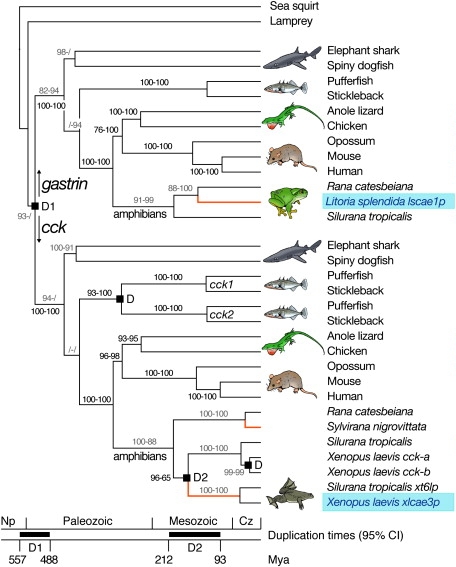
The authors explain this striking case of molecular convergence by the fact that the products of both cck and gastrin genes retained a common structure; this meant they could both function in the frog’s physiology and produce a compound that would repel a wide range of vertebrate predator (by affecting the same physiological processes).
In other words, natural selection was able to use gene duplication to maintain one function, and select another, focusing on the same tiny character, but in two very different genes.
[First posted at the z-letter]