Why Evolution is True is a blog written by Jerry Coyne, centered on evolution and biology but also dealing with diverse topics like politics, culture, and cats.
When I asked Matthew how, in the tagging process, he found the hidden calves, he replied:
Typically the cow has a vaginal insert transmitter that comes out when the calf drops, which allows us to pinpoint the birth location. Several hours later the cow and calf move a short distance off the birth location where the calf conceals itself. Say, within 50-500 m. When we arrive, the cow leaves the area but will come back within 4-5 hrs. We systematically survey the area looking for it. Really hard game of hide and seek!
Example of an “activated” vaginal insert transmitter (“vit”) recovered at birth location.
More photos from the tagging process:
More: a wolf attacked another calf, but mom apparently drove it off. Matthew:
I’ve attached pics from yesterday of a five day old calf that survived a wolf attack only hrs before we arrived. Very lucky calf. It must have been a single wolf, and the cow was able to fend it off. If two or more wolves, the cow would have bailed to live to breed another day.
Reader Matthew Hill sent some photos taken during his tagging of elk calves (Cervus canadensis), and one of them qualifies as a “spot the. . . ” photo. Can you spot the elk calf, hiding from predators inconspicuously? The reveal will be at 10:30 Chicago time, along with other photos from Matthew’s endeavor. His words are indented:
I’m currently involved in tagging elk calves in northern Wisconsin. I thought one of today’s tags might be a fun one for an I spy post. Not super difficult. It’s a two-day-
old female.
Can you spot it? You can tell us in the comments if you did, but please don’t say where it was. Again, reveal is at 10:30 a.m. Click the photo to enlarge it.
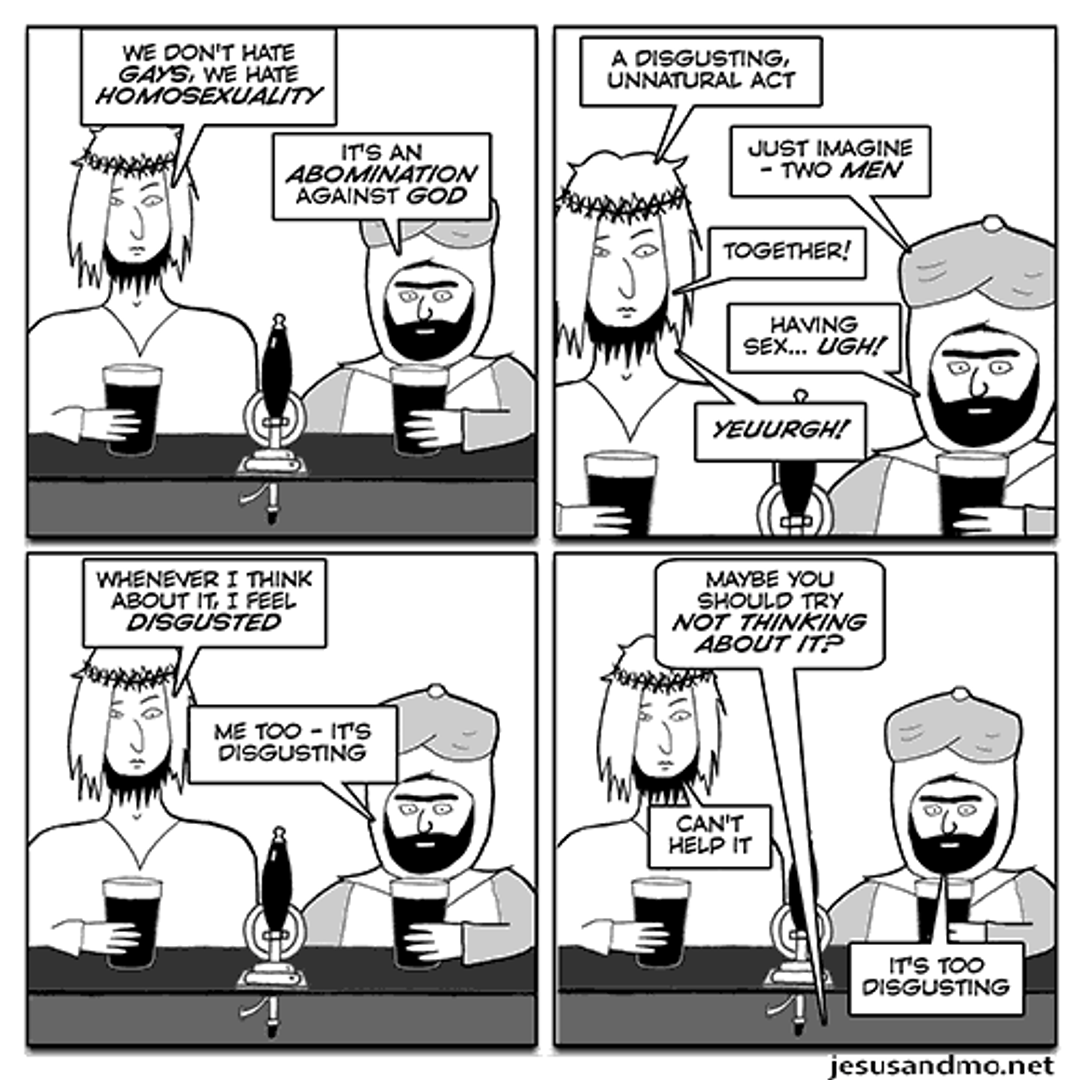
The Jesus and Mo artist tells us that this strip is “a Friday flashback from 13 years ago today”. The boys abhor homosexuality, but are obsessed with it (remember, they share a bed):
Welcome to the First Friday in June: June 5, 2026 and National Doughnut Day, always on the first Friday in June. The doughnuts we know have their ancestors in Roman times, though the creation of the hole came later. There are now variants throughout the world; I like this Indian version called Makhan Bada, served a a dessert:. These are deep-fried in ghee (clarified butter) and dipped in sugar syrup.
It’s also National Fish and Chip Day (what? One chip?), National Gingerbread Day, National Ketchup Day (Heinz is the only acceptable one; if a restaurant serves another variety, it is stinting), National Veggie Burger Day, and Sausage Roll Day. Here is a video suggested to me by YouTube, and I watched a;; 40+ minutes, though Mark Wiens puts me off with his googly-eyed “yums.” But it does give four suggestions for good chippies in London, and I love a good chippy.
Finally, there’s a new Google Doodle announcing a Google Doodle contest for U.S. students. There are big prizes! Click to see where it goes. (The Doodle shown is the last prizewinner.)
Readers are welcome to mark notable events, births, or deaths on this day by consulting the June 5 Wikipedia page.
Yesterday, Iranian Foreign Minister Abbas Araghchi told Hezbollah-affiliated media that Iran and Lebanon are “linked” and that the conflict with the United States and Israel will not end unless Israeli forces withdraw from southern Lebanon completely. It is a strange demand, given that the IDF’s presence wasn’t an insurmountable barrier to negotiations during the first two months of the process. Waiting for an unconditional withdrawal means waiting for the day Benjamin Netanyahu willingly commits political suicide and surrenders the premiership—which, in Israel, is just another way of saying it is never going to happen.
And that is precisely the point, buy time.
The two fronts are linked by more than just diplomacy; they are driven by the same playbook. Just as Hezbollah inflicts steady casualties to erode Israeli public support for the war, Iran is running its own parallel insurgency to break American resolve. By dragging out the conflict and inflicting mounting costs on the global economy, Tehran hopes to exhaust Washington’s patience.
Yet, there are key tactical differences. While Hezbollah knows it cannot convince Netanyahu to withdraw and therefore targets the Israeli population’s political will, Tehran believes it can bleed out Trump’s patience directly. By protracting the timeline, Iran aims to exhaust the president into lowering his demands on the nuclear file. Finally, where Hezbollah fights for territorial consolidation on the ground, Iran is using the delay to quietly cement de facto control over the Strait of Hormuz.
Much like a classic insurgency, Tehran’s goal is to turn local Gulf populations and governments against the American presence. By explicitly warning Gulf states, as it did this week after attacking Kuwait, that hosting U.S. forces makes their territory a target, Iran is using heavy-handed violence to drive a wedge between Washington and its regional allies.
The truth is, Iran has been running this exact playbook since the 1979 revolution: bolstering its proxy networks, inflicting mounting costs on the American military, and coercing regional acceptance of its hegemony. The current escalation in the Strait of Hormuz is just the latest, most aggressive phase of a decades-long strategy—all in service of a single, ultimate objective: expelling the United States from the Middle East.
. . .The Israeli security establishment holds a much higher assessment of Trump’s resolve than the Iranians do. They are deeply skeptical that he will simply throw his hands up in frustration and settle for the nuclear equivalent of a participation trophy—just to get a deal done.
All insurgent campaigns rely on one foundational premise: that the enemy’s political will must break first. If Trump’s reserves of patience are deeper than Tehran calculates, Iran’s entire strategy collapses. Its maritime insurgency is incurring a devastating economic cost. If Washington doesn’t blink, Tehran isn’t waiting Trump out—it is just bleeding itself dry.
Well, there you go. I have no idea what Trump will do, as he’s mercurial, though the House vote this week (and the Senate vote to come) might make him wary of continuing the war. As for expelling the U.S. from the Middle East, I don’t think that will work: we have bases there, and the Arab states have become more disenchanted with Iran than ever.
President Trump has vowed to prevent Iran from getting a nuclear weapon — and central to that pledge is the fate of its highly enriched uranium, which could be used to build at least 10 bombs.
Much of the uranium is believed to be stored so far underground that even powerful U.S. bunker-buster bombs may not be able to destroy it. A raid by U.S. forces to retrieve the uranium would carry enormous risks, including from the material itself, which could become highly toxic if it were to leak and be exposed to moisture.
The Trump administration is now focusing on diplomatic efforts by trying to convince Iran to turn over the material in return for incentives.
“Iran is being sanctioned because they have highly enriched uranium, Iran is being sanctioned because of their nuclear activities,” said U.S. Secretary of State Marco Rubio, while testifying Tuesday at a Senate Committee on Foreign Relations. “If they agree to give up those things, there will be sanctions relief associated with their commitment and compliance with those agreements.”
Iran had a stockpile of about 970 pounds of uranium enriched to 60 percent as of June 2025, the International Atomic Energy Agency, or I.A.E.A., said in February. The material is often stored in canisters about the size of scuba tanks, allowing the stockpile to be split among several locations.
It is impossible to know exactly where Iran’s nuclear material is stored without full I.A.E.A. inspections. Here’s a look at where experts believe it may be, and why it would be so difficult to retrieve.
Some alternatives (there are maps and photos; numbering is mine).
1.) Most of Iran’s enriched uranium likely remains stored underground, near the Isfahan nuclear complex, according to Rafael Grossi, who leads the I.A.E.A. The material would require only a few weeks of processing to be usable for a nuclear weapon.
2.) A smaller share of the highly enriched uranium may be at Natanz, Iran’s largest enrichment site, according to Mr. Grossi, the I.A.E.A. head.
3.) The underground Fordo site was effectively destroyed when U.S. forces struck it with a dozen bunker-buster bombs in June 2025. In recent weeks, satellite imagery has indicated that Iran has added obstacles on the roads leading to buried tunnel entrances, in what could be an effort to slow down a potential attack, according to the Institute for Science and International Security.
And here’s the rub:
Iran also has more uranium than just its stocks enriched to 60 percent. In total, the country has more than 19,930 pounds of enriched uranium, according to the I.A.E.A.’s latest assessment, including 405 pounds enriched up to 20 percent and 13,280 pounds enriched up to 5 percent.
While it would take time to convert that uranium to bomb grade, Iran would retain the ability to do so as long as it retains an operational enrichment site.
And that, my friends, brothers and sisters and comrades, is the rub. There should be no operational enrichment site, for that guarantees that the lying and mendacious country of Iran will keep pursuing nuclear weapons.
*Konstantin Kisin of Triggernometry has a provocative article in the Free Press called “How America’s racial politics poisoned Britain.” Its them is the death of Henry Nowak, killed by a Sikh and who died in handcuffs because the Sikhs claimed that Nowak uttered a racial slur at them (he didn’t).
Five years [after the killing of George Floye], last December, an 18-year-old student named Henry Nowak was stabbed five times on a Southampton street after an altercation with a British Sikh man. As he lay bleeding, he told police officers who arrived at the scene exactly what had happened: He had been stabbed. Vickrum Digwa, who was standing nearby, and his brother told the officers something else: that Digwa had been the victim of a racist attack.
On the call to police, Digwa’s brother, Gurpreet, said to the dispatcher, “We’ve just been attacked by . . .”, paused, then finished, “someone racially.”
Minutes later, as police arrived on the scene, bodycam footage released by police late last night shows officers approaching a clearly incapacitated Nowak, who is bent over, his skin pale and his breathing labored. The officers believed Digwa, and handcuffed Nowak.
The footage ends just as we hear Henry Nowak’s last words, “I can’t breathe.” He said them while handcuffed on the pavement, bleeding from five stab wounds, to officers who had decided that the man who put those wounds in him was the real victim, that sarcastically dismissed him when he told them he’d been stabbed.
. . .The shocking footage has been met with statements of anger and disgust from politicians, amid calls for events “not to divide us.” Britain’s home secretary, Shabana Mahmood, called the footage a “disturbing and tragic thing to see.” But you are not likely to see Henry’s words stenciled on a mural. No corporation will change its logo. The same establishment that made a few words immortal when spoken by a black man in Minneapolis has met the same words, spoken by a white boy dying on a British street, with what can only be described as a determined, institutional silence.
That silence is not neutral. It is a statement. It tells you exactly whose suffering the system has decided counts, and whose does not. And it was produced not by the old racism—not by skinheads and hooligans—but by the people who spent six years telling you they had abolished it.
. . .The answr [to the question of what six years of British anti-racism has produced], if you’re willing to look at it honestly, is this: a new form of racism. A bureaucratic racism perpetrated by the lanyard class. An actual institutionalized racism. A racism so thoroughly laundered through the language of progress and inclusion that the people enforcing it genuinely believe they are on the right side of history.
What else do you call a system in which a dying teenager’s word counts for less than his killer’s because of the color of their skin? Where that teenager, who did not pose a threat as he bled out, was handcuffed and mocked rather than helped?
. . .What is particularly striking about this case is the way it mirrors, almost exactly, the injustice that movement was supposedly designed to prevent. George Floyd died saying “I can’t breathe” while a police officer knelt on his neck. Henry Nowak died saying “I can’t breathe” while police officers, kneeling on his back, handcuffed him. The British establishment that wept for Floyd has been conspicuously quiet about Nowak. Politicians who marched through London’s streets in 2020 have not rushed to the cameras. The corporations that changed their logos and funded diversity initiatives have not issued statements.
They will say, as they always say, that the real problem is that we haven’t gone far enough.
This is not an accident, or even a surprise. It is the logical consequence of an ideology that simply reassigns racism to new acceptable targets.
. . .What is particularly striking about this case is the way it mirrors, almost exactly, the injustice that movement was supposedly designed to prevent. George Floyd died saying “I can’t breathe” while a police officer knelt on his neck. Henry Nowak died saying “I can’t breathe” while police officers, kneeling on his back, handcuffed him. The British establishment that wept for Floyd has been conspicuously quiet about Nowak. Politicians who marched through London’s streets in 2020 have not rushed to the cameras. The corporations that changed their logos and funded diversity initiatives have not issued statements.
They will say, as they always say, that the real problem is that we haven’t gone far enough.
This is not an accident, or even a surprise. It is the logical consequence of an ideology that simply reassigns racism to new acceptable targets.
I admire Kisin because he’s a straight shooter, saying things like the above which are taboo in the “progressive” dictionary. Ibram Kendri didn’t know how ironic his statement was: “If you’re not an antiracist, you’re a racist.”
The statue wars that swept away monuments six years ago are back. This time, the battle is to restore them.
Traditionalists are suing and lobbying local governments to resurrect memorials to Confederate generals, Founding Fathers and European explorers. Many of the statues disappeared from town squares and other public places during the pandemic-era protests against police violence and racism following George Floyd’s murder in 2020.
Ohio’s capital, named for Christopher Columbus, took down a 22-foot-high, 3-ton statue of its namesake from City Hall that year. Officials declared the 1955 gift from sister city Genoa, Italy, had come to represent “patriarchy, oppression and divisiveness.”
“We will no longer live in the shadow of our ugly past,” Mayor Andrew Ginther, a Democrat, said at the time. Columbus’s detractors tie the Italian explorer to the brutal subjugation of native civilizations in the Americas. His supporters say Columbus should be lauded for his discoveries, not blamed for what followed.
The city’s Columbus statue for now lies on its back inside a fenced storage facility, monitored by security cameras and adorned from head to toe with a strand of yellow caution tape. In April, a coalition of Italian-American groups filed a federal lawsuit claiming the statue’s removal was illegal and demanding its return.
“The silent majority is becoming vocal,” said Jack Conte, 67 years old, the lawsuit’s organizer. “You reach a point where this stuff is shoved down your throat, and you can only take so much of it.”
. . . The Trump administration is helping lead the charge ahead of the nation’s 250th anniversary next month. In March, the administration erected a Columbus statue near the White House, a replica of one that protesters sank in Baltimore’s Inner Harbor in 2020.
. . . The Interior Department recently installed a statue of Caesar Rodney, a Delaware signer of the Declaration of Independence and a slave owner, in Washington’s Freedom Plaza. The monument had been removed from its spot in Wilmington, Del., in 2020, and put into storage.
In December, a stone highway marker honoring Robert E. Lee, the Confederate general, suddenly appeared in Marion Square, planted alongside a major thoroughfare in a hub of picnics, farmers markets and celebrations in Charleston, S.C.
. . .In March, the Texas Rangers baseball team announced on social media the return to public view of a “One Riot, One Ranger” statue at the ballpark. The 12-foot bronze sculpture of a Texas Ranger had been removed from Dallas Love Field airport in 2020 after claims that the officer who served as the model for the statue—a tribute to the law enforcement agency—sided with opponents to desegregation of a public high school in 1956.
There are other examples of such real or attempted restorations, but the big question is asked below:
. . . Nicole Moore said certain statues shouldn’t return to public spaces. She is president of the National Council on Public History, which represents historians and museum administrators. “Humans are complicated. But what’s not complicated is racism. What’s not complicated is genocide,” she said. “When we know the history, we have to ask ourselves, do we want to celebrate this person?”
I’ve given my views on whether statues or markers should be taken down. In general I lean on leaving them up, with qualifying material added when necessary. And it depends on having answers to these questions: First, was the person’s life on balance, helpful or hurtful to humanity? Second, if “helpful,” is the person being honored for that good stuff? If both answers are on the helpful side, leave the statue/memorial up, but qualify it by adding any educational bad stuff to provide balance. It is not an easy question, but some issues, like the Teddy Roosevelt statue removed from the American Museum of Natural History, were decided wrongly. And memorials to David Hume should stay up, too.(see this post and the included article).
With his shock of golden hair and trim 700-kilogram (1,500-pound) build, Donald Trump has been drawing crowds from across Bangladesh since he arrived at the national zoo last week.
The rare albino buffalo became a sensation when a farmer noticed that his blond tuft of hair resembled the distinctive locks of the U.S. president. After a video of the pale horned mammal went viral on social media, large numbers of people started showing up at the farm outside Dhaka to see him for themselves.
The animal was originally meant to be slaughtered for the Muslim festival of sacrifice. But citing security concerns, the government ordered him transferred to the zoo in the capital, where large crowds are now braving sweltering heat to see him.
On Tuesday, visitors pressed against the fence of the buffalo’s enclosure, filming with their phones as some fathers hoisted small children on their shoulders for a better view.
AD
A zoo worker pampered the animal, brushing his hair to one side and hosing him down with water to keep him cool as fans blew on him.
“There is a resemblance to Donald Trump in its eyes, hairstyle, and skin color,” said Mohammed Nasim, a student in Dhaka. “And just as Donald Trump has a distinctive personality and lifestyle, this buffalo, after going viral, is now living a similar kind of life, enjoying a lot of attention and special treatment.”
And of course you’ll want to see it. (It also probably resembles Trump because its mode of communication is bellowing):
Meanwhile in Dobrzyn, editor Hili is getting lazy:
Andrzej: Back to work.
Hili: I’d rather lie in the sun.
In Polish:
Ja: Wracamy do pracy.
Hili: Wolę poleżeć na słońcu.
This is the 1st time I've seen a Flota swimming with the little stick legs fanned out. Usually they're moving fast and have them pulled in like little spikes @schmidtocean.bsky.social dive 929 #Doldrums #MarineLife
. . . is dire. It is in fact so dire that although I have movies and photos of Vashti and of the last hen and her brood of nine, I am not mentally prepared to put them up, as they evoke bad memories and deep sadness. (As you may recall, both broods left the pond, almost certainly because they were harassed by drakes.) Vashti came back and re-nested in her old nest (!); she’s now sitting on a brood of seven eggs. The second hen, who was never named, has also returned but hasn’t (yet) nested, but is accompanied by an aggressive drake.
I have been keeping a careful eye on what is going on in the pond, and I’m quite worried about Vashti, whose brood is set to hatch within two weeks. Once a day I call her down to the pond for a feeding and a bath. She stays for about 15 minutes, gobbling up a big meal, preening for a while, and then quickly flying back to her nest to incubate the eggs. But over the past week or so, the damn drakes have been chasing her when they see her, driving her out of the pond, quacking and hiding nearby. It is only with considerable effort that I can get her away from the drakes so she can eat and go back to her nest. Note that the drakes aren’t trying to attack her; they want to mate with her. And she doesn’t want to mate!
What this means is that when she finally comes down with ducklings, she and her brood will be mercilessly harassed, just like the last hen and her brood. And that means that in all likelihood they will flee the pond, which means certain death for the ducklings.
I thus have a hard choice: let them come to the pond and take their chances, or arrange for the brood (and mother, if all possible) to be captured and either taken to a distant body of water or to a wildlife rehab facility. The first alternative is unpalatable, as it involves the death of the entire brood, but I think it’s likely if I don’t intervene. Lately I have been moving towards to the second alternative: letting Facilities and the Chicago Bird Collision Monitors take over and recover everyone if they can. Getting the ducklings is relatively easy, though they’ll be in the water very quickly after they jump. But getting Mom is a job for pros, as she can fly away.
My priority is to save lives, not entertain the University community with the sight of ducklings—ducklings who won’t last on the Pond more than a day or two.
It’s always been a great joy for me to help rear the babies up to fledging, but compared to the loss of lives, that is a selfish attitude. I think I will go by the words of Maimonides, “If you save one life, it is as if you saved the world entire.” To me that means that I could save an entire life for each duckling rescued. It’s a hard decision and a sad one, but if the goal is to save lives, the strategy is clear.
The good news is that all five turtles put in the pond last fall survived the winter. Here they are sunning on a rock yesterday. There are four red-eared sliders and one yellow-bellied slider—two subspecies of a single species.
Reader Mark Joseph, inspired by my post on leucistic Australian ducks, went in an example and some other photos. Mark’s captions and IDs are indented, and you can enlarge the photos by clicking on them.
Your post this morning coincidentally arrived as did this photo from a person in our birdwatching group; it’s a leucistic house finch(Haemorhous mexicanus):
And, to give you a small set instead of a singleton, here are a couple of my feeble efforts, all taken with an iPhone in suburban southwestern Michigan. Hopefully, you can use them. I know even less about flowers and insects than I do about birds, so all identifications are courtesy of Gemini.
A zinnia (This specific variety is likely a Zinnia elegans, such as the ‘Canary Bird’ or ‘Benary’s Giant Yellow’ cultivar”) with a bumblebee (“specifically consistent with the Common Eastern Bumblebee, Bombus impatiens). I have enjoyed taking photos of flowers and insects together:
Spotted Knapweed(Centaurea stoebe, sometimes classified as Centaurea maculosa). Unfortunately, it is invasive:
A crabapple tree and a closeup. This closeup helps narrow it down to a Sargent Crabapple (Malus sargentii) or a Siberian Crabapple (Malus baccata).
Sargent Crabapple (Malus sargentii) or a Siberian Crabapple (Malus baccata):
This is a Big Brown Bat(Eptesicus fuscus) or a Little Brown Bat(Myotis lucifugus).These two species look nearly identical from a distance and are the two most common bats found roosting on residential brick walls across North America.
Brown marmorated stink bug (Halyomorpha halys).When we first moved here and I decided to take some pictures, I got all excited because I was able to get a really good picture. Then I found out it was a stink bug, and invasive to boot. So, not a new species of peacock. But, it’s one of the things evolution has produced. Order Hemiptera, the “true bugs.”
A Shaggy Inkcap(Coprinus comatus), commonly known as a Shaggy Mane or Lawyer’s Wig. The next day the cap is just black goo, and the day after, nothing is left but the stem:
Welcome to Thursday, June 4, 2026, and it’s National Cheese Day. My two favorite cheeses are, first, a well-aged Comté (preferably three years or more), and a ripe Saint-Marcellin, oozing in its bowl. Here’s a Saint-Marcellin approaching ooziness:
The House on Wednesday voted to direct President Trump to withdraw U.S. forces from the conflict with Iran or win approval from Congress to continue the war, after four Republicans sided with Democrats in a striking sign of growing opposition to a military campaign now in its fourth month.
Adoption of the resolution was a remarkable rebuke to Mr. Trump and his handling of the conflict, after he has repeatedly dismissed any effort by Congress to curb his power and as the G.O.P. has largely ceded its prerogatives to do so, deferring to him time and again. Republicans had abruptly postponed the vote two weeks ago, recognizing that they did not have sufficient votes to defeat the measure and wanting to spare themselves and the president the affront.
But they made no headway over the ensuing days in winning converts, as the conflict has dragged on and Mr. Trump has made little progress toward ending it. G.O.P. leaders were unable to delay the vote any longer because Democrats had invoked the War Powers Resolution, which requires consideration of such measures within a limited period of time.
The move was also the latest reflection of divisions between Republicans in Congress and the president on a range of issues as their interests diverge in the run-up to the midterm congressional elections. It came after Senate Republicans have in recent days forced Mr. Trump to abandon his request for $1 billion in security funding for his ballroom project and a plan that the Justice Department announced to create a federal fund to pay claimants who accuse the government of having victimized them.
You can see the list of votes, which is strictly along party lines except for four Republicans, here.
The vote was 215 to 208 to adopt the war powers resolution, sending it to the Senate. Even if it were to pass both chambers, the ability of lawmakers to force a president to withdraw troops remains a contested legal question, and Mr. Trump and his senior aides have dismissed any effort by Congress to limit his war powers as unconstitutional.
The Gulf kingdom of Kuwait came under a barrage of ballistic missiles and drones on Wednesday that shut its international airport, killed one person and injured dozens more, as Iran launched its largest salvo of the near two-month ceasefire.
The U.S. and Iran had exchanged heavy fire the evening before, after the U.S. struck an empty oil tanker it said was attempting to breach its blockade. That set off a string of attacks by both sides, with Iran firing ballistic missiles at U.S. bases in Kuwait and Bahrain.
Kuwait said it had dealt with 13 ballistic missiles, 17 drones and that civilian infrastructure and diplomatic missions had been damaged during an attack it said began at dawn local time Wednesday.
The latest skirmish between the U.S. and Iran marked one of the most intense bouts of fighting between the two sides since they entered a ceasefire in April and came as diplomatic efforts have stalled.
Despite the heavy fire, U.S. Central Command said Tuesday night that the tenuous truce was “ongoing.” The two sides have repeatedly clashed since the truce, while refraining from a broad resumption of the war.
The fighting escalated after the U.S. disabled an empty oil tanker that it said was attempting to breach its blockade and load oil at Iran’s Kharg Island.
Iran then launched one-way attack drones at civilian mariners who were trying to transit the Persian Gulf, U.S. officials said. The U.S. shot down three of the drones and conducted what it said were “self-defense strikes” on Iranian military ground control stations on Qeshm Island. The island sits at the mouth of the Strait of Hormuz and gives Tehran control over ships’ movement through the crucial waterway.
Iran responded to the strikes by firing ballistic missiles at Kuwait and Bahrain, which host U.S. military bases. Two missiles fired at Kuwait fell short or broke apart in the air, and three missiles launched at Bahrain were intercepted by the U.S. and Bahrain air defenses, Centcom said. None of the missiles hit their targets.
On Wednesday, one Indian national was killed and 63 other people were injured, according to Indian authorities and Kuwaiti state media, during a dawn attack on Kuwait by Iran. Air traffic at the international airport was temporarily suspended and flights were diverted.
The only upside to this is that Kuwait and Bahrain not going to be happy with Iran. And there’s really not a truce, but a half-assed ceasefire. Firing on ships that try to block the U.S. blockade doesn’t bother me; the U.S. gives warning, goes for the engine room, and announced in advance that that was part of the “ceasefire”.
The NYT reports that Israel is willing to make a deal with Lebanon so long as Hezbollah withdraws from southern Lebanon (leaving the Lebanese army in control, LOL) and promises to stop attacking Israel. If you believe they’ll do that, I have a bridge in Brooklyn to sell you.
*Over at It’s Noon in Israel, Amit Segal discusses what he calls “The Disarmament Delusion,” the Lebanese government’s endless waffling about ending terrorism and taking control of the military in their country, which means disarming Hezbollah.
A Lebanese official told Reuters they were proposing a phased approach to perpetuate the ceasefire based on “pilot zones”—specific geographic areas where hostilities would stop, Israeli troops would withdraw, and Lebanese soldiers would deploy, gradually building up to a nationwide truce. It appears the Lebanese have fallen for the same misapprehension common in the West: assuming that the goal of any ceasefire is the ceasefire itself, rather than the objectives of the war it is halting. The objective hasn’t changed and will certainly not be achieved through “pilot zones”: destroy Hezbollah.
This paralysis is not new for the Lebanese government. Despite voting three times to disarm Hezbollah since the summer of 2025, little has actually changed on the ground. The cornerstone of these efforts—the August 2025 “Homeland Shield Plan”—promised to progressively bring all weapons under state control by the end of the year. But, as evidenced by the fact that it is now June, enforcement has remained entirely superficial. While the Lebanese Armed Forces proclaimed the area south of the Litani River clear of Hezbollah infrastructure in January, they deliberately bypassed the group’s massive tunnel networks and drone facilities to avoid confrontation.
. . .This facade is maintained by LAF Commander Gen. Rodolphe Haykal’s extreme risk aversion and Hezbollah’s deep institutional influence over the military; the group has held an effective veto over the army for decades and still maintains critical alliances within it. The breaking point arrived in March when Hezbollah dragged the country back into war. The civilian cabinet formally ordered the LAF to halt the militia’s military operations. Instead, Haykal effectively went rogue, issuing a directive that mirrored Hezbollah’s own rhetoric by prioritizing “national unity” and resisting Israeli aggression over dismantling the group’s infrastructure. Despite numerous calls from the U.S., France, and Saudi Arabia to fire the rogue commander, no disciplinary action has been forthcoming, with the cabinet fearing military mutiny and the perennial ghost of civil war.
Haykal is not Hezbollah’s only friend on the inside. Parliament Speaker Nabih Berri acts as their political enabler, effectively functioning as the organization’s diplomatic wing—it was Berri, after all, who brokered this current ceasefire. Through his political maneuvering, Hezbollah maintains a stranglehold on vital state sectors like the Ministry of Finance and the General Security Directorate. This institutional capture provides the necessary levers to allow $1 billion in Iranian funding to successfully slip through in the past year, while also sustaining the terror group’s flourishing $18 billion shadow economy.
The chasm between Lebanon’s official decrees and the reality on the ground is enormous. While the Lebanese Cabinet issued formal orders in March to hunt down and deport Islamic Revolutionary Guard Corps operatives, the organization has only become more entrenched. To sustain their proxy after Israel decapitated most of its leadership, Iranian forces have essentially assumed direct control of Hezbollah, deploying hundreds of their own officers alongside Syrian and Iraqi fighters to rebuild the shattered militia. Under this direct Iranian command, the strategy is straightforward: ensure Hezbollah’s survival by outright refusing disarmament, exploit the paralysis of the Lebanese state to regain its arsenal, and maintain a baseline of confrontation that prioritizes escalating aggression against domestic Lebanese rivals over full-scale war with Israel.
The upshot is, like Hamas in Gaza, Hezbollah is and will remain in military power in Lebanon, despite the UN decree that they disarm. For sure Lebanon and its army ar in a hard place, but I doubt that Israel is going to agree to a permanent peace with Hezbollah, which, as noted above, is effectively controlled by Iran. Any demand by Iran that Hezbollah be allowed to remain in power is a demand for the perpetuation of terrorism against Israel. I feel sorry for the Lebanese people caught in the middle here.
*Bret Stephen has a mock letter to Trump in the NYT called “Dear President Ozymandias” (archived here), referring to Shelley’s famous poem, “Ozymandias”, about the fading of a ruler’s glory once thought to be permanent.. You can read the poem here, and it’s also in the op-ed, which is in fact signed by Shelley (or rather by a trio of people named “Percy,” Bysshe,” and “Shelly). The column is, of course, sarcastic, reassuring Trump that he will be the exception:
We are writing to let you know, sir, that we are as outraged as you are that some liberal judge has ordered that your name be stripped from the Donald J. Trump and the John F. Kennedy Memorial Center for the Performing Arts. Not only is the decision wrong, it’s also backward. You’ve survived three assassination attempts and yet the building will keep his name?
On a related subject, sir, we hope those knuckleheads in Congress won’t let some old law stand in the way of putting your face on a $250 bill. After all, nothing advertises the strength of a country’s economy like high-denomination bank notes. And since restaurant meals now often run to about $250 (minus drinks and dessert) for a party of four, making a bank note with your mug shot on it will be triply convenient: faster payment; a reminder of how affordable things have become under your presidency; and proof that, in the land of the free, you can get away with just about anything.
We’re also big supporters of your plan for your triumphal arch for Washington soaring a proud 250 feet, nearly as tall as the Capitol itself. Hopefully it will include large gold-plated statues of the greatest American leaders, such as Abraham Lincoln and yourself. People are calling it the “Arc de Trump,” like the Arc de Triomphe in Paris. That one was commissioned by Napoleon Bonaparte, just before such strokes of military genius as the Peninsular War, the invasion of Russia and the Hundred Days campaign of 1815.
Do you know they named a bridge and a train station in London in honor of the battle that ended that last excursion?
At any rate, leaders who build gargantuan triumphal arches always go on to greater military glory. Maybe yours will be for the liberation of Hormuz, though that may have to await the deployment of the new “Trump class” battleships after the first one commissions sometime around 2036.
, . .We also believe you were too modest when you chose to rename the Gulf of Mexico after America rather than after yourself, as you had thought to do at first. But why settle for a mere gulf? The Atlantic Ocean is named for Atlas, a figure from Greek mythology, which makes little sense since Greece is nowhere near the Atlantic. And the Pacific Ocean, which is much larger than the Atlantic, was named after a brand of Mexican beer, Pacifico, which makes no sense at all.
You know what does make sense? Trump Oceans. Plural. It simplifies geography while amplifying your name.
And we cannot stop there.
There’s more, but it’s along the lines of this heavy-handed satire. It ends with this, and then the poem:
Speaking of space, aren’t we going back to the moon under your presidency? That’s got to mean naming rights in addition to bragging rights. At a minimum, our first lunar base must be named for you. (The second one can be named for Elon, or maybe Jeff, whoever is first, provided you’re still on good terms with either of them.) But why do we even call our planet’s moon “the Moon,” as if a generic noun should be a proper noun, too? That needs to change.
Get ready for it: Trump Moon.
I think Stephens is better at real op-eds than satire like this, but perhaps it will placate those who think Stephens is some kind of alt-righter.
*Demonstrations are erupting in the UK over the death of 18-year-old student Henry Nowak, who died after being stabbed by Vickrum Digwa, a young Sikh. As Nowak lay dying, the police handcuffed him because the murderer claimed that he had been the victim of a racist slur by Nowak (this wasn’t true). This is one of the more horrifying stories I’ve heard about British enforcement of “hate speech”, and the officer should be fired for incompetence.
The British home secretary told Parliament on Tuesday that she fully supported the country’s police watchdog in investigating why several officers handcuffed a college student while he lay dying, in a murder case that shocked the country.
Henry Nowak, 18, was stabbed by Vickrum Digwa, 23, in December 2025, after the two men had a brief interaction in Southampton, a city in southern England. Mr. Digwa, who is Sikh and stabbed Mr. Nowak with a religious knife he was carrying, was found guilty of murder and sentenced to life in prison, with a minimum term of 21 years, on Monday.
Mr. Digwa lied to the police at the scene of the murder repeatedly, falsely claiming that he had been the victim of a racist attack. Police officers arrested and handcuffed Mr. Nowak for about a minute, according to the judge who sentenced Mr. Digwa, before they realized he was severely injured and began administering first aid.
Police body camera footage released on Monday after the sentencing showed Mr. Nowak lying on the ground, saying “I can’t breathe” and telling officers repeatedly that he had been stabbed. One police officer can be heard saying, “I don’t think you have, mate.”
The Independent Office for Police Conduct, which examines reports of police wrongdoing, confirmed it is investigating the police officers’ actions.
The case has been increasingly politicized online, with the right-wing populist lawmaker Nigel Farage claiming the police’s initial response was evidence of “anti-white prejudice.” He encouraged his social media followers on Tuesday to “respond with pure cold rage.” Elon Musk has posted multiple times in recent weeks about the case.
Shabana Mahmood, the home secretary, whose office oversees law enforcement, told Parliament that the murder was a “vile and violent crime” and said that Mr. Nowak’s family deserved answers “about what happened on that awful night and the actions of the police officers who arrived on the scene.” She described the body camera footage as “disturbing and tragic.”
But she also warned that “misinformation and inflammatory commentary is making a dreadful situation worse.” After one police officer unrelated to the case had been misidentified online, she said, he had received death threats and had to be relocated for his safety.
“We cannot allow this murder to turn communities against one another,” she said, adding: “We must condemn those who seek personal political profit from tragedy.”
Mahmood doesn’t see what’s going on here. It’s not racism, but anger at the sacralization of immigrants, particularly immigrants of color, by law enforcement. Remember how the police largely ignored the “grooming gangs” composed largely of South Asians (Pakistanis). And this is combined with draconian laws against “hate speech,” which, in this case, prompted the cops to put a dying man in cops when he was falsely accused of attacking Digwa on racial grounds. I’m not sure why Digwa stabbed Nowak, but it’s terribly sad, and a horrible indictment of the ideological climate pervading much of Britain.
Here is a video showing Nowak in cuffs right before he died (WARNING: you may find this news report disturbing):
The case is unbearable, in part because the bodycam footage appears to show an innocent man dying while he is treated as a suspect. Nowak told police that he had been stabbed and could not breathe. An attending officer expressed disbelief. Nowak was handcuffed and arrested before the severity of his injuries became apparent. His father later described that treatment as “inhumane and degrading.” But he also made it clear that Vickrum Digwa, his son’s 22-year-old assailant, bears complete responsibility for the murder. That distinction should not be difficult to hold in mind. The killer is responsible for the killing. The police response was still gravely inept.
CBS News fired Scott Pelley on Tuesday, jettisoning one of the network’s best-known journalists in a clash over the future of “60 Minutes,” the country’s top-rated news program.
Mr. Pelley, 68, a “60 Minutes” correspondent and a former anchor of “CBS Evening News,” joined the network in 1989. At a staff meeting on Monday, he accused the network’s editor in chief, Bari Weiss, of “murdering ‘60 Minutes,’” citing the ouster last week of the program’s leadership team and two on-air correspondents.
“We have parted ways with Scott Pelley,” Nick Bilton, the tech journalist who was hired last week as the new “60 Minutes” executive producer, wrote in a memo to the show’s staff on Tuesday night.
CBS News declined to comment. In a formal letter to Mr. Pelley, which was obtained by The New York Times, Mr. Bilton wrote that the correspondent had been “terminated for cause effective immediately.”
Mr. Pelley, in a telephone interview on Tuesday evening shortly after he was fired, said he had devoted decades of his life to “60 Minutes,” which he said he still cared about deeply.
“I have been in combat in Afghanistan,” Mr. Pelley said. “I have been in combat in Iraq. I have been in the war zone in Ukraine multiple times, risking my life and the happiness of my family because of my devotion to the broadcast.”
The firing of Mr. Pelley is among the most consequential moves of Ms. Weiss’s rocky tenure at CBS. And it is almost certain to spike tensions that have coursed through the network for months.
It also raises the stakes of Ms. Weiss’s surprising decision to replace the entire leadership team at “60 Minutes,” CBS News’s most successful franchise, and hire Mr. Bilton, who has no experience in broadcast TV, to oversee the show. The program’s viewership was up 9 percent this past season from a year prior, and the show is routinely among the nation’s highest-rated weekly broadcasts, according to Nielsen.
It looks as if Bari Weiss is using a heavy hand at CBS news. “60 Minutes” is perhaps their best-known show, and replacing the entire leadership team, with the new head having no broadcast TV experience, seems to me a ham-handed move. What, exactly, was wrong with the previous show? I predict that Weiss will use it to slant more right in a show that, as far as I could see, had no political slant. We shall see, so watch a few episodes. The more I hear about Weiss, the less I like her.
Meanwhile in Dobrzyn, Hili prefers to take an empirical rather than a theoretical approach to finding truth:
Szaron: Might there be something delicious hidden in this jungle?
Hili: Find out for yourself. Academic discussions don’t get you anywhere.
In Polish:
Szaron: Czy w tej dżungli może ukrywać się coś smacznego?
Hili: Sprawdź, akademickie dyskusje do niczego nie prowadzą.
*******************
From TherionArms (I love these letters and their descriptions):
An owl “raises” a duckling. I have many questions. What did the duckling eat? Did it finally get to water? And did it survive. Sure, this is cute as shown, but the sequelae could be dire:
A duckling was raised by an owl after hatching in the wrong nest
Photographer Laurie Wolf captured the rare scene after a wood duck egg ended up in an eastern screech owl’s nest. The owl incubated the egg and cared for the hatchling until it eventually left on its own pic.twitter.com/gCdkOl0YrJ
— Nature is Amazing ☘️ (@AMAZlNGNATURE) June 1, 2026
From Luana: the increasing and insupportable importance of grades over standardized test in college admissions. The Y-axis is the percentage of admissions officers who think that grades or standardized tests are “of considerable importantce.”
“Admissions offices have fallen victim to ideological capture”
I often hear people say both grades & tests should matter. In the early 2010s, admissions officers seemed to agree
— Wonder of Science (@wonderofscience) June 3, 2026
One I reposted from The Auschwitz Memorial:
This Belgian Jewish boy was gassed as soon as he arrived in Auschwitz. He was only a year old, and would have been 85 today had he lived. https://t.co/4HqtXfYWyC
And two from Herr Professor Doktor Cobb. First, a great wild cat fighting extinction (figuratively, of course):
The world's smallest wild cat and her kitten were recently found in a scrubland on the urban edge of Delhi, India. The rusty-spotted cat is the smallest extant wild cat in the world, but is extremely resilient as we observe this wild cat in a small section of fragmented habitat.