Jesus ‘n’ Mo ‘n’ the god-shaped hole

October 29, 2025 • 9:15 am

Today’s Jesus and Mo strip, called “joy2,” is a “resurrection from 2009.”  Mo, quaffing his usual Guinness, clarifies what the “god-shaped” hole really is:

I also discovered that there is a Jesus and Mo entry in Wikipedia, and this year is its twentieth anniversary! From the entry:

Jesus and Mo share a flat (and a bed), and occasionally venture outside, principally to a public house, The Cock and Bull, where they drink Guinness and engage in conversation and debate with an atheist female bartender known simply as Barmaid, who is never drawn but is characterised only as an out-of-frame speech bubble. The barmaid functions as the voice of reason when criticising the Abrahamic religions or religion in general. Other times, Jesus or Mo may act as the voice of reason depending on which religion a particular comic aims to criticise. Jesus will act as the author’s mouthpiece if the comic aims to criticise Islam while the character Mo will be used to criticise Christianity. They also converse with each other on a park bench.

Monday: Hili dialogue

October 27, 2025 • 6:45 am

Welcome to the beginning of the “work” week: Monday, October 27, 2025, and National American Beer Day. I’m trying to think of an American beer I like, but every craft beer seems to be overhopped these days. How about this one? You don’t need a man bun to drink it!

It’s also National Black Cat Day in the UK, National Parmigiano Reggiano Day, National Potato Day, and Sylvia Plath Day (the poet was born on this day in 1932, and killed herself at age 30.  Here she is (her greatest poem is here):

Rayless, public domain

And to celebrate UK Black Cat Day, here’s a photo from reader Laurie, who happens to live in London:

For National Black Cat Day, her uncle’s namesake, Miss Alcestis Jerry, wishes to pay homage.  

And a photo from Dublin taken by Christina Purcell. Their specialty: finch and chips. (Just kidding!)]

Readers are welcome to mark notable events, births, or deaths on this day by consulting the October 27Wikipedia page.

Da Nooz:

*Obituaries first: June Lockhart, famous for her roles in the t.v. show “Lassie” as well as “Lost in Space” (I watched a lot of the former, but never saw the latter), has died at 100.

June Lockhart, the soft-spoken actress who exuded earnest maternal wisdom and wistful contentment in two very different mid-20th-century television roles, on the heartwarming children’s series “Lassie” and the futuristic “Lost in Space,” died on Thursday at her home in Santa Monica, Calif. She was 100.

Her death was announced by a spokesman, Harlan Boll.

Ms. Lockhart replaced Cloris Leachman in the role of Ruth Martin, a farm wife and the foster mother of Jon Provost’s character and his courageous collie, Lassie, in 1958, at the beginning of the show’s fifth season. After six years of dispensing homespun wisdom, Ms. Lockhart was herself replaced, along with her human co-stars, in favor of a forest-ranger character (Robert Bray) who would guide the show’s canine heroine through her further adventures.

In 1965, Ms. Lockhart returned to series television, playing a wife, mother and interplanetary explorer turned castaway on “Lost in Space.” Her television family included a robot who seemed to announce “Danger, Will Robinson,” alerting the show’s boy hero (Bill Mumy) to extraterrestrial menace, as often as Lassie’s sensitive ears and nose alerted her to earthly emergencies. The series, which combined an over-the-top villain (Jonathan Harris as Dr. Smith) with low-budget production values, became something of a camp classic, acquiring a devoted following years after its original run.

Here’s an episode of “Lassie, which takes me right back to my youth.  Lockhart appears at 1:27.  I had no idea that Cloris Leachman played Ruth Martin before Lockhart!

*Les flics have made some arrests in the Louvre jewel heist., in which four men took more than $100 million in royal jewelry.

The police have made arrests in the brazen jewelry heist last week at the Louvre Museum in Paris, French authorities said on Sunday, without saying how many people had been taken into custody.

The robbery was carried out by four people. Laure Beccuau, the Paris prosecutor, said in a statement that the arrests were made on Saturday evening and that one man was arrested at the Roissy-Charles de Gaulle Airport as he was trying to leave the country.

It was not immediately clear whether the police had recovered any of the stolen jewelry, worth more than $100 million, which included gem-studded royal tiaras, necklaces and earrings.

The arrests were a major breakthrough in the case. They came one week after the daylight robbery at the Louvre, which put an uncomfortable spotlight on security lapses at the world’s most visited museum.

The arrests were first reported by French news media citing anonymous sources, apparently catching the authorities by surprise.

“I deeply regret the hasty disclosure of this information,” Ms. Beccuau said in her statement. She said that the leaked information would hinder “the 100 or so investigators who mobilized in the search for both the stolen jewelry and for all of the criminals.”

Ms. Beccuau said it was too early to provide further details, adding that she would provide more information after the police finish questioning the suspects.

They used DNA evidence!

Ms. Beccuau said that she would provide more information only after the police finished questioning the suspects.

In a recent interview with Ouest-France newspaper, Ms. Beccuau said that investigators had collected more than 150 forensic samples. That included DNA traces and fingerprints at the crime scene and on objects that the thieves left behind, including power tools, gloves and a motorcycle helmet.

Ms. Beccuau also said that investigators had analyzed video surveillance footage to track the thieves’ escape, although she did not provide details on the route they took.

“The amount of media coverage this organized robbery has received gives me a glimmer of hope that the perpetrators won’t dare to move the jewelry too far,” Ms. Beccuau told the newspaper. “And that we’ll be able to find it if we act quickly.”

Now we don’t know if the jewels were hidden, had the gems removed, or were sold already to some rich miscreant. It’s possible the criminals (if they ARE the criminals) could have hidden the loot and then recover it after they get out of jail. I suspect it will be long sentences after any conviction. And the fact that DNA evidence helped with the case suggests that at least one of the perps has been arrested before, for in France they take DNA from all suspects and criminals and put it in a national database. (UPDATE: The evening news last night said that at least one suspect had a criminal record.)

The French have 4 days after arrest to either release the suspects or charge them.

*Shoot me now department: Kamala Harris has intimated that she might run for President in the next election, proclaiming that she’s devoted her life to public service.

Former vice president Kamala Harris said in an interview that she “possibly” will run for president, adding an early twist to what is already likely to be a hard-fought and complicated race for the 2028 Democratic presidential nomination.

Speaking to the BBC for a segment that will air Sunday, Harris said she has not yet decided whether to seek the White House for a third time.

But when she was asked if her nieces would see a woman president, Harris said, “In their lifetime, for sure,” and then asked if it might be her, she added, “Possibly.”

“I am not done,” Harris said in the interview, part of a tour she is conducting in conjunction with the publication of her book, “107 Days,” about her lightning-fast campaign for the presidency last year after President Joe Biden ended his reelection campaign.

“I have lived my entire career a life of service, and it’s in my bones … There are many ways to serve. I have not decided yet what I will do in the future beyond what I am doing right now.”

Harris appeared to bristle when the interviewer, BBC’s Laura Kuenssberg, suggested that Harris has not performed well in early polls for the 2028 Democratic primary race.

“I think there are all kinds of polls that will tell you a variety of things,” the former vice president said. “I never listen to polls. If I had listened to polls, I never would have run for my first office or my second office, and I certainly wouldn’t be sitting here in this interview.”

While many Democrats insist they will not focus on the 2028 race until after next year’s congressional elections, party leaders are privately engaged in intense conversations over what kind of image and message they should present to voters after last year’s devastating second loss to Donald Trump.

Among those considered potential candidates are several prominent governors, including California’s Gavin Newsom, Illinois’ JB Pritzker, Pennsylvania’s Josh Shapiro, Maryland’s Wes Moore and Kentucky’s Andy Beshear. Other figures — including former Chicago mayor Rahm Emanuel, former transportation secretary Pete Buttigieg, Sen. Cory Booker of New Jersey and Rep. Ro Khanna of California — are also said to be considering running.

The race promises to be a fight between a variety of figures with vastly different ideas on how the Democratic Party can recover from the Trump era. It will feature an unusually blunt debate over what the party should be in the years to come, given the broad rejection of the Democrats by large majorities of rural voters and those without college degrees. In the meantime, the party has been slow to complete a thorough autopsy of what went wrong in 2024.

Against that backdrop, Harris presents a complex figure for Democrats. She is appreciated by many in the party as the first woman to serve as vice president, and the first Black and Asian American person to fill that role.

Enough of this identity stuff: we need a candidate who can win! Among those mentioned above, I’d much prefer Buttigieg, Booker, and Pritzker (not mentioned).  But not Harris, whom I’ve always disliked (though not as much as Trump!). Do you think I just fell out of a coconut tree? The “joy” bit touted by the Dems in the last election was cringeworthy.

*Man, we’re really kicking Canada in the tuchas!  Trump has raised tariffs on Canadian goods by another 10% because an Ontario station ran an ad showing Ronald Reagan opposing tariffs.

The U.S. will impose an additional 10% tariff on Canada, President Trump said on Saturday, a punitive measure in response to an ad campaign that he said misrepresented comments by former President Ronald Reagan.

“Because of their serious misrepresentation of the facts, and hostile act, I am increasing the Tariff on Canada by 10% over and above what they are paying now,” Trump posted on his Truth Social platform on Saturday.

The ad campaign, released by the Canadian province of Ontario, uses audio from a 1987 radio address delivered by Reagan, in which he explains that despite putting tariffs on Japanese semiconductors that year, he was committed to free-trade policies. While tariffs can look patriotic, Reagan said, “over the long run such trade barriers hurt every American worker and consumer,” lead to “fierce trade wars” and result in lost jobs.

U.S. Treasury Secretary Scott Bessent in an appearance Sunday on NBC’s “Meet the Press” called the ad “a kind of propaganda against U.S. citizens.”

“What was the purpose of that other than to sway public opinion?” he asked.

Trump had threatened to cut off trade talks with Canada on Thursday over the ad, claiming it misrepresents Reagan’s comments, and was being used to influence the U.S. Supreme Court ahead of a hearing on the administration’s tariffs next month. In response, Ontario Premier Doug Ford said that he would call off the campaign, effective Monday. But the ad still ran on Friday night during the first game of the World Series—a fact Trump noted in his Saturday post, saying that the ad “was to be taken down, IMMEDIATELY.”

The ad ran again Saturday night during the second game of the World Series.

From the Guardian:

The dispute comes as both countries face critical deadlines in the next few weeks. Next week marks the cutoff for public comments on the scheduled review of the United States-Mexico-Canada Agreement, which faces its mandatory six-year assessment in July 2026. The following day, 4 November, Carney, will deliver a federal budget expected to focus on reducing reliance on US markets.

Here’s the ad, and I don’t see much distortion of what Reagan said, nor did Trump specify what was wrong.  But Trump is ticked off that Reagan’s being used against him. Right now, tariffs on goods from Canada range from 35% to 50%, but some goods are excempt because of North American trade agreements. What my dad told me when I was a kid aligns perfectly with what Reagan says (my dad was an economist with the government after he left the Army).

*Dinosaur mummies, with fossilized skin and scales rather than just bones, are very rare, but two more have been found in Wyoming.  And they give us a good idea of what the dinos looked like in real life.

During a 1908 dig in Wyoming, the fossil hunter Charles H. Sternberg made an unfathomable find: a dinosaur skeleton covered in scaly skin.

The duck-billed Edmontosaurus specimen ended up at the American Museum of Natural History. When it was unveiled in 1909, The New York Times proclaimed the find “was not only a skeleton, but a genuine mummy.”

A year later, in the same part of Wyoming, Mr. Sternberg and his sons discovered a second Edmontosaurus mummy, which they shipped to a museum in Germany.

Nearly a century later, a team of paleontologists returned to Wyoming’s “mummy zone” and unearthed two more Edmontosaurus mummies that preserve an array of rarely fossilized features, including the first example of dinosaur hooves. In a paper published on Thursday in the journal Science, the researchers describe the fossils and propose a mummification process that involved microbes and took place more than 66 million years ago.

“For the first time, I think that we’ve got Edmontosaurus’s look completely down,” said Paul Sereno, a paleontologist from the University of Chicago and lead author of the paper. “Based on our drawings, you can put it in a Hollywood movie and it’s going to be accurate head to toe.”

Here’s the paper in Science; click screenshot to read for free. The first author, Paul Sereno, is an evolutionary paleontologist here at Chicago, and has made a number of striking finds:

The abstract:

Two “mummies” of the end-Cretaceous, duck-billed dinosaur Edmontosaurus annectens preserve a fleshy crest over the neck and trunk, an interdigitating spike row over the hips and tail, and hooves capping the toes of the hind feet. A battery of tests shows that all the fossilized integument (skin, spike, hoof) are preserved as a thin (< 1mm) clay template that formed on the surface of a buried carcass during decay prior to loss of all soft tissues and organic compounds. Unlike the underlying permineralized skeletal bone, the integument renderings of these “dinosaur mummies” are preserved as a thin external clay mask, a templating process documented previously only in anoxic marine settings.

Here’s a picture of one mummified duck-bill, used with permission by Sereno and Keillor, and photo taken by Tyler Keillor at the new Fossil Lab. It’s pretty amazing.

And several of the reconstructions in the paper, showing feet, head and body. Click photos to enlarge:

Fig. 3. Pedal hooves, digital pads and fleshy profile in E. annectens. See paper for full caption.

Meanwhile in Dobrzyn, Hili does not want to move:

Andrzej: Hili, have mercy, I’m trying to find something in this book.
Hili: Try looking for it in another one.

In Polish:

Ja: Hili, litości, ja czegoś szukam w tej książce.
Hili: Poszukaj tego w innej.

*******************

From Facebook: a cat movie

From Merilee; I can’t vouch for its accuracy!

From The Language Nerds; good advice for everything. Here’s another protip: if somebody asks you a question that you’ve answered earlier, don’t remind them of that: just answer the question again. Reminding them that they asked the question before is a form of shaming, and nothing’s to be gained by doing that.

From Masih, a woman blinded by the Iranian regime (there are so many of them!) speaks out. Sound up, and there are English captions. Masih’s would-be assassins will, as the blinded woman notes, be sentenced this coming Wednesday.

From me via Maarten Boudry:

Richard Dawkins tweets about Anna Krylov’s refusal to do any reviewing for Nature, and gives the Heterodocx STEM link.

One from Malcolm. The U.S. needs more of these!

From Luana, satire of Greta, probably the most-satirized person in Scandinavia:

One from my feed; the hijabis get what they deserve.

One I reposted from the Auschwitz Memorial:

27 October 1938 | A Dutch Jewish girl, Beppy Abrahamson, was born in Amsterdam.She was deported to #Auschwitz and murdered in a gas chamber. —Children at AuschwitzLesson: https://lekcja.auschwitz.org/dzieci_EN/Podcast: https://youtu.be/aYKx_zpLSqA

Auschwitz Memorial (@auschwitzmemorial.bsky.social) 2025-10-27T03:00:06.626768853Z

And one from Matthew. I can’t embed the first one, but click on the screenshot to see the short video:

Readers’ wildlife photos

October 19, 2025 • 10:00 am

This may be the last post of the day as I’m a total wreck from insomnia (about two hours of sleep last night). But, as always, I do my best.

Today Lou Jost, an ecologist and evolutionist who works at a conservation-based field station in Ecuador, sent some photos of fluorescent frogs, something recently mentioned by another reader. Lou’s text is indented, and you can enlarge the photos by clicking on them.

Fluorescent frogs

A couple of days ago Ephraim Heller made an interesting Readers’ Wildlife Photos submission about his Brazilian Pantanal experiences, including what scientists have described as the first fluorescent frog in the world. Fluorescence  occurs when light hits a molecule and excites it to a higher energy level. This is unstable and a photon (generally of a longer wavelength than the exciting wavelength) is emitted when the molecule drops back to its ground state.  The discovery of a fluorescent frog was published in 2017 in the prestigious Proceedings of the National Academy of Sciences (PNAS), and got lots of press and media attention. The article and the press gave the impression that fluorescence is unusual among frogs. The article’s main photo (Fig 1a) shows the fluorescent frog glowing bright green when illuminated by a deep blue or near-ultraviolet lamp, and this is the photo that all the popular media republished:

Fig. 1A:

(From the paper): Fluorescence in the tree frog H. punctatus. (A) Adult male under UV-blue light (400 nm; Upper) and white light (Lower).

I didn’t know any of this but I do a lot of fluorescence photography, so when I had the opportunity in 2021 to photograph a rare glass frog (Nymphargus anomalus) from one of our reserves, I wanted to see its fluorescence. Almost everything fluoresces, and I was not surprised to see that this frog had a beautiful aqua fluorescence, especially its bones. The normally green mosses and liverworts beneath it fluoresced red, green, yellow, and blue. Because this was a randomly chosen frog species out of the hundreds that exist here, by the Copernican Principle I assumed that this was not unusual.

“Normal” photos (by Lou)

Same frog fluorescing (this and one at bottom also by Lou):

So when I read Ephraim’s RWP and his helpful response to my comments there, I was surprised to learn of all the hype about the first fluorescent frog, Boana punctata, formerly named Hypsiboas punctatus. It seems the authors did not bother to check for themselves  whether that frog was really unusual in its fluorescence. Today, checking the internet, I see that 100% of the 150+ South American frog species tested in 2024 by researcher Courtney Witcher were fluorescent!!!  The Copernican Principle works (usually)!

Well, maybe there was still something special about the original frog, whose photos show a bright green fluorescence instead of the aqua fluorescence I had observed. Unfortunately the authors of the original PNAS article took that green photo through a filter that only lets green or longer wavelengths pass through it. They filtered out the blue fluorescence. In reality their frog fluoresces with exactly the same aqua blue color as my frog, as can be seen  in their Fig. 1C, center photo. They had mistakenly labeled that photo as having been taken through a filter that only passes wavelengths greater than 516nm (green, yellow, orange, red). If their figure legend were correct, there would be no blue in the photo, but the frog in that photo is completely blue.

Fig 1C (caption from paper):

. (C) Female under UV blue light excitation (400 nm) and long-pass emission filters (Left: 435 nm; Middle: 516 nm), or under white light and no emission filter (Right). (

This conclusion is confirmed by a photo of the same species taken under UV light in 2024.

Anyway there may still be an interesting story to reveal about the biological significance of frog fluorescence. But caveat emptor…

The AAUP finally goes down the drain

October 16, 2025 • 10:00 am

The American Association of University Professors (AAUP) was founded in 1915 to defend freed0m of speech and academic freedom of faculty after a series of incidents resulted in faculty being fired for unpalatable political views. Up to the last five years, the AAUP had done a pretty good job fulfilling its mission.

But now things have changed—big time. The AAUP has taken a number of steps that are inimical to its mission.  First, it defended DEI statements as an important tool for hiring and promoting professors, even though those statements constitute compelled speech, which the AAUP previously opposed.  Then, though it was previously opposed to academic boycotts, the AAUP did a 180° and declared that such boycotts could be okay.  It’s not coincidental that this, occurring in the summer of 2024, coincided with a number of academics favoring boycotts of Israel and the implementation of the BDS program. I can’t believe that any rational person would think that the AAUP’s complete change of position was not motivated by one thing: the desire to allow opprobrium to be directed at Israel.

But wait! There’s more! In January of this year, as my colleague Tom Ginsberg reported, the AAUP decided that institutional neutrality, as embodied in the University of Chicago’s Kalven report, wasn’t important. Ginsburg wrote about this, and the general decline of the AAUP, in The Chronicle of Higher Education:

Now comes a third statement, this one adopted in January: “On Institutional Neutrality.” Committee A unhelpfully declares that institutional neutrality is “neither a necessary condition for academic freedom nor categorically incompatible with it.” The main feature of its analysis is a rejection of the policies of the University of Chicago. But the statement contains several mischaracterizations, including a grave misunderstanding of academic freedom itself.

Institutional neutrality is important in ensuring that the speech of university members is not chilled by the school or its departments taking official positions on moral, ideological, or political issues. Ignoring it means that you don’t mind speech being chilled.

But wait! There’s STILL more, and it’s not a set of Ginsu Knives. Now the AAUP has published an article in its flagship magazine (Academe) arguing that a diversity of opinion in universities is not only something we don’t need, but could be positively inimical. The piece is called “Seven theses against viewpoint diversity“, with the subtitle “The problems with arguments for intellectual pluralism.” WHAAAAAAT?  Isn’t intellectual pluralism one of the foundations of a university, necessary—along with empirical investigation guaranteed by academic freedom—for finding truth?  More than that: intellectual pluralism among faculty guarantees that students get to hear different sides of an issue, which helps them hone their ability to form informed opinions.

The Academe article was written by Lisa Siraganian, identified as “the J. R. Herbert Boone Chair in Humanities and professor in the Department of Comparative Thought and Literature at Johns Hopkins University and the president of the JHU-AAUP chapter.” I think one can take this as a semi-official position of the AAUP itself, since it justifies the continued dismantling of the AAUP’s mission by giving left-wing views intellectual priority. (Remember, the vast majority of American faculty are left-wing, and there’s little viewpoint diversity. This has led many students and faculty to censor themselves.)

In an article in The Eternally Radical Idea, a website apparently run by Greg Lukianoff, the estimable president of the Foundation for Individual Rights and Expression (FIRE), three authors, two of them from FIRE, join with a professor of politics at Sarah Lawrence College (Samuel Abrams), to take apart the AAUP’s article.  They are not recommending an affirmative action plan for professors, so that hiring and promotion priority should be given to conservatives, but they do think that we need a greater diversity of viewpoints on campus, and are hoping that campuses will reform themselves without government pressure or blackmail.

Click the article’s headline to read it:


Lukianoff et al. begin in a defensive posture, saying that they have taken action against the Trump administration on several fronts, so they’re not simply shilling for Trump when they ask for more viewpoint diversity. A bit of their justification, which seems to me a little excessive, although some of it may be necessary. Here’s a small snippet:

When the State Department threatened to revoke students’ visas and deport them for protected speech, we sued to defend the right to campus expression.

And when the White House announced its “Compact for Academic Excellence in Higher Education,” we called it out as an attempt to impose government-funded orthodoxy.

In other words, we’ve spent the better part of this year defending higher education from a White House intent on micromanaging its politics.

Those are the roses proffered to liberal academics. But then come the brickbats:

But we think those with the biggest vested interest in campus — professors and administrators — often don’t seem to have gotten the memo. At the faculty level, particularly in the humanities, the reflex too often remains obstructive.

No institution better embodies that reflex than the American Association of University Professors (AAUP). Under its current leadership — President Todd Wolfson, who frames criticism of academia as part of “right-wing forces… striving to dismantle our institutions” — the AAUP has responded to legitimate calls for reform with a mix of denial and deflection. “Professors are not the enemy,” Wolfson recently declared. “Fascists are.”

While FIRE defends higher education from federal intrusion, the AAUP defends higher education from reform. It is a guild that sees itself as untouchable: the critic-proof steward of a trillion-dollar industry, allergic to feedback from a public it doesn’t seem to know it serves. It stands atop its Perfect Rhetorical Fortress, ready to (mis)label anyone who disagrees with it.

Here’s what the AAUP has called various stands for academic freedom and free speech.

The genuinely politically diverse heterodox Academy? “Conservative.”

Critical of DEI, which has in fact been used to threaten academic freedom? “Right-wing.”

FIRE? “[C]omplicit with the attacks on higher education being led by the right” — and when someone demanded evidence, the AAUP hilariously pointed to the STOP WOKE Act, which FIRE successfully sued to block. (And then, of course, they deleted the tweet.)

Finally, Lukianoff et al. masticate the meat of Siraganian’s article, taking her seven arguments one by one. (they call her piece a “masterclass in how to lose the moral high ground”).

I’ll show Siraganian’s seven points in bold, and will give some brief excerpts from Lukianoff et al. (indented) refuting those points. Bolding in their quotes comes from the authors:

Thesis 1: “Viewpoint diversity functions in direct opposition to the pursuit of truth, the principal aim of academia.”

The piece starts out with this genuine banger. Siraganian treats “viewpoint diversity” as a threat to truth-seeking itself, tossing out caricatures about “flat-earthers” and “QAnon believers” (because of course it does) to avoid addressing the real question: How can you find truth in a system that systematically excludes dissenting voices?

. . .For decades the educational case for affirmative action was that diversity — of background and experience — improves the exchange of ideas. Last year, the AAUP put out a statement reading, “Progress toward diversity goals has resulted in better knowledge production that has started to fill in some of the gaps, expose and correct blind spots, and open entirely new vistas of inquiry that were not possible without it.”

If viewpoint diversity by racial proxy is good because it enriches the conversation, then direct diversity of viewpoints should be celebrated, not considered “direct opposition to the pursuit of truth.”

That’s a good analogy, but of course the purpose of increasing racial diversity was never really to provide viewpoint diversity but to produce racial equity. And it’s always assumed, in a patronizing way, that all members a given minority would have similar and “approved” opinions. No diversity wanted there!

Thesis 2: “Viewpoint diversity can only work as an instrumental value.”

In a nutshell, Siraganian is arguing that viewpoint diversity isn’t the real goal. Rather, truth is the real goal, and so it’s okay to remove viewpoint diversity in the pursuit of truth since it is merely “instrumental.”

. . . Call viewpoint diversity instrumental if you want, but it’s one of the most important instruments we have.

Thesis 3: “Viewpoint diversity assumes a partisan goal based on unproven premises.”

This is where the essay’s denialism crosses into comedy. Siraganian insists there’s “no proven problem” of ideological imbalance in academia — as if fifteen years of research documenting it, often by scholars inside the system, never happened.

In fact, the evidence is overwhelming. In 2012, Inbar and Lammers found that many social and personality psychologists admitted they would discriminate against conservatives in hiring or publication decisions. As Sam wrote in his initial response to Siraganian’s article:

Faculty surveys consistently reveal dramatic ideological imbalance. In many humanities and social science fields, the ratio of liberals to conservatives exceeds 10 to 1. In disciplines such as sociology, gender studies, and English, the imbalance is so extreme that it approaches a ratio of 100 to 0. A 2022 national survey found that nearly 80 percent of professors identify as liberal, while just six percent identify as conservative. These results have been replicated across multiple studies and over many years.

Thesis 4: “Viewpoint diversity undermines disciplinary and specialized knowledge and standards as well as the autonomy of academic reasoning and scholarship.”

The AAUP’s stance on DEI statements makes its hypocrisy on viewpoint diversity even worse. It has come to defend DEI statements — literal ideological litmus tests — as compatible with academic freedom. The same organization that sometimes rails against loyalty oaths now endorses their mirror image, provided the creed is fashionable. When Republicans want loyalty oaths, it’s “fascism.” When the test runs the other direction, it’s “progress.”

This extraordinary hubris merits no deference.

Thesis 5: “Viewpoint diversity is incoherent.” A remedy for the problem is contained in Lukianoff et al.’s response (via Jon Haidt):

The search for truth is the search for ever more complicated and refined questions. We pursue that search by considering competing possible answers. To do that, we need a diversity of speakers to postulate such answers, and more carefully refine the next question. Therefore, the search for truth requires a diversity of views. As Ohio State University professor Michel W. Clune explained in his own response to Siraganian, citing viewpoint diversity defender (and Greg’s The Coddling of the American Mind co-author):

The goal, for Haidt, is neither the proportionate representation of conservatives in academe nor the representation of every possible view on an issue, but “institutionalized disconfirmation.” There should be a sufficient diversity of views in academic units to enable teachers and researchers to identify and challenge claims that, in homogenous conditions, are often tacitly accepted.

Thesis 6: “Viewpoint diversity has already been used, both in the United States and abroad, to attack higher education and stifle academic freedom.”

and the last one:

Thesis 7: “The argument for viewpoint diversity is made in bad faith.

This one is particularly rich, given the organization has frequently engaged in bad faith arguments — such as their recent approval of academic boycotts. Of course, the major boycott movement underway is BDS, a movement against Israel. But that’s not really why they did it, you understand. It’s only a coincidence that Todd Wolfson decided the very next thing he’ll do is support BDS at Rutgers.

It was transparent, and it thought people looking on were fools. Yes, the AAUP’s decision to abandon its position on boycotts while pretending there wasn’t one specific thing it wanted to boycott was made in bad faith. Indeed, it’s hard to take the argument that viewpoint diversity is anathema to academic freedom as anything other than bad faith, given that the AAUP, like many institutions, seizes the value of viewpoint diversity when it’s attached to identity, color, or sexuality, but not when it’s attached to actual diversity of opinion.

Done and dusted! The dissimulation of the AAUP when it rescinded its opposition to academic boycotts was definitely an example of bad faith, and if you think otherwise, you’re clueless. It was made to rubber-stamp boycotts of Israeli universities and academics.

THE SOLUTION:  Here’s how Lukianoff et al. end their piece: by telling us what we should do (i.e., reform ourselves) and how the AAUP, which now seems completely worthless, is in fact buttressing the anti-academic authoritarianism of Trump:

Since these theses were a challenge, we have a challenge in return. If you’re serious about reform, prove it in two moves:

First, say it out loud: “We have a homogeneity problem that makes error invisible and dissent costly.”

Second, do the basics: End compelled statements and ideological screens. Adopt institutional neutrality and robust free-expression commitments. Protect due process. Build recurring, in-house debates across real schools of thought.

If you can’t do those two, you’re not serious. You’re just ideological bullies looking for protection against a much bigger, scarier ideological bully.

Where this ends.

We’ve said it before, and we’ll say it again: FIRE will fight government overreach from any administration. But the AAUP’s current posture — insisting that higher ed has nothing to fix while the public’s trust in academia plummets — is a gift to every demagogue who wants to control it.

This is how Trump wins — not because his administration understands or cares about free speech and academic freedom, but because the people who should have been steadfastly defending those principles decided they were optional.

Reform is coming either way. The only question is whether universities will do it themselves, or have it done to them.

This is getting long, so I’ll just recommend that you read the critique of the AAUP by attorney and legal scholar Jonathan Turley on his website (click below):

A quote from Turley, who has another solution, though he does seem to approve of some government interference (“public-funding legislative bodoes”). To me, pressure from donors are fine, but not so much the government.

The current generation of faculty and administrators has destroyed higher education by destroying diversity of thought and free speech on our campuses. The effort of the AAUP and faculty like Siraganian to rationalize the basis for this intolerance is evidence of the hold of such bias. Faculty members would prefer to allow higher education to plunge to even lower levels of trust and applications than to allow for greater diversity in their departments.

Once again, we cannot rely on faculty members to restore balance. We will need to focus on donors (as well as public-funding legislative bodies) to withhold money from these departments. Universities will not allow for opposing or dissenting views unless they have little financial choice. In this sense, we need to focus on public universities as the best ground to fight for diversity of thought. These schools, directly subject to First Amendment protections, can offer an alternative to schools like Johns Hopkins and Harvard for those who want to learn in a more diverse environment.

Finally, dispelling the notion that the boycott reversal of the AAUP had nothing to do with Israel, here’s an exchange published in the Review section of the Chronicle of Higher Education (h/t: Luana; Len Gutkin is a writer and editor for the magazine):


From: Len Gutkin

Subject: The Review: The AAUP’s president called me ‘straight TRASH.’ Here’s what happened.

Back in August, the president of the American Association of University Professors (AAUP), Todd Wolfson, told Inside Higher Ed that his organization believes “strongly that no weapons should be sent to Israel, at all. Not defensive or offensive, nothing.” I was surprised. I pay a lot of attention to higher ed’s politics, and this was the first I’ve heard of the AAUP supporting an arms embargo against Israel. Wolfson’s follow-up interview with the Chronicle’s Emma Pettit failed to clear things up. I looked around the AAUP’s website and found nothing.

I called them up. Things got kind of weird. Wolfson abruptly ended a call with me when I asked him about the arms embargo. Over a couple of weeks, I spent a lot of time being lectured to by an AAUP public-relations representative about my misplaced interest in this trivial question. No one at the group would send me any documentation. I contacted some AAUP members, none of whom had heard of support for an arms embargo until the Inside Higher Ed interview.

So what really happened? I got to the bottom of it, more or less, although not without Wolfson taking to Bluesky to call me “straight TRASH” and “Pathetic!” I confess I was initially taken aback by this rhetorical posture on the part of a person in his position. But on reflection, it seems of a piece with the stimulating, if also disorienting, coarseness of our moment, when the leaders of august institutions — from the president of the United States to the president of the AAUP — enjoy an expressive latitude unindulged by their predecessors.

Clearly the AAUP isn’t institutionally neutral, for it has taken explicit political stands—and without the approbation of its member!

Seriously, the AAUP has no credibility left. We can no longer count on this institution to do what it was founded to do. In that respect it’s going down the drain along with the ACLU and the SPLC.

Ladies and gentlemen, friends and comrades, here’s the AAUP President going after not only Gutkin, but the respected Chronicle of Higher Education. Such gravitas!

Women called “menstruators” in universities

October 8, 2025 • 9:45 am

It is the burgeoning phenomenon of some biological men identifying as women (“transwomen”, also called called “trans-identified women”) that accounts for the replacement of the definition of woman as “an adult human female” with the new but ludicrous definition of “anybody who says they’re a women”. If people were entitled to all the rights and recognition of any person, thing, or animal that they think claim to be, but aren’t, society would be in a hopeless mess. (This of course goes for “transmen” and “trans-identified men”, who, we’re told, are pretty much the same as biological women.)

Of course ordinary people recognize that a man doesn’t become a woman because he says so, and vice versa, but we are enjoined to engage in this language-twisting. I’ll do so to some extent, though I won’t refuse absolutely, like Jordan Peterson. And, at any rate, if you address such a person diorectly, you can always use “you” as a pronoun.  I frankly find it cringeworthy, to be honest, to refer to people in the third person as “they” or, if they’re a female-identified male, as “she”. But that’s the norm in places like the New York Times and other MSM.  It is a way to signal your virtue, and is unique to the “T”s in “LGBTQ” folks.

And nowhere is this change of definition more pervasive than among intellectuals and academics.  In response, I can only quote George Orwell from “Notes on Nationalism“:

One has to belong to the intelligentsia to believe things like that: no ordinary man could be such a fool.

At any rate, two readers sent me similar photos from different academic institutions.  In both places we see the euphemism “menstruators” is used for “women”, just as “uterus bearers” or “birthing person” can be used.  Here’s a classic cover from The Lancet with yet another euphemism.

But these refer to “biological women”, and the first reader, who, out of concern for their own hide, is anonymous, thinks that the word “women” could suffice. The reporter’s words are indented:

Someone already mentioned that men’s bathrooms are stocking feminine hygiene products.  I wanted to share my picture of this from a meeting at Bates College this past summer.  This picture is mainly for people who live and work in saner places and have never seen anything like this.  It actually happens.

This, of course, is aimed at trans men who are using the men’s rooms, though most trans men won’t need feminine hygiene products (see below).

More from the reporter:

This campus has apparently partnered with Aunt Flow.  [JAC: apparently Aunt Flow wants to place these products in “all public restrooms”, men’s or women’s.]

Here is a snip from the Aunt Flow website:

As my correspondent notes:

So, women, let it be known that you are not women.  You are menstruators.
Finally, we need to be done with the term “biological male”, in my opinion.  What other type of male is there, other than biological?  There is no such thing as a non-biological male.  There is no need to qualify male with “biological”.  I see using this type of language as a sort of capitulation that I think should be avoided.
I should add that if you’re really a trans-identified woman, you wouldn’t need period products because taking testosterone suppresses menstruation.  Thus, if you are a trans-identified woman using the men’s room and taking hormones to change your appearance, you won’t need the services of Aunt Flow.

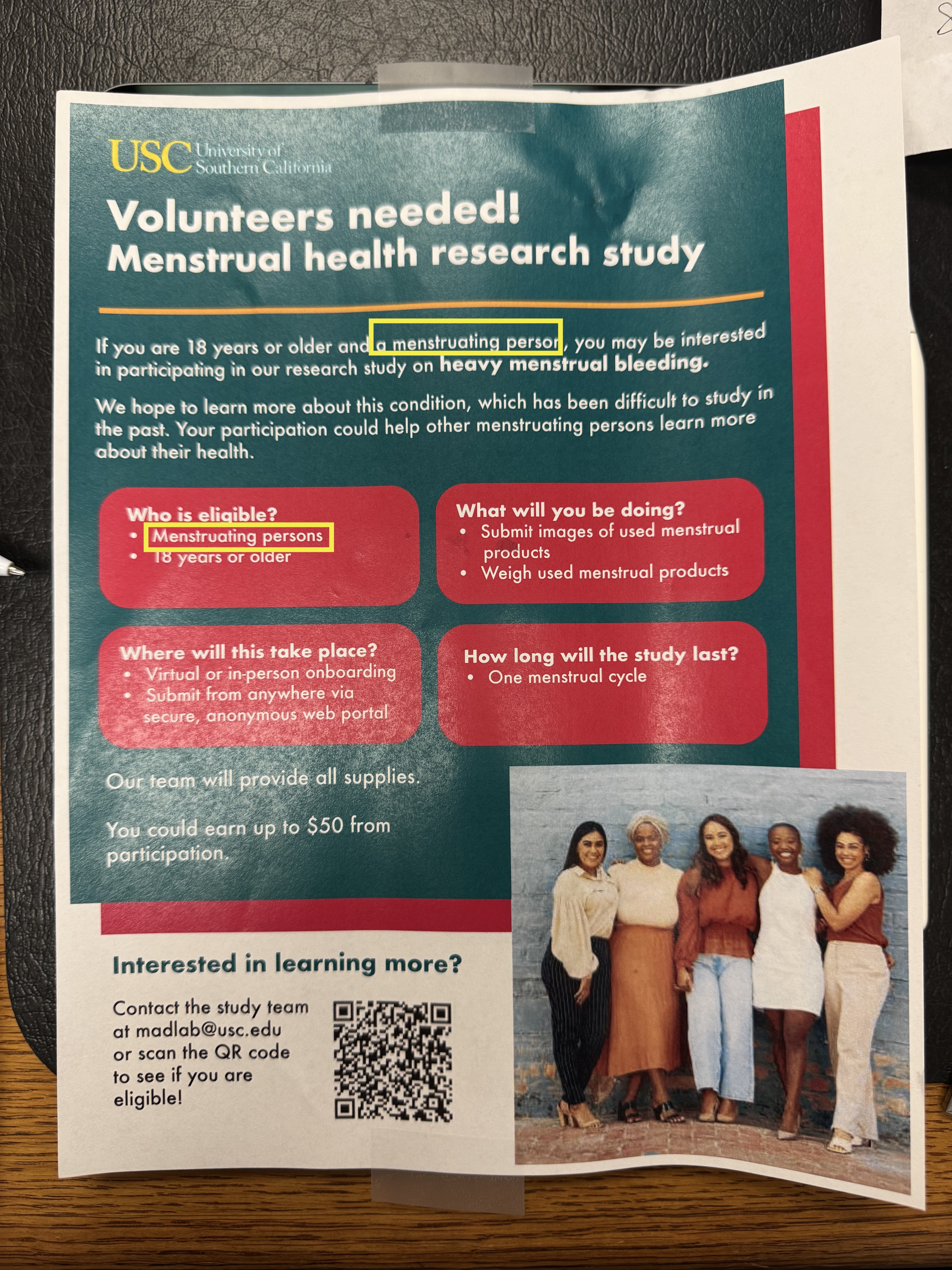
Finally, here’s a photo sent by reader Anna Krylov, who photographed this in the women’s restroom in the USC chemistry building (in both this case and the one above, the restrooms are not identified as “all gender’ but are specified as “women”.

Below women are referred to as “menstruating persons”, so the problem is not exactly the same as the one above (yellow boxes are mine). Still, referring to women as “menstruating persons” seems a bit rude to me, like referring to men as “ejaculating persons.” (Come to think of it, why don’t men’s rooms offer free condoms for “ejaculating persons”?)

But the main point is the avoidance at all costs of the word “woman” when it refers to “biological women” or “people recognized as women at birth”.  Refusing to accept trans women as biological women is about the worst mistake you can make in woke society, though some trans people don’t object to it.

Anna tells me that this poster isn’t limited to the women’s room, but it posted all over the campus, including in elevators.


UPDATE:  J. K. Rowling tweeted this today; it’s of some relevance:

A new song from a “rock god” celebrates the first birthday of Colossal Bioscience’s genetically tweaked grey wolves (aka “dire wolves”)

October 2, 2025 • 9:35 am

Several scientists, including me, pointed out that Colossal Bioscience’s “dire wolves” were nothing like the extinct animals for which they were named, but only grey wolves with a few gene edits taken from ancient sequenced dire-wolf genomes.

Here’s a succinct summary from Wikipedia of the mishigass about this canid: (see also here); I’ve removed the numbered references for ease of reading, but they’re in the article:

In April 2025, it was announced that Colossal Biosciences used cloning and gene-editing to birth three genetically modified wolf pups, six-month-old males Romulus and Remus and two-month-old female Khaleesi. In-house scientists made 20 edits to 14 key genes in gray wolf EPC cells to match those genes from the dire wolf in order to recreate distinctive dire wolf traits. Colossal stated that these minor genetic modifications effectively revive dire wolves as a species. No ancient dire wolf DNA was actually spliced into the gray wolf’s genome.

Independent experts disagreed with the Colossal Biosciences’ claim that these animals are revived dire wolves, asserting that they are “not a dire wolf under any definition of a species ever”.[128][129] The IUCN Species Survival Commission Canid Specialist Group officially declared that the three animals are neither dire wolves nor proxies of the dire wolves based on the IUCN SSC guiding principles on creating proxies of extinct species for conservation benefit. They commented that creating phenotypic proxies does not change the conservation status of an extinct species and may instead threaten the extant species such as gray wolves, and therefore concluded that the Colossal Biosciences’ project “does not contribute to conservation.”[130] Colossal Biosciences released a clarifying document Alignment of Colossal’s Dire Wolf De-Extinction Project with IUCN SSC Guiding Principles in response.

In May 2025, the company’s chief scientist Beth Shapiro stated that the three animals are “grey wolves with 20 edits” as purportedly stated by the company “from the very beginning”, acknowledging that it is impossible to bring back an extinct organism, or at least an organism “identical to a species that used to be alive”. She stated that the term “dire wolves” applied to the pups are a colloquialism. This was called a “major departure from what Colossal had said previously”.

One thing that people (including Wikipedia) do get wrong is how many edits in the gray wolf actually were derived from the dire wolf genome. It was 15, not 20. The rest were mutations known in domestic dogs and gray wolves that, thought Colossal Biosciences, would make the gray wolf resemble what they thought the dire wolf looked like.  As I wrote earlier:

There were indeed 20 edits in the gray wolf genome, made in 14 genes, but five of those edits weren’t taken from the ancient DNA of the dire wolf; they were taken from mutations in dogs and gray wolves that resembled what Colossal thought dire wolves looked like. (We’re still not sure.) And among those five dog/wolf mutants were the color alleles that turned the faux wolves white.

Remember, nobody’s seen a real dire wolf, only its skeleton.  The idea that they were white seems to me ludicrous, as no wolves are white. Colossal engineered light coat-color mutations into gray wolves because the dire wolves in the show Game of Thrones were white.  Scientists believe that the ancient dire solves were either gray or reddish brown; white ones would have stuck out like sore thumbs to predators—except in canids, like Arctic Foxes, that live in the snow.

But does the public know this? I doubt it. And if they knew it, would they care? I doubt that, too. People like Paris Hilton, who have invested big bucks into Colossal’s dubious “de-extinction” projects, don’t care: they just want something that Colossal calls a dire wolf, just as other investors want a tweaked, hairy Asian elephant that Colossal—if it ever produces one—would call a “de-extincted woolly mammoth.”   Although Colossal’s head scientist Beth Shapiro finally admitted that Colossal didn’t really made dire wolves, she later backtracked, saying this according to the May 11 NYT:

The resulting animals [the gene-edited wolves] were larger and fluffier and lighter in color than other gray wolves. The company’s chief science officer, Beth Shapiro, says this is enough to make them dire wolves, if you subscribe to the “morphological species concept,” which defines a species by its appearance. “Species concepts are human classification systems,” she told New Scientist, “and everybody can disagree and everyone can be right.”

Yep, according to Colossal, if you look even slightly like a dire wolf, you ARE a dire wolf. But this “capitalistic species concept” hasn’t fooled biologists except apparently those in the pay of Colossal. And it smacks of the woke-ish tendency to change the meaning of words if they buttress your well being (or your funding).

But I digress.  Yesterday I got a puff email from Colossal celebrating the first birthday of two of the edited gray wolves, and the company is STILL calling them dire wolves.  It even came with a special, albeit dreadful, birthday song. You must hear it! But first let’s see the email’s text, which I’ve pasted in below.

Note that they affirm that the two tweaked gray wolves were indeed “the first dire wolves to walk the Earth in over 10,000 years.”  That is of course dceply misleading, since the three creatures produced are not dire wolves like the ones from 10,000 years ago. They are modern grey wolves with a few genetic edits.  And if their story is a “banner of hope,” well, I find that misleading, too, since truly “de-extincting” a species has not only not been done, but will likely never be done. Nor is it something that many conservationists want to be done since the ancient animals would have to be put in an environment in which they didn’t evolve, and without the genes for behavior that allowed them to survive in ancient environments.

Here:


Here’s the song on YouTube. Be sure to listen to the “guitar crunching riffs, amazing solos, and sticky melodies” (what is a “sticky melody”?) produced by 80s “rock god” Stan Bush.  I don’t know Bush, or whether he really has the status of a “rock god,” but I’ll let Rick Beato pronounce on that.

Here’s the four-minuite birthday song!

Did you like that? I didn’t. The music is anodyne, with lame rhymes that remind me of a substandard version of “Eye of the Tiger.”  Plus, as far as I know, the newly created dire wolves are not allowed to hunt. And “nothing to stop you”?  They are kept in a fenced enclosure hidden from all but a few guests and, perhaps, investors. (You can see the fences that stop them in the video.) They will likely never be set free in any ecosystem except Colossal’s fenced enclosure.

And here’s the Instagram post with the same song:

Is civility a fantasy?

October 1, 2025 • 10:15 am

This big op-ed in yesterday’s NYT, which I read on the plane (on real paper!), is one of the worst op-eds from the Left I’ve ever seen in the Paper of Record.  It should be much better given Roxane Gay‘s training and background, which Wikipedia describes this way:

Roxane Gay (born October 15, 1974) is an American writer, professor, editor, and social commentator. Gay is the author of The New York Times best-selling essay collection Bad Feminist (2014), as well as the short story collection Ayiti (2011), the novel An Untamed State (2014), the short story collection Difficult Women (2017), and the memoir Hunger (2017).

Gay is the Gloria Steinem Endowed Chair in Media, Culture and Feminist Studies at Rutgers University.

Of course the headline attracted me because I always ask readers to be “civil”, and by that I simply mean address and dismantle arguments, not people. No name-calling. Be courteious, but by all means muster up as much passion as you want.

In this piece, which you can read by clicking below or finding it archived here, Gay makes the mistake of repeatedly conflating “civility” with “absence of passion” and, in fact, also with “agreeing with Republican/Trumpy policy.” In the end, she equates civility with bigotry!

I’ll first mention what I see as “civility” in a discussion, which is one of the definitions given in the Oxford English Dictionary:

Behaviour or speech appropriate to civil interactions; politeness, courtesy, consideration. In later use frequently with negative overtones: the minimum degree of courtesy required in a social situation; absence of rudeness.

“Absence of rudeness, courtesy, and politeness” pretty much sums up what I mean by “civility”, and what I like to see in the comments. Yes, we all slip sometimes, but being rude and impolite, all things equal, is not going to help you convince somebody else. And, by and large, the readers here are civil, and I’m proud of that.

I’m not sure why Roxane Gay thinks that civility isn’t a virtue, but she surely does. I’ll give some excerpts below.


Gay somehow thinks that civility is a fantasy because people who push “civility” are often Republicans now (i.e., fans of Charlie Kirk), or they are bigots and think that being civil justifies bigotry.  A few quotes:

Civility is the mode of engagement that is often demanded in political discourse; it is the price of admission to important political conversation, its adherents would have us believe; no civility, no service. But civility — this idea that there is a perfect, polite way to communicate about sociopolitical differences — is a fantasy.

The people who call for civility harbor the belief that we can contend with challenging ideas, and we can be open to changing our minds, and we can be well mannered even in the face of significant differences. For such an atmosphere to exist, we would have to forget everything that makes us who we are. We would have to believe, despite so much evidence to the contrary, that the world is a fair and just place. And we would have to have nothing at stake.

In the fantasy of civility, if we are polite about our disagreements, we are practicing politics the right way. If we are polite when we express bigotry, we are performing respectability for people whom we do not actually respect and who, in return, do not respect us. The performance is the only thing that matters.

Civility obsessives love a silver-tongued devil, wearing a nice suit, sporting a tidy haircut, while whispering sweet bigotries. The conservatives among them push for marginalized people to lose their rights and freedoms and, sometimes, even risk their lives. They will tolerate a protest but only if you congregate in an orderly fashion, for culturally sanctioned causes, and if you don’t raise your voice or express anger or overstay your welcome.

Gay might just as well have said “civility” is the same as “bigotry” or “a love of Trump.” But who among us conflates the words that way? And so she defines its opposite, “incivility,” as “being passionate about good liberal views. But you can be passionate without being rude. Why doesn’t she see that? (I’ll give a good example shortly):

Within this framework, incivility is refusing to surrender to hatred, refusing to smile politely at someone who doesn’t consider you their equal, refusing to carve away the seemingly unpalatable parts of yourself until there is nothing left. To be uncivil means pointing out hypocrisies and misinformation. It means accurately acknowledging what people have said, with ample documentation and holding them accountable for their words and deeds.

It means protesting injustice while recognizing that protest isn’t supposed to be demure or mindful. It means exercising one’s constitutionally protected right to free speech. It means believing in science and factual information and public education and other such heretical ideas. Civility is a cage that we’re supposed to lock ourselves into and then we are expected to be grateful for our incarceration.

And the notion of two groups— civil and not — is predicated on the idea that we’re all playing by the same rules, and we’re standing on equal footing, untroubled by the inequities and bigotries of the world. As I said, civility is a fantasy, because our political discourse never happens in a vacuum. It happens in the beautiful mess of the real world. It is naïve, at best, to believe civility is more important than who we are, what we stand for and how.

Politeness and courtesy are things that should be afforded anyone, even one’s enemies, though I grant it’s often hard to maintain such a demeanor these troubled times.  But what do you have to gain by being rude except blowing off steam? Or does Gay somehow construe “uncivil” in a new way? At any rate, for her, ‘incivility” equates to “protest against Trumpism”, and thus is a virtue:

Within this framework, incivility is refusing to surrender to hatred, refusing to smile politely at someone who doesn’t consider you their equal, refusing to carve away the seemingly unpalatable parts of yourself until there is nothing left. To be uncivil means pointing out hypocrisies and misinformation. It means accurately acknowledging what people have said, with ample documentation and holding them accountable for their words and deeds.

It means protesting injustice while recognizing that protest isn’t supposed to be demure or mindful. It means exercising one’s constitutionally protected right to free speech. It means believing in science and factual information and public education and other such heretical ideas. Civility is a cage that we’re supposed to lock ourselves into and then we are expected to be grateful for our incarceration.

And it’s clear her opponent is not civility, but Republicans and Trump. That’s fine with me, but why couch it all in “civility” terms?

Whatever political norms may have once existed have been shattered time and time again since the beginning of the second Trump presidency. In this new abnormal, we can only gape, with incredulity, at the many ways in which our democracy is being torn asunder — the undue influence of billionaires, the dismantling of vital government programs, the relentless pursuit of undocumented immigrants and ensuing incarceration in inhumane facilities and an ever-growing list of other, uniquely American horrors. But to speak these truths is uncivil, impolite, un-American. To speak these truths means you are one of them, outside the protection of the leaders of this country.

Well, I don’t speaking these truths means that you’re uncivil or impolite, for you can speak them with passion but also without name-calling, calls for death, and so on.  Gay adds other insupportable statement, at least according to the definition of “civility” I see around me and try to employ here:

And the notion of two groups— civil and not — is predicated on the idea that we’re all playing by the same rules, and we’re standing on equal footing, untroubled by the inequities and bigotries of the world. As I said, civility is a fantasy, because our political discourse never happens in a vacuum. It happens in the beautiful mess of the real world. It is naïve, at best, to believe civility is more important than who we are, what we stand for and how.

She even equates incivility with resistance to the Jim Crow south by protestors in the Sixties.  What she means, though, is not “civility” but ‘nonviolence,” something completely different.  The lunch counter sit-ins, in which black had ketchup and coffee dumped on their heads, were examples of both civility on the part of the protestors (and incivility on the part of white bigots), but also of nonviolence and moral passion.  It’s a mystery to me why Gay bangs on about the Civil Rights movement as some sort of evidence against the efficacy of civility. In fact, I think that nonviolence and civility go hand and hand, and, at that time, was a good strategy: one that ultimately gained black people their rights. But Gay emits this nonsense:

Nonviolence didn’t mean passivity. It was a strategy, intended to reveal the brutal contrast between the tactics of the oppressor and the experiences of the oppressed. Nonviolent, civil protest was met with rank incivility, which is to say that the hypocritical way in which we presently understand civility and incivility is nothing new.

Calling for civility is about exerting power. It is a way of reminding the powerless that they exist at the will of those in power and should act accordingly. It is a demand for control.

Civility is wielded as a cudgel to further clarify the differences between “us” and “them.” It is the demand of people with thin skin who don’t want their delicate egos and impoverished ideas challenged. And it is a tool of fearful leaders, clinging to power with desperate, sweaty hands, thrilled at the ways they are forcing people, corporations and even other nations to bend to their will but terrified at what will happen when it all slips away.

This is balderdash. Maybe conservatives calling for people to lionize Charlie Kirk, and extol his “civility”, are trying to wield poer, but we’ve seen plenty of argument about how, while Kirk may have been civil, that could have been a schtick or a ruse. But what kind of ruse? Perhaps he wouldn’t change his mind about much, but he would always be polite.  Was that a bad thing?

In the end, I get the feeling that the whole column stems from Gay being somewhat unhinged about Trump—unhinged to the point where she writes a whole essay to argue that a word that means one thing actually means another. I have bolded the first sentence as it makes no sense to me:

As a writer, as a person, I do not know how to live and write and thrive in a world where working for decency and fairness and equity can be seen as incivility, where it can result in threats on my life, or those of my family; where I worry about a rogue Supreme Court trying to legally nullify my marriage; where I worry about my neighbors and community who are vulnerable to unchecked power. I worry and I worry and I worry and I feel helpless and angry and tired but also recognize that doing nothing is not an acceptable choice.

Every single day I read the news, and I can hardly process it all. I keep wondering when we will reach a cultural breaking point, when finally the Trump administration will go far enough to shove us out of the comforts of our day-to-day lives. I look at our elected leaders, especially the Democratic ones, and hardly recognize them. I’ve written, many times, about how no one is coming to save us, but I never imagined that our leaders would agree, that they would comply with so much in advance, that they would rely as a political strategy more on embracing conservative policies than on standing up for progressive ones.

Of course Gay is a “progressive,” which is fine, but has she been called “uncivil”? When she gets threats on her life, do they say she should be killed because she’s uncivil? Who ever said she should do nothing about the politics that upset her because doing something is “uncivil.” (Note that she seems to be angry at the Democrats who aren’t opposing Trump strongly enough. That anger is perhaps what will make her reach the breaking point.)

I surely agree with Gay’s politics far more than I agree with Trump’s.  And I admire those who, in the face of a country going downhill fast, are working hard to stop the slide, futile though their actions may be. But you don’t stop the slide by simply changing the meaning or words.  Indeed, semantic change seems to be one way that “progressives” think they can win political victories. It is one of the main tactics of wokeness (three examples: “violence”, “woman”, and “equity”, with the latter once meaning “fairness” or “impartiality”).

For a living example of how civility can go hand in hand with passion, and even change people’s minds, I give you Natasha Hausdorff, legal director of the UK Lawyers for Israel. Below she’s being rudely interrogated  about Israel by members of the House of Commons. She’s deeply passionate about Israel, but you will see or hear no incivility in her words or demeanor.  You don’t have to listen to the whole thing, but pick almost any ten-minute segment to see what I mean.  You may not agree with Hausdorff, but you have to admit that she’s civil in the face of hostile opinion. She is what Roxane Gay thinks of as a human oxymoron.