Readers’ wildlife photos

August 1, 2024 • 8:15 am

Today we have a collection of photos from several readers. All of their captions and IDs are indented, and you can click on the photos to enlarge them.

First, three from Martin Riddle:

I take lots of nature photos around the campus of Brooksby Village, a retirement community in Peabody,Ma.

Ruby-Throated Hummingbird  (Archilochus colubris):

Hummingbird hawk-moth (Macroglossum stellatarum). [JAC: this is a great example of convergent evolution when taken together with hummingbirds]

American Painted Lady butterfly (Vanessa virginiensis):

From Norm Gilinsky:

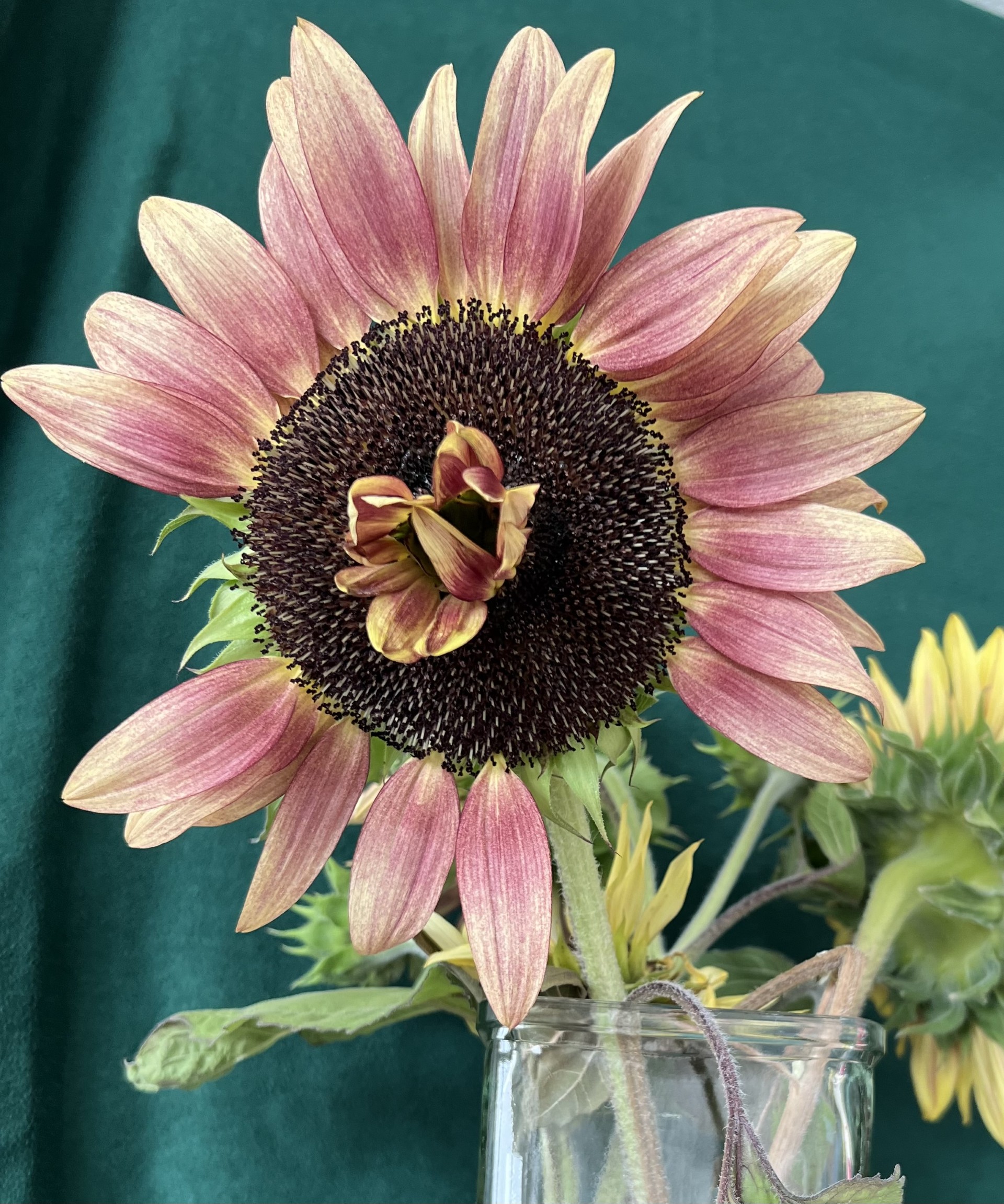
This is perhaps more of a conversation starter than an actual wildlife photo, but we found this seemingly unique sunflower in a field of sunflowers. This one is from a farm in Woodinville, Washington. It’s a cultivar of the Common Sunflower (Helianthus annuus).

What’s up with that? It’s a well-formed flower within the main flower. Since sunflowers are in the Asteraceae (Formerly the Compositae), it’s a composite within a composite. Strange and interesting:

From Simon Badderley:

Lin was walking down Democracy Street in our village when she saw this on the step of a derelict house in the middle of Ano Korakiana, Corfu.It’s a Giant Peacock Moth (Saturnia pyri), the largest moth in Europe, having a wingspan close to five and a half inches (140mm). It’s often thought to be a bat when flying at night. This is the female without the male’s feather-like antennae. The adult moth does not feed, but the caterpillar feeds on various deciduous trees including fruit trees and is regarded as a nuisance by fruit tree owners. These moths are active from March to late June. This one was almost inert, willing to be touched.

From Bryan Lepore:

 A photo of a green burgundy stink bugWikipedia says it’s Banasa dimidiata, the green burgundy stink bug, is a species of stink bug in the family Pentatomidae.”  Photo details: Taken in mid-Massachusetts: Middlesex county, July, 2024 – i.e. just a couple weeks ago. Mid-day, sunny, dry… on the recycle bin lid. iPhone 13 mini; enhanced photo:

And a lovely mountain from Larry Zelenak:

Not a wildlife photo, but maybe you can use it anyway, perhaps in a new series of best views from commercial plane flights.  This is Mt. Rainier on the morning of July 9 from an Alaska Airlines flight from SEA to RDU, taken with an older iPhone.

Readers’ wildlife photos

April 23, 2024 • 8:15 am

If you got ’em, send ’em in, please!

Today we have photos by Dean Graetz of Australia. His captions are indented, and you can enlarge his photos by clicking on them. Aussie backyards have some cool stuff, especially the birds!

A Southern Hemisphere Backyard

Here is a sample of the inhabitants of our backyard in Canberra, Australia.  Mid-March, at latitude 35°S, is a time of rapidly shortening daylength, and of harvesting the fruits of a coolish Summer.  Our non-native garden shrubs (Buddleia davidii, aka ‘Butterfly Bush’) are popular attracting this new and hard to identify, visitor.  We think it is a ‘Brown’, or Heteronympha species:

A large butterfly with a 10 cm wingspan, this female Orchard Swallowtail (Papilio aegeus), is always eye-catching, and always harassed by ever-present Cabbage White butterflies:

The common Meadow Argus (Junonia villida) which, after enjoying a nectar feed, often unhurriedly suns itself on our warm garden pathways, adding colour in two places:

The also common, and charmingly named, an Australian Painted Lady (Vanessa kershawi) choosing feed on a desert wildflower (Xerochrysum sp.) which we also grow as another inducement for butterflies.  All the butterfly photos were shot from a 3-5m distance with zoom lenses:

A pair of aged adult Crimson Rosellas (Platycercus elegans) feeding on our neighbour’s tall shrub.  These parrots are everyday sightings in Canberra gardens that are not far from surrounding native woodlands where they breed as hollow nesters:

A juvenile Crimson Rosella in the process of changing its dull green plumage to the bright reds and blues of the sexually mature adult.  The coloured feather contrasting patches are so sharp that these birds enjoy the common name of ‘Patchworks’:

An adult Satin Bowerbird (Ptilonorhyncus violaceus), sex not obvious, having enjoyed a vigorous bath now eyeing the photographer.  At age 7 years, a male bird will change from this khaki plumage to a brilliant blue-black glossy version, build a bower in a grassy woodland, decorate it with blue objects (same colour as its eyes), such as flowers, clothes pegs, bottle tops.  The purpose is to attract, court and mate with numerous females.  Hard to believe?  Go here to watch:

A juvenile Kookaburra (Dacelo novaeguineae) now regularly arrives and sits patiently surveying our back yard for any living food items, such as lizards, mice, or snakes.  These birds readily habituate to hand feeding by the lonely to become a mendicant friend for life:

An adult male Australian King Parrot (Alisterus scapularis) enjoying the last of an unripe pomegranate in a neighbour’s tree.  The dark lower beak is staining.  These are frequent visitors to Canberra at this time of the year.  Being predominantly fruit eaters – their favourite is cherries – has required nearby fruit growers to cover their entire orchards with parrot (and hail) proof tents:

Close by, and part of a family flock, was this juvenile female King-Parrot, elegantly holding an unripe olive with toe and beak.  They skillfully rotate each olive with their blunt tongue to flense off all the edible flesh.  To us, hard green olives are unappealing, but this female ate steadily for about 15 minutes before flying off with a noticeably full crop:

Readers’ wildlife photos

April 11, 2024 • 8:15 am

I am weary of begging readers to send in wildlife photos, as I have about three days left.  If nobody sends any in, we’ll go to sporadic presentations and then. . . . nothing.  Then the Caturday felids will go and then. . . the void.

But today we have a presentation by UC Davis ecologist Susan Harrison, who visited a wildflower farm.  Here captions and IDs are indented, and you can enlarge the photos by clicking on them. There are two bird pictures at the end.

Visit to a Wildflower Farm

To restore degraded land and improve it for wildlife, there have to be farms that provide native plant seeds in large amounts. Native seed farming is a highly skilled enterprise in which source material is often gathered from the wild, cultivation must be done with care to maintain adaptive genetic traits, and all techniques from germinating through harvesting and storage must be tailored for numerous finicky plant species.  It’s a tough business to succeed in, and there’s a great need for more of it.

Hedgerow Farms in Winters, California is a much-admired member of Northern California’s native seed industry. Their chief scientist, a recent graduate of our Ecology program at UC Davis, invited me to attend their annual Field Day in April 2024.  It was a fun and enlightening experience.

Touring the fields on a hay bale ride:

Goldfields, Lasthenia californica:

Desert Poppies, Eschscholzia californica mexicana (orange field):

Cream Cups, Platystemon californica, with a smattering of Succulent Lupine, Lupinus succulentus, that was grown in the same field last year:

Blue-eyed Grass, Sisyrinchium bellum, not a grass but a member of the iris family:

The wildflowers (or “forbs”) are beautiful, but grasses are grown and used in much larger quantities.

Meadow Barley (Hordeum brachyantherum):

Purple Needlegrass, Stipa pulchra, the most popular species in Californian grassland restoration, intermixed with leftover California Phacelia, Phacelia californica:

Sedges, Carex species, essential for restoring streambanks:

Growing native seeds requires a great deal of both manual labor and creatively MacGyvered farm machinery.

Hoeing a field of Woolly Sunflower (Eriophyllum lanatum):

Seed cleaning apparatus, in which field-harvested material enters from the bins on the right of this photo, passes through a series of threshing and sifting machines adjusted differently for each plant species, and emerges as bags of nearly-pure seed:

Seed samples on display:

Native plants are also used for the conservation practices with which enlightened farmers retain their soils and support wildlife.  Tailwater ponds and hedgerows are two such practices that we saw on the tour.

Tailwater ponds are small wetlands that trap irrigation runoff and allow sediments to be recycled onto the fields:

Hedgerows are roadside plantings that provide food and cover for wildlife, and may stabilize canals and ditches:

A hedgerow of native shrubs (yellow: Flannelbush, Fremontodendron californcum; pink: Western Redbud, Cercis occidentalis; blue: California-lilac, Ceanothus); note the more typical, barren roadside in the foreground:


Okay, now for the animals!   Among this farm’s many community partners is the falconry club, who brought their beautiful birds to the field day. From left to right are a Peregrine Falcon (Falco peregrinus), female Harris’s Hawk (Parabuteo unicinctus), two Merlins (Falco columbarius), and male Harris’s Hawk:

Several birds and people in this photo are falconry-based pest abatement professionals. The most famous pest-abating bird is Rufus the Hawk, a Harris’s Hawk who keeps pigeons off the courts at Wimbledon.

Harris’s Hawk closeup:

From Allaboutbirds on Harris’s Hawk: “The most social of North American raptors, these birds cooperate at nests and hunt together as a team. When hunting, a group of hawks surround their prey, flush it for another to catch, or take turns chasing it. This hawk’s social nature and relative ease with humans has made it popular among falconers and in education programs.”

Readers’ wildlife photos

April 2, 2024 • 8:15 am

Today’s wildlife photos are by Rodney Graetz from Australia. His captions and IDs are indented, and you can enlarge his photos by clicking on them.

Mornings by a Wetland

An adult Purple Swamp Hen (Porphyrio porphyrio) using its foot to hold back the long grass and let its two chicks begin the day.  Their grassy cave was not a nest, just an overnight camp.  Likely about 2+ weeks old, the chicks will now be supervised to forage along the water’s edge, but not out on it.  Adult Swamp Hens can swim, but pin-feathered chicks cannot.

Cattle in peak condition are described by cattlemen as ‘fat and shiny’.  We would describe this adult Dusky Moorhen (Gallinula tenebrosa) as ‘fat and shiny’.  Bright-eyed, bright coloured, with chest plumage freshly groomed, standing on a small raft of Cumbungi (Typha sp.), surrounded by wetland and grassland full of insects.  Its world is looking good.

A wren in non-breeding plumage: most likely a female Superb Fairy-wren (Malurus cyaneus).  Unusual to have stayed perched long enough to be photographed.  Their typical foraging and socialising activities are best described as feverish: one of continuous, high speed, flitting movement.

An adult Black Swan (Cygnus atratus) sublimely cruising offshore.  It is a female, judging by the neck length and the mass of curled ‘bustle’ feathers on its rump.  So far, this year, no (creamy white) cygnets have been sighted.

A Straw-necked Ibis (Threskiornis spinicollis) with a cape of iridescent feathers captured with bunched toes doing a wing stretch.  The ‘straw’ chest display involves specialised coloured and shaped feathers.  If you look closely, the deep ‘Saturday Night Fever’ vee-shaped gap in them indicates it is a male bird.  Spectacular formation fliers, they are great nomads.

Aware that the bird photo encyclopedist, John Avise, recently posted his photos of Australasian Darters (Anhinga novaehollandiae), we add a complementary one of a adult female stretching its surprisingly large gape, given its needle-like beak.  One can imagine the size of the fish that could be swallowed.

This Great Cormorant (Phalacrocorax carbo) is also ‘fat and shiny’ and in the breeding plumage of the bright yellow beak surrounds, and a barely visible crest low on the head and neck.  It is Australia’s largest cormorant species with a wingspan of 80+ cm (30+ inches).  It has a small feather stuck on its beak from an interrupted grooming.

We have posted this photo of an Australian Wood Duck (Chenonetta jubata) family before.  We repeat it here to contrast the next two puzzling photos.  The takeaway impression here is the close supervision of the 10 ducklings by both parents, especially the ever alert male: behaviour that makes this species a very successful breeder.  With this in mind, go to the next photo.

A cluster of 11 (Wood Duck) ducklings, aged 4+ weeks, instinctively huddled together for warmth and security.  Missing are any adult parents: a critical absence that we have never seen before.  These ducklings look ragged and stressed, so our conclusion is they have been orphaned.  But how?  All possible predators of just the adult birds – people, fox, native water rat – are implausible, plus there were no signs of struggle, feathers, etc.  We can’t accept that they were just deserted.

The cluster spontaneously but listlessly moved out onto the water to sit there, seemingly bewildered, and obviously lethargic.  Where now is safety at night: on land or on water?  On land would be most comfortable but unsafe, and ducks are reputed to never sleep on water.  Their future?  We’ve unsuccessfully searched for them since.  A mystery, still.

From Jerry: The abandoned ducklings broke my heart.

Readers’ wildlife photos

February 5, 2024 • 8:15 am

Today we have the second part of a two-part post on Australian trees, the eucalypts, contributed by Reader Dean Graetz. (Part 1 is here.) Dean’s captions are indented, and you can enlarge the photos by clicking on them.

The Trees that identify Australia

Australia is one of many countries that include plants as part of their identity.  The national floral emblem is the Golden Wattle (Acacia pycnantha), one of more than 1000 Acacia species found on the continent.  The two colours of the plant represent the essence of the continent.  The golden flowers represent its beaches, mineral wealth, grain, and wool harvests.  The green of the (leathery) leaves imitates the continent’s forests and productive landscapes.

Sparsely located in the arid heart of the continent is this visually striking tree.  Commonly known as the Ghost Gum, it was recently renamed with an appropriate Aboriginal Australian species word (Corymbia aparrerinja).  A much more impressive image is here.

Similarly, sparsely located in the drier areas of the continent is this tree.  Evocatively named Bloodwood (Corymbia opaca), there appears no external colouring which supports that name.\

However, if you manage to find a seeping wound, then the reason for its name will be obvious, the colour of the exuding sap (Kino) is a vivid.

When sedentary farmers and graziers were added to Australia’s population, substantial areas of eucalypt woodland, about 13% of the continent, were transformed.  Trees were either clear-felled and burnt for cropping, or just thinned for pastures.  This satellite image shows a large area of mallee, a eucalypt woodland type (dark), cleared in part for growing (wheat) on the bright sandy soil.  The sharp boundary on the LHS is a state border.  Multiple millions of eucalypt trees have been removed here and elsewhere for the reality of it is ‘Either Them or Us’.

Snow Gum woodlands lie on the snow line and are episodically burnt by lightning-induced bushfires, as here.  The many tall stems of each tree have been killed and have bleached white in the high UV environment.  However, the trees are not dead.  Each tree had developed a lignotuber, and from this a ring of new shoots have sprouted and will replace the tree’s burned canopy in about 5 years, or so.  Even so, the sea of bone white, dead stems is eye catching.

An ephemeral dry-country watercourse with three tall River Red Gums (Eucalyptus camaldulensis), the most wide spread Eucalypt, from lining the banks of permanent rivers to tapping the subsurface water of this small dry creek.  Never visually elegant or symmetrical, these trees, with their scrabbling roots and scarred stems, suggest one word: Survivor.

As does this extraordinarily large River Red Gum, possibly the largest and oldest known.  Residing in a cleared paddock, it is still healthily growing and supporting a large canopy.  Eucalypts do not annual ring, so its age cannot be measured, just guessed at 300+ years.  The gap in the trunk was likely generated centuries ago by a small fire lit close to it sheltering from the wind.  Repeated often enough to burn through the sapwood and into the heartwood, thereafter the weather and dry rot eventually hollowed the stem but left the sapwood continuing to thrive today.

All Eucalypts produce very hard, dense wood, which when dried after death, is difficult to saw or cut.  A few species are known ‘branch droppers’: large living branches just drop off, for no obvious reason.  Such species are also known as ‘Widow Makers’ for the fatalities of sleepers and sitters under the canopy.  The River Red Gum – see above – is well-known Widow Maker’.  However, branch shedding usually leaves large openings into the stem to be eventually hollowed out and occupied by parrots, such as this Sulphur-Crested Cockatoo (Cacatua galerita).  Because all Australian parrot species are hollow nesters, dead and holed Eucalypts are much sought after trees.

For an Australian away from the built environment, the visual presence of familiar gum trees reinforces your identity: you are home.  There is another personal experience that builds on this.  And that is the smell of burning gum leaves.  In the past, and still today, whenever a small fire was lit ‘to boil the billy’, the fragrance of the fire was associated with friendship, convivial tea-drinking, and conversation.  Dried gum leaves were the perfect one-match fire starter.  The smell of burning gum leaves is pleasant, readily recognised, and soon becomes a deeply held memory.

“The families back home heard and understood this and sent gum leaves with their letters to those at the front.  Nurses wore gum leaves pinned to their capes.  Soldiers sometimes burned the leaves in small piles at the front line so the smell would drift along the trenches and others could be reminded of their country’s distinctive smell.

The smell of Eucalyptus is the smell of home.”

Readers’ wildlife photos

January 4, 2024 • 9:15 am

I overslept tonight, and may be coming down with the virus that’s going around. Posts will be fewer today, and late. But we still have readers’ wildlife, thanks to kind readers. (Send in your photos!)

Today’s batch was sent reader Rodney Graetz, but there are two authors.  The captions and IDs provided are indented, and you can enlarge the photos by clicking on them.

Australian Wildlife photos for WEIT January 2024

M. E. & R. D. Graetz

It is mid-Summer here in the Southern Hemisphere, and the natural world is bubbling with The Game of Life: If you win, you stay in the game.  Here a Noisy Miner (Manorina melanocephala), a very aggressive honeyeater, searches for the nectar of a flowering ‘Gum’ tree in our backyard.  Gum trees, aka Eucalypts, are Australia’s iconic tree with about 800-900 species, all of them evergreen with individual leaves living for 2-3 years.  When Gum trees decide to flower, the colours and nectar are very obvious:

In my neighbour’s yard another tree has burst into spectacular flower also dripping with nectar.  This species, erroneously named ‘Silky Oak’, is Grevillea robusta, a widely admired native tree cultivated for its unique cabinet-making wood, and for its spectacular flowering and providing so much nectar that birds noisily dispute access:

The first honeyeater on the scene is the Noisy Friarbird (Philemon corniculatus), so named by it featherless ‘bald’ head and for its continuous maniacal calling:

As well as the numerous honeyeater species, the common, large seed-eating Sulphur-crested Cockatoos (Cacatua galerita)  join in the nectar feasting.  There’s no delicate probing with slender beaks; they just bite off a whole twig, chew one or two flowers, then drop the twig and bite off another:

Back on ground level, several species of butterfly search ceaselessly for nectar during the warmest daylight hours.  What species they all are, and where they disappear to when the temperature drops remains a work in progress:

Again, in a neighbour’s yard, a male Australian King Parrot, (Alisterus scapularis) in exquisite breeding plumage, munches on the thin fleshy coating of seeds.  His permanent colouring is a very effective ‘look at me’ strategy:

We (happily) leave our lawn un-mowed to provide insects and worms for ground-feeding birds such as this female Magpie-Lark (Grallina cyanoleuca), probably the most widely distributed Australian bird.  Always in industrious pairs, apparently mated for life, they are yearlong visitors to our backyard:

This year, the resident Magpie-Lark pair are attempting to breed.  This is their nest in a street tree about 10 metres above ground.  The tail of a sitting bird is visible.  The substantial nest is a mud and grass bowl that was built beak-by-beak loads of wet soil and lawn clippings from our backyard.  So far, it has withstood several heavy storm rains:

A lurking threat to the nesting Magpie-Larks.  This long-tailed, deep satin-blue bird is an Australian Koel (Eudynamys cyanocephalus), a cuckoo-related, nest parasite.  It’s a migratory bird that appears when favoured susceptible species of birds are nesting.  Its mating call, regarded as Australia’s most annoying bird call, is loud and repetitive.  Once mated, the female finds a susceptible nest in which to lay one egg, which, on hatching, removes or kills the existing host bird’s nestlings.  The Magpie-Lark nest is one known to be susceptible to the Koel:

The ‘Look at Me’ season, when males display to attract a mate, began in Winter (July) with the ducks and still continues in mid-Summer with land birds.  Here a male Maned Wood Duck (Chenonetta jubata) performs for a seemingly uninterested female.  Considered choice is imperative when mating for life, as this species is thought to do:

Some of Australia’s smallest birds are the Wrens, and this is a male Superb Fairy-Wren (Malurus cyaneus) growing his breeding plumage.  Though small, they are hyperactive in hunting for insect prey, and, as many post-graduate research students have found, they are hyperactive in their breeding behaviour.  It’s always a joy to (briefly) spot their flash of colour deep in the foliage:

Some birds’ breeding signage is subdued but unmistakable.  With the Australasian Grebe (Tachybaptus novaehollandiae), a small bird by Grebe standards, both male and female temporarily develop coloured cheek-neck patches for their combined ‘Look at Me’:

The neck flexibility of an Australasian Darter is enviable.  We thought this young male (Anhinga novaehollandiae) was wounded until I realised it was vigorously rubbing its head on its oil-producing ‘preen’ gland at the base of its tail feathers.  Watching a little longer, it was not ‘Look at Me’ breeding behaviour, just ‘Looking Good’, everyday oiling of feathers:

The first job after successful breeding is looking after the offspring.  Two Dusky Moorhen adults are encouraging their reluctant chick to join them in the water.  The adult birds always appear polished and groomed.  Their chick has yet a lot to learn:

Joining birds in the trees are these temporary mammalian visitors.  In November, about 5000 Grey-headed Flying-foxes (Pteropus poliocephalus) arrive from the north-coast to restart their summer occupation of a ‘camp’ near the city centre.  Departing around April, they are noticeable by sight, smell, and sound, but most people remain unaware of their presence:

This species is Australia’s largest bat: a megabat with a wingspan of almost a metre.  Nocturnal nectar and fruit feeders, by day they roost hanging by one or two feet, using their wings to shroud their eyes, and sleep – briefly – because this species is inherently quarrelsome.  Facing away from the sun (and photographer), the orange-red hair collar and the pointed ears are obvious, which contribute to their ‘fox’ naming:

Frontal views reveal the grey-haired head and chest, along with the large eyes and snout that is the other component of the ‘fox’ naming.  Their looks are appealing, but current understanding is that any contact, such as with wounded animals, is hazardous because of the viruses they are likely carrying.  However, it is also known that Aboriginal Australians ate these and other bat species:

By chance, one of our images revealed this ‘Pup’: a young, chubby, and hairless bat.  By size, it is unlikely that it was born in Canberra.  Rather, it was carried here, clinging to its mother’s chest.  It is known that Pups of about this size remain when the mother flies out to feed at night:

Readers’ wildlife photos

October 25, 2023 • 8:15 am

As we near the end of my photograph queue, we have a contribution from ecologist Susan Harrison of the University of California at Davis.  Her captions and narrative are indented, and you can enlarge the photos by clicking on them.

Birds on Non-Native (Alien, Invasive, Exotic….) Plants

Non-native species, usually ones introduced from other continents, are often called one of the worst threats to biodiversity, along with habitat loss, overexploitation, and climate change. We all know of terrible examples – kudzu, “the plant that ate the South”;  mammal-swallowing Burmese pythons in the Everglades; the grasses that fueled the Maui fires. There’s a long list of ecologically devastating non-native species (here are 100 of the worst ).

Some conservationists argue that we should make peace with many non-native species and appreciate any benefits conferred by them. Other commentators go further and charge that opposition to non-native species is nothing but xenophobia (a hotly contested viewpoint).  My one concession to this debate has been to shift to more neutral words (introduced, non-native) instead of potentially loaded ones (alien, exotic, invasive).

Birdwatching has sneakily softened my negativity toward non-native plants, however. One recent instance of this involved Sage Thrashers (Oreoscoptes montanus), a jauntily striped, melodious resident  of the Great Basin sagebrush country that has been scarce and evasive in my experience.  What a surprise it was to see veritable flocks of Sage Thrashers at Malheur National Wildlife Refuge, preparing for fall migration by gorging on berries of Russian Olive (Elaeagnus angustifolia) — one of the most hated non-native plants in U.S. deserts.  In a five-day period, I never saw these birds eating anything else.

Here are some Sage Thrashers eating Russian Olives:

You can readily get Californians arguing over “the great Eucalyptus debate” – whether these towering and widely-planted Australian trees should be protected or eradicated. Our riparian bird hotspots in Davis, California have Eucalyptus (mostly River Red Gum, Eucalyptus camaldulensis) mixed in with the native Valley Oaks (Quercus lobata), California Walnut (Juglans californica) and other trees.   It’s been a surprise to me how much native birds use Eucalyptus.

Black-headed Grosbeaks (Pheucticus melanocephalus), Bullock’s Orioles (Icterus bullocki), Western Tanagers (Piranga ludoviciana), and various warblers feed on lerp psyllids (Glycaspis brimblecombei), sap-sucking insects that arrived here from Australia in 1998.  Red-breasted Sapsuckers (Sphyrapicus ruber) skip the lerp psyllids and feed directly on Eucalyptus sap after drilling into the trunk.  The height of Eucalyptus trees makes them favored nest sites for raptors such as Great Horned Owls (Bubo virginianus).

Black-Headed Grosbeak on Eucalpytus:

Red-breasted Sapsucker on Eucalpytus:

Eucalyptus with lerp psyllids on leaves and sapsucker damage on trunk:

Great Horned Owl nest with nestling:

Here are birds using some other much-despised non-native plants at the local creek:

Lesser Goldfinch (Spinus psaltria) on Yellow Star-Thistle (Centaurea solstitialis):

House Finches (Haemorhous mexicanus) on Salt-Cedar or Tamarisk (Tamarix chinensis):

Savanna Sparrow (Passerculus sandwichensis) on Black Mustard (Brassica nigra):

At home, while I’ll continue dutifully planting the yard with natives, I confess to sometimes envying the abundance of birds on the neighbors’ ornamental plants.

Cedar Waxwings (Bombycillus cedrorum) on Cotoneaster (Cotoneaster):

Western Tanagers on Pear (Pyrus):