
Readers’ wildlife photos

November 27, 2025 • 8:15 am

Today on Thanksgiving, we have pictures of MOOSE from Ephraim Heller. Ephraim’s captions are indented, and you can enlarge the photos by clicking on them.

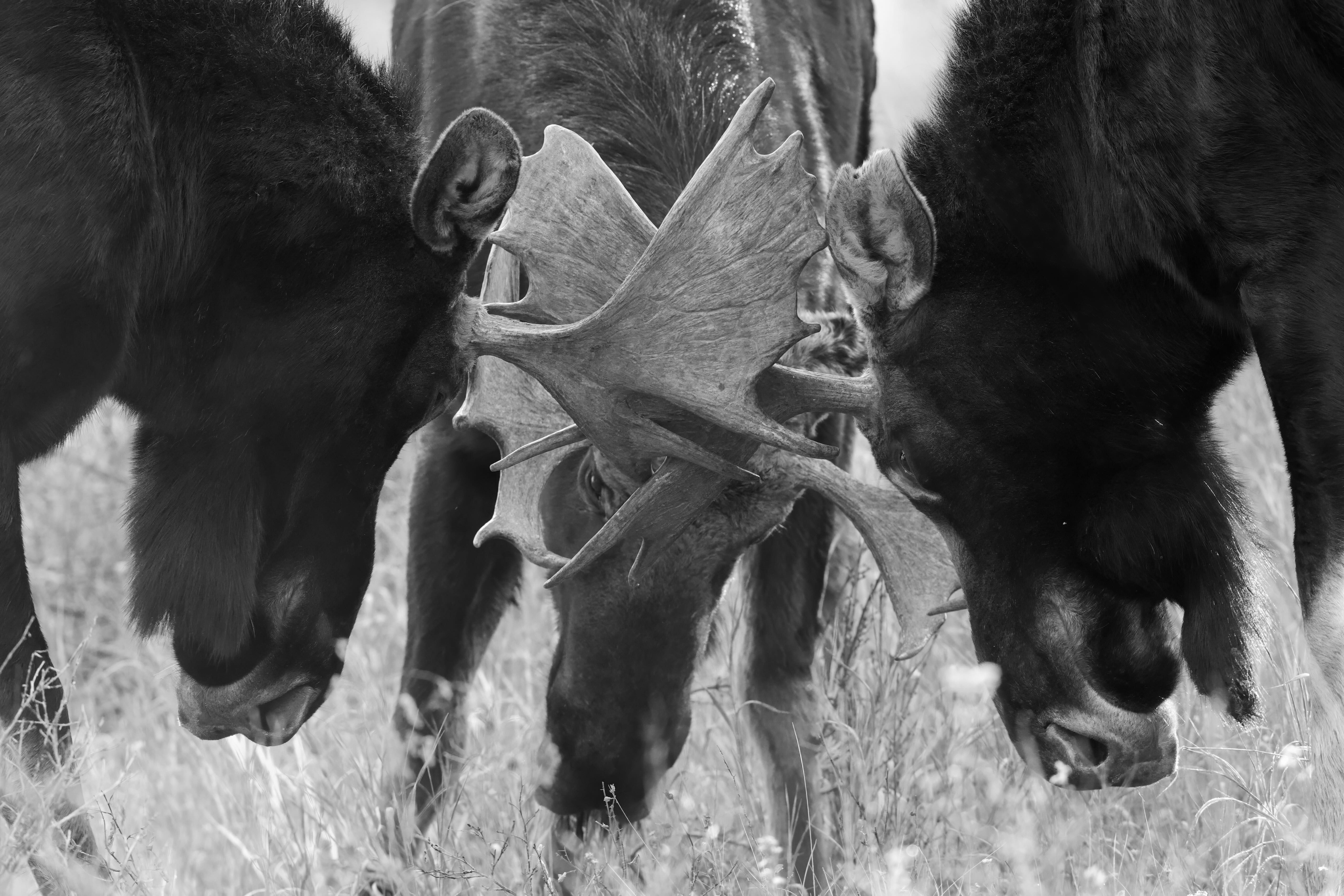
On a chilly early morning in late October I came across a group of seven bull moose [Alces alces] in Grand Teton National Park, not far from my home. It was late in the rut and they were busy sparring with each other while I watched.
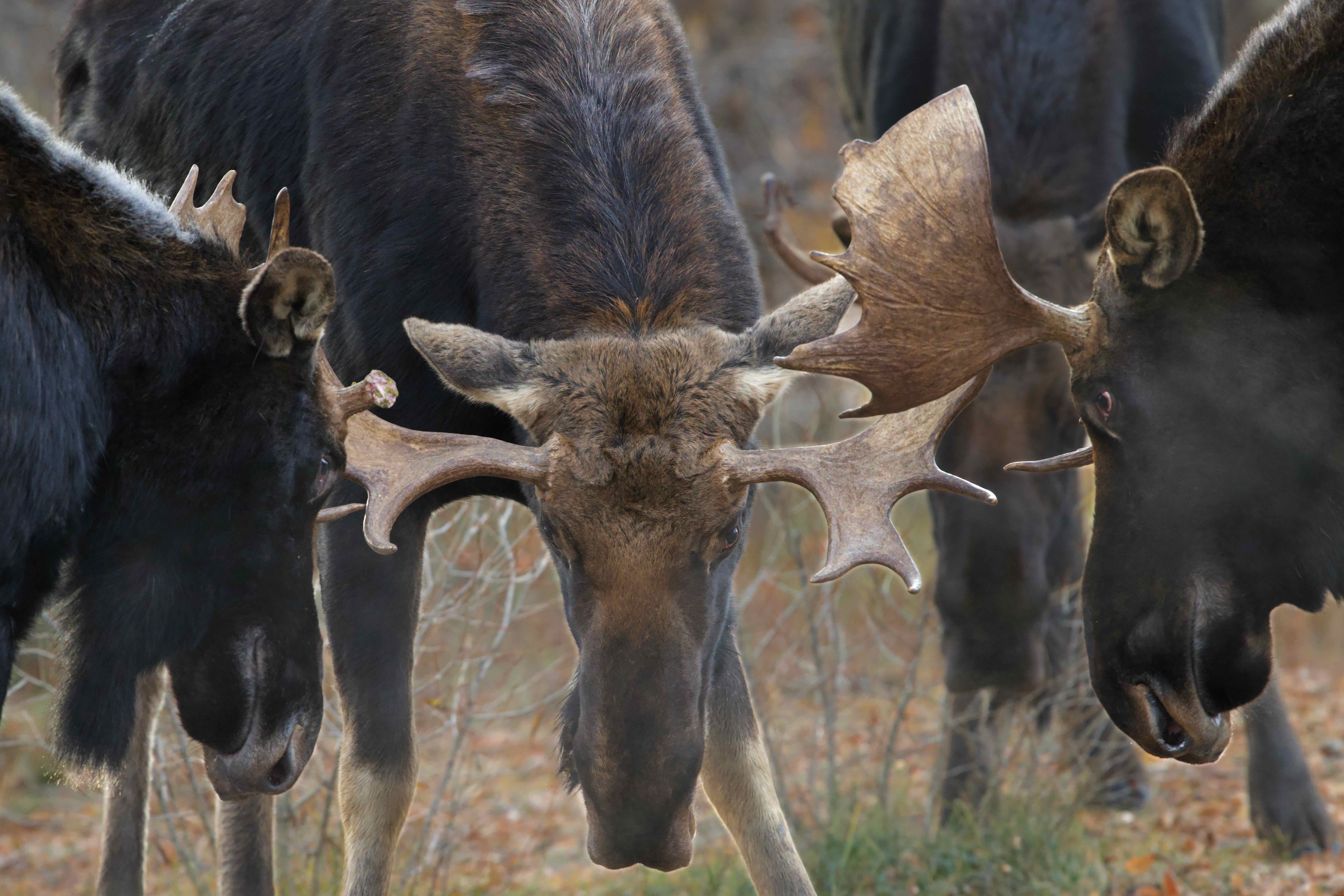
Most often two individuals would bang heads, but sometimes they decided that three is the right number. Note that the individual on the left has a broken right antler, but that didn’t deter him.
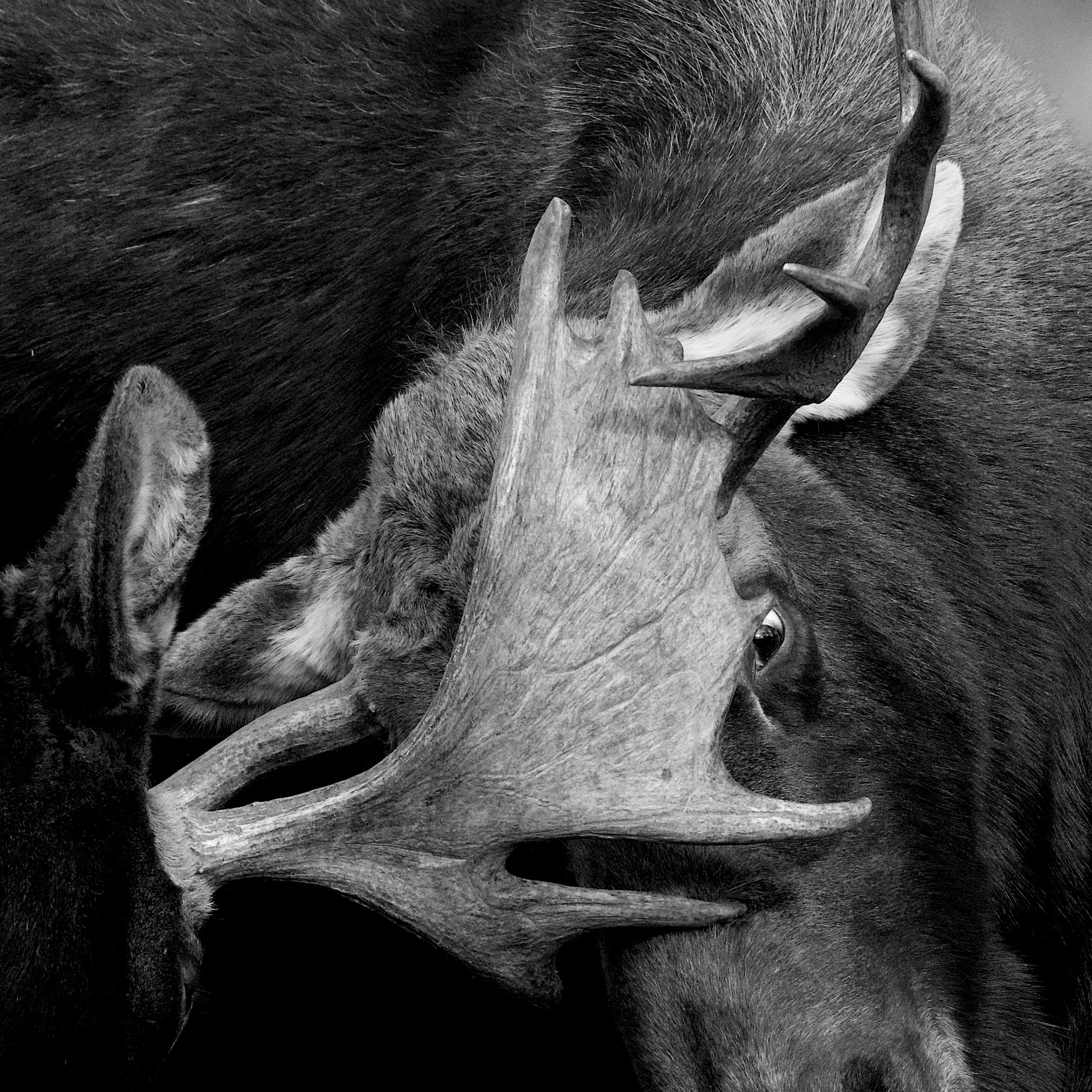
The Shiras moose (Alces alces shirasi), also known as the Wyoming or Yellowstone moose, is the smallest of North America’s moose subspecies.
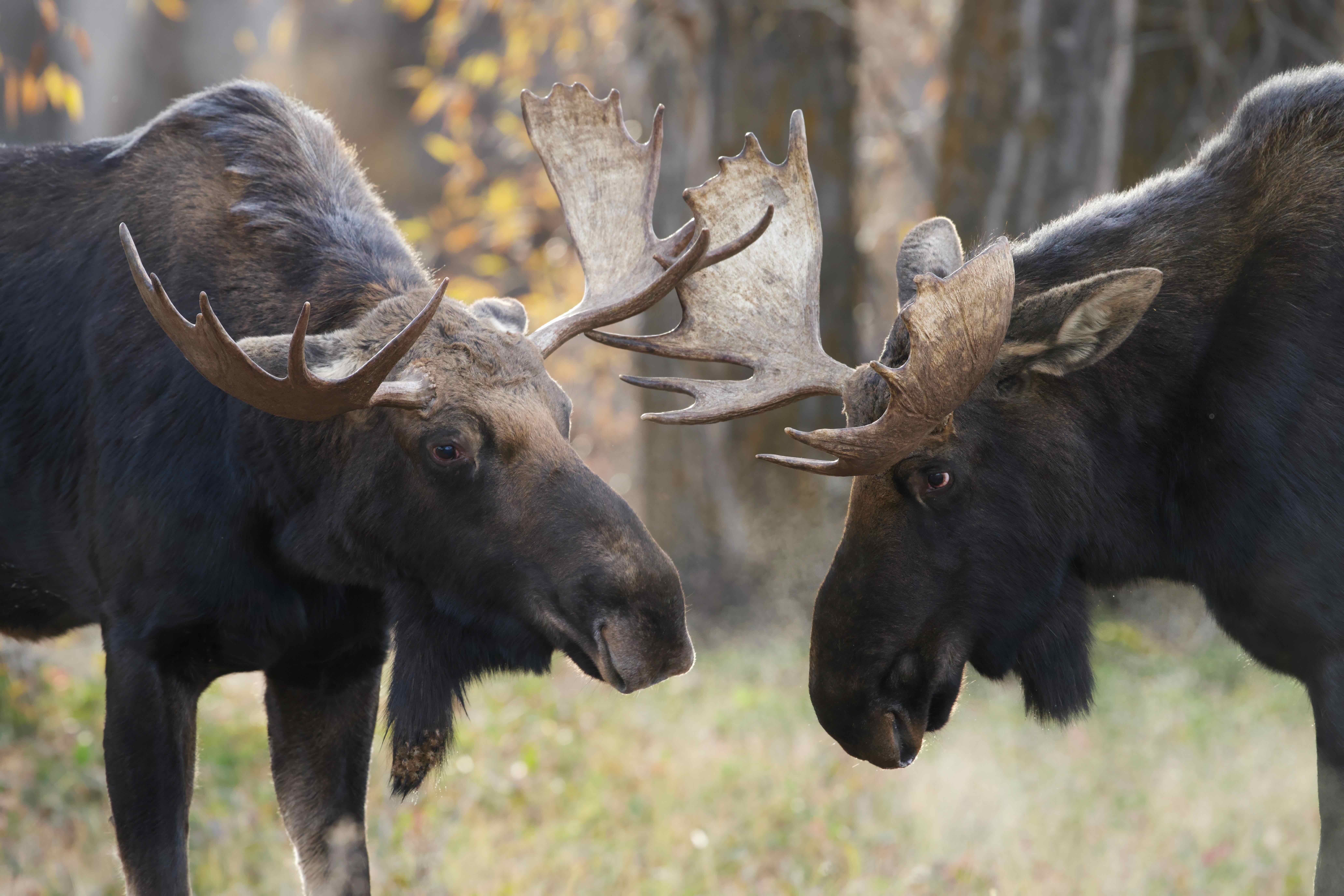
The moose rut in Wyoming occurs in September and October. The rut is triggered by photoperiod — the ratio of daylight to darkness. As day length decreases the pineal gland responds by releasing increasing amounts of melatonin, which stimulates testosterone production in bulls and triggers estrous cycling in cows. This hormonal cascade is so precise that the rut rarely deviates more than a few days from year to year in any given location.
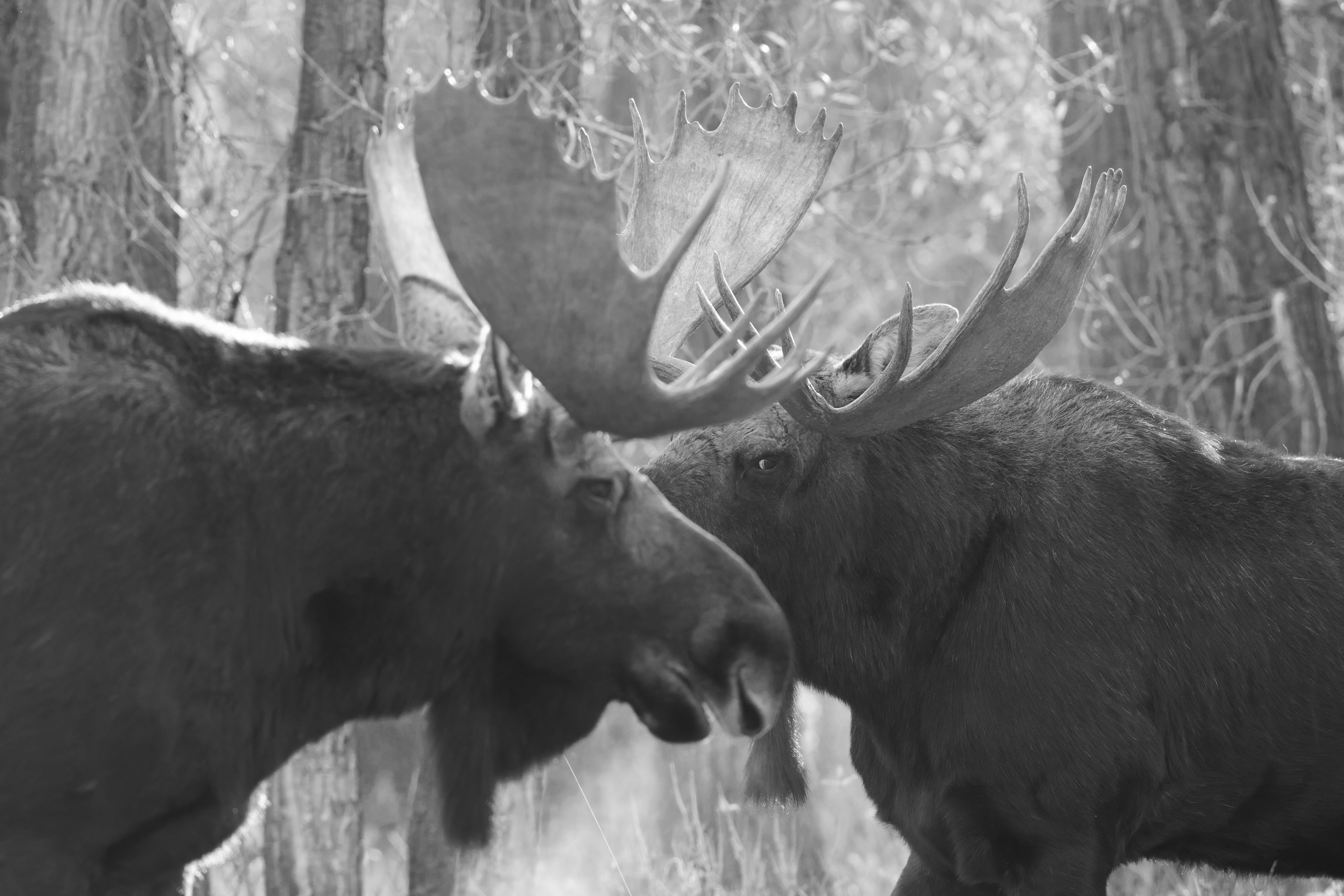
Female moose are seasonal polyestrous mammals, with the estrous cycle averaging 24 days and ranging from 22–28 days. The period of standing estrus—when a cow will accept a bull—is brief, lasting only 1 to 36 hours. If not successfully bred, cows may experience up to six recurrent estrous cycles, though approximately 83% of conceptions occur during the first estrus.
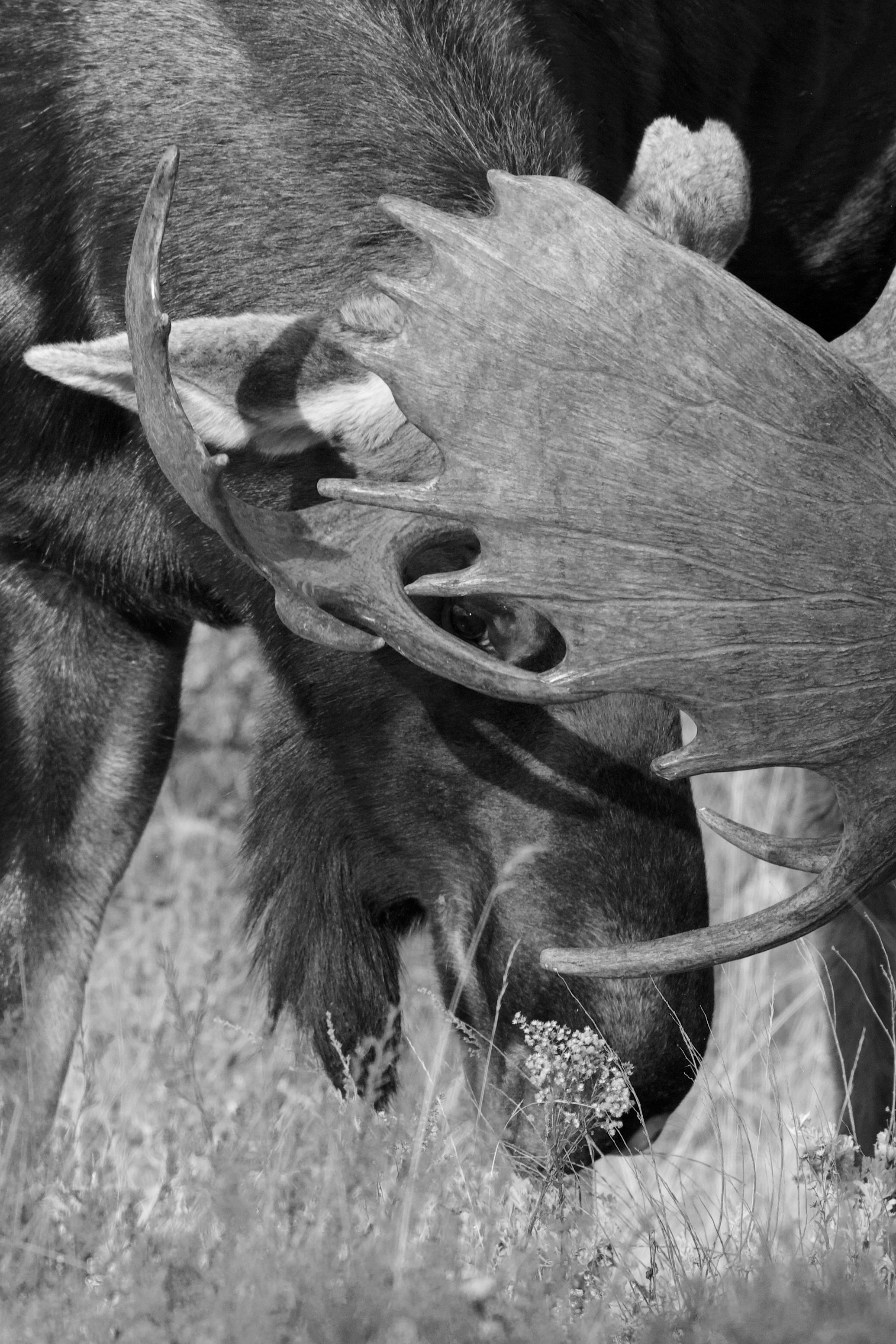
The rut induces a spike of up to twentyfold in bull testosterone levels. Neck muscles expand to approximately twice their normal size. Bulls may enter the rut having gained up to 250 pounds of fat and muscle during summer foraging, then largely cease eating during the breeding period, surviving entirely on stored reserves.
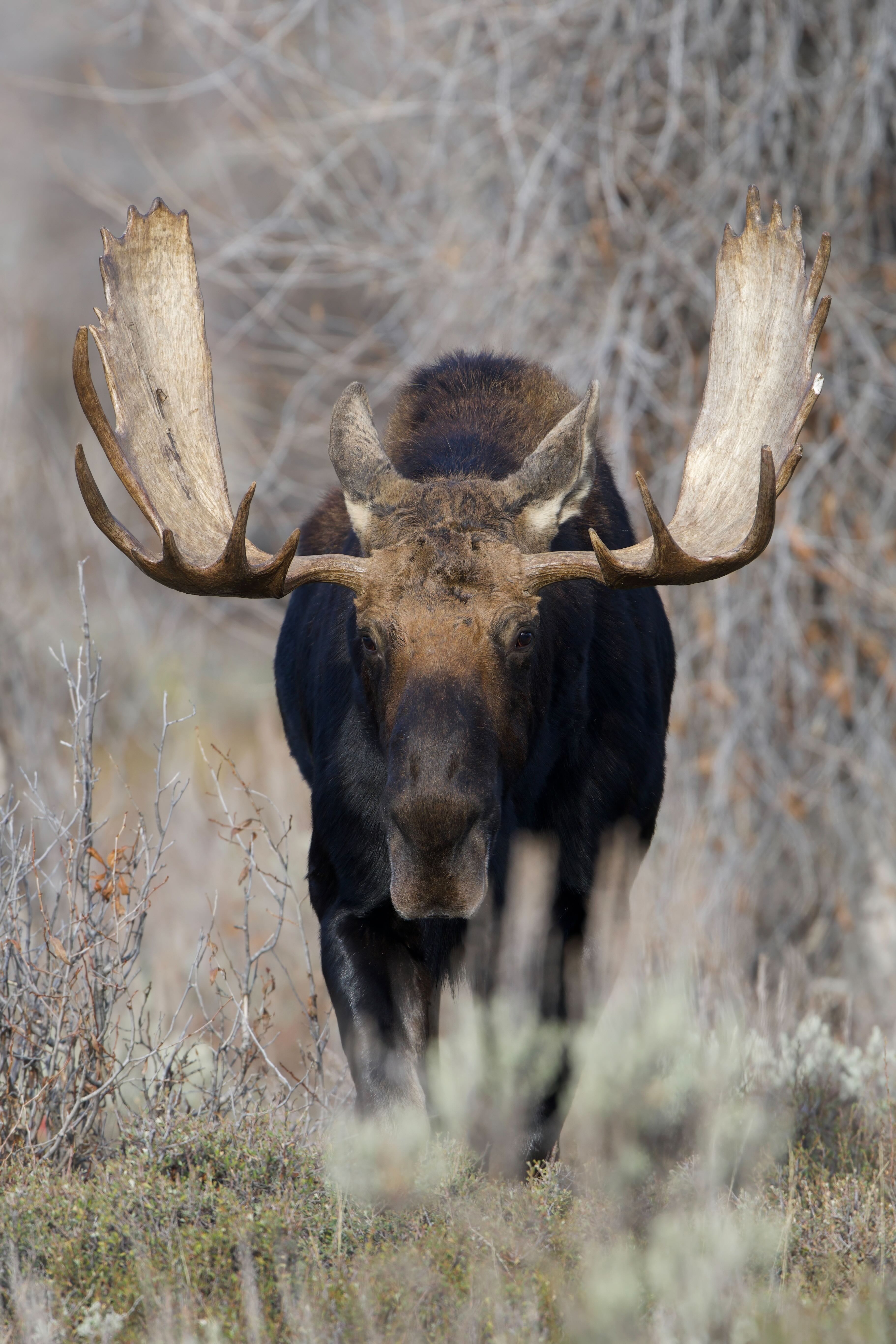
By late August, bull moose shed the velvet covering from their antlers revealing hard bone that darkens from white to chocolate brown within days. These antlers serve multiple functions: impressing females, intimidating rivals, and as weapons during combat.
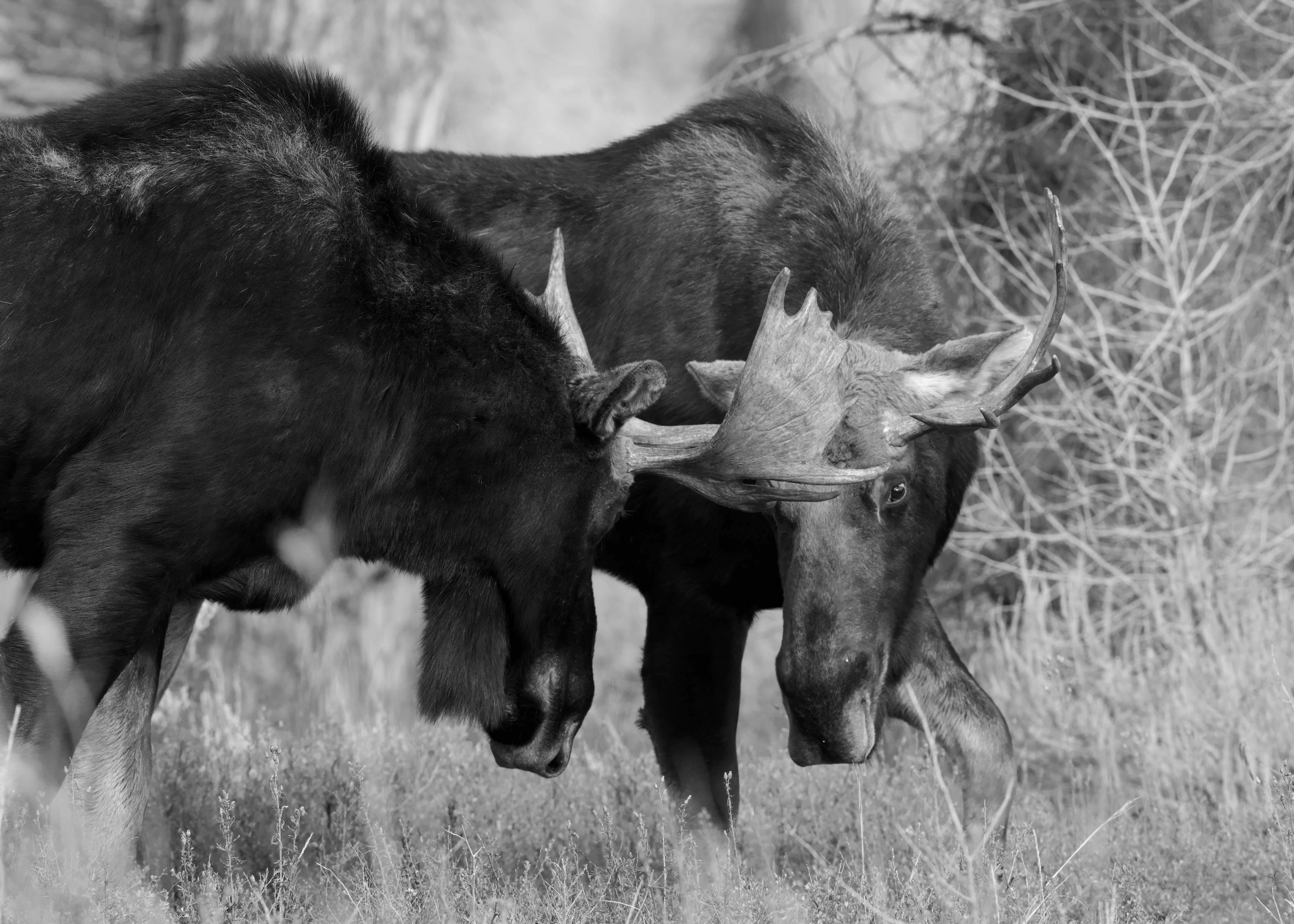
Unlike elk, which assemble harems, moose do not collect groups of females or form large social aggregations during breeding. Instead, bulls travel widely to locate receptive females, typically staying with a single cow for several days to approximately one week before moving on to seek additional mates. Large, highest-ranking bulls perform approximately 88% of all copulations.
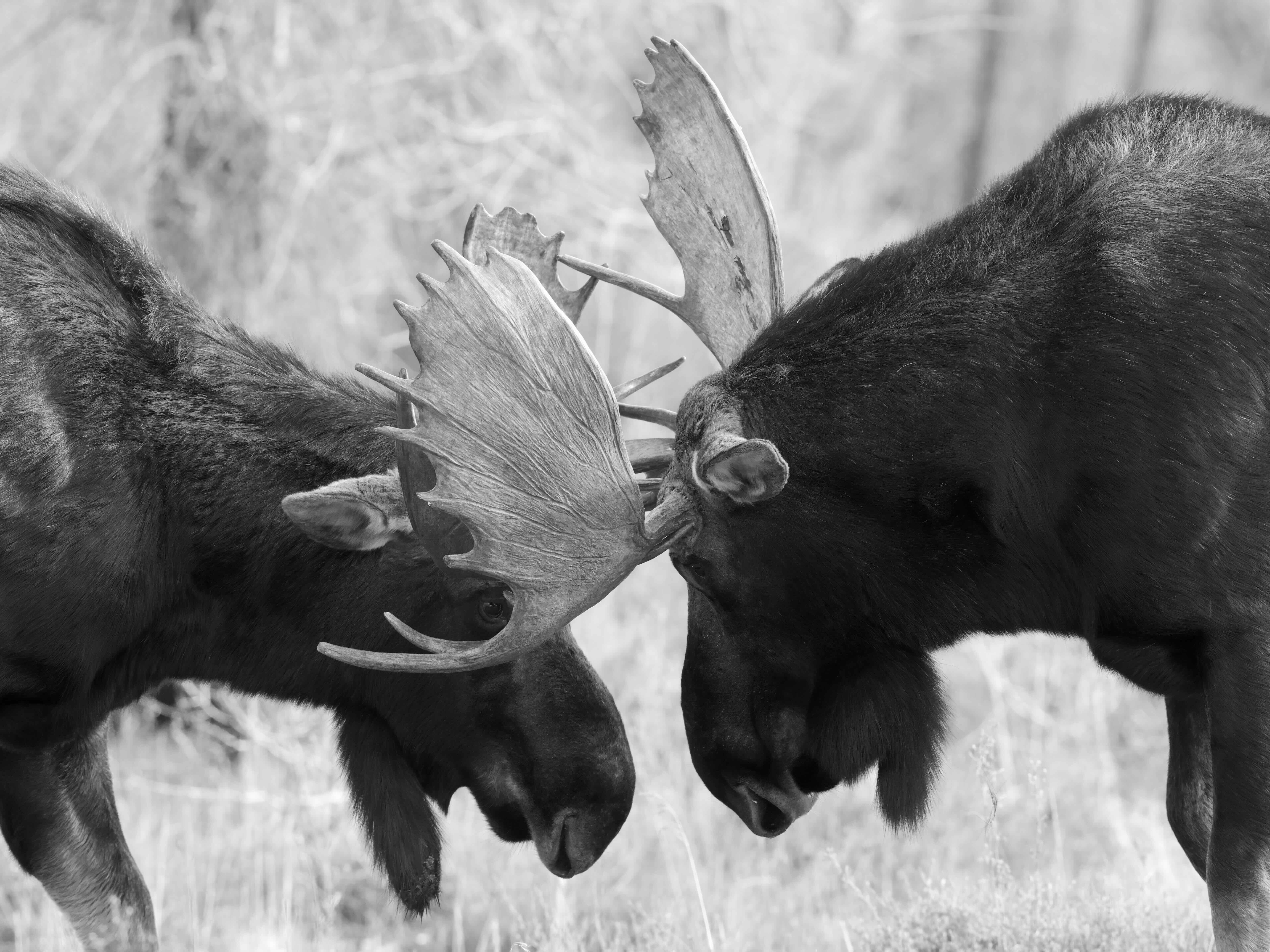
Bulls emit bellows, roars, and grunts—with grunts audible up to 500 meters away. Cows attract mates using long, drawn-out moaning calls. These acoustic signals are particularly important because moose have poor vision but excellent hearing.
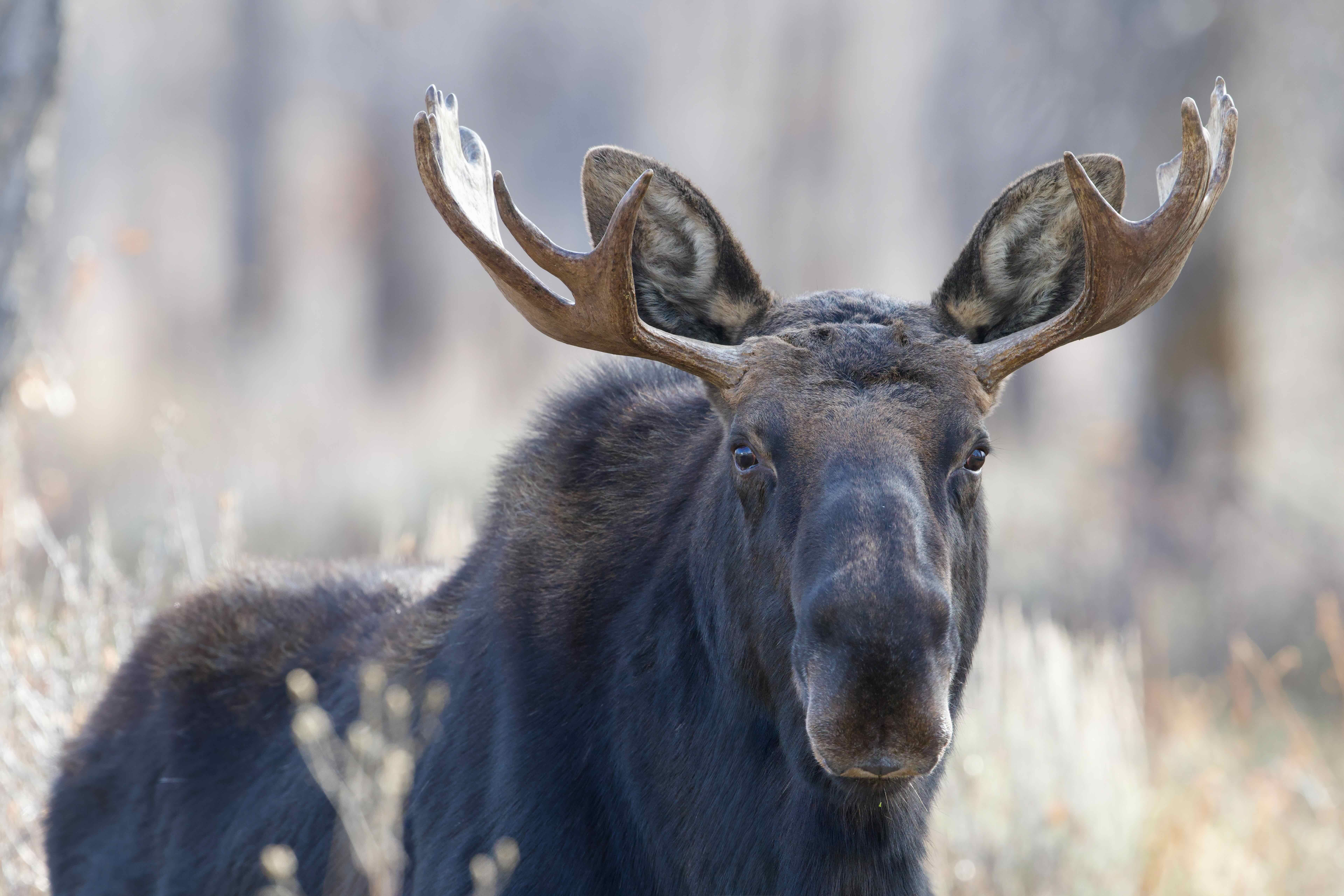
Other than sparring, scent-marking is the most impressive element of moose courtship. Bulls dig shallow depressions called rutting pits or wallows—typically 1.5 to 3.5 feet long and 3 to 6 inches deep—into which they urinate before wallowing to anoint themselves with their musky odor. Naturally, this “perfuming” behavior attracts cows, who may compete with other females for access to a preferred male’s wallow. Both sexes also scent-mark by rubbing their heads against trees.
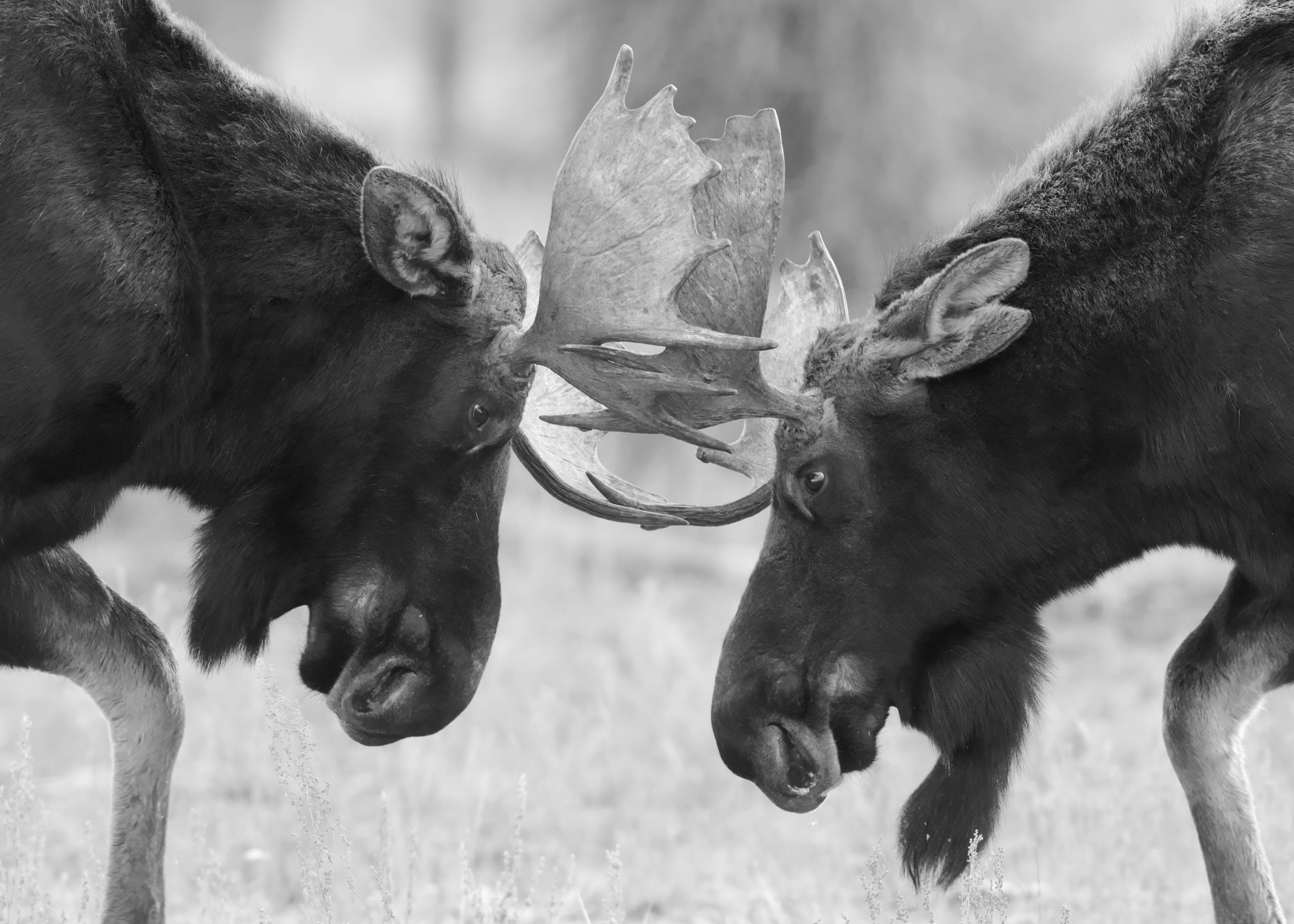
Bull moose engage in two distinct forms of physical competition: sparring and fighting. Sparring occurs primarily early in the rut as a mechanism for males to assess relative strength without risking injury. Fighting, by contrast, is violent and can result in injuries ranging from minor wounds to fatalities. Most fights occur between mature bulls of approximately equal size; when size disparities are obvious, smaller bulls typically withdraw before combat ensues, bowing out through displays rather than physical confrontation. If the bulls’ antlers become interlocked during combat then both animals will die.
Readers’ wildlife photos

November 26, 2025 • 8:15 am

Well, these Thanksgiving photos are the last I have, so if you have others suitable for Readers’ Wildlife, please send them in. Thanks!

Today’s butterfly photos come from reader Martin Riddle. His IDs are below (indented), and you can enlarge the photos by clicking on them.

Top to bottom:  Painted Lady (Vanessa cardui), American Lady (Vanessa virginiensis), Great Spangled Fritillary (Speyeria cybele),Yellow Swallowtail (Papilio machaon), and Monarch (Danaus plexippus). All photos are from the resident gardens at Brooksby Village in Peabody, Massachusetts.

Readers’ wildlife photos

November 25, 2025 • 8:15 am

This is the last batch I have, so we’ll have a photo hiatus over Thanksgiving unless somebody sends in some pics.

Today’s photos come from reader Uwe Mueller, who sends us bird photos from Germany. Uwe’s captions and IDs are indented, and you can enlarge the photos by clicking on them.

The first five pictures were taken in the Bergisches Land, Germany.

A Great tit (Parus major) taking a steep turn directly in front of the camera. It took a lot of attempts to get this kind of shot from this little bird in flight:

This bird was really a hard one to identify. It could either be a Marsh tit (Poecile palustris) or a Willow tit (Poecile montanus). Both birds are very similar and only distinguishable by some minor differences in a few features. After a lot of investigation I tend to think that this is a Marsh tit. But I could still be wrong:

Grey wagtails (Motacilla cinerea) are to be found mostly at small creeks or shallow ponds where they meticulously search the water and the banks for food like worms and insects. They are quite skittish birds and don’t like the human presence. To get a close shot like this you have to stay low-key in nature and have a long lens:

A Eurasian blackcap (Sylvia atricapilla), one of the most widespread warblers in Germany. I had some difficulty with its identification because the blackcap of the bird in the picture is more like a mid-brown cap:

A European green woodpecker (Picus viridis), another bird that you often hear but rarely see:

A Great crested grebe (Podiceps cristatus) is feeding one of its chicks with fresh fish. This picture was taken at the river Ruhr:

A flock of Canada geese (Branta canadensis) flying over the Ruhr. In the upper right corner of the picture you can see a Greylag goose (Anser anser) and two hybrids also flying in this flock. My guess is that the hybrids are the offspring of the Greylag goose. Canada geese and Greylag geese are known to mate with each other and produce offspring:

A European herring gull (Larus argentatus) flying very low over the Baltic Sea near the town of Kiel, Germany:

A male Red-breasted merganser (Mergus serrator) with its distinct red eyes, also near Kiel:

Another picture from Kiel, a Great cormorant (Phalacrocorax carbo) sitting in a surge of waves:

This funny little fella is a Sanderling (Calidris alba). They are constantly rushing over the beach with little mincing steps that are so quick that you hardly see their feet while running. Due to this behaviour they are called “Keen Tid“ in Northern German dialect which translates to “Don’t have time“. Every now and then they stop and stick their beak into the sand, searching for worms and small crabs, like in this picture that I took on the East Frisian island of Juist:

Readers’ wildlife photos

November 24, 2025 • 8:15 am

This is the last collection of photos I have, so the feature won’t be available until I get new pictures. Just sayin’. . . .

But today we have a photo-and-text essay from Athayde Tonhasca Júnior.  His captions and IDs are indented, and you can enlarge the photos by clicking on them.

The unfairly despised

The renowned entomologist, evolutionary biologist, naturalist, conservationist and target of woke troopers Edward O. Wilson popularised the concept of biophilia (love of life), the intuitive affiliation humans have with nature that is expressed by our attraction to animals, plants, landscapes and other natural things. For Wilson, biophilia is an evolutionary trait ingrained in the human personality. While his hypothesis has been supported by anecdotal and quantitative evidence, not all forms of life are equally cherished. Snakes and spiders, for example, evoke fear and revulsion in many people, responses that are also embedded in our brains and shaped by ancestral fears of animals that could harm us.

Little Miss Muffet being scared by a spider, by William Wallace Denslow © Wikimedia Commons:

Among the many types of animal phobias (the irrational, exaggerated and uncontrollable aversion to certain creatures), entomophobia is one of the most common across countries and cultures. Many theories have been proposed to explain the negative emotions triggered by insects (Lockwood, 2013), but anthropologist Hugh Raffles was spot on in describing entomological scenarios that can trigger primordial horrors: “there is the nightmare of fecundity and the nightmare of the multitude; there is the nightmare of unguarded orifices and the nightmare of vulnerable places; there is the nightmare of swarming and the nightmare of crawling; there is the nightmare of awkward flight and the nightmare of clattering wings; there is the nightmare of entangled hair and the nightmare of the open mouth.” (Raffles, 2010).

The fear of being stung, bitten, or swarmed by flying living things help explain why, in a 2021 survey, Britons placed spiders and wasps at the top of the list of unpopular invertebrates. The survey also revealed an interesting aspect of human perceptions and attitudes: largely harmless animals are more disliked than mosquitoes, the world’s most lethal to humans.

Results of a YouGov 2021 survey © Statista:

Cockroaches came third on the British dislike scorecard, surely only because they are not that common in the country. In warmer places, where people are likely to have had close encounters with cockroaches, these insects shoot up to the top of the list, and by a considerable margin. A shiny, greasy appearance, probing antennae, erratic skittering and a sewage aroma are off-putting enough, but their flying and occasional accidental entanglement in one’s hair can send the toughest character shrieking away. On top of that, domestic cockroaches are associated with filth, which triggers an uncontrollable feeling of disgust. For psychologist Mark Schaller, this reaction reflects our Behavioural Immune System, a set of innate responses shaped by evolution to identify signs of contamination by pathogens and avoid disease. If something looks like it could make us sick, we flee from it.

A sight to make many people cringe: an Oriental cockroach (Blatta orientalis) sharing our table © H. Zell, Wikimedia Commons:

The upshot of all this bad PR is that many people loathe cockroaches. Fervently. And yet, there’s more to cockroaches than abjectness and pestilence.

There are some 4,500 described species of cockroaches, of which 25 are synanthropes (organisms adapted to live near humans) and considered pests. The remainder are found in a variety of natural ecosystems, predominantly in tropical and sub-tropical regions. They live among leaf litter, rotting wood, underneath tree bark and among vegetation, feeding on almost anything of nutritional value. Together with termites, which belong to the same order Blattodea, cockroaches are highly beneficial by accelerating the breakdown of organic matter and the release of nutrients into the environment.

Florida woods cockroaches (Eurycotis floridana) munching away on rotten wood © Happy1892, Wikimedia Commons:

And another ecological role of cockroaches is slowly becoming better known: pollination.

Some plants and cockroaches share the same type of habitat: shaded, humid spots under the cover of thick vegetation. These places are not the best for recruiting the usual pollinators such as bees, hover flies and moths. But a cockroach may be the ticket for efficient transport of pollen from one plant to another. And that’s an opportunity not missed by Balanophora tobiracola, a parasitic flowering plant from Yakushima Island, Japan. Margattea satsumana cockroaches are seen scurrying all over B. tobiracola plants, suggesting they may do more than feed on pollen and nectar. Indeed, exclusion experiments – where plants accessible to visitors are compared to those with no access – revealed that cockroach visitation enhanced pollination, while the contribution of moths, flies and beetles was negligible (Suetsugu, 2025).

A M. satsumana cockroach visiting a B. tobiracola plant © Suetsugu & Yamashita, 2022:

Cockroach pollination on a Japanese island is not an isolated case. In French Guiana, the cockroach Amazonina platystylata is the main pollinator of Clusia aff. sellowiana (a potentially new species related to Clusia sellowiana). The cockroaches have no specialised pollen-collecting structures, but their bodies are coarse enough to retain pollen grains and transport them from flower to flower (Vlasáková et al., 2008).

An A. platystylata cockroach and a Clusia flower © Cockroach Species File and Scott Zona (Wikimedia Commons), respectively:

Cockroaches are known to pollinate some ten other plant species, so they are not exactly major players in plant reproduction. But part of the reason for these meagre figures is lack of information. Shy, nocturnal insects living deep down in thick forests are not observed very often, much less researched. Cockroach pollination also illustrates plants’ capability to adjust and make the best of challenging settings; when run-of-the-mill pollinators are not around, a busy, inquisitive cockroach would do just fine.

Not all cockroaches are unappealing to us, like the Mardi Gras cockroach, aka Mitchell’s diurnal cockroach (Polyzosteria mitchelli), from Australia © Evelyn Virens, iNaturalist:

Readers’ wildlife photos

November 23, 2025 • 8:50 am

Two kind readers sent photos yesterday, so we’re good until Tuesday.  If you’re off work for the Thanksgiving week, why not collect some of your good wildlife photos (if you have them) and send them in?Thanks!

Today we have some lovely butterfly pics from Pratyaydipta Rudra, a professor of statistics at Oklahoma State.  Pratyay’s captions and descriptions are indented, and you can enlarge his photos by clicking on them. (I just found out that he and his wife share a photo website called “Wingmates“).

When birding gets slow during the summer, we often pay closer attention to the insects, especially the pollinators that are quite abundant during the hotter months. Our garden (as well as some local botanical gardens and farms) has plenty of native species that attract a variety of pollinators including butterflies and moths. Below are some butterfly images that I took earlier this year.

Gulf Fritillaries (Dione vanillae) on our Swamp Milkweed (Asclepias incarnata). This plant attracts a huge number of pollinators over the summer, and it is also one of the host plants of Monarch butterflies:

Monarch (Danaus plexippus), caught in flight with an interesting morning lighting:

Variegated Fritillary (Euptoieta claudia) on Indian heliotrope (Heliotropium indicum). This plant is not native to North America, but it is quite widespread in our area, and the flowers are pretty:

Gulf Fritillary (Dione vanillae) coming in for landing on a zinnia. Flight photography of butterflies is way more difficult than birds-in-flight photography, but possible with modern cameras and a lot of patience:

The larval stage of Gulf Fritillary (Dione vanillae), on a purple passionflower (Passiflora incarnata) plant, the host plant for them:

Two generations… This adult Gulf Fritillary (Dione vanillae) might be quite worn, but she stopped by to lay eggs, perhaps one last time, as one of the caterpillars from the next generation keeps munching on the leaves:

Great Spangled Fritillary (Speyeria cybele) on Garden Phlox (Phlox paniculata). A relatively uncommon fritillary for us in this part of the state. In fact, it’s the first time I found one in our county:

Diana Fritillary (Speyeria diana) and Monarch (Danaus plexippus). This is one of my most favorite images from this summer. This was also my first encounter with a Diana Fritillary. This male Diana was nectaring on the Butterfly Milkweed (Asclepias tuberosa) when the Monarch flew in. Mr Fritillary wasn’t happy at all:

There was some kickboxing that took place at this point and there was a clear winner…:

The fritillary was able to hold ground, and the Monarch took off:

American Snout (Libytheana carinenta). Not difficult to see why it is named that way. It’s always fun to find one of these little ones with the long “nose”!:

Eastern Tailed Blue (Cupido comyntas). These so-called tails are parts of their wing which they keep moving. This is theorized to be useful to fool the predators into thinking that these are their antennae. Many butterflies actually have several traits like this that give a “false head” impression. We present a Gray Hairstreak in the second image which has a similar false head:

A recent study found that these traits have evolved in a correlated manner, likely driven by a common selective pressure helping them to develop complex head-like structures on their posterior side.

Gray Hairstreak (Strymon melinus) – Another common butterfly in our area that has a similar “tail”:

Pearl Crescent (Phyciodes tharos) – A common butterfly, especially during the fall migration. For those of you who are interested in photography, this image was taken at ISO 256000 (by mistake), but the modern noise reduction programs are unbelievably capable of removing such noise due to low exposure:

Phaon Crescent (Phyciodes phaon). This one is relatively uncommon here. I was glad to find several this year:

The crescents are quite small, and Phaon Crescent (Phyciodes phaon) is typically smaller than the more common Pearl Crescent. Here is an image that has my two-year-old daughter’s finger as a reference. I am glad to have this new butterfly-watcher in our camp!:

Readers’ wildlife photos

November 22, 2025 • 8:15 am

I have pretty much run out of contributions, but am also allowed to plunder the wonderful photos of Scott Ritchie from Cairns, Australia. Here are some more from his trip to Western Australia. Scott’s captions and IDs are indented, and you can enlarge the photos by clicking on them. (Scott’s Facebook page is here.)

An update on the WA trip, part III. Here are some of my favourite birds and mammals from my travels through Denmark and Albany. I will also provide an in depth look at the aquatics from Lake Sepping, Albany in the next post. It’s a great area, wonderful trees, intriguing flowers, dramatic landscapes, brilliant cool climate wines and outstanding birds!

Golden or Western Whistler (Pachycephala fuliginosa):

A White-browed Scrubwren (Sericornis frontalis) declares his patch:

Sooty Oystercatcher (Haematopus fuliginosus) has to dodge the surf.

That was close!:

Heh, I was first! A Silvereye (Zosterops lateralis) stares down an incoming bee at a nectar bar:

While the ever agro honeyeater, the New Holland Honeyeater (Phylidonyris novaehollandiae), shows off his diving form chasing any other bird that shows up:

Scarlet Robin (Petroica boodang). “Red, red robin goes bob, bob bobin away!”:

A Sacred Kingfisher (Todiramphus sanctus) shuffles out the rain:

Then flies down for a tasty slug:

I love the icy blue head on the Red-winged Fairywren (Malurus elegans)!:

A Red-eared Firetail (Stagonopleura oculata) lights his afterburner:


Before going into high speed orbit!:

Pelicans at Ocean Beach. Turn around or you’ll miss the rainbow!:

A Nankeen Kestrel (Falco cenchroides) hovers above Green Pool at Denmark, enjoying a grasshopper for brekkie:

“Watch out, here he comes!”  The kestrel then flies to Elephant Rocks where he is given a rude welcome by a Welcome Swallow (Hirundo neoxena):

Heavy winter rains made for quite a itchy visit! Local mozzies were driving the Western Grey Kangaroos (Macropus fuliginosus) crazy:

Australian Ringneck (AKA 28 Parrot; Barnardius zonarius) enjoys the flowers in the field:

Readers’ wildlife photos

November 21, 2025 • 8:15 am

Well, this is it, people: the last batch of photos I have on hand. Please send in yours if you have good ones. Thanksgiving break would be a good time to get those snaps together.

Today’s pictures come from Paul Handford, who sent photos of thrushes from British Columbia and Ireland. Paul’s captions and IDs are indented, and you can enlarge the photos by clicking on them.

Here’s a sampler of members of the Family Turdidae, the thrushes et al.  Some are from our decade living in south central British Columbia, while others are from around here now, in Ireland.

First, BC. As before, all images are from the area around Kamloops, mostly from our yard.

American robin, Turdus migratorius: IMG_7029.

Almost everyone living in North America is familiar with this bird, dubbed “robin” on account of its brick-red underparts, recalling to early European immigrants their familiar Old World robin, a much smaller bird, from a different avian family.  Its vocalizations and general behaviour strongly resemble those of the Eurasian blackbird in the same taxonomic genus, Turdus merula (see below):

Mountain bluebird, Sialia currucoides.

A bird of higher-elevations in western parts of the continent.  The males are the very bluest of the three North American. bluebird species.  Like other Sialia species, they are cavity-nesters, and feed primarily on ground invertebrates, spotted from elevated perches on fence-posts and local vegetation.

Females are generally a more subtly beautiful beige & ashy, with blue restricted to wings, rump and tail.

Male:

Female:

Townsend’s solitaire, Myadestes townsendi.

Like the mountain bluebird, this is a species of the mountainous west.  It is a year-round resident in southern BC, but its breeding range extends way north into Yukon and Alaska.  Almost exclusively insectivorous in the breeding season, it overwinters in our area on diverse berries—as here on rowan (Sorbus):

Swainson’s thrush, Catharus ustulatus.

Other than in the mountains and coasts of the western US, this is a breeding bird of forsts and woodlands of Canada and Alaska.  More often heard than seen, this secretive bird has a distinctive haunting, flute-like song [JAC: you can hear its songs here.]

Varied thrush, Ixoreus naevius.

Another strictly western bird, one typical of the deep forest, where its one-note songs, usually repeated at slightly different pitches, provide for a rather eerie ambience.  Though mainly a summer breeder in BC, individuals often would overwinter, subsisting on berries, again in our dependable rowan tree:

Eurasian blackbird, Turdus merula:

This species is the rough counterpart of the American robin:  a familiar songster in parks and gardens pretty much all over.  As Paul McCartney memorably told us, they often do produce their lovely fluting song “in the dead of night”. [JAC: A variety of song recordings is here.]

Male.  The male is the one that gives the vernacular name. Apart from crows et al, this is the only common jet black bird in these parts, so the name offers no room for ambiguity:

Female:  The female’s plumage is mostly a rather sooty brown, and it lacks the striking crocus-yellow bill and eye-rign of the male:

Mistle thrush, Turdus viscivorus.  

A large, rather pale greyish thrush, with round spots on the white breast and belly, that forms noisy little gangs during the winter, often giving their distinctive rattling calls.  They have a typical thrush invertebrate + fruit diet, though their names derive from a presumed predilection for the beries of mistletoe, Viscum album:

Song thrush, Turdus philomelos.  
This is the thrush that most closely resembles the form of the typical North American thrushes, with brown-russet back, with streaky-spots on pale under-parts that becoming buffy on flanks and near the throat.  A familiar denizen of gardens and parks, as well as in woodland and forests, this thrush has a distinctive song comprising sequences of repetitions of short whistled phrases: