Why Evolution is True is a blog written by Jerry Coyne, centered on evolution and biology but also dealing with diverse topics like politics, culture, and cats.
Well, this is the last batch of photos I have, and it’s very sad that the tank is empty. Please send some in if you have them. Don’t make me beg!
Today we have photos of ducks—or rather, one female duck— rom Aussie reader Keira McKenzie in Perth. Keira’s captions are indented, and you can enlarge her photos by clicking on them.
Here is a series of photos I took of a lone Pacific Black Duck [Anas superciliosis] from this afternoon [Feb. 11] at the park. Since the islands in the ponds have been completely cleared of all vegetation (the western island) and all the undergrowth cleared from the eastern island (this is because of the devastation throughout Perth’s trees from the polyphagous shothole borer), moat of the waterbirds have left for areas where they can roost & nest.
The photos are taken in Hyde Park, Perth, Western Australia, on a hot humid afternoon.
I am very fond of them. I rescued one when it flew into the electric wires on the other side of the road one night. I carried it back across the road and into the park, putting it near the water’s edge. It was a pond-smelling little bundle, seemed uninjured and was very calm, and waddled off into the water and sailed into the night.
What a beautiful hen! It makes me eager for Duck Season to arrive at Botany Pond. Keira also sent a picture of her cat:
I shall sign off with a pic of my little Baba (currently zooming around the place for no apparent reason) slothing in the armchair in the heat with one of her favourite toys (the other is a wombat).
We’re almost out of photos again: one more batch to go. If you have any good wildlife photos, please send them in. Thanks!
Today we have some birds from British Columbia from reader Paul Handford, including DUCKS. Paul’s captions are indented, and you can enlarge the photos by clicking on them.
Here’s a few more species of non-passerine birds from south-central British Columbia, all within a few miles of where we lived from 2011-2021 in Barnhartvale, Kamloops, before retiring to Ireland.
First, a few waterfowl from the South Thompson River, upstream from Kamloops, in the vicinity of Campbell Creek. It’s a great place for viewing a diversity of ducks, geese, and swans, especially in winter and spring:
It’s been a while since we had some photo from evolutionary ecologist Bruce Lyon at UC Santa Cruz, but he came through yesterday with some lovely photos of DUCKS! Bruce’s captions and IDs are indented, and you can enlarge his photos by clicking on them. It comes in the form of a letter to me:
While you are waiting for help to arrive, here are some photos to calm your frayed nerves and stop the incessant paddling.
The photos were taken at Neary Lagoon, a city park near my home. It is the best place to see wood ducks (Aix sponsa) locally. They hang out in the wetlands in the park and often fly over to feed on settling ponds at the nearby sewage treatment facility. Delicious! The park also has lots mallards (Anas platyrhynchos).
The wood ducks are often hidden from view—they perch on branches in dense vegetation at the edge of the lagoon. But sometimes they come out and paddle around, giving nice views. Ducks pair up earlier than many other birds and many birds are in pairs but some are courting.
Darwin famously said that peacocks made him feel ill—”The sight of a feather in a peacock’s tail, whenever I gaze at it, makes me sick!” (expressed in a letter to his friend Asa Gray). The peacock’s ornamentation is so crazy complex that Darwin found it hard to explain. Sure, sexual selection explains why animals are ornamented, but this is just crazy. I feel the same way about male wood ducks, but I feel awe instead of nausea:
This male was courting a female that was perched above him out of frame. He would do head tilts while puffing out part of his plumage:
The courting male photographed mid head tilt. Note his fanned out buffy flanks with the nice black and white edging. Clearly, fanning out a specific part of the plumage like this suggests that is an important part of the display:
A lovely female wood duck but not the object of the above male’s desire:
In fact, the above male, who was courting a female perched out of sight above him, often pecked at the female that was sitting right next to him. Perhaps she was interested in him, but the attraction was not mutual:
A male wood duck on the water:
Not far away, mallards provided great opportunities for getting flight shots. I like this one because the out-of-focus males in the background add a pleasing element:
Flight shots can be challenging but these mallards made it easy. They wanted to roost on the floating walkway in the marsh and would swim up close to the walkway and bob their head rapidly up and down a few seconds before launching into flight. Made it easy. Here is a female mallard approaching the railing:
Unbeknownst to me, the powers that be in our department decided to celebrate my creation of the Jerry Coyne/Honey the Duck Graduate Fellowship (a grad-student fellowship for studying organismal evolutionary biology) by putting pictures and captions on the wall of our seminar room, which features other photos of research activities of department members. Here are two photos related to the JCHDGF over the blackboard:
And enlargement of the photos:
And the two captions that go with the photos (first one for the left photo, second for the right).
I was delighted to see this, for the photos and fellowship will be the only real form of immortality I have. Like all scientists, I realize that whatever research I produced will eventually be outmoded or replaced. And Honey will live at most a dozen years; in fact, she’s probably already crossed the Rainbow Bridge. But my fellowship is forever.
Kudos to the office staff for getting this made and installed.
And two other photos of Honey, just for old times’ sake:
Today we’re featuring photos of the birds of Perth taken by Scott Ritchie, who hails from Cairns. Scott’s captions and IDs are indented, and you can enlarge the photos by clicking on them.
Social media, including Facebook, gets quite a bit of negative press these days. I get that. But one of the great values of social media is that it can put you in contact with people who can really help you out. In Sept. 2025, I started posting bird photos from my Western Australia trip. I was contacted by John Edmond, who lives in Perth. Last year, I met John in Cairns on our regular Tuesday AM bird walk, and then showed him some local birds along the Cairns Esplanade. John loves a twitch, and was especially happy to see Nordy, Nordmann’s Greenshank.
So John reached out on FB and offered to take me for a day’s birding in Perth. We had a great time and I particularly touring around Herdsman Lake. Here is some of my favourite images from that day’s birding.
The Pink-eared Duck (Malacorhynchus membranaceus) is one of my favourite birds. I was lucky to get nice close images of this bird. If you’re wondering about the name, look carefully at the head. You can just see a little bit of pink behind his eye. Personally, I’d name it the Zebra-breasted Duck:
And another. The flaps along the bill are used to help funnel microbe-rich water into their mouth:
The Great Crested Grebe (Podiceps cristatus) is another amazing bird. I just love the hairdo and the neck feathers during breeding season. Interestingly, this bird is found in wetlands from Asia Europe, Africa, Australia. This is one of the grebes that does a upright mating dance that you may have seen on TV:
JAC: Here’s a YouTube video of the mating dance:
So am I gonna get lucky tonight? Let me think about it:
I love the raking light on this stunning bird:
The Australian Shelduck (Tadorna tadornoides) during breeding season. The female is the one with the spectacles. It’s obvious she’s the only one with a good sense to wear glasses:
I like these this couple out for an evening promenade in the quiet water:
Herdman Lake like has more than water birds. This pair of Tawny Frogmouths (Podargus strigoides) are a bit of an institution there. People come around looking for these interesting, well-camouflaged birds. See me if you can:
Australian Reed Warbler (Acrocephalus australis) was regularly heard singing in the rushes. Lovely calls, the sound of the Aussie wetlands:
At an earlier stop, I was happy to see the Western Spinebill (Acanthorhynchus superciliosus). It’s not the world’s best shot, but it’s still beautiful bird and I hope to get better views of it in the future:
And finally, I’ll leave off this WA tour with a robin, a male Scarlet Robin (Petroica boodang). Robins are so cute and they sit nicely for the camera, not jumping around like some crazy caffeinated gym rat like so many birds do. Speaking of which, I’m off for a coffee and a workout to work off some of the pounds I put on during this trip:
Things are moving along at Botany Pond. Although the ducks have left (with only a few returning for a brief visit), six species of native fish have been introduced; a bunch of goldfish that people dumped in (probably from their aquariums) have been removed (none were killed; they are up for adoption and removed because we want only native flora and fauna in the pond); and five large “original” turtles, removed to another pond when Botany Pond was drained and fixed over the last few years, have been put back. This post documents the latest doings.
When 11 turtles were removed several years ago, they were marked by clipping off a bit of shell at the front, and then put for safekeeping in a large pond in southern Illinois. There were other turtles there, too, so to retrieve them for re-introduction to the pond, they had to be trapped, which took some time. One died in their “babysitting” pond, but there are five there, and we hope to get them next Spring.
But on October 2, the first three were released. All of the turtles were red-eared sliders (Trachemys scripta elegans), a species that is now native here, as the range has moved northward as the climate warmed. Again, these turtles must have lived in Botany Pond for a number of years when they were removed. Since it’s changed a lot since they lived here, I wonder if they remember it?
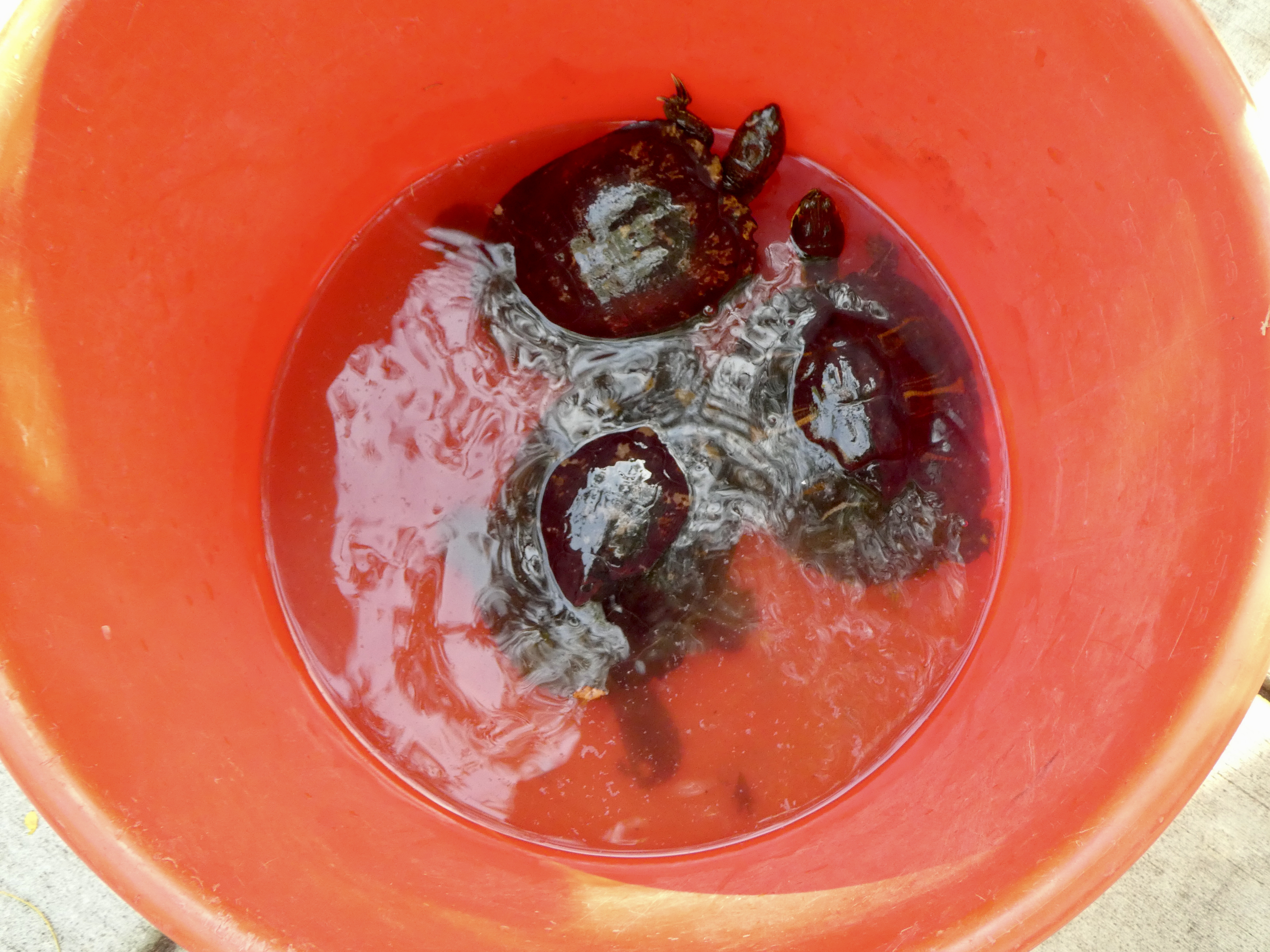
The first release. Here are the turtles in their bucket, restless and ready to go:
One just about to be introduced to the pond, hopefully her forever home. You can see a bit of the red stripe behind her eye.
The species is sexually dimorphic, with males having longer claws than females (they’re used to rake the female’s head before mating and then to hold onto her during the Act). These are short claws, ergo a female. We have at least two of each sex in the pond now, but breeding is unlikely as they bury eggs in the dirt near the pond, and those eggs have historically died during the cold winter. That’s why this is really the northernmost bit of their range.
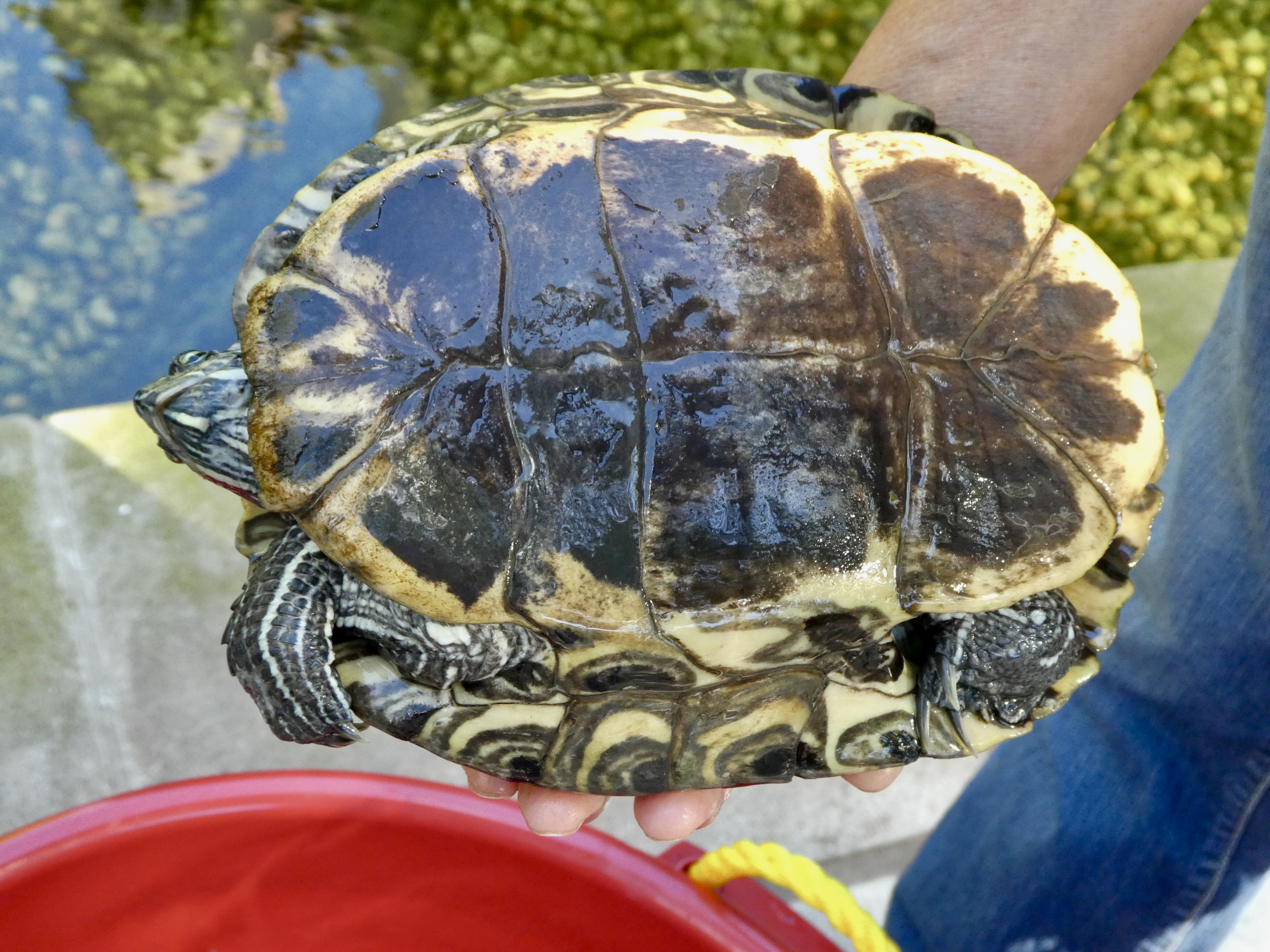
The bottom of the shell:
Head-on shot:
. . . and the head from below. These really are beautiful animals:
Here’s a video of the first release. You can clearly see the red stripe on the last turtle released.
They will spend the winter in hibernation; right now Facilities is feeding them frozen smelt, and they can also eat the minnows supplied in the second release (below). The turtles will spend the winter huddled in special “turtle caves” that Facilities has put on the rocky pond bottom (below); they can breathe from their butts (“cloacal respiration”) while hibernating. Here’s one of the turtle caves:
Between the first and second release, a fine pair of mallards came to the pond, but, sadly, flew away after a day when snorkelers (!) went into the pond to capture the goldfish. Ducks will not tolerate the presence of any humans in the pond.
I really, really miss the ducks, and almost none have stopped by the Pond on their way south. Here’s the handsome mated pair that we had for two days:
The second release of turtles was on Oct. 9.
The pair in their bucket, raring to go:
Note the red stripe on the head that gives this species its name:
Front view:
Bottom view. As you see, these turtles can be distinguished by the pattern on the bottom of their shells (compare to the ones above and below).
Big difference! The short claws indicate that this is another girl turtle:
The first released of two. They seem a bit flummoxed for a short while, and then they take off like a shot.
A close-up video of a released turtle. Note the longer claws: this is a male.
And the released minnows:
The turtles appear to have taken to their homes on the bottom lately (they can go several hours underwater without breathing), and I’ve seen them only rarely. They get their smelts twice a week and there is also dry turtle food (Mazuri Aquatic Turtle food) and the living minnows.
But I await the ducks next spring. There better be some!