Caturday felid trifecta: Donut-loving cat heads the bakery line daily; Judaism and cats; cat memes; lagniappe

January 4, 2025 • 9:45 am
We’re back with caturday felids again, though I’m writing for another venue today and posting will be light. But here, have some cats.

Click below to read about  Oreo, a tuxedo cat in South Carolina who is always first in line at the donut shop.

Excerpts:

From classic glazed to wild, gourmet flavors, donuts are probably some of the most delicious and satisfying treats, and in Chapin, South Carolina, many people love to start their day by getting some at their local bakery, called Chickenbutt Donuts. Yet there’s always one furry guy who gets in the line first.

Local stray cat Oreo is the most loyal client of all. The cat is obsessed with Chickenbutt’s sweet treats, so he refuses to let anyone into the bakery before him.

“We open at 6am. Line starts behind this guy,” Chickenbutt Donuts shared on their Facebook next to the hilarious photos of the cat patently sitting right in front of the door and looking inside.

It appears that Oreo does this every single morning before sunrise, while bakery staff are still preparing trays of donuts and fritters for their opening.

“Business hours do not apply to him because he is cat. Assist him right meow,” one of the commenters wrote.

“See, this is how it really works, you actually tricked him! He saw the word chicken in the name of your business and thought you served chicken. You should be ashamed for tricking the poor cat!” another one added.

“You guys should make him a chicken donut!” the other one noted.

All photos from the FB page of Chickenbutt Donuts (what a name)!

Image credits: Chickenbutt Donuts / Facebook


Image credit: Chickenbutt Donuts, Facebook

From classic glazed to wild, gourmet flavors, donuts are probably some of the most delicious and satisfying treats, and in Chapin, South Carolina, many people love to start their day by getting some at their local bakery, called Chickenbutt Donuts. Yet there’s always one furry guy who gets in the line first.

Local stray cat Oreo is the most loyal client of all. The cat is obsessed with Chickenbutt’s sweet treats, so he refuses to let anyone into the bakery before him.

“We open at 6am. Line starts behind this guy,” Chickenbutt Donuts shared on their Facebook next to the hilarious photos of the cat patently sitting right in front of the door and looking inside.

It appears that Oreo does this every single morning before sunrise, while bakery staff are still preparing trays of donuts and fritters for their opening.

“Business hours do not apply to him because he is cat. Assist him right meow,” one of the commenters wrote.

“See, this is how it really works, you actually tricked him! He saw the word chicken in the name of your business and thought you served chicken. You should be ashamed for tricking the poor cat!” another one added.

“You guys should make him a chicken donut!” the other one noted.

They don’t say how many or what kind of donuts Oreo eats, but he’s a chonk!:

Image credit: Chickenbutt Donuts/Facebook

While for many of us, waking up before 6am may seem painfully early, this cat doesn’t seem to make a big deal of it since he knows how delicious the freshest donuts can be.

The stuff from Chickenbutt Donuts explained that Oreo has been a staple in their little corner of White Rock for a good long while.

“We all keep food on hand for him, and the good people at SIR make sure he’s got cover when the weather gets rough. After the wild success of this morning’s post, it seemed like a good time to introduce him to the world!” shared the bakery right after their first publication’s about the cat, which instantly went viral, and also noted that sometimes they just can’t help but give in to the cat’s desires.

And that can be perfectly seen in another post by Chickenbutt Donuts where the short clip shows the cat running to get a bite of a donut.

“Chonky boy got his donut, y’all!” the bakery wrote next to the video.

The cat really seems to like the taste of the soft treat, as well as the cuddles that always come on the side.

While the residents of Chapin might not always get the first delicious treats at Chickenbutt Donuts’, they are also not mad about the situation since they love to see their furry neighbor waiting at the front door.

Actually, here he is nomming a plain donut, If they love him, I hope they only give him a bite or two every day.

Image credit: Chickenbutt Donuts/Facebook

You can vote at the site, too. Here are the results so far:

. . . and here’s a video. But I hope someone would give Oreo a forever home and cut down on his pastries!

**********************

The site My Jewish Learning has an article on “Judaism and Cats” (I’d read an article on any religion and cats so long as it didn’t describe killing or hurting cats). Click below to read.

Actually, I was distressed to learn that many ancient Jews were not all that fond of cats and thought they killed babies! But some had them as pets (I’d like to know what their names were.):

Alhough cats were commonly kept as pets in the ancient Near East, especially in Egyptian society, cats are not mentioned often in traditional Jewish sources. In fact, small cats are not mentioned in the Hebrew Bible at all, though some of their larger relatives, particularly lions, feature prominently. But the Talmud does mention cats several times. There, they seem to occupy a crossroads between wild and domesticated, dangerous and helpful.

In Shabbat 51b, for example, the rabbis are discussing which items worn by animals are necessary for human safety and control and which are not (because unnecessary equipment on the animal is considered a burden the animal should not carry in public spaces on Shabbat). The rules are different for domesticated and non-domesticated animals and it is in this context that cats appear as an example of an animal that is not domesticated — yet sometimes accompanying humans and wearing a collar.

The image of a cat as a wild animal is most pronounced on Bava Kamma 80b where a cat tragically attacks a baby and severs its hand. This initiates a discussion among the sages about the safety of keeping cats. Rav, clearly affected by the attack on the baby, makes the following declaration:

With regard to a cat, it is permitted to kill it (even if it is privately owned); and it is prohibited to maintain it in one’s possession; and it is not subject to the prohibition against theft; and, in the case of a lost cat, it is not subject to the obligation of returning a lost item to its owner.

Obviously designed to discourage cat ownership, this ruling also reveals that in the rabbis’ world there were in fact people who kept cats as pets. In response to Rav’s declaration, the Gemara offers another teaching that describes why some people might have found cats useful around the house:

This is typical Jewish argumentation about issues. And there’s more. Here’s one more except:

Other texts in the Talmud also recognize cats as useful mousers (see Bava Metzia 97a), and they are even admired for their prowess as hunters. However, their predatory nature is also considered a liability, especially to chickens (see Peah 3:7 and Hullin 52b).

Modern pet owners sometimes remark that cats, on average, do not view their owners as masters with reverence or obedience in the way dogs do. A similar sentiment is found in the Talmud:

The students of Rabbi Elazar asked him: For what reason does a dog recognize its master, while a cat does not recognize its master? Rabbi Elazar said to them: If it is established that with regard to one who eats from that which a mouse eats, eating that item causes him to forget, with regard to the cat, who eats the mouse itself, all the more so does eating it cause it to forget. (Horayot 13a)

Rabbi Yohanan, on the other hand, sees cats as one of several animals whose behavior teaches an important lesson: “Even if the Torah had not been given, we would nonetheless have learned modesty from the cat.” (Eruvin 100b). Why? Because cats are discrete and cover their own excrement.

Well, cats do recognize their “masters,” they just don’t see them as masters! To read more about ancient Jewish pilpul about cats, click on the headline above.


**********************

The third item is a link to 50 cat memes, and I’ll reproduce but six (I believe they were all created by the owners of the Pizzacat account; see below). You can see them all by clicking on the headline. The post adds this:

But since you clicked on this post in the first place, I assume you already knew that. So I’ll stop pussyfooting around and invite you to scroll down to find a list full of original memes masterfully crafted by the Pizzacat Instagram account.

While you’re at it, make sure to check out a conversation with the creators of Pizzacat, Mat, and Jacquelyn, who kindly agreed to tell us how the viral meme was born.

Note that the Pizzacat is photoshopped; the authors warn you not to put your cat’s head through a hole in a pizza!

The photos are all credited BoredPanda.com but also “the_pizzacat”:

*****************

Lagniappe: LOOK AT THIS KITTEN!

Smudge The Insult Cat 🐀 (@disentingcat.bsky.social) 2024-12-25T14:48:22.247Z

Extra Lagniappe:A 70-second video of a dg trying to pwn a cat.  That dg needs to go to obedience school!

h/t: Ginger K.

Caturday felid trifecta: Gene for orange coat color found; the evil Icelandic Yule Cat; a hungry cat bursts through a snowbank, and lagniappe

December 21, 2024 • 10:15 am

I think in the last year a trope has originated in which orange cats are said to be mischievous and weird.  I’m not sure about that, but several studies (two below) report a paper that has apparently found the gene that, when mutated, causes a cat to be orange. From the first source (click on headlines to read):

Orange cats have earned an online reputation for being chaotic, energetic rascals. But among scientists, they’ve long been known for something else: the enduring mystery of their distinctive coats.

Now, two independent studies by American and Japanese scientists have probed the genetic origins of these cats’ color—and, working separately, the teams reached the same conclusion. They suggest that orange cats have their bright, warm pelts as a result of genetic variations on their X chromosomes. The papers, which have not yet been peer-reviewed, were recently posted to the preprint server bioRxiv.

Scientists Greg Barsh from Stanford University and Hiroyuki Sasaki from Japan’s Kyushu University and their teams studied feline genomes to pinpoint which protein encoded by a cat’s genes brought out the orange hue. What they found was astonishing: a tiny deletion on the cat’s DNA influenced its entire color scheme.

“Our work provides an explanation for why orange cats are a genetic unicorn of sorts,” Kelly McGowan, a Stanford University geneticist who participated in the American study, says to Tom Howarth at Newsweek. The orange cat is a “fascinating exception” to the way orange-like color variants occur in many other domestic species, such as dogs, sheep, horses or rabbits, she adds.

In most other mammals, mutations in a protein called Mc1r lead to red hair color. But this has failed to explain orange color patterns in cats. “It’s been a genetic mystery, a conundrum,” Barsh tells Science’s Sara Reardon.

Instead, the new studies point to a gene called Arhgap36, a protein on the X chromosome. It had never been in the lineup of potential candidates for the “orange gene,” so to speak, because it controls aspects of embryonic development. As a result, scientists thought major mutations to Arhgap36 would likely kill the animal, Barsh said.

Nevertheless, Barsh’s team found that Arhgap36 in orange cats produced almost 13 times more RNA—molecules that help translate DNA into proteins the body can use—compared to the same gene in other types of cats. When they took a closer look, they saw that an increased amount of Arhgap36 in melanocytes, or skin cells that produce hair color, led to production of a light red pigment, making a cat’s fur appear orange.

From The Smithsonian Magazine (click to read):


The article below from phys.org implies (it’s never stated explicitly in the non-scientific literature) that the gene which, when mutated, causes orange-colored fur, also causes black or other coloration when it occurs in other forms. Since the genes for coloration are on the X chromosome, and males are XY (the Y carries no color genes), males can be black or orange, but never both because they have only one X chromosome=. Females, with two Xs, can show both colors, and that’s why calico and tortoiseshell cats, with black and orange, as well as white, are nearly always females, as you see below. (Rare XXY torties occur, and they’re male but show the black-and-orange pattern.

The reason why you have different-colored patches of fur in torties and calicos is because “dosage compensation” in females in effected by having one X chromosome turned off in each cell, and adjacent cells inherit that condition. Thus one gets patches of orange and black (or white) corresponding to parts of the fetal kitten in which the different X chromosomes are activated and inactivated.

Here’s a calico cat (female):

Ellisn95, CC BY-SA 4.0, via Wikimedia Commons

As Wikipedia notes, “A calico cat is not to be confused with a tortoiseshell, who has a black undercoat and a mostly mottled coat of black/red or blue/cream with relatively few to no white markings. ”  Here’s a tortie:

Lucashawranke, CC BY-SA 4.0, via Wikimedia Commons

***********************

Iceland harbors the saga of the Yule Cat (Jólaköttur ), whose myth originated around 1862, It is a fearsome felid. As Wikipedia notes:

The Yule cat (IcelandicJólakötturinnIPA: [ˈjouːlaˌkʰœhtʏrɪn], also called Jólaköttur and Christmas cat) is a huge and vicious cat from Icelandic Christmas folklore that is said to lurk in the snowy countryside during the Christmas season and eat people who do not receive new clothing before Christmas Eve. In other versions of the story, the cat just eats the food of people without new clothes. Jólakötturinn is closely associated with other figures from Icelandic folklore, considered the pet of the ogress Grýla and her sons, the Yule Lads.

ZME Science says the story actually originated in the Dark Ages but wasn’t written down until the mid-1800s. Here’s how the myth goes:

In Medieval Iceland, employers rewarded their employees and members of their households with new clothes and sheepskin shoes. The gifts were made as a reward for a year of hard work and as a motivator to finish the work before Christmas — particularly processing the autumn wool. Here’s the thing, though: if you didn’t have new clothes for Christmas, the dreaded Yule Cat would come out and eat you — and this was no ordinary cat.

It towers above the tallest buildings, prancing around Iceland looking for people without new clothes. It especially looks for children and inspects them to see if they have new garments. If they were too lazy to earn them, the unfortunate children might just end up on the menu of the Yule Cat.

Over time, the legend evolved. You don’t need to buy new clothes every year, one way to avoid the Yule Cat’s claws is by being generous: Gifting clothes to the less fortunate also keeps the cat at bay.

Here’s a cartoon of a girl with new clothes who gets saved from the  Jólaköttur, while her brother, bereft of new garb, seems to have been badly scratched (though not eaten):

And below is a video of Björk singing a song about the Jólaköttur.  The Icelandic lyrics are at the YouTube site, and here’s their Google translation (Listen for the word “Jólakötturrinn” in the first line.)

You know the Christmas cat
that cat was a giant
People didn’t know where he came from
or where he went

He opened his eyes
both glowing
It wasn’t for the fainthearted
to look at them

The combs were sharp as thorns
up from his back
and the claws on his hairy paws
were ugly to see

That’s why the women competed
with combs and looms and spinning wheels
and knitted colorful scarves
or little socks

Because the cat wasn’t allowed to come
and tease the children a little
They had to make clothes
from the adults

And when the lights were turned on on Christmas Eve
and the cat peeked in
the children stood there, red and excited
with their parcels

He waved the stele strongly
he jumped and he scratched and blew
and was sometimes up in the valley
or out on the headland

He hovered, hungry and fierce
in the bitterly cold Christmas snow
and made the hearts tremble
on every farm

If there was a pitiful sleigh outside
the misfortune was immediately certain
Everyone knew that he hunted men
but did not want mice

He laid down on the poor people
who did not get any new sleighs
for Christmas – and struggled and lived
in the poorest conditions

From that he took the food
at once
all of their Christmas food
and ate it most of the time almost by himself
if he could

That was why the women competed
with combs and looms and spinning wheels
and knitted colorful scarves
or little socks

Some of them got aprons
and some had received shoes
or something that was considered necessary
but that was enough

Because the cat could not eat anyone
who received some clothing
Then she hissed rather badly
and ran away

Whether she still exists, I do not know
but her path would be sad
if everyone next
had some bread

You may now have in mind
to help, if there is a need
maybe some children
who do not get anything

Perhaps, the search for those who suffer
from the lack of light in the world around
gives you a good day
and a merry Christmas

**********************

The description of this video, which appears to have gone viral, is this:

This hilarious video shows the moment a hungry moggy would not let anything get in the way of his dinner. Plume the cat bursts through a wall of snow after his owner put a dish of his favourite grub out and calls the famishing feline.

The cat, who is a sprightly 14-year-old, was caught on camera by his owner Ann Got after she noticed he tried to make a hole in previous snowdrifts. As the footage rolls, a chilly Plume can be seen outside before Ann, 25, opens the back door to reveal a pile of snow up against. Then as Ann shouts she has food seconds later Plume bashes his way through the snow drift.

Ann said: “This happened after a huge snowstorm in Gaspe, in Quebec, Canada, on February 16. “Plume had made this entrance before then I was thinking he can make it again and then after some more snow he did it again. “I have been surprised but the funny reaction, but we have had some people say he was thrown through, which he was definitely not. “He’s just a very straightforward cat.” Video licensing : agencemediafailsworld@gmail.com


******************

Lagniappe from Cat Memes: From Iceland, a depiction in lights of the Jólaköttur:

h/t: Russell

Caturday felid trifecta: A felid customer service line; “Flow”, a new animated cat movie; cats in the snow

December 14, 2024 • 10:00 am

Reader Debra says “Farbsy is a comedian on Instagram who pretends to run a customer service line for cats.” That is, the animals call in to beef.

Click the picture or here to see the video on Instagram, and sound up:

***********************

There’s a new cat movie called “Flow”, made in Latvia, which gets an unheard-of rating for both critics and audience on Rotten Tomatoes:

And the NYT review, archived here, is also excellent, especially if you’re an ailurophile:

“Flow,” an animated adventure film with a touch of magical realism, is a welcome entrant in the cat-movie canon, exuding a profound affection for our four-legged friends.

Its hero, a plucky black cat with round, expressive eyes, doesn’t speak a word of dialogue, and acts more or less like a domestic house cat, but under the Latvian director Gints Zilbalodis’s doting gaze, he’s as well-developed as Atticus Finch, a noble character you can’t help but root for. Purring, scratching and scrabbling up walls, this cat virtually leaps off the screen.

“Flow,” written by Zilbalodis and Matiss Kaza, concerns the cat’s survival during a flood of almost biblical proportions. The story, simple but compelling, unfolds as a kind of feline picaresque, as he clambers aboard a passing sailboat that drifts from one scenic exploit to another. He soon encounters other stranded animals, including a guileless Labrador retriever and a benevolent secretary bird, who tag along to form what eventually resembles a charming, ragtag menagerie. Their adventures together range from hair raising, as when a thunderstorm threatens to capsize their ship, to endearingly mundane, like when a rotund capybara helps a lemur gather a collection of knickknacks.

It sounds saccharine, but Zilbalodis largely avoids the sort of whimsy and sentimentality that might plague, say, a Disney movie with the same premise. The animals act like real animals, not like cartoons or humans, and that restraint gives their adventure an authenticity that, in moments of both delight and peril, makes the emotion that much more powerful. With the caveat that I’m a cat lover, I was deeply moved.

The trailer:

The film also has a Wikipedia entry (it also summarizes the plot, which you may want to avoid before you see it), and it details the movie’s encomiums:

Flow (Latvian: Straume) is a 2024 animated fantasy adventure film directed by Gints Zilbalodis and written by Zilbalodis and Matīss Kaža. The film is notable for containing no dialogue.

Upon premiering at the 2024 Cannes Film Festival, the film received critical acclaim and won numerous film and animation awards, including the Best Animated Film awards at the European Film Awards, the New York Film Critics Circle Awards, the Los Angeles Film Critics Association Awards, and the National Board of Review Awards.  The film was selected as the Latvian entry for Best International Feature Film at the 97th Academy Awards.

******************

And here’s a five-minute video compilation of cats in the snow:

*************

h/t: Laura, Jez

Caturday felid trifecta: Cats falling in zero gravity; awesome working barn cats; the Chinese Mountain Cat; and lagniappe

November 23, 2024 • 10:00 am

For a long time astronauts have been tested by subjected them to short “zero-gravity” conditions using “reduced-gravity aircraft“. These planes fly up and down on a parabolic flight path, creating a free-fall condition for part of the flight:

Initially, the aircraft climbs with a pitch angle of 45 degrees using engine thrust and elevator controls. The sensation of weightlessness is achieved by reducing thrust and lowering the nose to maintain a neutral, or “zero lift”, configuration such that the aircraft follows the same path that an object in free fall, with no air resistance, would follow. Engine thrust is used to exactly compensate for drag. Weightlessness begins while ascending and lasts all the way “up-and-over the hump,” until the aircraft reaches a downward pitch angle of around 30 degrees.

But of course the first question an ailurophile would ask is, “Well, what about falling cats?”  We all know that a cat held up and dropped to the floor only a foot above the ground will nevertheless right itself and land on its feet.  And SCIENCE has also learned how cats do this, using a clever evolved pathway called “the righting reflex“:

They can turn themselves the right way around during the fall to land safely on their feet. The vestibular apparatus inside a cat’s ear is used for balance and orientation and this enables cats to quickly figure out which way is up, and rotate their head so the body can follow.

Cats also have incredibly unique skeletal structures: they have no collarbone and a very flexible backbone with 30 vertebrae. This flexible spine means that they can correct themselves easily and quickly during a fall. Their back arches, the feet go underneath the body and bring their forepaws close to the face to protect it. Their low body to weight ratio also helps cats to land on their feet as it manages to slow their velocity while falling.

Cats develop the righting reflex very early on and is first seen in kittens as early as 3 weeks old, and by 7 weeks it is fully developed.

Here’s Destin from “Smarter Every Day” showing the normal righting reflex, which involves an initial determination of “down” and then twisting the front and back halves of their bodies in opposite directions:

But what happens to a cat released in zero gravity, when there is no cue to tell up and down? The article below explains: the cats go haywire:

An excerpt:

The first experiments were conducted on board a Convair C-131 Samaritan, and yes, there is absolutely video of the proceedings. A similar experiment involved releasing pigeons inside the C-131 during parabolic flight. The humans seem to have had a somewhat cavalier attitude towards having eyes.

It’s fascinating to watch. The narration for the video says the cats’ “automatic reflex action is almost completely lost under weightlessness”. Almost – but not quite. Although the cats seem disoriented, they are still able to twist and turn their bodies around as they try to figure out where they are going to fall.

That was far from the end of the experiments. A 1957 paper in The Journal of Aviation Medicine documents experimenting with eight kittens in T-33 and F-94 aircraft performing parabolic flights – “not only to satisfy our own curiosity,” wrote Siegfried Gerathewohl and Herbert Stallings of the US Air Force, “but to clarify the role of the otolith organ during weightlessness.”

. . .All these kitty-cat shenanigans helped scientists understand cats. In 1969, mechanicians Thomas Kane and MP Scher of Stanford University published an analysis in the International Journal of Solids and Structures that described the motion of a falling cat as two cylinders that twist in relation to each other in order to right themselves quickly while falling.

The research had implications for humans, too. The same two scientists also wrote a 1969 document for NASA that used mathematical models to better understand the motion and orientation of the human body in freefall.

And of course you’ll want to see a video. But oh, those poor kitties! I hope they got plenty of treats for having to do this. But note the lessons that the cats imparted to human astronauts in zero gravity:
***********************

Here’s a 3½-minute video showing three barn cats doing their job.  Note how well they supervise the goats, keeping them in line. and also ensure that the small d*gs do not engage in bad behavior, giving them a swat for bad behavior.

The cats also walk on tightropes, count barn swallows, consume leftover milk, patrol the fence line, and keep each other company with cuddles.


************************

Finally, Matthew sent me this tweet from Bluesky (I’m now on it) showing the Chinese mountain cat, Felis beiti. As Wikipedia notes:

It is endemic to the Tibetan Plateau of western China, where it lives in grassland above elevations of 2,500 m (8,200 ft). It has been listed as vulnerable on the IUCN Red List since 2002.

Have you ever heard of the Chinese mountain cat?I hadn't until I read Ruth Kamnitzer's piece on this small cat that was only photographed for the first time in the wild in 2007.news.mongabay.com/2024/11/easy…

Rhett Ayers Butler (@rhettayersbutler.bsky.social) 2024-11-20T04:48:24.473Z

Here’s a photo of a captive cat from Wikipedia. Looks like a household tabby, no?

西宁野生动物园, CC BY-SA 3.0, via Wikimedia Commons

Click on the article from Mongabay (below) to read about Chinese scientists who found and studied the cat:


From the Mongabay article:

In 2018, Han Xue-song, then a researcher with the Beijing-based Shan Shui Conservation Center, was in the Sanjiangyuan region on the Qinghai-Tibet Plateau, surveying black-necked cranes (Grus nigricollis). At an elevation of more than 4000 meters (13,000 feet), this is a windswept land of alpine meadows and rolling hills that stretch as far as the eye can see.

On this particular day in mid-September, Han and his colleagues were taking a break by the side of the road when they spotted something on a distant hillside. The animal was difficult to make out, but looked like a red fox (Vulpes vulpes), which are fairly common in the area. Han took out his camera, snapped a couple of pictures with its powerful 400-millimeter lens, and didn’t think much more about it.

But later that evening, when Han downloaded the photos, he was in for a surprise. A strange cat — about twice the size of a domestic cat, with straw-colored fur, tufted ears, a white lower lip, and startling blue eyes — was staring back at him. Beside her was a small kitten. It was only after Han sent the photo to another biologist that he realized the significance of the find.

(From the article): A Chinese mountain cat in winter, in Menyuan county, Qinghai province. Chinese mountain cats are only found on the eastern edge of the Qinghai-Tibet Plateau, at elevations of 2,000-5,000 m (6,600-16,400 ft). Image courtesy of Kong Yue-qiao.

“Even at that time, when we had the picture in our hands, we didn’t know that’s a Chinese mountain cat,” Han says. “Most of us had never heard of that species.”

The Chinese mountain cat (Felis bieti) is China’s only endemic felid, and one of the least-known small cats in the world. Historically, most records came from skins or museum specimens of dubious origins. It wasn’t until 2004 that scientists figured out the cat has a very confined distribution along the eastern edge of the Qinghai-Tibet Plateau, and it was another three years before biologists captured the first photographs in the wild. The species is classified as vulnerable to extinction on the IUCN Red List, but until very recently, almost nothing was known about its distribution, habitat use, or threats.

. . .In 2020, Liu Yan-lin, a professor at Qinghai Normal University, undertook the first comprehensive survey of Chinese mountain cats in and around the newly established Qilian Mountain National Park, a 50,200-square-kilometer (19,400-square-mile) protected area on the northern edge of the cat’s range.

. . . . Liu found that the Chinese mountain cat lived on the southern side of the Qilian range, and it appeared to be particularly abundant in Menyuan county, a high-elevation basin between the Qilian and Daban mountains. The county is a mix of small- and large-scale agriculture and tree plantations, as well as native shrubland and grassland. It’s inhabited by Han Chinese, pastoral Hui and ethnic Tibetans, and Liu says he was surprised that it appeared to be a stronghold for the cats.

“At the beginning, before I did the survey, my impression was that the cats live in remote areas, far away from people. But after the survey in the Qilian mountain [my impression] changed,” Liu says. “So, it’s actually living nearby people, even with the people.”

To figure out what was going on in Menyuan county, Kong Yue-qiao, a doctoral candidate at Peking University co-supervised by Liu, took on the first ecological study of the Chinese mountain cat in the wild. {JAC: Sadly, the article is in Chinese]

Kittens!:

(From article): A female Chinese mountain cat with kitten outside their den in the Sanjiangyuan region of the Qinghai-Tibet Plateau. By setting up camera traps outside the den site, researchers were able to record photos and videos of the female and her two kittens, in the first ever observations of an active Chinese mountain cat den. Image courtesy of Han Xue-song.

More kittens:

(From paper): Chinese mountain cat kittens playing outside their den in Menyuan county, Qinghai province. Image courtesy of Kong Yue-qiao.

But they are introgressing with domestic cats. That is BAD!

In 2021, Luo co-authored a study that found there was ongoing and recent genetic introgression between Chinese mountain cats and domestic cats. Genetic introgression is  the transfer of genetic material from one species into the gene pool of another, which happens when two species interbreed over numerous generations.

Those findings were worrying, Luo says, but only based on genetic samples from four Chinese mountain cats. To figure out the full extent of the problem, they needed more samples.

Over several years, Luo and her team managed to collect samples from 51 Chinese mountain cats on the Qinghai-Tibet Plateau. Luo and her colleagues haven’t yet published the results of their analysis, but she says they found evidence of a greater degree of introgression, with gene flow going both ways.

For example, Luo sampled one cat that had most of the markings of a Chinese mountain cat, except for a small patch of white on one paw and slightly-darker-than-usual stripes; the genetic analysis revealed about one-third genetic introgression from domestic cats.

Here’s a hybrid:

From the paper: A hybrid Chinese mountain cat with about one-third genomic introgression from domestic cats. Note the white toes on the right front paw and darker stripes, both morphological features of domestic cats. The photo was taken at Xining Zoo, Qinghai province, of a rescued animal born in the wild. Image courtesy of Luo Shu-jin/Peking University.

Dogs and cars are also a danger to these cats, but the scientists are hopeful that now that we know more about this threatened species, better conservation measures will be applied.

Like this one:

(From paper): A sign alerting motorists to the presence of Chinese mountain cats. During her two-year field study, Kong Yue-qiao identified vehicle strikes as a major threat to the Chinese mountain cat. To reduce the threat, she designed and placed signs asking drivers to slow down in high-risk areas. Image courtesy of Kong Yue-qiao.

***************

Lagniappe.  I initially had trouble getting this one, but perhaps you won’t. Give it a try.

h/t: Ginger K., Merilee, Matthew

Caturday felid trifecta: Cats meeting the Golden Ratio, a rae pack of EIGHT cheetahs, Istanbul’s cutest stray cats

November 16, 2024 • 9:45 am

The Fibonacci series is defined thusly:

. . . . the series of numbers where each number is the sum of the two preceding numbers. For example,

0, 1, 1, 2, 3, 5, 8, 13, 21, 34, 55, 89, 144, 233, 377, 610, …

Mathematically we can describe this as:

xn= xn-1 + xn-2

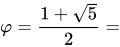
It is the basis of a spiral figure, too, though it’s not quite the same as the “Golden Spiral,” which itself is defined as “a logarithmic spiral whose growth factor is φ, the golden ratio. That is, a golden spiral gets wider (or further from its origin) by a factor of φ for every quarter turn it makes.  And that factor is one that satisifes the quadratic equation

φ²=φ+1

1.618033988749….  (this is an irrational number, like pi or e. 

But we’re talking about the Fibonacci spiral, which is this:

Another approximation is a Fibonacci spiral, which is constructed slightly differently. A Fibonacci spiral starts with a rectangle partitioned into 2 squares. In each step, a square the length of the rectangle’s longest side is added to the rectangle. Since the ratio between consecutive Fibonacci numbers approaches the golden ratio as the Fibonacci numbers approach infinity, so too does this spiral get more similar to the previous approximation the more squares are added, as illustrated by the image.

And how it’s constructed: you see here the rectangle with added squares, and how a spiral that touches each junction between the squares becomes the Fibonacci spiral.

FakeRealLogSpiral.png: Cypderivative work: Silverhammermba & Jahobr, CC BY-SA 3.0 via Wikimedia Commons

But on to the cats, which, according to this article from Bored Panda, occasionally form themselves into something approximating a Fibonacci spiral:

And one from reddit:

***************

I thought of cheetahs as a solitary cat, but Wikipedia says that this is not exactly true:

Cheetahs have a flexible and complex social structure and tend to be more gregarious than several other cats (except the lion). Individuals typically avoid one another but are generally amicable; males may fight over territories or access to females in oestrus, and on rare occasions such fights can result in severe injury and death. Females are not social and have minimal interaction with other individuals, barring the interaction with males when they enter their territories or during the mating season. Some females, generally mother and offspring or siblings, may rest beside one another during the day. Females tend to lead a solitary life or live with offspring in undefended home ranges; young females often stay close to their mothers for life but young males leave their mother’s range to live elsewhere.

Some males are territorial, and group together for life, forming coalitions that collectively defend a territory which ensures maximum access to females—this is unlike the behaviour of the male lion who mates with a particular group (pride) of females. In most cases, a coalition will consist of brothers born in the same litter who stayed together after weaning, but biologically unrelated males are often allowed into the group; in the Serengeti, 30% of members in coalitions are unrelated males.

Here’s a BBC Earth video showing a group of cheetahs filmed in Maasai Mara park in Kenya. There are eight: five males (clearly from a “coalition), one female, and her two cubs. The males are obviously competing with each other for access to the females. What beautiful cats!

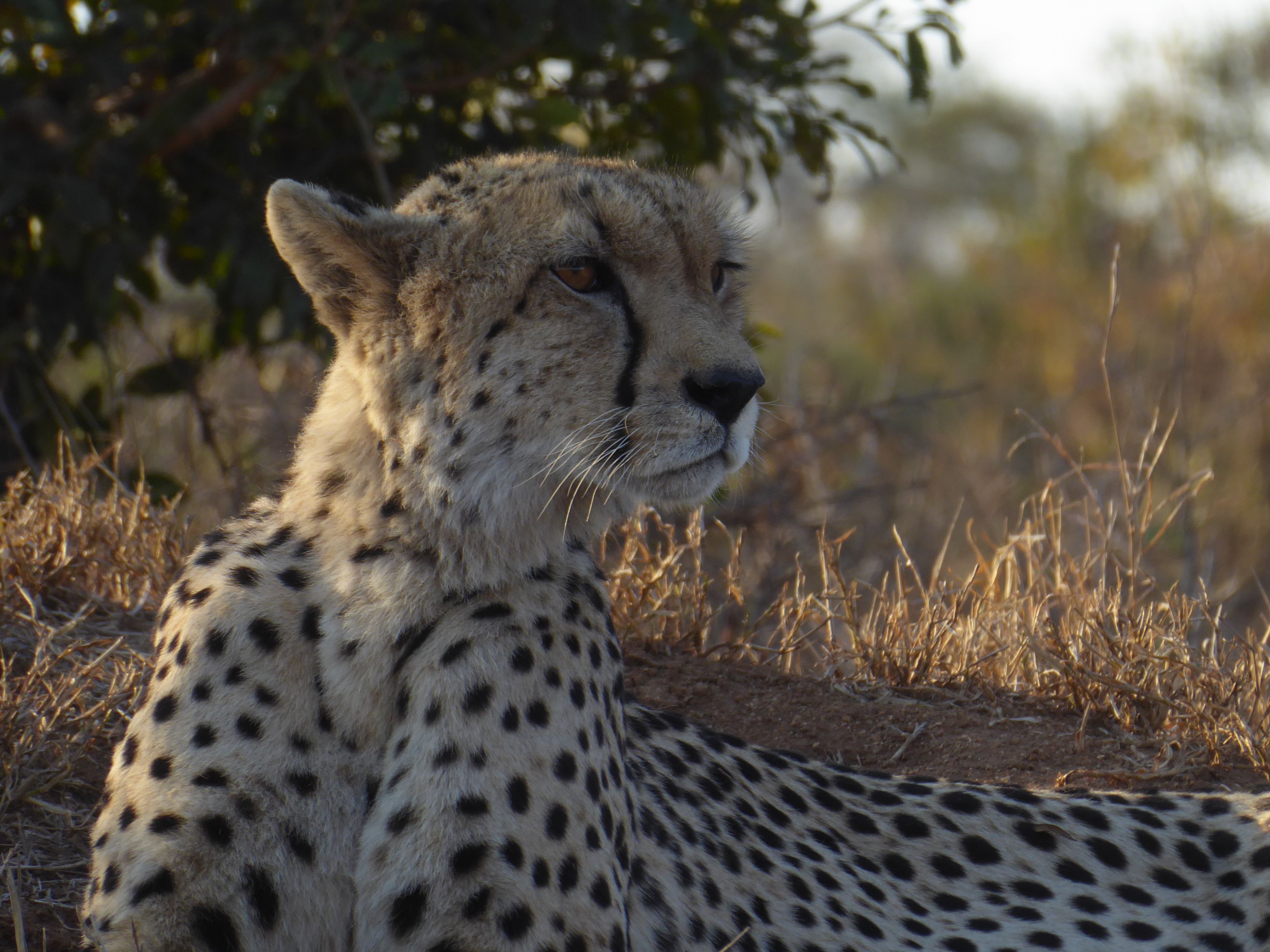
Just to throw this in, here’s a wild cheetah that I photographed when I visited Manyeleti Game Reserve earlier this year. You can see how tame they can be around humans from this photo, taken with a zoom lens on a point-and-shoot camera from an open vehicle. Clearly the cats are used to the human presence.

***************

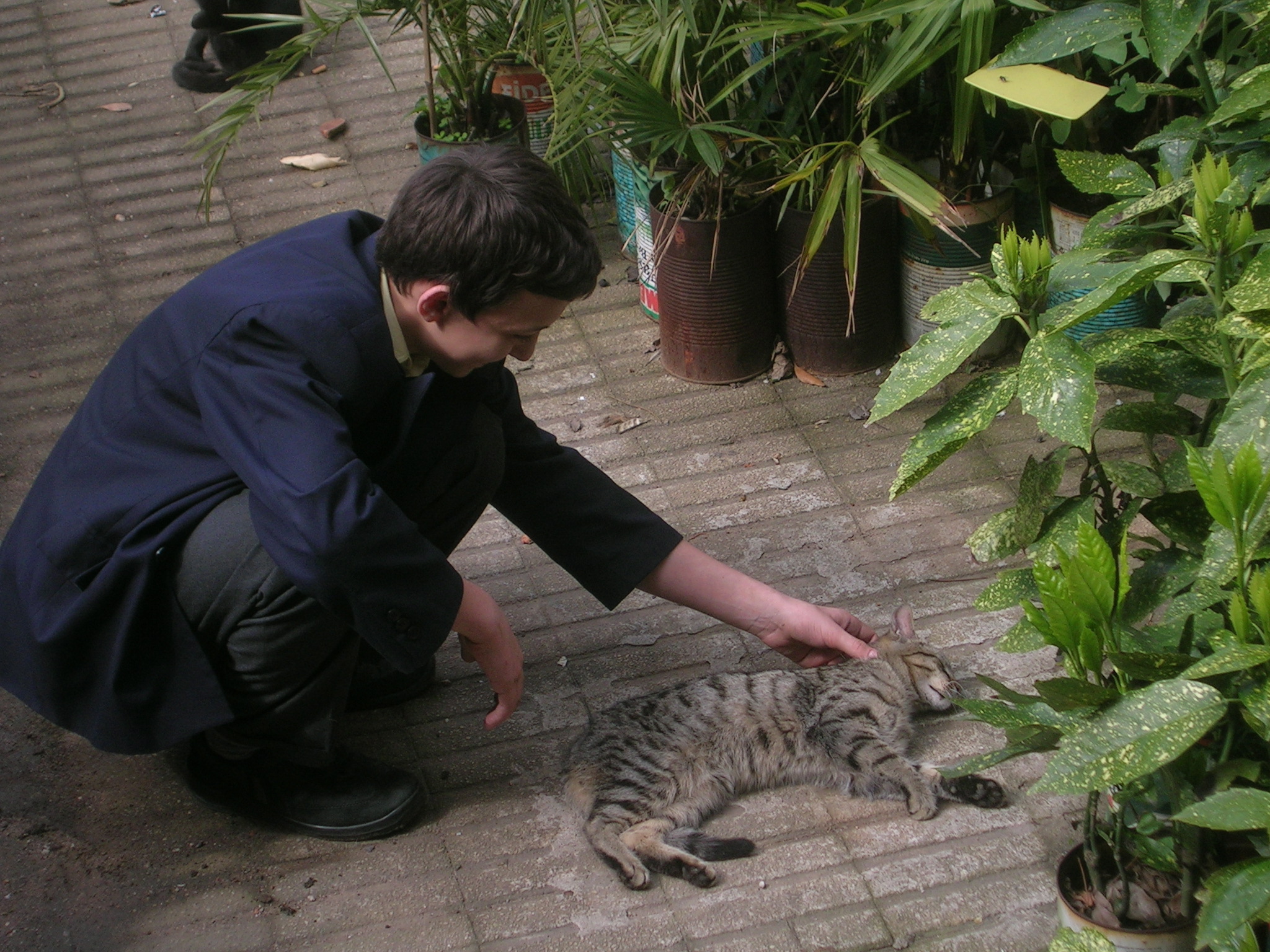
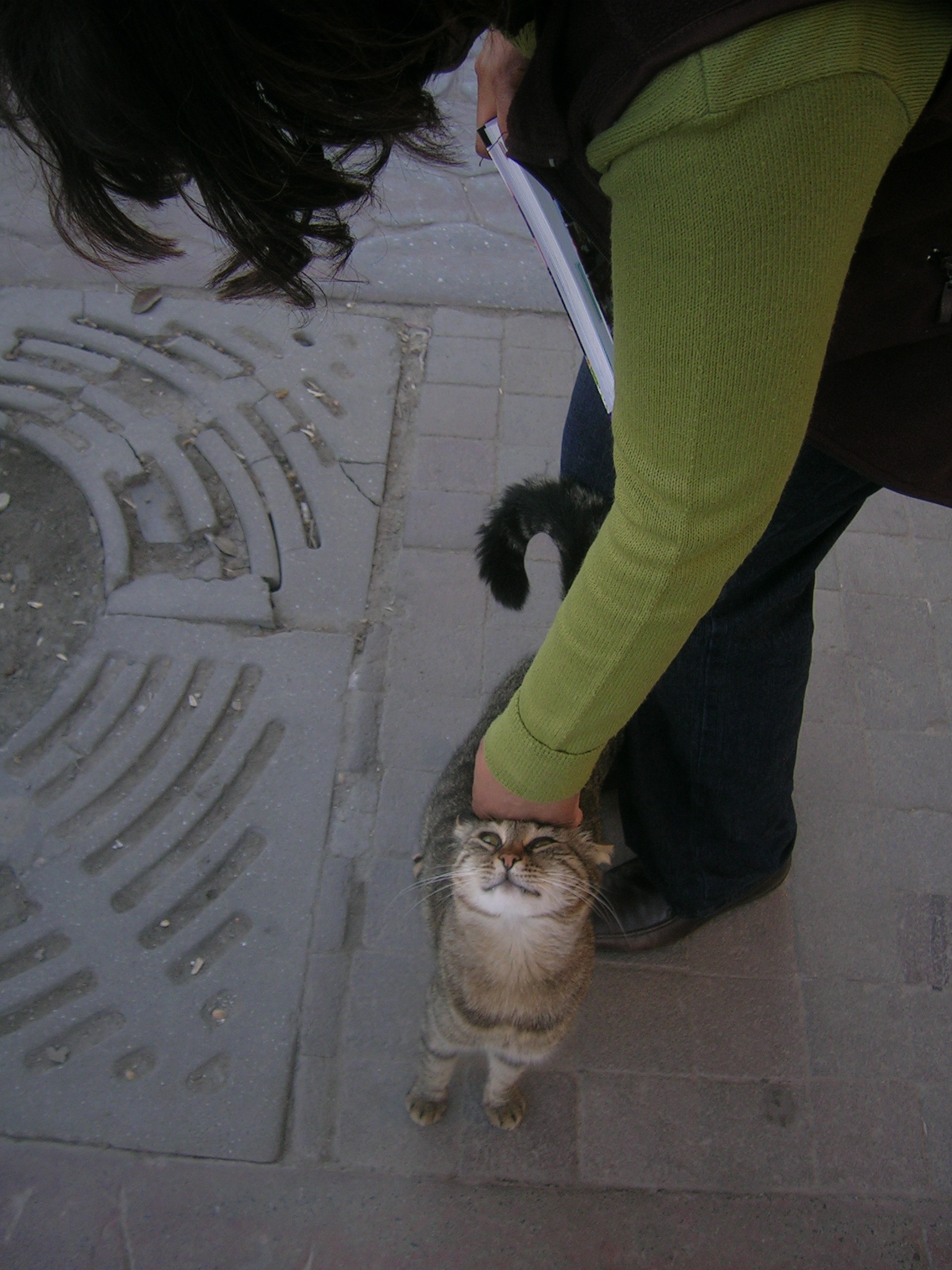
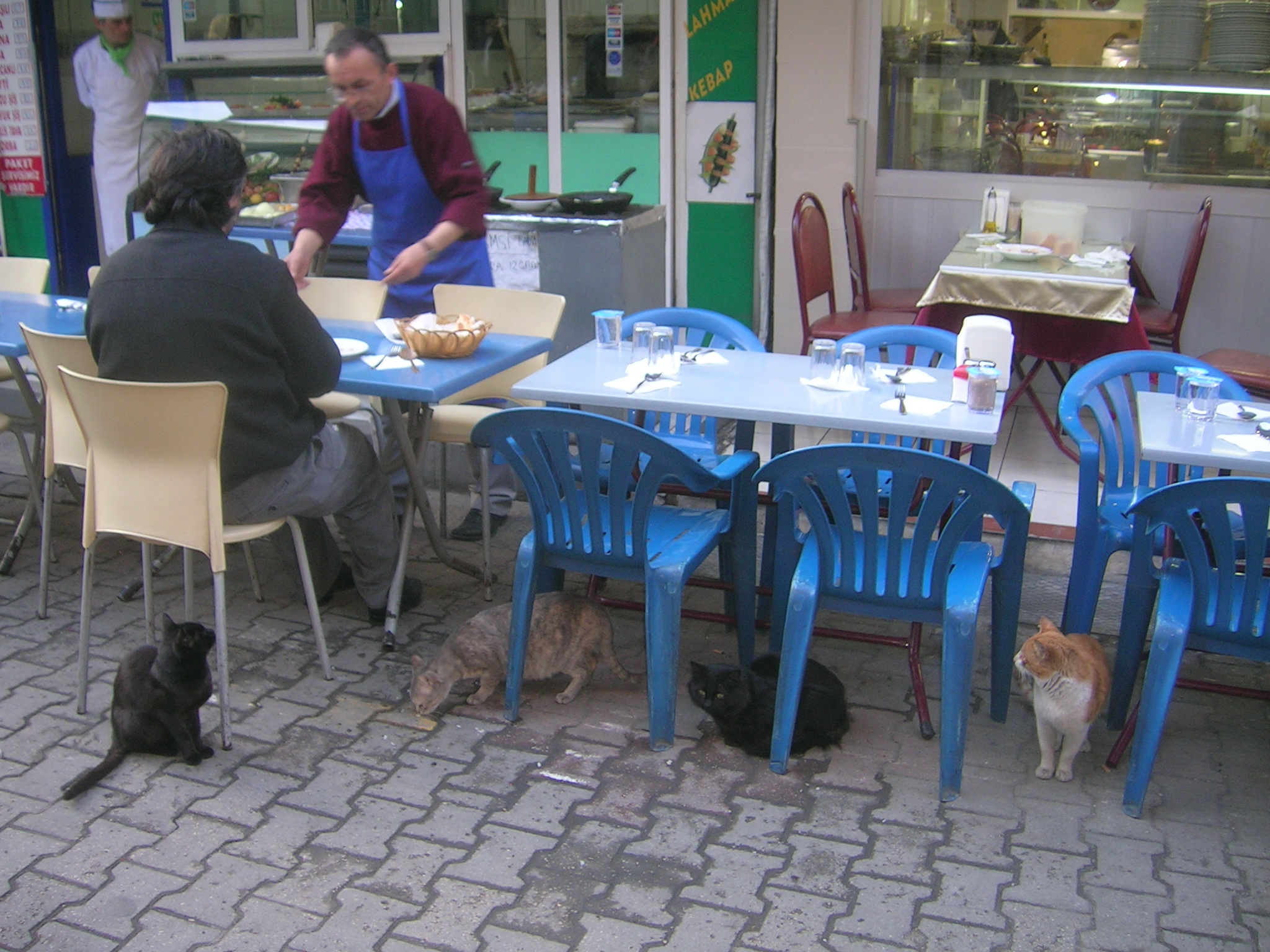
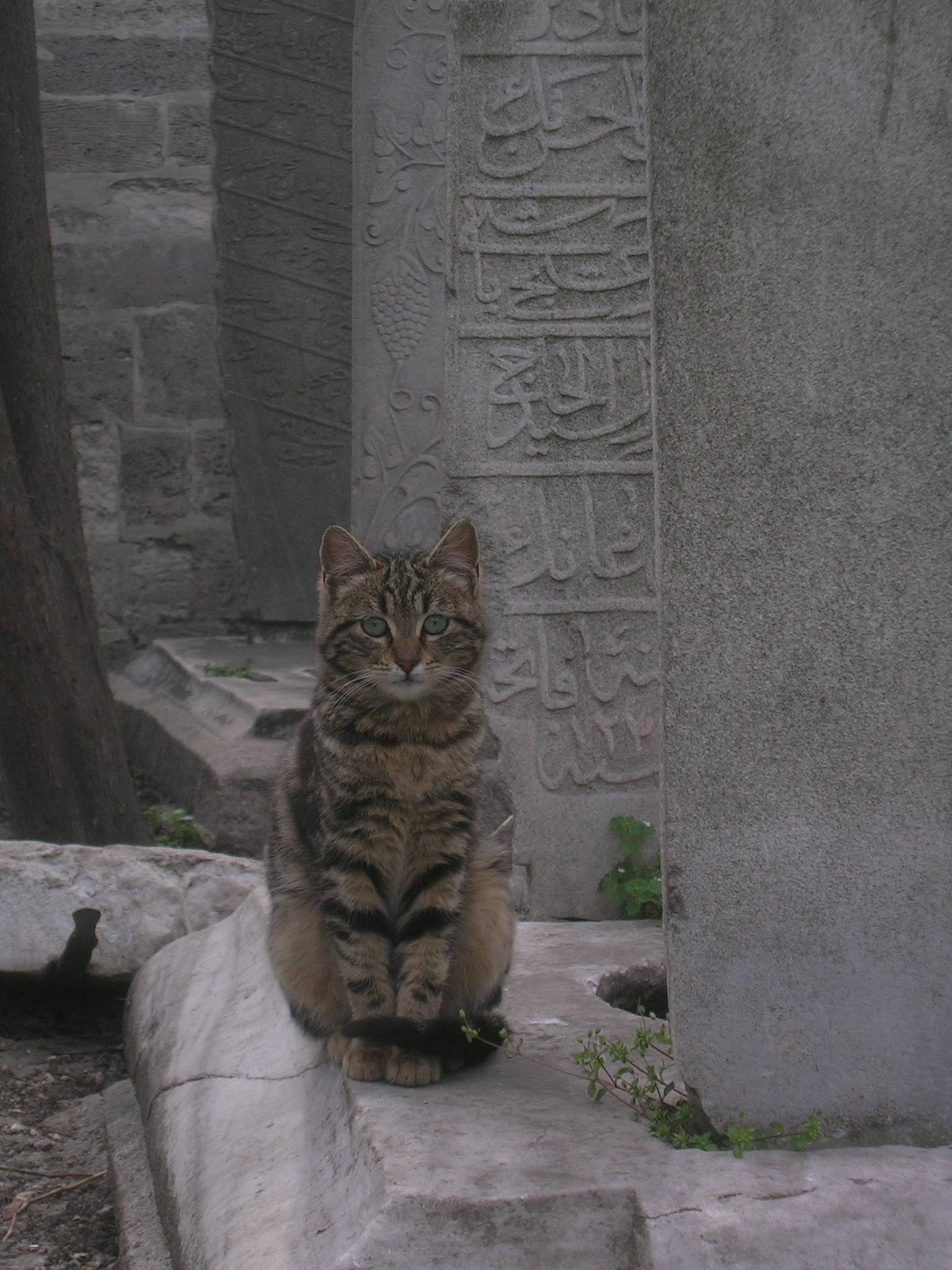
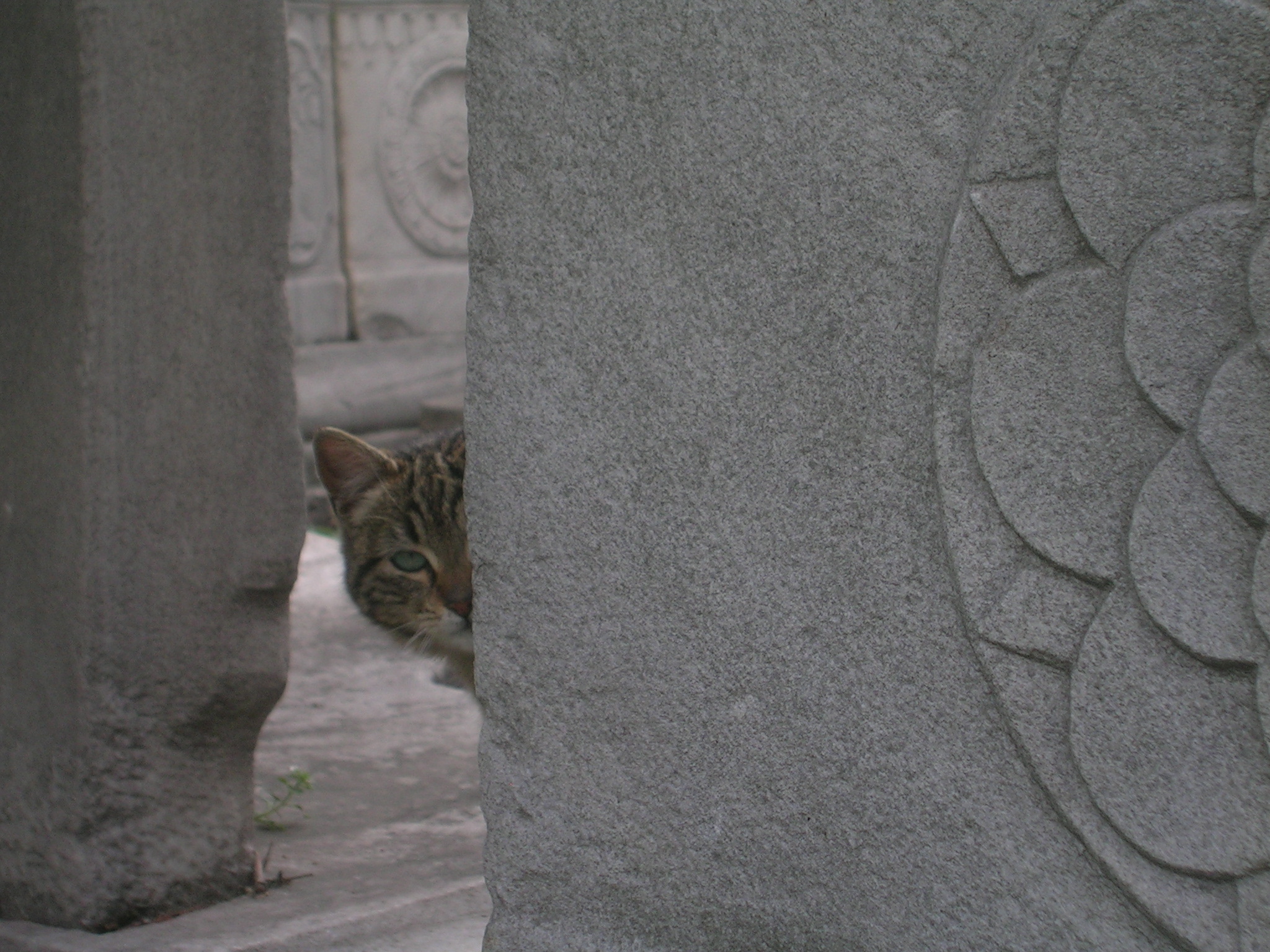
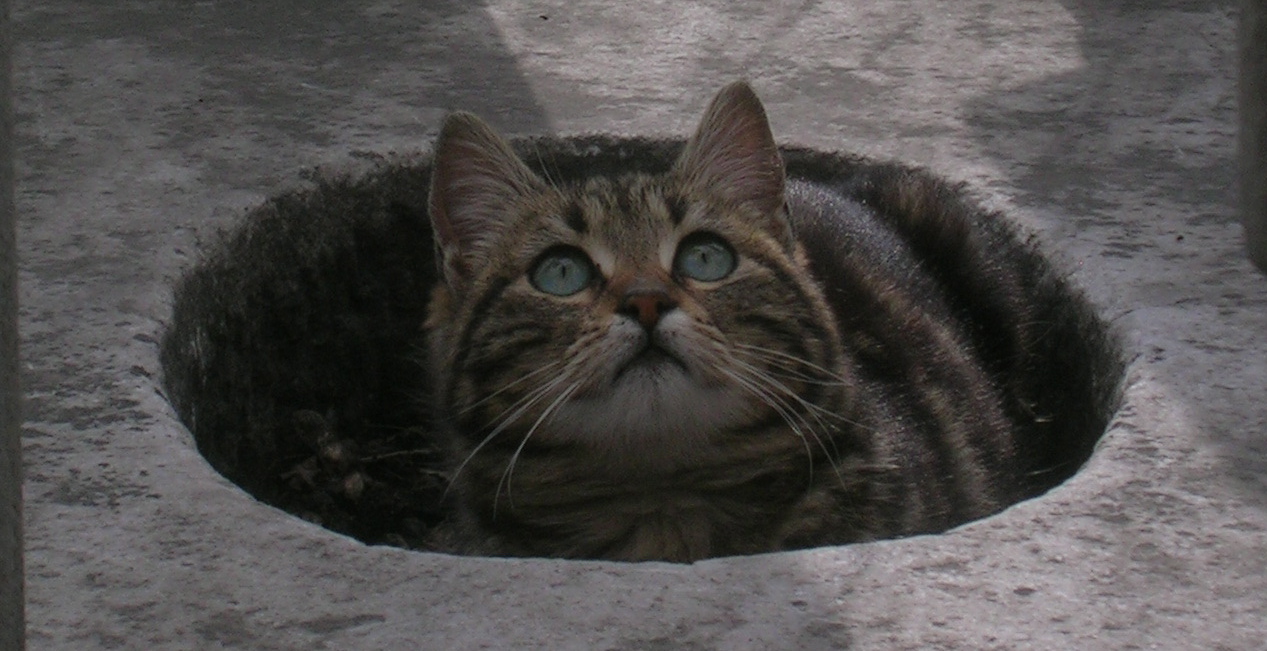
Everywhere She Travels, a lovely website written by Canadian traveler Caitlin Mundy, has a guide to the friendly cats of Istanbul, I will just use Catlin’s text and illustrate her words with my own photos of Istanbul, taken in April, 2008. Catilin’s text is indented.

This is all true!

If you’re heading to Turkey for your next trip, I sure hope you’re an animal lover! In particular, a cat lover. Not only will you find lots of cats wandering all over the streets of Istanbul, affectionately nicknamed Catstanbul, but you can find them in cities and towns all over the country too! From the back corner of a mosque, to perched on top of a pole, walking on a ledge, or sitting in a store window, cats are everywhere. Seriously, you’d be hard pressed to make it more than 10 minutes without seeing one. And not only are there a lot of them, they might just be the friendliest cat population in the world! Just bend down near one, and chances are it will be running over for pets. So, if you have a love of animals, then Istanbul is certainly a special place to visit.

If you want to see a wonderful movie about the cats of Istanbul, find the movie Kedi (“cat” in Turkish), which has a Rotten Tomatoes rating of 98% from the critics. Somehow filmed at the level of a cat’s eyes, it is a mesmerizing documentary—even if you don’t like cats.

Another time cats love to approach people, is when they are sitting at a restaurant. Several times throughout the 5 days I spent in Istanbul a cat wandered up to me while I was sitting at a restaurant and made his/herself at home. This was always a welcome surprise for me, though it did make eating a little difficult sometimes.

I believe this is a Turkish Van cat with odd-colored eyes:

On my first night in Istanbul, I met some girls at Cheers Hostel who had been in the city for a few days at that point. I decided to join them in visiting the Hagia Sophia at night, to avoid the long daytime lines. While wandering around, I noticed a sweet cat cuddled up under a table. My first (of many) indoor cat sightings! I went to find my new friends to point her out. Look how cute, there’s a cat in here! I said. They smiled politely and told me they weren’t surprised. There are cats everywhere here. As an avid cat lover myself, this came as great news. And throughout my trip, I made sure to pet and photograph as many cats as I could.

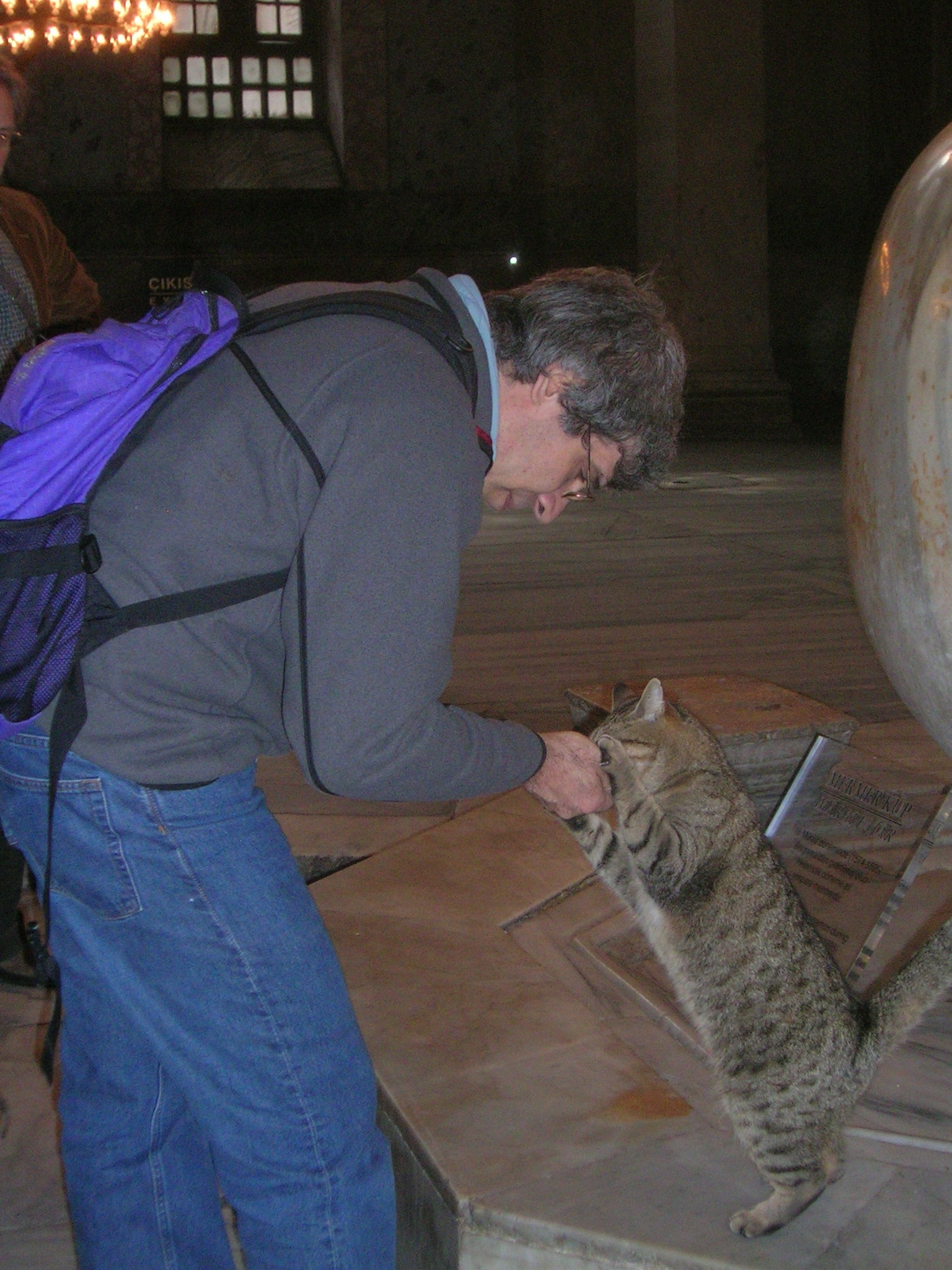
I did, too! In the Hagia Sofia they might have seen Gli, who died in 2020, and whom I was fortunate enough to meet (and feed; see below):

Now you might wonder, with so many stray cats, what kind of shape could they be in? The answer is excellent. Walking around Istanbul on my first full day, I immediately noticed how healthy all the cats looked. If I had seen any one of them on the street somewhere else, I would have guessed they were a well loved pet cat way before I would have guessed a stray. But, in a way, they’re both. They may be strays but they are definitely well loved too and seem to be, in general, quite happy cats.

To pull from the popular saying it takes a village to raise a child, in Turkey it takes a village to care for a cat. And it’s true, the whole community seems to step up and look out for these cats! From restaurant owners, to friendly neighbors, and people out for a walk, it seems like just about everyone has a sweet spot for these adorable Turkish cats.

The first clue of this is the abundance of water bowls, small containers of cat food, and little cat houses found outside restaurants, in public parks, and next to people’s homes. These cats are certainly not going hungry or lacking a cozy place to curl up for a nap.

. . . .With all the kindness shown to these beautiful felines, it makes sense that they are friendly in return! I mean, if you are used to receiving pets, treats, and love from humans, why wouldn’t you seek them out? One of my first moments interacting with a cat in Istanbul started with me trying to take a photo. The sweet little white and black cat was standing on a rock near the river, so I bent down to get a good shot. She immediately ran over, climbed onto the purse hanging off my shoulder, made herself comfortable and started purring. After a few moments of crouching down and petting her, I moved over to the rock. We sat there together for at least 20 minutes, while I fantasized about bringing her home with me.

Yep, this is me with a friendly Istanbul moggy!

Me petting Gli, the late but very famous cat who dwelled in the Hagia Sofia. Like many residents, I carried a bag of dry cat food around with me, and Gli got some:

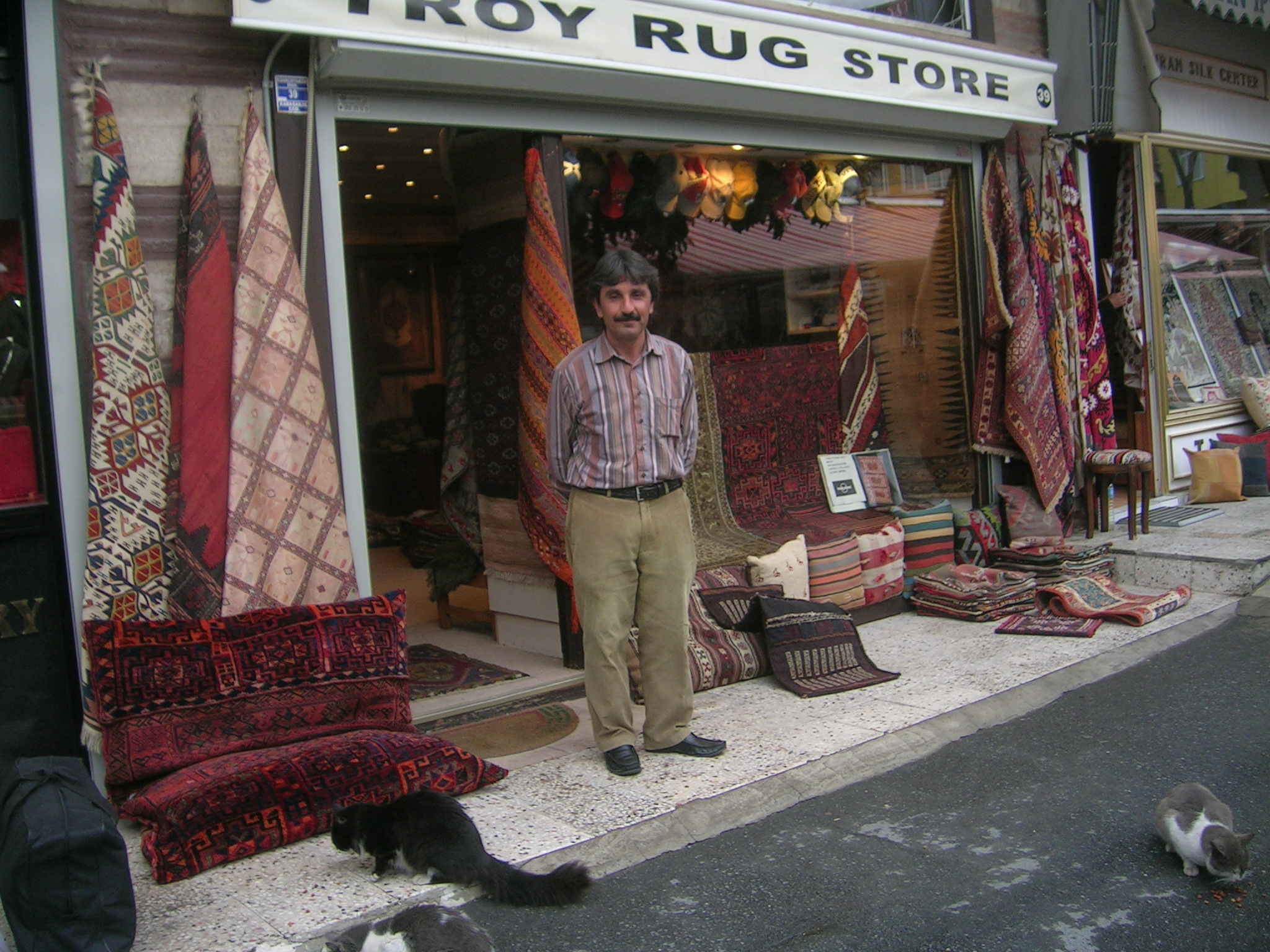
And of course I was lured to this rug shop, and the rest is history: I bought several small rugs from this guy, which were beautiful (like the cats):

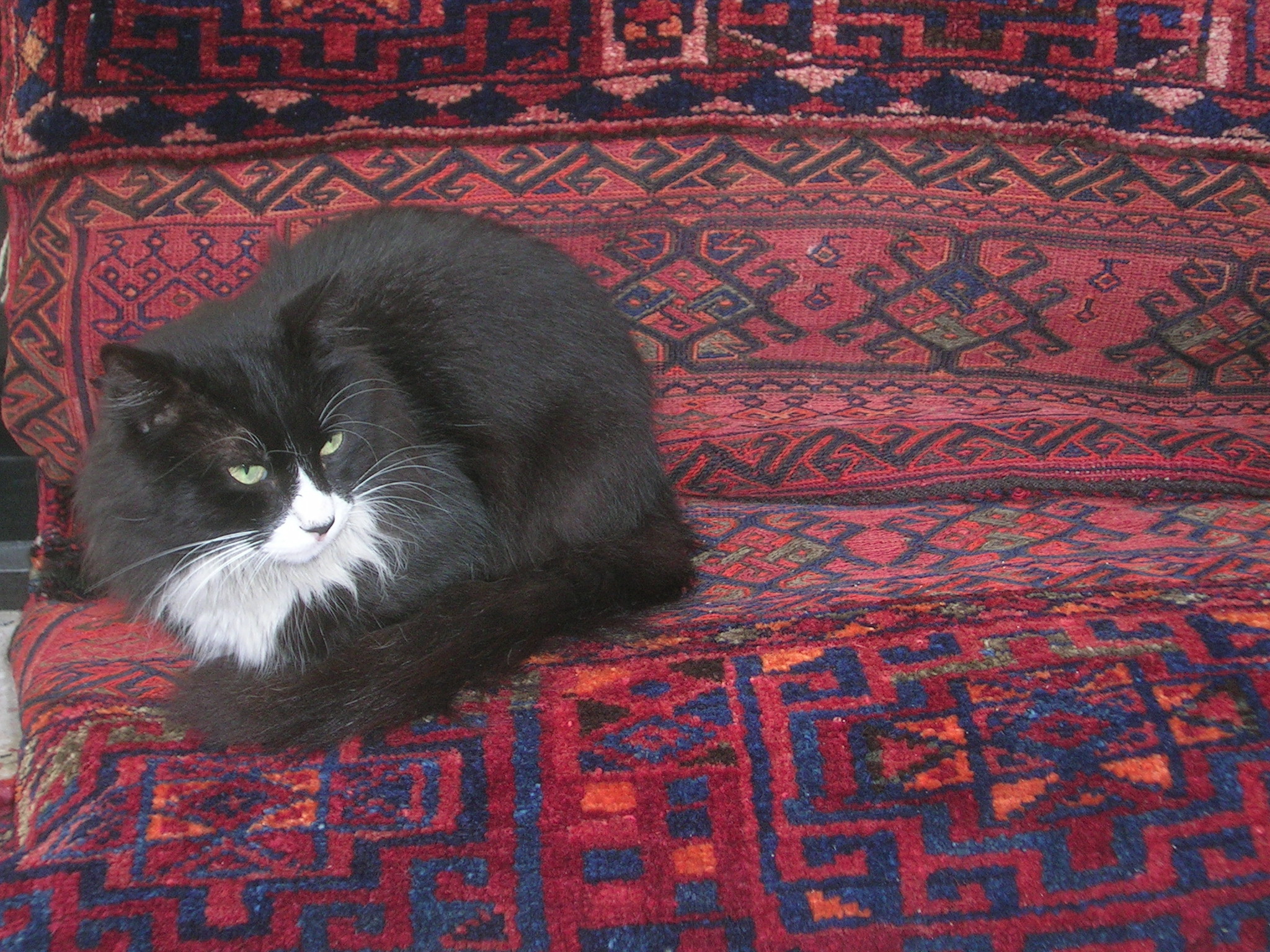
Having cats around your store is a sure way to lure in ailurophilic tourists!

Part of the affection towards cats in Istanbul, and Turkey as a whole, can be attributed to Islamic culture. In Islam, cats are admired for their cleanliness. Since they are seen as clean animals, they are welcome in people’s homes, as well as into mosques. In fact, it’s even considered acceptable to use water from a bowl a cat has drank from for religious purposes, or to eat food from the same bowl as a cat.

The connection between Islam and cats dates back to the time of the prophet Muhammad. Muhammad is said to have been a cat lover himself. In particular, he had a cat named Muezza who he loved dearly. A famous story about Muezza says that one day she was sleeping on the sleeve of Muhammad’s prayer robes. Instead of disturbing her in her slumber, he simply cut off the sleeve of his robe before going to pray. Clearly this story has set a precedence for how cats are treated, even today.

Mosque cats (see Gli above):

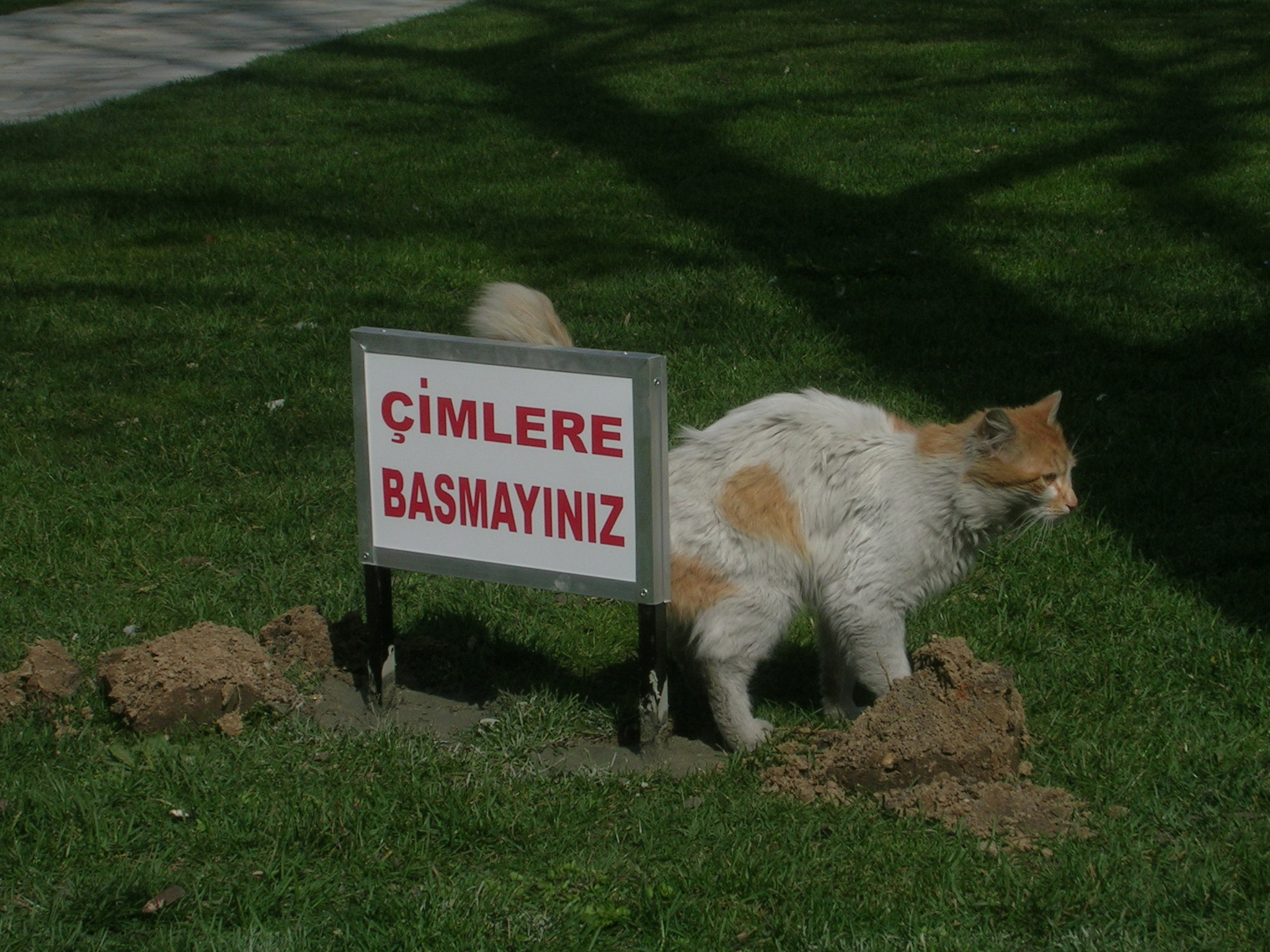
This cat doesn’t look like it’s in as good a shape as the others (you’ll notice the rest of them, which are feral, are nonetheless looking good). This was on the grounds of a mosque, and the Turkish reads “Do not step on the grass.” But of course that doesn’t apply to cats, nor does it apply to urination!

h/t: Michael

Caturday felid trifecat: Three-year courtship of a feral cat; “Schrödinger’s Cat” experiment maintains superposition state for a record period; Florida cat and its staff discovers a new virus; and lagniappe

November 9, 2024 • 9:45 am

Yes, I deliberately misspelled “trifecta” in the heading (actually, it was a typo, but turned out to be appropriate).  First is a short video from The Dodo about a woman who tamed a very wary feral cat—with her hair! It took three years.

The mystery is why Spooky liked the smell of the woman’s hair but was wary of the smell of her body.

*******************

And an article from IFL Science (you know what the “IFL” stands for) discussing an experiment by seven Chinese researchers who created a superposition state lasting for 23.3 minutes. You probably remember that the Schrödinger’s Cat thought experiment involved an implication of the “Copenhagen interpretation” of quantum mechanics.  Here’s a description of the experiment by Wikipedia and a drawing of it:

In Schrödinger’s original formulation, a cat, a flask of poison, and a radioactive source are placed in a sealed box. If an internal radiation monitor (e.g. a Geiger counter) detects radioactivity (i.e. a single atom decaying), the flask is shattered, releasing the poison, which kills the cat. The Copenhagen interpretation implies that, after a while, the cat is simultaneously alive and dead. Yet, when one looks in the box, one sees the cat either alive or dead, not both alive and dead. This poses the question of when exactly quantum superposition ends and reality resolves into one possibility or the other.

Although originally a critique on the Copenhagen interpretation, Schrödinger’s seemingly paradoxical thought experiment became part of the foundation of quantum mechanics. The scenario is often featured in theoretical discussions of the interpretations of quantum mechanics, particularly in situations involving the measurement problem. As a result, Schrödinger’s cat has had enduring appeal in popular culture. The experiment is not intended to be actually performed on a cat, but rather as an easily understandable illustration of the behavior of atoms. Experiments at the atomic scale have been carried out, showing that very small objects may exist as superpositions; but superposing an object as large as a cat would pose considerable technical difficulties.

The “Copenhgagen interpretation” of quantum mechanics, the one held by Bohr, Heisenberg, and many other founders of the field, sees q.m. as inherently indeterministic, involving only probabilities that certain states will occur. Schrödinger apparently thought the idea that a cat could be in a superposed state of being both alive and dead at the same time was ludicrous, so the feline Gedankenexperiment was really a critique of the Copenhagen interpretation. But it’s become part of the Copenhagen interpretation as far as I understand, with the boxed cat both alive and dead at the same time, and the superposition (wave function) resolved only when the cat is observed when the box is opened.

There are other interpretations of this experiment, notably the “many-worlds” theory, in which there is no superposition, but a splitting of the universe when the experiment is conducted, with the cat alive in one universe and dead in the other.  Don’t ask me which interpretation is “right”!

(Caption and attribution from Wikipedia): Schrödinger’s cat: a cat, a flask of poison, and a radioactive source connected to a Geiger counter are placed in a sealed box. As illustrated, the quantum description uses a superposition of an alive cat and one that has died. Dhatfield, CC BY-SA 3.0, via Wikimedia Commons

No cats were superposed in any experiments. But according to the experiment described below, the experiment was performed on an isotope of the metallic element Ytterbium, kept in superposition (having opposite spins at the same time) for over 23 minutes. IFL Science gives a summary (click headline to read):

Excerpt:

States in quantum superposition are notoriously fragile but researchers in China have reported creating such a state that lasted for a whopping 23 minutes and 20 seconds. This record-breaking result is exciting in itself but the team believes that it could open new ways to high-precision measurements and even information processing for quantum computers – possibly even allowing scientists to probe the limits of physical theories.

The study, which is yet to be peer-reviewed, conducted by scientists at the University of Science and Technology of China, saw 10,000 atoms of ytterbium cooled down to a few thousandths of a degree above absolute zero and trapped using light. Each atom could be controlled with great accuracy and was put into the superposition of two very different spin-states. This is known as a “quantum cat” state.

In the famous Schrödinger’s cat thought experiment, we see a cat closed in a box with a poison activated by a random quantum process. Without opening the box we cannot ascertain the state of the cat, so it is both alive and dead, two contradictory states in the non-quantum reality we experience. In the quantum world, quantum cat states are superpositions where a quantum state can exist in several ways at once, although it’s impossible to tell which one it really is so it’s effectively all of them at once.

In the new experiment, it is the length of this quantum cat state that is astounding. In nature, the superposition will collapse into one or the other in a fraction of a second, but here it persisted for 1,400 seconds. The team thinks that with a better vacuum system, it can be made to last even longer.

“It’s a big deal because they’re making this beautiful cat state in an atomic system and it’s stable,” Barry Sanders, from the University of Calgary who was not involved in the study, told New Scientist. “A probe gets jiggled and pushed and nudged and prodded, and then by seeing what happens, you learn about the things that interact with it.”

Here’s a screenshot of the paper’s title from Arχiv (click to read). I’ve put its abstract below, but good luck understanding it!

The abstract:

Quantum metrology with nonclassical states offers a promising route to improved precision in physical measurements. The quantum effects of Schr{ö}dinger-cat superpositions or entanglements allow measurement uncertainties to reach below the standard quantum limit. However, the challenge in keeping a long coherence time for such nonclassical states often prevents full exploitation of the quantum advantage in metrology. Here we demonstrate a long-lived Schr{ö}dinger-cat state of optically trapped 173Yb (\textit{I}\ =\ 5/2) atoms. The cat state, a superposition of two oppositely-directed and furthest-apart spin states, is generated by a non-linear spin rotation. Protected in a decoherence-free subspace against inhomogeneous light shifts of an optical lattice, the cat state achieves a coherence time of 1.4(1)×103 s. A magnetic field is measured with Ramsey interferometry, demonstrating a scheme of Heisenberg-limited metrology for atomic magnetometry, quantum information processing, and searching for new physics beyond the Standard Model.

***************

Finally, one more example, from ZME Science, of a cat aiding scientific discovery. This wouldn’t have happened if the cat’s staff didn’t include a scientist, which helped identify a new virus in a mouse caught by his moggie. Click to read:

An excerpt:

It’s not uncommon for cats to bring home “spoils” from their hunt — usually a mouse, lizard, or some other unlucky creature. So, it wasn’t a shock when Pepper, a Florida cat, came back with a cotton mouse (Peromyscus gossypinus). But Pepper’s owner, John Lednicky, is a microbiologist and virus hunter at the University of Florida. So rather than toss out the rodent, Lednicky brought it to his lab. And there, he made an unexpected discovery: a previously unknown virus.

. . . Lednicky and his team initially tested the mouse to see if it carried mule deerpox virus (MDPV), a pathogen that has recently spread through Florida and a few other US states. Instead, they discovered something completely new.

By using next-generation sequencing technology, the researchers decoded the virus’ genome and classified it within the paramyxovirus lineage.

Paramyxoviruses belong to a larger group called Jeilongviruses. This family includes viruses responsible for measles and mumps in humans, as well as severe animal diseases like Hendra and Nipah. The newly identified virus, named GRJV1, exhibited an ability to infect various mammalian cell types, from rodents to humans. This broad “cell tropism” suggests the virus could potentially spill over from animals to humans or other mammals, which raises some concerns.

The lesson: don’t handle wild mice! And don’t buy mice in the wet market!

Here’s a three-minute video of the discovery:

***************

Lagniappe:  A 6-7 year old injured street cat makes a miraculous recovery:

h/t: Ginger K.

Caturday felid trifecta: Brian Cox vs. Robin Ince: Which is better, cats or dogs?; three-legged lion and brother swim across dangerous waters; scientific tails about cats; and lagniappe

October 19, 2024 • 9:50 am

Here’s a 45-minute BBC podcast of The Infinite Monkey Cage featuring physicist Brian Cox and comedian/actor Robin Ince, joined by others, arguing about the relative merits of cats and d*gs.  Here’s the BBC summary.

Brian Cox and Robin Ince sniff and paw their way through the evidence to put to rest the age-old debate of whether cats are better than dogs. They’re joined by TV dragon and dog devotee Deborah Meaden, comedian and cat compadre David Baddiel, evolutionary scientist Ben Garrod and veterinarian Jess French. They learn how the domestication of our four-legged companions by humans has had a profound impact on their physiology, temperament and methods of communication. They debate which species is the most intelligent and skilled and try to lay to rest the most important question of all – which one really loves you?

Click on the title below to access the podcast.

Veterinarian Jess French is, in my view, the most eloquent exponent for cats, which, of course, is the best of the two species. The voice vote at the beginning shows, as it did during our Cat-vs-D*g debate for the New Yorker, that the audience is biased towards cats, for people want to be constantly loved by an animal.

But Listen to Jess French at 7:01, giving the reason she favors cats, which comports with my own view. Dogs are obsequious, while cats decide when to spend time with you—and that is more like what humans do. (French is also a television presenter and a well known author of children’s books on nature and animals).There is plenty of biology (and some evolution) involved, but of course it being the Monkey Cage, there’s plenty of humor as well.

In the end the participants have to choose. One person equivocates, one votes for cats, and one points out that cat owners don’t live as long as d*g owners. But a voice vote again is for d*gs, which is sad. In the end, they talk about their favorite other species, and you’ll want to hear French talk about the scariest animals she’s ever treated.

It’s a good episode and well worth listening to for a Saturday morning laugh-and-learn

************************

From ScienceAlert we have a story and a video about two lion brothers, one with a missing leg, crossing a crocodile- and hippo-infested river in Uganda. Click the headline to see, and there’s a video below:

Excerpts:

A pair of lion brothers have been captured on video taking a death-defying 1-kilometer (0.6-mile) swim across a Ugandan river packed with predators – a sign of increasing human-caused pressures forcing animals to take more risks.

The brothers, Jacob and Tibu, crossed the Kazinga Channel at night. It’s the first visually documented long-distance swim for African lions (Panthera leo), and it involved a couple of false starts.

Researchers recorded potential predators possibly trailing the lion duo before they successfully made it across. In collaboration with the Uganda Wildlife Authority, the international team tracked their movements using heat-detecting drone cameras.

“Lions are known to hunt both crocodiles and hippos on occasion, but when in water they themselves become vulnerable,” the researchers write in their published paper.

“River crossings in Africa come with considerable risk of injury, or even death, from encounters with the much larger Nile crocodile or hippopotamus.”

The video (there is not much video of the swim, so watch carefully near the end):

They made it! A bit more:

“The fact that he and his brother Tibu have managed to survive as long as they have in a national park that has experienced significant human pressures and high poaching rates is a feat in itself,” Braczkowski adds.

The reason for Jacob and Tibu’s adventure? Most likely, finding females to mate with. However, this is less a story of romantic courage, and more a sobering tale about a lion population that has been decimated by poaching and expanding human activity across Queen Elizabeth National Park.

“Our science has shown this population has nearly halved in just five years,” says Braczkowski.

Indeed, there is a road bridge that the lions could’ve used more safely – but conservationists think that the presence of people on and around the bridge, which is currently being guarded by the Uganda Peoples’ Defense Force, would’ve put the brothers off using it.

Instead, researchers have observed lions choose the far-riskier, croc- and hippo-infested lake channel crossing six times.

. . . “Competition for lionesses in the park is fierce and they lost a fight for female affection in the hours leading up to the swim, so it’s likely the duo mounted the risky journey to get to the females on the other side of the channel,” says Braczkowski.

The research has been published in Ecology & Evolution.

Here’s the paper: click to read:

****************************

ListVerse gives 10 heartwarming and “scientific” stories about cats, many accompanied by videos. Click below to read, and I’ll show a few of the videos:

A contraceptive vaccine for feral cats, easier than trapping and neutering:

Cats sitting in squares:

Exceptional visual perception and brain wiring are why cats love sitting in 2D squares or other shapes, even if those shapes are incomplete (i.e., four cut-outs placed apart from each other in the shape of a square).

The fact that these appear to create an enclosed form is the Kanizsa square illusion, exploiting our brain’s tendency to fill the gaps and see contours that aren’t there. The same thing occurs in the cat’s mind, meaning your kitty will likely love a flat, incomplete square as much (or almost as much) as a fresh, cozy box.

If you have a cat, you may have noticed that they have whiskers on their legs. But what are whiskers for?

Cats don’t just have whiskers on the whiskers part of their bodies. They also have whiskers on the non-whiskers part of their bodies, including the back of their legs. These are called carpal vibrissae because carpus means wrist, and vibrissae is the fancy Latin scientific word for whiskers, or technically nose hairs.

Like the whiskers around their snouts, these vibrissae aren’t just to tickle you; they’re sensory organs used for sensing a cat’s surroundings. They can detect tiny movements, such as air pressure changes and the surrounding environment, to help cats navigate their world and achieve their superb feline agility. By using these wrist whiskers, as it were, cats can feel surfaces and objects, giving them better spatial awareness, environmental orientation, and hunting skills.

And a new breed of cat with unusual fur:

The universe released a new cat type, recently described by science, in May 2024. This rare, domestic Finnish feline has a novel coat pattern called “salmiak,” and it’s kind of a cookies-and-cream vibe. People in Finland began noticing the pattern emerging around 2007, noting that instead of conventional tuxedos, these black-and-whites rocked a color gradation, like a sprinkling of salt and pepper. The ombré effect occurs as the fur grows lighter from root to tip, from black to white.

To make it official, scientists identified the genetic mechanics in the journal Animal Genetics as “a 95-kb deletion downstream of the KIT gene.” Ah, of course, that makes so much sense! In more understandable terms, a missing piece of DNA leads to the “salmiak” coat type, named after a popular type of Finnish salty licorice. Because Finnish people love licorice for some reason. But they love cats, too, so it evens out

********************

Lagniappe:  Cats in a Japanese cat cafe react to a 2018 earthquake. I’m betting they started reacting before humans detected the quake, and they flee quickly.

h/t Barry, Bill