Why Evolution is True is a blog written by Jerry Coyne, centered on evolution and biology but also dealing with diverse topics like politics, culture, and cats.
I found the story of Kiddo the Cat in the tweet below (you can click “read more” to see it), and at the Smithsonian’s site “Kiddo the cat, reluctant aviator” (click headline to read). The short version: Kiddo was onboard the first airship trying to cross the Atlantic. But the airship failed and had to ditch into an attached lifeboat. Kiddo was also lowered into the lifeboat; all mammals were rescued; and Kiddo became a hero. Click to read:
An excerpt:
On October 15, 1910, Kiddo the cat became the first of his kind to attempt to cross the Atlantic Ocean by airship—and he wasn’t very happy about it.
When aeronaut Walter Wellman’s America airship was preparing for take-off from Atlantic City, New Jersey, Kiddo was found in the airship’s lifeboat. The wide-eyed grey tabby was not pleased about his unexpected journey, and his howling annoyed the airship’s chief engineer, Melvin Vaniman. (The duo seemed to have made-up after their spat—enough to pose for a photo together, at least.)
The America was the first airship to have radio equipment. Kiddo has the distinction of being the subject of the first ever radio communication from an aircraft in flight: “Roy, come and get this —damn cat.”
The 71 hours that Kiddo and the rest of the crew spent in flight were fraught with storms and engine failure. After traveling just over 1,300 miles from their launch point, the America sent out a distress signal. Kiddo and the crew were evacuated via the airship’s lifeboat on to a Royal Mail steamship. The America—no longer weighed down by the boat, crew, and cat—drifted away and eventually crashed off the coast of Maryland.
According to the airship’s navigator, Murray Simon, Kiddo preferred the sea-faring portion of the journey; he described Kiddo as perched on the lifeboat’s sail, “washing his face in the Sun, a pleasant picture of feline content.”
Despite not making it across the Atlantic, the America did break the record for the longest sustained flight. Kiddo returned to dry land a hero (and even got to meet his adoring public during his brief residency in a gilded cage filled with pillows at a New York City department store) and retired from the aviation field, going to live with one of Wellman’s daughters. The crew credited Kiddo and his nine lives with helping them survive the perilous journey.
Kiddo’s escape vehicle, the America airship lifeboat, became part of the Museum’s collection in 2010.
The tweet. Click “see more to get the whole story.”
. . . and here’s a video of Kiddo and the airship:
***********************
Simon’s Cat hasn’t made an appearance here in a while, but this two-minute video shows the moggy getting his Christmas present, which happens to be loaded with catnip. The cat gets baked and causes havoc!
***************************
I should have realized that animals other than humans get dementia, but how do we know it? Well, SCIENCE has figured it out, and the signs of dementia in your cat are given in this article from The Conversation. Click the headline to read. Realize, though, that there’s little you can do about it in cats, and not much more in humans. The article is by Joel Abrams.
An introduction and then the signs of cognitive decline:
Many cat owners don’t realise that just like humans, cats can suffer from dementia. A recent paper has even found many similarities between feline and human dementia, finding that cognitive impairment may develop in similar ways.
Some of the symptoms of dementia in cats are even similar to what we might see in humans – though not all of them, of course. Knowing what signs to look out for is important so you can provide your cat with the best care during this phase of its life.
Feline cognitive dysfunction syndrome (also known as feline dementia) is an age-related decline in a cat’s cognitive abilities. It’s generally characterised by behavioural changes that cannot be attributed to other medical conditions.
Feline dementia is thought to be very common in older cats. One study found that by 15 years of age, more than half of cats showed signs of dementia. However, some behaviour associated with the condition has also been identified in cats as young as seven. A separate survey of cat owners also found that around 28% of cats aged between 11 and 14 exhibited at least one behavioural change associated with dementia.
. . .Behavioural changes are often the first indication that there may be something wrong. There are eight signs to look out for that might indicate your cat has dementia.
1. Unusual vocalisation: Your cat might start to vocalise excessively, or in new situations. A common example of this is meowing loudly at night.
2. Altered interactions: Cats with dementia sometimes seek attention more often or become “clingy”. Equally, cats with dementia might interact less than previously, appear irritable or seem not to recognise familiar people.
3. Sleep changes: You may notice changes in your cat’s sleeping habits – often becoming restless at night and sleeping more during the day.
4. House soiling: Changes in toilet habits can be a sign of several different conditions, but toileting outside the litter tray can be a common sign of dementia in cats.
5. Disorientation: Just like people with dementia, cats may show signs of confusion or wandering behaviour. This might appear as losing their bearings, staring blankly at walls, getting stuck behind objects or going to the wrong side of the door.
6. Changes in activity levels: A cat with dementia may be more or less active than usual. They may play less often or be less inclined to explore. You might also notice them spending less time taking care of themselves, for example grooming or washing themselves less.
7. Appearing anxious: A cat with dementia might show signs of anxiety in situations that they were previously confident with – such as around familiar people, places or sounds. An anxious cat might hide more often, going under the bed or on top of cupboards to escape.
8. Learning problems: Cats with dementia may be less unable to perform previously learned tasks, such as finding their food bowl, and may have difficulty learning new tasks.
What to do if your cat is diagnosed with dementia (that alone must be hard)? Well, enrichment or environmental changes could ameliorate the symptoms somewhat, but, in the end, there’s little you can do.
*****************
Lagniappe: Here’s UCLA’s Powell Cat, as remembered by Jen, the Good News Girl. You can read another memoriam for Powell Cat here.
If you didn’t dislike Trump before (I doubt we have anyone here who didn’t), this is the cherry on the Sundae of Hate. Trump has dissed Republican NYC mayor candidate Curtis Sliwa (misspelled “Curtin” in the story), because Sliwa has a well known love of cats. As we know, anybody who doesn’t like cats can’t be trusted, and so we have one more instantiation of that claim. Click below to read:
An excerpt before we get to the video (bolding is mine):
President Donald Trump mocked Republican New York City mayoral candidate Curtin [sic] Sliwa Sunday for his admiration for cats, refusing to endorse him in the race and alleging he intended on turning the governor’s mansion into a refuge for felines.
Sliwa is running to defeat former New York Gov. Andrew Cuomo and Democratic nominee Zohran Mamdani, but has struggled in the race and polled at a distant third, with Mamdani showing a strong double-digit lead.
Trump was asked by Fox News’ Maria Bartiromo Saturday if he would consider making an endorsement in the race, specifically if he would endorse Sliwa, whose affinity for cats is well documented, having once owned 17 at once.
“Well, I don’t know. Is he really a Republican, am I a big fan? This isn’t exactly ideal where he wants to make Gracie Mansion a home for the cats,” Trump said, referencing New York City’s historic residence for New York City’s mayors. “Gracie Mansion is a magnificent home of Fiorello La Guardia, and the great mayor Rudy Giuliani, Giuliana was the greatest mayor in the history of New York, he did a great job!”
. . . Trump has railed against Mamdani as a “communist,” with many GOP lawmakers having called for him to be deported. Mamdani won his stunning upset victory back in June running on a progressive policy agenda that included pledges to implement rent freezes and increase taxes on the city’s wealthiest residents.
Here are Trump’s remarks. The “President” would not have cats because they are independent and don’t defer to their staff (and Trump could never be “staff”). I’m guessing that if he has or had an animal, it’s probably a servile d*g:
From CNN, a response from Sliwa’s sister (Sliwa once had 17 cats!):
Sliwa did not respond to Trump on Friday. His sister, the media director of the campaign, instead sent a statement from his campaign manager that didn’t mention the president but went in depth about his long history of caring for pets and having a vision about animal welfare along with increasing affordability, being tough on crime and enhancing quality of life. In addition to being the Republican nominee, Sliwa is running this fall on a second, independent ballot line called “Protect Animals.”
****************************
And this article from People shows the remarkable resilience of cats. Click to read about Xiao Mao, the cat who survived three weeks in a shipping container sent from China to Minnesota.
An excerpt:
A feline named Xiao Mao, who survived a harrowing weeks-long, trans-Pacific voyage from China to Minnesota in a shipping container, is now putting on weight, gaining trust, and inching closer to adoption.
After being rescued over the summer, Xiao Mao is reportedly on the road to recovery. Once deathly thin and highly distrustful after days in the shipping container without food or water, the cat has blossomed under the care of Pet Haven Inc. in Minneapolis, Minn.. According to a report from CBS News, the volunteer foster organization hopes to place her and a feline companion with whom Xiao Mao has bonded in a forever home in the next few months.
“It’s actually amazing she survived that journey, and we are not 100% sure how she did it,” Kerry D’Amato, executive director of Pet Haven, told the outlet. “Three weeks without food or water, she would not be alive. She must have been drinking condensation, maybe eating bugs and rodents there.”
The survival success of Xiao Mao, which means “little cat” in Mandarin Chinese, is partly credited to Pet Haven’s Wallflowers Program, which specializes in helping shy or traumatized animals, like Xiao Mao, learn to trust again.
The cat’s journey began in June when she accidentally hitched a ride inside a shipping container, traveling roughly 8,000 miles over three weeks from China to Minnesota. When the container arrived in Oakdale, Minn., Xiao Mao was found cowering under pallets — remarkably alive but emaciated and severely dehydrated.
After being trapped and secured by animal control, the feline was sent to Northwoods Humane Society in Wyoming, Minn. However, due to Xiao Mao’s fragile condition, the shelter wasn’t equipped for the intensive rehabilitation she required, so Pet Haven and its Wallflowers Program stepped in.
“When she arrived to us, she was deathly thin and very ill,” D’Amato recalled. “She would charge at us, hiss, and lunge. Today, she chirps at us and comes out when we call her. Her eyes are bright, her ears are forward, she is giving us all the indications she is trusting.”
In the early months of recovery, Xiao Mao was extremely skittish, hiding from any human contact. Through patient and steady trust-building, she began to relax and now seeks out attention from her caretakers.
. . . . A breakthrough came when she was paired with another cat named Prince, whose calm presence has helped her grow more confident.
Xiao Mao is pretty well recovered, and should be ready for adoption soon. Here’s a video showing the hapless moggy:
***************************
I have heard good things about this PBS series documenting a mountain lion and her SIX cubs. There’s a video preview below the title, but if you click on the headline, you’ll get a description of the series (no telling how many episodes there will be, and perhaps they will be free (as each is released) on the website. The link below also takes you to to awesome videos, one of Willow taking down a huge elk—much bigger than she—right in front of their den. The other here, shows a warmer-weather hunt. Don’t miss the two videos. As PBS notes:
Mountain lions risk everything to hunt elk, prey more than twice their size. After ten years of monitoring mountain lions in Montana, this crew has captured this behavior on camera only four times.
From the PBS blurb:
A unique, decade-long mountain lion study uses a vast network of over 200 trail cameras scattered throughout Montana’s Sapphire Mountains to piece together the story of a female mountain lion named Willow and her kittens. The film weaves together footage of mountain lions and their complex interactions with each other. Witness an epic saga about life and death that contains never-before-captured events and behaviors at every turn.
And a preview from YouTube. Remember, the series starts on Wednesday.
****************************
Lagniappe: Here’s a video of act who, six months ago, was cited by Guinness as having the world’s longest tail: 46.99 cm (18.5 inches). However, a new reddit post (it has two photos) says that a black cat named Xûr has the longest tail the poster ever saw. Unfortunately, no measurements were provided, but you can see Xûr’s story at Newsweek and I’ve put one photo from reddit below.
Lagniappe: From reddit user MeowntyPython, the six-month-old cat (no tail measurements provided). A measurement is in order in a few months!
This story has become viral, and I still can’t figure out how a cat maintained his footing atop a speeding van for 100 miles. Nevertheless, he did. Click below to read the tail (or find it archived here):
An excerpt:
Tony Denardo plans to run a marathon in every state — which is why his family set out on a road trip to Keene, New Hampshire, late last month. The Denardos brought their youngest child and three of her friends with them, and decided to continue on to New York City after the race.
They left their home in Kittanning, Pennsylvania, early in the morning on Sept. 26, and drove east, stopping for gas and a bathroom break after about 100 miles.
Tony got out of the van, and when he looked up, he saw the family’s 8-year-old cat, Ray Ray, perched atop the roof. Laughing and completely floored, Tony called to his wife, Margaret, to come see for herself.
“All these things are going through my head. The roads that we’ve traveled on, the semitrucks that we’ve passed, the hills, the stop signs, everything. How did this cat stay on there?” Margaret said. “And he was completely unfazed. He’s stretching like he just got up from a nap.”
. . .At first, the family was panicked. What if Ray Ray had fallen off?
The family had luggage strapped to the roof of the van, and their theory is that the cat must have lodged himself next to it somehow.
“There were some claw marks,” Margaret said, where she thinks Ray Ray must have been holding on. “I assume he somehow burrowed his way, maybe underneath it or even around those straps, to stay put where he was.”
She also thinks Ray Ray must have been hunkered down, because no one on the interstate honked or indicated to them anything was amiss, like that their cat was on their roof holding on for dear life.
Margaret grabbed the cat and brought him into the car while the couple discussed what to do. Apart from vet trips and short rides around town, Ray Ray had never left their small farm before. They had someone coming to take care of Ray Ray and their other animals — including sheep, a pig and a couple of dogs — later that morning.
At that point, they decided they were too far from home to turn around and take Ray Ray home.
The family found a Petco and stocked up on the supplies Ray Ray would need for a week away, including a harness, leash and a cat backpack so they could easily take him along while sightseeing.
Here’s a video of the intrepid Ray Ray:
**********************
I saw this notice on Facebook about an agéd moggy named Flossie:
This is what Wikipedia says about Flossie, who, at 29 (approaching 30) is the world’s oldest living cat:
Early life
Flossie was born on 29 December 1995. As a kitten, she lived in a feral cat colony near St Helens Hospital, Merseyside. Several staff who worked at the hospital adopted the kittens of the colony, including Flossie.[3] Flossie lived with her first owner for ten years until their death, and was then adopted by their sister. The cat lived with the second owner for 14 years until her death.. . .
Adoption
In 2022, Flossie was adopted by Victoria Green. Green at first thought that the advert posted online by Cats Protection was a mistake, because the age listed for Flossie was 27 years.[2] Green lived in Orpington and had previous experience caring for senior cats. Flossie was deaf and had limited eyesight. After moving in with Green, she was initially disoriented due to her advanced ailments, but over time settled down and became comfortable living with Green.
Guinness World Records
Just before Flossie’s 27th birthday, Guinness World Records officially recognized her as the oldest living cat, becoming an official world-record title holder. Despite Flossie’s advanced age, she remains active and often will wake up early for breakfast, before napping and playing for most of the day. Flossie is the seventh oldest verified cat to have ever lived, behind Creme Puff, who lived to the age of 38 years, as well as Puss, Ma, Granpa Rexs Allen, Kitty, and Scooter. Other cats have been claimed to have been older, but were not verified.
Here’s a 9.5-minute video of Jake Perry, Creme Puff’s staff and some of his many his cats. It’s lovely—watch it! You can see Perry cooking breakfast for the cats; Granpa, a Sphynx, makes an appearance; and record-holder Creme Puff finally shows up at 7:23, looking very good for 35!
And here’s a video of Flossie taken a while back:
*************************
Unfortunately, the 52-minute movie below: “Istanbul: The City of Cats” is not available on YouTube in the US, or in English, though it was once on YouTube (see here). But if you speak French or German, you can watch it and understand the language (use the “language” button to the left of the volume button).
The good news, however, is that you can enjoy it even without speaking the language; the scenes themselves tell you what’s going on. Click on the screenshot below to see it. Also, if you want to see a fantastic movie about Istanbul’s cats made in English, find the movie Kedi (Turkish for “cat”) and watch it. Even if you aren’t a cat fan, you’ll love this movie, as it’s about Turkish culture, too. You can watch “Kedi” on YouTube Premium; go here to get started.
************************
Lagniappe: From Lorenzo the Cat, one of the best explanations ever for why cats are the best pets:
The Guardian has a piece by Ruth Lawes who, observing the social-media stardom of cats like Nala, decided to turn her black cat Olly into a social-media star. Did she suceed? Click below to find out:
Excerpts are indented. First, the model cat (I had no idea you could monetize your moggy) this heavily):
The most famous cat influencer is Nala, who was propelled to stardom by virtue of being extremely cute and cross-eyed. In 2020, she secured the Guinness World Record for having the most followers for a cat on Instagram, currently 4.4 million, and now she has her own premium cat food brand, Love, Nala. Others include Don’t Stop Meowing at 2.8 million Instagram followers and Venus the Two Face Cat at 2.2 million.
These sizeable followings are also translating into cold, hard cash. Wardle tells me pet influencers with more than 200,000 followers can earn between £2,000 and £3,000 a post and £10,000 for a campaign, comprising three or four pieces of content. Accounts with millions of followers can demand “tens of thousands”, with a minimum fee of £15,000. More people than you’d expect, he adds, have now abandoned their day jobs to manage their cats’ careers, estimating you need about 200,000 followers to do so.
And so Lawes decided to try monetizing her cat Olly:
Frankly, Wardle had me at £2,000 a post. Turning to the family cat, Olly, I no longer saw a pet, but my first serious investment portfolio. Surely, it can’t be that difficult to make him into a social media star? I begin hatching a plan to turn him into the next Nala, using tips and tricks from the experts. Seven days seems feasible in the golden age of viral content. Hopefully at least one of us will get a pension fund out of it.
Olly in his “natural habitat” (photo described as a “handout”).
And so
To maximise Olly’s chances of becoming a cat influencer, I approach Niki, who runs the Instagram account Lady Lola and her Boys (336,000 followers), documenting the lives of her 20-year-old cat, Lola, and her two adopted siblings, Teddy and George. She began posting at the start of 2024 for a more noble reason than mine: she craved a creative outlet outside her demanding corporate job.
This first thing she did was to film Olly lying on his back and put it on Tik Tok. Then Lawes films him meowing. No dice: Tik Tok is not set on fire. Then a flop video flops:
In the morning, Olly collapses to the floor with theatrical abandon, and I know exactly how he feels. His small act of resignation, however, sparks an idea. “You can’t predict the weird things that people connect to,” Wardle reminds me. “Plus, it should be a fun hobby; you’re not trying to work your cat to death.”
Could Olly’s “flop” be our breakthrough? After all, others have built entire followings out of a single quirk – much of Organic Nature Channel’s 146,000-strong audience is devoted to nothing more than his two cats loafing. Emboldened, I post Olly’s second flop of the day. The post flops. I flop. Olly yawns.
Day six (a “USP” is a “unique selling proposition”—what makes a product (or a cat) different from its competitors:
On a quiet Friday, I improbably spend my evening “rebranding” Olly. I have not fully embraced Niki’s advice, and the consequences are evident. After a quick audit, she recommends I change the account’s name and reminds me of Olly’s USPs, which I have so far neglected.
It works, sort of. Olly – no longer “The Average Cat” but “The Black Senior Rescue Cat” – receives his first-ever TikTok comment. “Olly, you are a very handsome boy,” one user writes. I don’t tell Olly, though: I’m scared he’ll want to replace me with a Beverly Hills cat agent.
Finally, Lawes gives up after a week:
By the end of the seven days, Olly has fewer followers than my nextdoor neighbour, at 106 on TikTok and 15 on Instagram, one of whom is his vet. I am mostly to blame, as usual. Niki tells me she “thrives” on making content. I do not.
. . . . The threat of trolls, coupled with the demands of running a cat-influencing empire, are enough for me to leave Olly’s social media accounts lying dormant. As I realise this, he rolls over on the floor next to me, apparently in agreement. My online ineptitude – unimproved, even with the help of experts – may have destroyed Olly’s last shot at fame and fortune. But as he saunters over to his Amazon box and settles in I suspect he’s much happier than he would be on a film set or magazine shoot, anyway.
That’s what you get, I suppose, for trying to make yourself rich off your cat. What does your cat get out of that? This is rampant capitalism, pure and simple!
****************
As long as I can remember, there has been a resident cat living at the Mount Washington Observatory in New Hampshire. The observatory sites atop the eponymous mountain at 6288 feet (1916 m): it’s the highest mountain in the NE United States, and it gets some dreadful weather. From Wikipedia:
The summit station of Mount Washington has an alpine climate or tundra climate (KöppenET), although it receives an extremely high amount of precipitation, atypical for most regions with such cold weather. However, elevations just beneath treeline have a subarctic climate (Köppen Dfc) which eventually transitions to a humid continental climate (Köppen Dfb) near the mountain’s base and the surrounding lower elevations.[24]
The weather of Mount Washington is notoriously erratic. This is partly due to the convergence of several storm tracks, mainly from the Atlantic to the south, the Gulf region and the Pacific Northwest. The vertical rise of the Presidential Range, combined with its north–south orientation, makes it a significant barrier to westerly winds. Low-pressure areas are more favorable to develop along the coastline in the winter due to the relative temperature differences between the northeastern United States and the Atlantic Ocean. With these factors combined, hurricane-force wind gusts are observed from the summit of the mountain on average of 110 days per year. These extreme winds also contribute to the mountain’s very short treeline, with elevations as low as 4,400 feet (1,300 m) being too hostile to support any plant life more than a few inches (centimeters) in height.[25][26]
Mount Washington once held the world record, and still holds the Northern Hemisphere and Western Hemisphere record, for directly measured surface wind speed, at 231 mph (372 km/h), recorded on the afternoon of April 12, 1934. A new wind speed record was discovered in 2009: on April 10, 1996, Tropical Cyclone Olivia had created a wind gust of 408 km/h (254 mph) at Barrow Island off the western coast of Australia.
There have been cats as permanent residents of the Observatory for nearly a hundred years, and the latest is named Nimbus. You can read about them at the Observatory’s website below (Nimbus helped write the article!). Click to read:
Here is Nimbus from the MWO page:
A few Q&A’s. Note Nimbus’s answers:
1. So, what is the story behind the cats at Mount Washington Observatory?
This is probably one of the most commonly asked questions that observers receive while working on Mount Washington. I am far from the first cat to find a home atop of Mount Washington. The history of cats on the summit actually starts back in 1932 with the founding of the Observatory. During these times, cats were kept at the Observatory to keep the rodent problem under control and to keep the weather staff company on their long shifts.
2. Who was the first Mount Washington Observatory cat?
The first known cat was Tikky. By 1934, logs recorded an amount of 8 felines kept in the Observatory, and some of their names included Oompha, Blackie, Ammonuisance, Elmer, Manx, and George. As decades have passed since then, the summit cats have gained a lot of fame, with my feline friends and I featured on T-shirts, posters, postcards, and other souvenirs.
4. When did Nimbus join the Mount Washington Observatory staff?
I joined the Observatory staff in April 2021, and I am now part of the long list of resident cats that have lived at the summit since the Observatory’s founding in 1932.
5. Where is Nimbus from?
In my past life before I joined the MWOBS staff, I was a cat named Greg and lived on the streets of Oklahoma.
6. Why the name Nimbus?
With staff input, the name Nimbus was chosen after the large gray clouds (just like my meownificant gray fur) that produce precipitation.
7. How old is Nimbus?
I will be turning 5 years old come this March. Don’t be fooled by my age though! I still have plenty of kitten energy, and can get the zoomies at any and all hours of the day.
8. What type of cat is Nimbus?
I am a Grey Shorthair, but don’t let that fool you- my personality is anything but dull!
9. Does Nimbus ever go outside at the summit?
While I definitely prefer the warmth and comfort of inside, I do like to venture outside when the weather is nice enough. When I am outside, the observers will spot me hiding in some of the little caves in the rocks. I definitely know where my food is though, so I always reliably come back to the Observatory.
11. What is Nimbus’ personality like?
I consider myself a sociable cat and I like to use meows, chatters, and purrs to get the attention of staff members and visitors.
12. Does Nimbus live at the summit year round?
Besides my occasional routine visit to the doctor, I do live at the mountain year round. When I do take a trip down to the valley, though, I always forget how there is 20% more oxygen at the base of the mountain than at the summit.
13. Does Nimbus like the winter season at the summit?
I am less than thrilled when the weather turns colder, snowier, and windier at Mount Washington in the winter. So, most days, the observers will find me enjoying the warmth of our living quarters. Sometimes, I’ll even lay directly on the heater in the living quarters when I am not warm enough.
Here’s a video about Nimbus, apparently wearing a down jacket, from Jen, the Good News Girl:
Nimbus even has his own pair of custom boots made by Limmer Boots. Here they are (I doubt he wears them):
And here’s a longer video about what it’s like to be a weather observer on Mount Washington. Nimbus makes a surprise appearance at 3:01!
********************
Finally, here’s a happy-ending story about Francine, a resident cat at a Lowe’s store in Richmond VA, who went missing. This launched a HUGE search involving thousands of people. He was found a few weeks later at a distribution center one state away. Click to read:
An excerpt:
Francine the calico cat is back home at a Lowe’s store in Virginia after going missing for a few weeks, hitching a ride on a truck that turned up at a sister facility in another state.
Two employees from a Lowe’s in Richmond made the 90-minute drive early Monday to pick up Francine, who disappeared in September and recently was discovered at the company’s distribution center in Garysburg, North Carolina.
She was back on the job Tuesday, playing with customers, posing for photos and soaking in affection.
“Francine is one of us,” store supervisor Wayne Schneider said in a telephone interview. “She’s just amazing. What she means here to the store and the employees, you really can’t imagine the outpouring that the employees and also the customers give her daily.”
Francine spends much of her time either at the customer service desk or in the store’s seasonal area. But things went awry in September as the store brought in items for the upcoming Christmas season. Store general manager Mike Sida said that disruption may have prompted Francine to seek comfort elsewhere.\
After store employees hadn’t seen Francine for a few days, they reviewed past surveillance video. There were glimpses of her in the appliance section and then the receiving department, where she darted into a truck. An overnight manager is then seen shutting the truck’s door and off it went to Garysburg, about 85 miles (137 kilometers) to the south.
“And then, of course, when she got down to the distribution center, she shot off the truck,” Sida said. “That’s when we found out where she was and she was missing.”
An animal control office set up humane traps at the distribution center, where photos of Francine were posted throughout. The center had dozens of monitoring cameras, and Lowe’s brought in thermal drones to survey the area. An Instagram account unaffiliated with Lowe’s dedicated to finding Francine grew to more than 34,000 followers.
On Saturday, Francine was spotted on camera near the distribution center. After more humane traps were installed, a volunteer checked each trap throughout the night. Finally, one of the traps triggered and Francine’s meows could be heard.
Schneider and Sida got in a car early Monday and drove to get Francine.
As you can tell from the energy put into that search and the video below, people really loved Francine. Few store cats would get that much attention! (This is a great video.)
*****************
Lagniappe: from Larry the Cat, Chief Mouser to the Cabinet Office: click the screenshot to go to the video:
For some reason the community of Somerville, MA, where I’ve just been (it abuts Cambridge) has decided to elect a cat Mayor for its community bike path! And it was a heated and well-attended election, with 70 cats contending for the mayorship. The election is now over, but on September 5, before it took place, the Guardian described the race (click headline below to read). Minerva, a favorite, is shown in the headline, with her sole campaign issue, “Crime”, given on her poster. Did she favor more crime or less crime? Or did she commit crime? It’s unknown.
If you click you’ll see all eleven contenders pictured, but there were a total of 70 cats running!. An excerpt from the Guardian article:
n Somerville, Massachusetts, a community bike path has, in recent months, become a hotly contested political constituency. A cat with a distinctive black smudge on her nose, Berry, had been sighted on the path by a number of concerned neighbours, who reported her missing. But she wasn’t actually anywhere she shouldn’t have been – Berry is an outdoor cat who lives in the area – so her family put up a poster dubbing her the bike path’s “mayor” to let neighbours know not to worry. It wasn’t long though before things got out of hand. How come Berry got to be mayor, asked other pet owners?
A heated election is now under way. There have been dirty tactics (at one point, Berry’s campaign sign was stolen), scandal (candidates were outraged when a local vet claimed to be “sponsoring” the race), and even death: Pirate, the candidate whose family took it upon themselves to set up the online ballot, died unexpectedly, mid-race. Voting (for Somerville locals only) ends on 5 September – and with 73 pets currently in the running, there’s plenty of choice. So who are the runners and riders?
The incumbent, Berry, faced a stiff challenge by Minerva, who hasn’t even been on the bike path:
“Make cats outside again,” reads Berry’s sign campaigning for re-election. The current mayor is a three-year-old black and white cat who can be found on the bike path “daily, when I’m not visiting my humans”, the literature says. She has a dedicated team of humans around her: seven-year-old chief of staff Amias and five-year-old chief canvasser Emmeline; as well as campaign manager Mallory, a 39-year-old scientist. Her team claims she has improved community morale and should she be elected, will “unite the community under cat supremacy”.
Self-designated mayor Berry (no caption or credit shown):
The simplest – and most intriguing – sign to have appeared along the bike path features a one-word slogan: “CRIME”. This provocative message has won nine-year-old Minerva many supporters online – despite the fact that, as an indoor cat, she has never been seen on the bike path. “Her minions monitor the path for her,” say her owners. “CRIME” remains her sole policy.
The Guardian piece. There were actually 90 contestants:
And People magazine named the winner (click to read): MINERVA!
An except;
From this lighthearted local feud sprang an intense, viral mayoral race that caught the attention of the nation. According to NBC10, after a little over two weeks of voting on over 70 candidates, Minerva the cat came out the winner. Minerva stood out from other feline candidates with her one-word campaign slogan: “Crime.”
“Minerva’s platform of crime, I think, really resonated with people,” said one Somervillian to the Boston Globe. “Minerva’s platform inspired someone to steal Minerva’s sign and also steal the QR code voting sign, right before the last day of the election.”
Minerva’s owner, Daniel Abraham, shared a brief statement at the unveiling of the sign proclaiming Minerva the winner of the Bike Path Mayor race.
“Minerva asked me to say one thing on her behalf and only one thing: Crime,” said Abraham, as he stuck a sticker of the winning cat to the sign in front of a cheering crowd.
“Berry does have my endorsement as a proven leader defending our bike path values. I also admire her approach to rat control,” said Ballantyne at the time. “This race has been absolutely purr-fect for our community, capturing our creativity and community spirit. Nothing brings people together like debating whether Puzzle’s platform calling for more catnaps is fiscally responsible.”
Here’s a really nice YouTube video showing the contentious election and the winner:
***************************
For some reason New Zealand is plagued with cats who steal the clothes and possessions of neighbors, and trying to investigate the first one I found several other Kiwi Cat Burglars. I’ll show two, the first one (from RNZ, click to read) is the thieving Nico. The title shows him returning home in Hamilton with a sock, of which he’s stolen over 20o.
And from One News, with a picture showing Nico with a pair of purloined knickers.
An excerpt:
Nico the Great has built a reputation for nicking knickers – which is not so great for the people whose knickers he is nicking.
The feline has apparently sneaking onto people’s properties day and night, collecting their smalls and other bits and bobs.
Nico trumpets his return to his Hamilton home, meowing repeatedly when its been a successful hunting party and displaying the ill-gotten gains for his whānau.
His thieving has reached epic levels – he has collected about 200 items since April, all of which need to be returned to their rightful owners.
Nico the Great’s owner Kateshe Clark told RNZ’s Checkpoint it was an entertaining situation, “but also quite concerning and somewhat embarrassing as well”.
Clark said the majority of stolen items tended to be socks, but also women’s underwear, men’s trunks, dishcloths, tea-towels, sponges and most recently a little puppet.
She said when Nico returned home with his treasures, he was “very loud and proud” about it.
“He waltzes in and just leaves the items, usually in the hallway, for us to stumble across.”
The thefts started in the evening, but Clark said Nico’s activities have spread throughout the day.
“We’ll go out during the day and we’ll come home and there will be several socks left as gifts in the hallway for us.”
But she said they had not been able to find many owners.
“I’ve done the walk of shame a couple of times, up our long driveway and onto our street, and had some conversations with our neighbours, leaving our contact details in case they are missing any items.
“I’ve found the odd pair of socks and kids clothing that the owners have claimed, but apart from that we really have no idea how far he’s actually going to bring these items back.”
She had posted details on local social media pages, but have not had much luck.
And another perverted Kiwi cat that likes to steal knickers. He’s been named Leonardo da Pinchy. Click the AP header to read:
An excerpt:
Most cat owners dread their pets bringing home mice or birds. But for the owners of one felonious feline in Auckland, New Zealand, there’s a worse shame — being the unwitting accomplice to an unstoppable one-cat crimewave.
His prolific laundry-pinching from clotheslines and bedrooms in the placid beachside neighborhood of Mairangi Bay has turned 15-month-old Leo into a local celebrity and earned him a new moniker. He now goes by Leonardo da Pinchy.
AD
And he’s got expensive taste. His frequent hauls include silk boxer shorts, thick men’s work socks — preferably with clothespins still attached — and in one mortifying episode for his humans, a brand-new 300 New Zealand dollar ($181) cashmere sweater.
“My daughter was at home sick and she rang me at work saying, ’It’s bad, it’s bad, this is the worst thing he’s brought in, it’s really bad,” said Leo’s owner, Helen North. “Because it was beautiful. I was like, ‘Ooh, can I keep that?’ But I couldn’t.”
Instead, North turned to a neighborhood WhatsApp group to return Leo’s stolen goods to their rightful owners. Her usual message: “Are these your undies?”
But the pilfered stash kept piling up: socks (piles), underwear (loads) and even a 5-foot-long stuffed snake (bizarre). On one record-setting day, Leo returned with nine items, enough for a full outfit if you didn’t mind a mix of everything from baby clothes to menswear.
“He brought in a jersey this morning at 10 past 8,” North said. “The shops hadn’t even opened.”
With dozens of items unclaimed, the embarrassed owner took her search for Leo’s victims wider this month, posting photos of his hauls on a local Facebook page along with an apology and her address. Those who showed up to claim their belongings included a woman who recognized her pink and purple underpants and a boy whose beloved and missing sports jersey was helpfully identifiable by his name printed on the back.
And here’s a video showing Leonardo and his staff. The staff is quite exercised:
**************************
Finally, you may want to plug your ears on this one. You’ve surely heard at least the first one of composer Erik Satie’s Gymnopédies, which I consider the most mournful song ever written (listen to it here), but there are actually two more (listen to #2 here and #3 here). Here they are performed by cats and other animals:
The Gymnopédies (French pronunciation:[ʒim.nɔ.pe.di]), or Trois Gymnopédies (‘Three Nude Dances”), are three piano compositions written by French composer and pianist Erik Satie. He completed the whole set by 2 April 1888, but they were at first published individually: the first and the third compositions were published in 1888, while the second wouldn’t be published until 1895.
This took a lot of work for someone to make, so listen for at least a minute!
Lagniappe: Cats disport themselves with a frying pan:
Me: cats are easily entertained
*Realizes I just watched two cats watch a frying pan spin*😭😭 pic.twitter.com/VG52Z4nPxM
It is a testament to my diligence that, although I’m on vacation, we shall have a Caturday felid post today. It will be shorter than usual, but there are still cats. We’ll start with a big one. Click headline to read.
An excerpt:
A jaguar in Brazil has been documented making a record-breaking swim of up to 1.54 miles (2.48 kilometers). This distance is far beyond the previous verified record of around 650 feet (200 meters) for jaguars, according to the study authors.
Jaguars (Panthera onca) are adept swimmers, often inhabiting rainforest regions threaded with rivers that frequently overflow their banks. They dive into the waters of their Central and South American range without hesitation — but these dips are normally brief and undertaken to capture prey such as caimans, fish and turtles.
However, in a paper that appeared Sept. 10 on the preprint server bioRxiv, which has not been peer-reviewed, scientists documented a jaguar swimming a much greater distance.
Click below to see the paper:
From the paper’s abstract (bolding is mine):
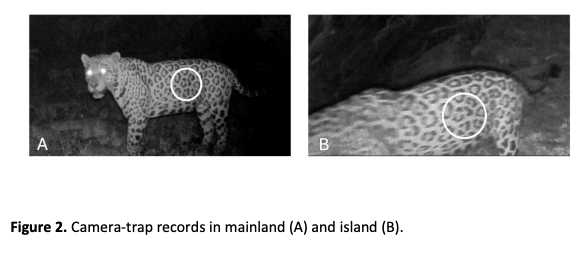
Here, we report the first confirmed long-distance swim by a jaguar (Panthera onca) across an artificial lake and discuss its implications for landscape connectivity. Camera traps around Serra da Mesa Reservoir (Central Brazil; 1,784 km²; 54.4 km³) photographed an adult male on the mainland and later on a forested island. Flank-pattern matching confirmed a 100% identity between records. Geodesic analysis identified two possible routes: a direct 2.48 km crossing or an alternative path involving a stepping-stone islet (1.06 km + 1.27 km). In the absence of evidence for use of the islet, we conservatively adopt the largest continuous water segment—1.27 km—as the minimum distance swum. This represents nearly six times the longest previously verified jaguar swim (≈ 200 m).
Note that the article above gives the maximum and not the minimum distance!
They knew it was the same leopard because the spots matched (this is the way we match female mallards across years, but using the bill pattern. Here’s the photo and caption of this aquatic leopard from the paper:
Why did the jaguar cross the water? From the first article:
Even if the swim were undertaken over two journeys, this still represents a record-breaking distance for jaguars, the authors wrote.
It is unclear why the jaguar made the swim. “Prey in this region appears to be fairly evenly distributed, lead author Leandro Silveira, a biologist with the Jaguar Conservation Fund, told Live Science. “Nothing suggests the island has more prey, nor do the shorelines. We think he decided to explore a new area — more likely related to searching for females or territory than a lack of food.
“We generally expect animals to seek the best cost-benefit option for movements, choosing narrower, less risky crossings,” he added. “That’s why this record was so surprising.”
However, Fernando Tortato, a project coordinator for the big-cat conservation organization Panthera who wasn’t involved with the paper or observations, notes that long swims probably are not unusual for jaguars.
“Most of the jaguar population is located in the Amazon basin,” he told Live Science. “The main rivers there are in many places much larger than 1.6 kilometers. Some places are more than 10 kilometers. We know that jaguars do not see a river as a barrier.”
Here’s a jaguar, apparently in the wild, swimming against a stiff current:
********************
Here’s a nine-minute PBS video of the variety of vocalizations of big cats, including lions, leopards and cheetahs, and what these vocalizations mean. I have heard lion roars in the wild, but not from close up–at night from inside my tent as the various lions in Manyeleti Reserve told each other where they were located.
Cheetah vocalizations are not what you expect. They chirp! Leopards have a cross between a snort and a bark.
At the end, the narrators describe another aspect of cat behavior that doesn’t involve noise but still facilitates communication.
******************
Finally, a regular moggie named Bean, who is very acquisitive and possessive about his noms. He will eat and steal anything consumed by his staff!
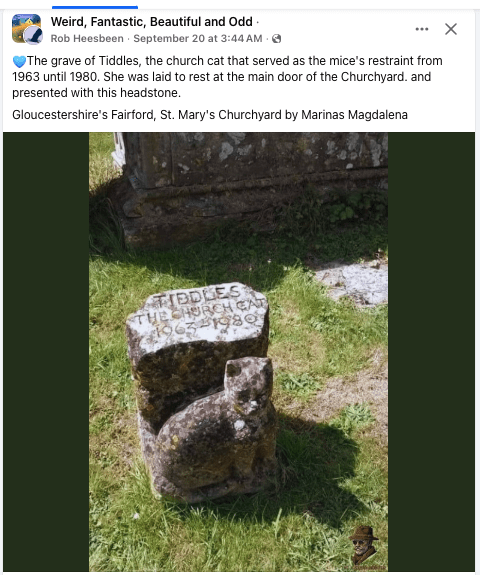
Tiddles the tabby cat became a well-known figure at St Mary the Virgin Church in Fairford, Gloucestershire. From 1963 until her death in 1980, she was a familiar sight and helped keep the church mice at bay.
She often joined the congregation and was particularly close to the verger and his wife. She was known to curl up on the knees of parishioners.
When she died, local stonemason Peter Juggins felt she deserved a proper memorial. He carved a stone to mark her grave, just by the church entrance. The memorial was a likeness of Tiddles, carefully capturing her appearance.
Backpacker.com reports an Air BnB’s orange cat guiding hikers along the Appalachian Trail. Well, it doesn’t really go with them on long hikes, as the trail is well marked, but the cat does accompany them—and groused if they get off the trail. The cat also guides them home again. Click to read:
Foxglove Farm boasts a newly renovated bathroom and kitchen, easy access to the Appalachian Trail, and a private patio that looks out onto the forests of Garrison, just an hour and change north of New York City. But the Airbnb’s most popular amenity may just be an orange cat named Cinamen who loves to hike with guests.
Cinamen went viral earlier this month after X user Sebastian S. Cocioba posted about his stay with the cat. “Went with my partner upstate and the AirbnB host’s cat took us for a guided hike along the Appalachian Trail,” wrote Cocioba alongside photos of Cinamen stalking through the moss, sitting on Cocioba’s chest during a break, and perching on the edge of a puddle. “Apparently this is what she does with every guest. She would complain when we took a wrong turn off the trail and knew the way back. Amazing cat. Would apocalypse with.” The post went viral; as of the time of writing, it has been viewed more than 1.6 million times.
While Cinamen—actually male, owner Trisha Mulligan says—may be new to the internet, he’s not new to the trail by any means. A quick scan of Foxglove Farm’s reviews turns up more than a dozen mentions of the cat: “We were thrilled to have her sweet kitty [Cinamen] walk with us on the trail for a bit so we got to check off hiking with a cat from our bucket list,” one guest wrote. “We had an amazing time with [Cinamen] who went on a hike with us, coolest cat on earth,” wrote another. “[Cinamen], the cat, accompanied us on the hike and was a reliable tour guide,” a third noted.
. . .Most of Mulligan’s guests seem to agree; some, she says, come back repeatedly just to visit the cat.
“There’s this one guy, this Russian guy who comes back regularly. He never leaves reviews, but he always sends me pictures—he’s a photographer—and he books because he wants to be with Cinamen and he wants to do the trail with Cinamen,” she says. “I’ve had other people say, ‘Oh my God, we were hiking and lost, but Cinamen wouldn’t let us get lost.’” (Downside: If you’re hoping for Cinamen to join your tramily, you may be out of luck. While Mulligan says that Cinamen sometimes stays out long enough with hiking guests to worry her, he rarely spends the night outside.)
Here are two tweets (second screenshotted) of one guy’s experience with Cinamen:
Went with my partner upstate and the AirBnB host’s cat took us for a guided hike along the Appalachian trail. Apparently this is what she does with every guest. She would complain when we took a wrong turn off the trail and knew the way back. Amazing cat. Would apocalypse with. pic.twitter.com/Ubomeix285
— Sebastian S. Cocioba🪄🌷 (@ATinyGreenCell) March 11, 2024
Here’s Jen, the Good News Girl, presenting Cinamen on Tik Tok:
This AirBnB host is causing a lot of commotion online because he keeps following guests around for their entire stay. And the AirBnB has nearly a perfect rating, because it turns out that Cinnamon the cat is actually an amazing tour guide. Guests have even been coming back specifically to see him! 🐈 📸 Sebastian S. Cocioba (atinygreencell / X) #cat#catsoftiktok#newyork#appalachiantrail#hiking#hikingwithcats
From Science, a prècis of a published paper on why cats eat plants and then vomit (click to read). The authors hypothesize (and show supporting evidence) that cats eat plants because the serrated parts of the plants catch onto swallowed hair, and, when the cats vomit up a hairball, it contains plant matter with the attached hair. In other words, the plants induce vomiting, and by being attached to hairballs that might otherwise clog the gut and cause big problems, plant-eating helps preserve health by helping expel hair clogs. Click to read, and I’ll give an (indented) excerpt below:
An except:
Of the many mysterious behaviors cats exhibit, one of the biggest is also one of the most disgusting: Why do they insist on eating grass, when it only seems to make them throw up? Scientists have proposed many theories over the years, but the latest may be the one that sticks—literally. In a study published last month in the Journal of Veterinary Behavior, researchers show the grass species felines eat tend to be jagged and covered in spikelike projections. That allows them to latch onto intestinal hairballs, the team proposes, potentially helping cats dislodge them.
The study suggests cats may have figured out how to take advantage of features that plants originally evolved for self-defense, says T. Michael Anderson, an ecologist at Wake Forest University. “This could be another fascinating example of how animals use plants in ways that don’t involve getting calories and nutrients by eating them.”
Hairballs come with the territory of being a cat. Our feline friends swallow lots of fur during grooming, even more if they eat furry prey. The thick bulk can block their digestive systems—until it’s thrown up. Although scientists generally claim that cats eat grass to get rid of intestinal worms, some people suspect they do it to help expel hairballs. So far, there’s been no evidence to support this, however.
So in the new study, Nicole Hughes, a plant biologist at High Point University, focused not on cats, but on the greens they eat. “I know what grass looks like—it’s spiky and likely to snag,” she says. A mom to two tuxedo cats—Mildred and Merle—Hughes has been saving their hairballs for years, waiting for the right research project to come along. That’s just what happened when undergraduate student Kara Bensel, now an animal behaviorist at Appalachian State University, joined the lab.
Together, Bensel and Hughes clipped off bits of six homegrown hairballs and coated them in gold—a necessary step for scanning them with an electron microscope. Detailed images of the plant matter embedded in the hair wads revealed both jagged edges and trichomes, spikelike projections that stick out like prongs. Depending on the plant, those microstructures were two to 20 times longer than cat hairs were wide—meaning they were just the right size to snare fur.
Hughes says it was like looking at “drain snakes,” jagged coils of plastic designed to yank human hair out of bathroom sinks. Cat parasites like roundworms and tapeworms are up to 60 times larger than these plant microstructures—too large to be snared. That makes parasite removal a less likely reason cats eat grass, Hughes says.
Most of the plants found in the hairballs were common backyard grasses and indoor house plants such as spiderwort, according to a genetic analysis by Megan Rudock Bowman, a geneticist also at High Point. All are fairly rough surfaced, at least at the nanometer level. It’s as if the cats were specifically choosing microscopically scratchy plants, Hughes says.
The one problem with this, which author Lasserre cites, is this, quoting Benjamin Hart, a veterinary prof at UC Davis, “dogs and other animals that don’t suffer from hairballs eat grass, too. Instead, he believes the behavior is an evolutionary holdover from an ancient ancestor that may have munched grass to expel parasites. ‘Now they’re just hard-wired to do it.’”
Here’s the paper, which you might be able to download if you click below (I had trouble). But if you want it, just ask me. I’ll put in the abstract and one SEM photo:
The abstract from the preprint:
Domestic cats and dogs have long been observed consuming fibrous plant material such as leaves and stems, and then regurgitating this matter, undigested, shortly thereafter. Previous researchers have hypothesized that consumption of plant matter by carnivores aids in the expulsion of parasites and/or hair trapped in their digestive tracts from feeding and grooming. Although direct interactions between ingested leaves and parasites have been reported in stools of many mammalian species, no such interactions have been reported for hairs expelled orally or in stools. In this study, we used scanning electron microscopy to examine six regurgitated plant masses naturally produced by two indoor/outdoor domestic cats belonging to one of the authors. DNA barcoding was additionally used to identify plants in all samples. Scanning electron microscopy revealed that all consumed/regurgitated plant matter exhibited microscopic serrations and/or epidermal hairs (trichomes), and that direct interactions between these structures and animal hairs were clearly visible in all samples examined. Ingested plant material included grasses as well as several other indoor and outdoor plant species, representing a variety of taxonomic groups. These findings are consistent with the hypothesis that consuming textured leaves is a healthy behavior that could help cats and other carnivores avoid intestinal blockages by hairs ingested during feeding or grooming.
And a photo, captioned in the paper, showing cat hairs entangled with plant material. (Fve cats were examined and their vomit inspected under a scanning electron microscope, which requires that the dried mess of hair and plants be coated with gold dust!)
Figure 1. SEM micrographs of plant microstructures observed ensnaring hairs. Images include leaves of Araceae featuring trichomes (A and B), Poaceae featuring serrations only (C), Poaceae with serrations and trichomes (D), and Commelinaceae (Tradescantia sp.) with trichomes only (E).
Now if only they’d figure out how to ensure that cats stay off the rugs when they vomit up hairballs. (As every ailurophile knows, cats seem to prefer barfing on rugs rather than on bar floors.)
************************
Lagniappe: A mountain lion gets stoned on catnip in a pet store! From StoryTime on Facebook:
The caption ends this way:
After sniffing around, the big cat stopped at the catnip shelf, pawed a bag down, ripped it open, and immediately flopped onto the floor. Rolling back and forth, it rubbed its face and paws in the catnip, completely intoxicated by its new discovery.
When employees unlocked the doors, they were stunned to find the “customer” sprawled out in the toy aisle, surrounded by shredded bags of catnip. Wildlife officers carefully coaxed the lion outside before relocating it back into the nearby hills.
Experts explained that while mountain lions aren’t known for reacting to catnip like housecats, curiosity and the strong scent could have triggered its playful behavior. When asked about the situation, the store owner just smirked: “Colorado’s known for its plants making folks feel good, guess now we know the animals are into it too.” #cat#animals