
I am back from New Mexico, but as I was traveling yesterday, I didn’t prepare a Hili post. Here’s today’s Caturday post instead.
This is one of the coolest items I’ve presented as a Caturday feature. It comes from Discover magazine (click on the link to read), and details a rare brain condition, prosopometamorphosia, which distorts the faces you see. In one version of this condition, the first face you see each day is superimposed (in bits) on every other face for hours. If the first face you see is that of your cat, which was the case for one man, you see people’s faces melded with that of your cat. There’s a Wikipedia page on this condition, adding that another name for the condition is also called “demon face syndrome,” and explains that the condition can manifest itself as simple distortion of faces, not necessarily as a cat face or a “first face you see” distortion. But one man did have the cat distortion, and another had a “poodle face” condition.

An excerpt:
Picture this: You wake up. Your cat is staring up at you. And so, you give them a pat, fill their bowl with kibble, and go about your day.
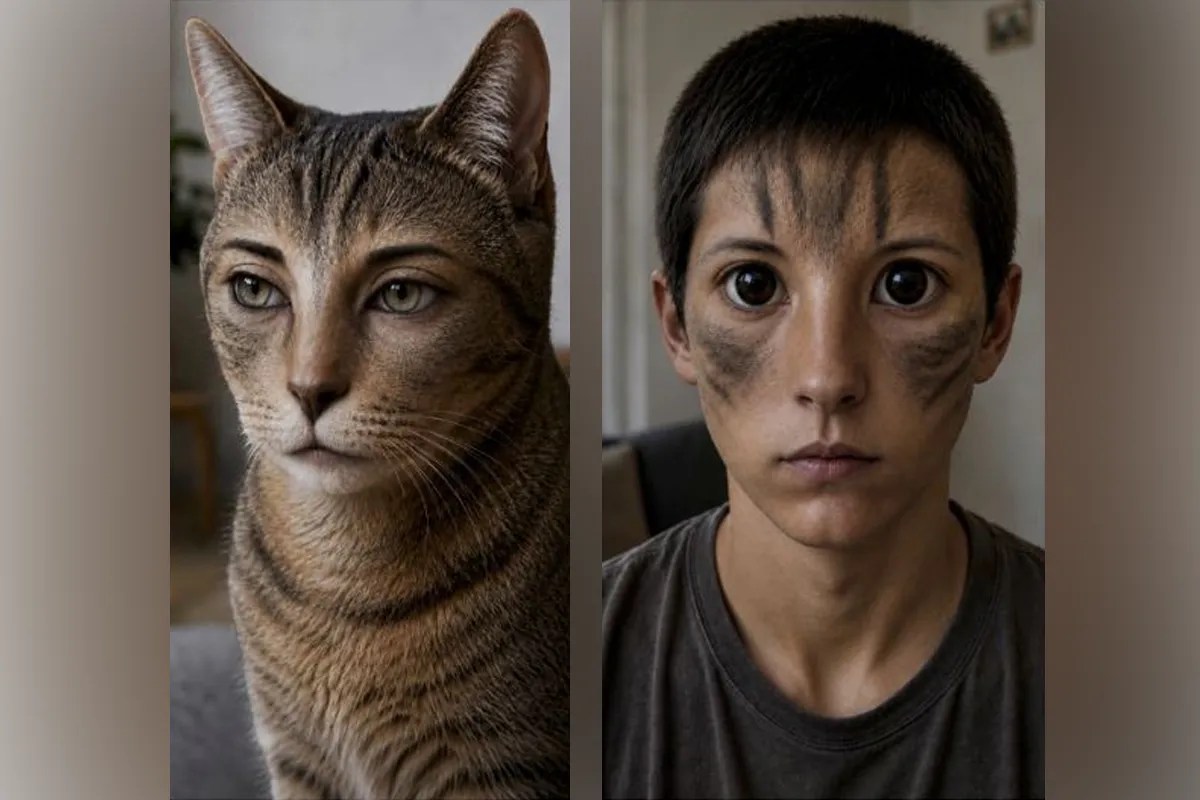
Only from that moment on, anyone you encounter — the commuters on your journey to work, the barista at your favorite coffee shop, your boss and your best friend — appears visually distorted.
Maybe their pupils are enlarged. Perhaps they’ve developed some striped markings. Somehow, it’s as if part of your cat’s face has merged with theirs.
This might sound like a Kafkaesque nightmare, but for Karl, a 28-year-old man suffering from palinopsia, it is reality. The first face he sees is imprinted on all other faces he comes across — and often, that first face is Luna’s, his gray tabby cat.
These visual distortions can persist for several hours and sometimes last all day.
“This case of Karl seeing his cat’s features in human faces and vice versa demonstrates that individual features can be pulled from memory and influence our ongoing perception,” lead author Brad Duchaine, a professor and chair of psychological and brain sciences and principal investigator of the Social Perception Lab at Dartmouth, said in a statement.
The case has been described in a paper published in the journal Cortex. [JAC: see below for the paper.]
Here’s part of a figure from that paper, showing the cat’s face imprinted on woman (right) and a “familar woman”‘s face imprinted on his cat (left). The full Cortex paper below describes how these images were generated using AI:
The image in Panel B [left] was generated using ChatGPT 5.5 (Open AI) based on Karl’s verbal descriptions. The image in Panel C [right] was generated with ChatGPT 5.5 from a sketch Karl drew. Both images were then repeatedly refined over several months in response to Karl’s feedback, with some modifications made directly by Karl using Kimi K3 (Moonshot AI), until he judged them to match his visual experiences.
This is the first use of AI that I wholeheartedly applaud. The fact that ChatGPT can produce a modified image almost immediately, and that Karl can say whether or not the images are accurate representations of what he saw, makes it especially useful. Although the article doesn’t mention it, this method will surely be useful for reconstructing the faces of crime suspects based on a victim’s description. In the past, this has been done via laborious renderings and re-renderings by a police artist. (Note that a cat with a human face was a common way that medieval artists depicted cats.)
A bit more:
Karl, who lives in the northeastern U.S., has a form of palinopsia called prosopometamorphopsia (PMO), which causes facial distortions.
He first developed the condition two years ago, after brain surgery to treat an arteriovenous malformation (AVM).
AVM is an abnormal tangle of blood vessels that, if not treated, can cause brain bleeds. But in Karl’s case, removing the arteriovenous malformation also meant removing part of his right temporal lobe — an area of the brain involved in facial processing.
This has caused him to experience a version of PMO in which features of one face are transferred onto others.
The researchers emphasize these features are not generic but belong to specific faces. This includes familiar humans and often, his cat Luna.
That’s not what the Wikipedia article says, though. Perhaps this is true of Karl, but not of everyone with the condition.
This is the original paper from Cortex (click title below to read; pdf here), with an additional case of “poodle face”:

An excerpt describing the person with a “poodle face” condition:
In 1986, Cortex published a report describing a remarkable case of palinopsia (Landis et al., 1986). Nine months after suffering a stroke in the region of the right posterior cerebral artery, Patient 2 was riding in a bus when she looked at a poodle sitting on the lap of a passenger. When she looked away from the dog, everyone on the bus appeared to have the poodle’s face in place of their own. This visual perseveration continued even after Patient 2 exited the bus, finally resolving 30 minutes later.
This case of poodle-face palinopsia is notable not only for its extraordinary phenomenology but also for its theoretical implication. Because the poodle’s face appeared only on other faces and not on other visual stimuli, it suggests that faces are processed differently than other visual categories. Grüsser and Landis (1991) later included line drawings depicting the events in a chapter on face-processing disorders (Fig. 1, left). It is now possible, though, to produce photorealistic visualizations of such percepts using artificial intelligence tools, and Fig. 1 (right) presents our depiction of Patient 2’s poodle-face palinopsia.
And a figure from the Cortex paper (with caption) showing “poodle face”:

How long does this condition last? The Discover article says this:
According to Duchaine’s lab, the majority of cases last days or weeks, though there are those – like Karl’s – that can persist for years.
These visual distortions are thought to occur because of abnormalities in areas of the brain associated with facial processing or damage to white matter connections linking these regions.
Duchaine hopes AI images will prove helpful to patients when it comes to explaining the condition to healthcare professionals, friends and family.
*******************
From reader JGGL we have a poem I haven’t read before: “Ode to the cat” (Original: “Oda al gato”). by Pablo Neruda. Here’s the English translation by someone whose first name is “Juan,” but I can’t find the full name.
Neruda (1904=1973) was a famous Chilean poet, as well as a Communist, and he had a colorful life, including years in exile. In the end he won the Nobel Prize for Literature in 1971. I saw his house when I was waiting in Valparaiso for our ship depart for a trip to Antarctica.

The poem below reminds me of an updated version of Christopher Smart’s “For I will consider my cat Jeoffry,” a segment of a larger poem he wrote while confined in an insane asylum.
Ode to the cat (translation)
The animals were imperfect,long tails, sad-lookingheads.Little by little they startedto improve,making themselves part of the landscape,acquiring spots, grace, flight.
The cat,only the cat,appeared completeand proud:born completely finished,walks alone and knows what it wants.
A man wants to be a fish and a bird,the serpent would like to have wings,the dog is a disoriented lion,the engineer wants to be a poet,the fly studies to be a swallow,the poet tries to imitate the fly,but the catonly wants to be a catand every cat is a catfrom whiskers to tail,from sensing the presence of a live rat,from the night to his golden eyes.
There is no single unitlike it,neither the moon nor the flowerhave such a physique;it is only one thinglike the sun or the topaz,and the resilient line of its contourfirm and subtle as isthe line of the prow of a ship.Its yellow eyesleft a singleslotto drop in the night’s coins.
Oh little emperor without a world,conquerer without a homeland,miniscule tiger of the living room, nuptialsultan of the ceiling of erotic tiles,the wind of love in the open air,you claim when you pass byand you pose four delicate feeton the floor, smelling, suspiciousof everything terrestrial,because everything is foulto the immaculate foot of the cat.
Oh independent beast of the house,arrogant vestige of the night,lazy, gymnastic and foreign,profoundly a cat, secret policeof the bedrooms, an insignia ofvanished velvet.Surely there is no mysteryin your method.Perhaps you aren’t mysterious.The whole world knows you and you belongto the inhabitant less mysterious.Maybe everyone believes it,everyone believes they are the owners and proprietors,the cat’s uncles, companions,colleagues, disciples or friendsof their cat.
I don’t.
I don’t subscribe to that.
I don’t know the cat.
I know everything; life and its archipelago,
the sea and the immense city,
botany, the gynoecium with its deviations,
the plus and minuses of mathematics,|
the volcanic funnels of the world,
the unreal hide of the crocodile,
the ignored kindness of firemen,
the blue atavism of the priest,
but I cannot figure out a cat.
My logic slipped in its indifference,
its eyes have golden numbers.
********************
We’ve had several cat songs by The Kiffness (David Scott) before, but here are ten by him and his guitar-playing colleague “Spraul“. (Spraul didn’t appear in the previous videos.) The video is 28 minutes long and the songs are good. They have a beat, and you can dance to them:
Lagniappe:
First, a cat beefing about the most offensive questions asked by humans.
From The Venn Diagram of the Day: You should get it even if you know only a few words of French.

And from CinEmma. True!

h/t: Michael, JGGL