
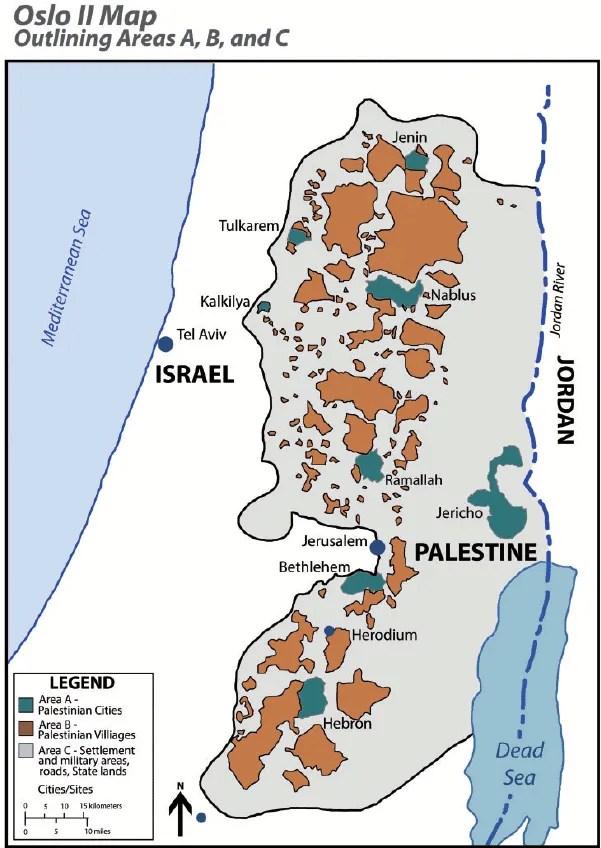
UK barrister, international law advocate, and legal director of UK Lawyers for Israel Natasha Hausdorff has argued several times on video why Israeli’s occupation of Area C of the West Bank is neither illegal nor constitutes “ethnic cleansing” of Palestinians. Remember, according to the 1995 Oslo II accords, Areas A and B are largely under Palestinian control, with area A under full Palestinian civil and security control, while area B is under full Palestinian civil control and joint Israeli/Palestinian security control—and Jews aren’t allowed to live in either area. Area C is under full Israeli security and civil control, and both Palestinians (about 300,000) and Israelis (about 500,000) are allowed to live in that area. The Palestinians in that area are largely descendants of people who were there pre-Oslo, and Palestinians are rarely allowed to build new houses or settlements there. Israelis are allowed to move there of their own accord.
Note that these borders are temporary, and the whole division was supposed to be settled at some time after Oslo II. But that settlement never happened. I believe the idea was that all of area C was supposed to be transferred to Palestine, but not until there was a full settlement, including apportionment of land, between Palestine and Israel. And if you think Israel won’t move its own residents out of an area to bring peace, then you’re forgetting Israel’s own “ethnic cleansing” of Jews from Gaza in 2005. Did that bring peace? You know the answer.
You can see several videos of Hausdorff’s arguments (e.g., here, here and here) which are pretty clear (the first is marred by the interviewer shouting). But in a recent article in the Spectator (click on archived link below) Hausdorff is a bit confusing, to the extent that her argument is obscured by fine points of international law and claims of those who oppose them. It’s not her fault; the situation is complicated. You can read her argument by clicking on the archived link below, but I’ve asked Grok to put her argument in simpler language.
The whole question appears to hinge on two issues:
- Whether the West Bank lies within Israel’s sovereign boundaries. Hausdorff argues “yes”.
- Whether Israel forcibly transported or deported its citizens into the West Bank or whether Israelis settled in Israeli-administered territory of their own volition. Hausdorff maintains the latter, arguing (correctly, I think) that the border of area C is an “armistice” line rather than the border of a sovereign territory.
To quote her Spectator article:
A legal rule selectively (and incorrectly) cited whenever Jews build houses across an armistice line, which is not and never was a border, is not the application of law but political posturing. Additionally, the Oslo Accords, which gave Palestinians self-government in Areas A and B of the West Bank, left Area C under Israeli administration, and deliberately reserved settlements, borders and Jerusalem for final-status negotiations.
. . . The consequences extend far beyond legal disputes. The phrase ‘illegal settlements’ is increasingly being used to mean something much more disturbing: that Jews should not live in certain places because they are Jews. Consider what is being demanded. A future Palestinian state is routinely imagined as requiring the removal of hundreds of thousands of Jews from their homes. The Jewish residence in Hebron, the cradle of Jewish civilisation, is inexplicably presented as an international crime. As is the Jewish Quarter of Jerusalem or the Jewish communities re-established after their inhabitants were expelled.
No comparable demand would be tolerated elsewhere. We would immediately recognise the ugliness of saying that peace between two peoples requires territory to be cleansed of one ethnicity. Yet once the proposition is dressed in the language of ‘settlements’ and ‘international law’, politicians repeat it.
. . . Crimea illustrates the point: Russia’s occupation does not extinguish Ukrainian title. If Ukrainian forces recover Crimea tomorrow, Ukraine will not suddenly become the occupying power just because Russia controlled the peninsula for a decade. The sovereign title comes first.
. . . International law was designed to provide rules by which disputes could be resolved. It was not created to furnish political campaigns with intimidating vocabulary. The starting point should therefore be the law itself, applied consistently: the Mandate, uti possidetis juris, the actual status of the 1949 armistice lines, the wording of the Geneva Convention, subsequent agreements, including the Oslo Accords, and state practice elsewhere.
I’m absolutely sure that about 95% of people who throw around the phrase “illegal settlers” (or “settler colonists”) and “ethnic cleansing of Palestinians” do not know the international law that applies here. They’re merely following the progressive party line.
But read for yourself (click the headline):

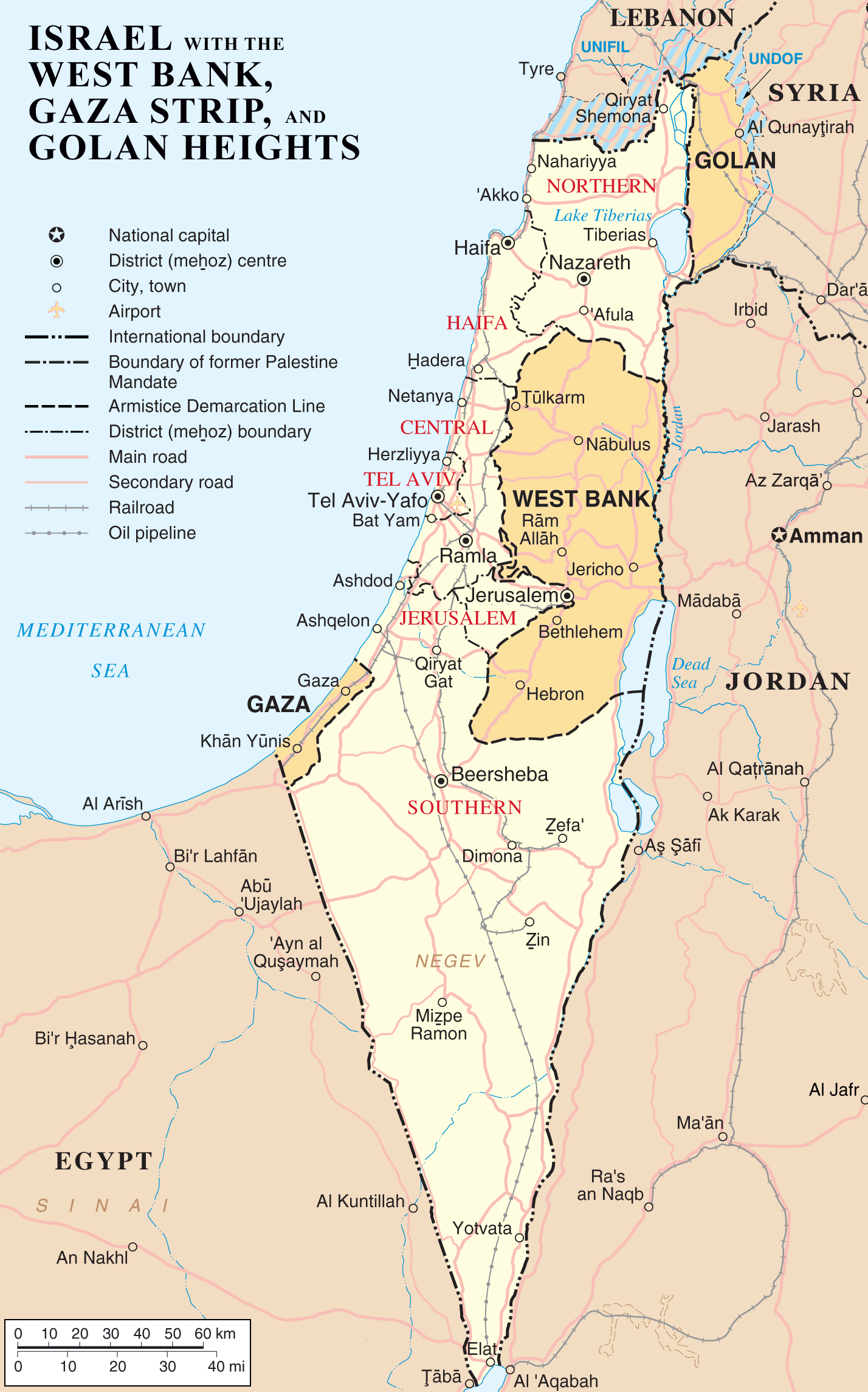
To help out with the argument, I’ll post two maps. First is the Green Line (from here). The “international boundary” indicated below—dash, two dots, dash— is the “green line” boundary that, says Hausdorff, constitute the sovereign boundaries of the state of Israel, including the West Bank.
And here are areas A, B, and C of the West Bank (map from here):
I quote the bot Grok in answer to my question: What is Natasha Hausdorff’s argument for why Israelis are not settling illegally in the West Bank, and why they are not committing “ethnic cleansing”?
Grok’s full answer is indented, and I’ve put crucial bits of the argument in italics. I’ve left out Grok’s references supporting its answer, but I see no errors there.
Natasha Hausdorff, a British barrister and legal director of UK Lawyers for Israel, argues that claims of “illegal settlements” and Israeli “ethnic cleansing” in the West Bank rest on a misapplication of international law and invert historical facts. Her case, set out in writings such as her September 2026 Spectator article [article above] and in interviews and parliamentary evidence, has two main parts.
Why settlements are not illegal
Hausdorff starts with the status of the territory itself. She says the legal story does not begin in 1967. Under the customary rule of uti possidetis juris, a new state inherits the administrative boundaries of the preceding entity unless those boundaries are changed by agreement. When Israel declared independence in 1948 it was the only state that emerged from the remaining Mandate for Palestine west of the Jordan (Transjordan having already been separated). The Mandate’s lines therefore became Israel’s default international borders and included Judea and Samaria (later called the West Bank) and East Jerusalem. The 1947 UN partition resolution was a non-binding General Assembly recommendation that the Arab side rejected; it never displaced the customary rule.
Jordan seized the area in the 1948–49 war and held it until 1967, but occupation does not confer sovereignty. Only two states recognized Jordan’s annexation, and the 1949 armistice lines were explicitly military ceasefire lines, not borders. In 1967 Israel therefore recovered territory over which it already held title; a state cannot occupy its own sovereign land. Hausdorff uses the analogy of Ukraine recovering Crimea: no one would then call Ukraine the occupying power. The ICJ’s 2024 advisory opinion, she notes, is non-binding and simply assumed occupation without addressing uti possidetis.
Even if one treats the West Bank as occupied for the sake of argument, she says Article 49(6) of the Fourth Geneva Convention does not make civilian Jewish communities illegal. The article forbids an occupying power from deporting or transferring parts of its own civilian population into occupied territory. It was drafted after World War II to stop forced, state-organized population transfers of the Nazi type. Israeli Jews who live in the West Bank move voluntarily; some re-established communities (such as Gush Etzion) that Jordan had expelled. The provision does not create ethnically exclusive zones or criminalize private residence. Hausdorff also points to inconsistent international practice: large-scale civilian settlement in other prolonged occupations has not drawn the same legal condemnation.
She adds that the Oslo Accords left Area C under Israeli administration and reserved settlements, borders and Jerusalem for final-status talks. Much of the unauthorized construction she identifies as illegal is Palestinian building in Area C, not Israeli communities built with planning permission.
Why Israel is not committing “ethnic cleansing”
Hausdorff treats the ethnic-cleansing charge as projection. Jordan ethnically cleansed Jews from the West Bank and East Jerusalem between 1948 and 1967. Areas A and B, under Palestinian Authority control, are already free of Jews. Demands that Israel evacuate Jewish communities from Area C, she argues, amount to a call for the remaining parts of Judea and Samaria to be made Judenrein [JAC: “free from Jews”]. She has described the ICJ’s language as effectively endorsing that outcome.
On the facts, she says the Palestinian population in Israeli-administered Area C has grown, not shrunk. There is no evidence of a systematic Israeli policy of removing Palestinians from the territory; the opposite demographic trend is visible. Accusing Israel of the crime that was actually committed against Jews in the same area, she contends, inverts both history and law.
Hausdorff’s overall position is that the phrases “illegal settlements” and “ethnic cleansing” function as political slogans that apply a double standard to the only Jewish state and that they are used to justify excluding Jews from places of historic Jewish presence. She maintains that genuine international law, applied equally, does not require that result.
That is the argument which, according to Hausdorff, complies with international law. She recognizes that Israeli violence against Palestinians in area C is illegal and should be dealt with harshly, and also that this division of land is temporary, though it doesn’t look as if a two-state solution is anywhere in the offing. Until there is a final settlement, Hausdorff considers the “illegal settler/ethnic cleansing” argument to be a canard—indeed, a blood libel.
h/t: Christopher
I agree completely with Ms. Hausdorff. The “West Bank” is disputed territory, not occupied, and settlements in Area C are not illegal as per Oslo II. But the problem has transcended the law, unfortunately. When the U.N. and the European nations—which liberally throw about the phrase “International Law” as a symbol of their sophistication—nonetheless reject Israel’s right to defend itself, its right to enforce its borders, and even its right to exist, they are telling us that “International Law” is a virtue signal and nothing more. I admire Hausdorff’s brilliance and her tenacity, and it’s good to have international law on your side. But sadly, few will change their positions based on the subtleties of international law. The opprobrium against the State of Israel is something more.
I just wanted to clarify the argument against the “illegal settlers” and “ethnic cleansing” claims. I am not saying that my posts here on Israel (which get very little attention) are going to change the minds of opponents. But at least it will buttress those of us who want to know the facts.
Yes. I’m glad that you are bringing her views to your audience. Her arguments will sway those who can be swayed by facts and law, so they are valuable—and I have certainly learned from her writing and her debates. Please keep the conversation going.
I would speculate that the posts on Israel may not draw many written comments, but as a number of people said a few weeks ago, sometimes they do not feel knowledgeable enough to comment, but that they are reading the posts and learning….that such posts are very important.
This is a good one, particularly in making the maps of areas A, B, and C available. It may be a minority opinion here, but my view has developed into no matter what one calls them, the hilltop youths and their Israeli friends who bully the Palestinians through setting up new outpost farms and ranches in Area C but in close proximity tonAreas A or B, are just trouble makers who look to agitate palis into rock throwing or the like so that Israeli force can be used. These bullying tactics remind me of much of the arab behavior that went on toward Jews short of the actual killings of the pre-1940 palestine. Just because you have a legal right to be in some place does not mean you have to or should go there. Be a mensch and work toward peace.
Ok let me have it!
Okay, Jim, I’ll let you have it. From the not-so-distant Southern past:
“Those people have plenty of land near their own kind. They can go live over on that side of town. The fact they come live by us shows they’re just wanting to start trouble.”
Imagine this parody in the mouth of a Palestinian. I know the outlook doesn’t reflect your sentiment regarding Jews (or blacks). Perhaps you are expressing what you would do in such circumstances simply out of consideration for others, just as a wise older black man might have said, “No good’s gonna come of you going over there and getting them thinking you are stirring up trouble.” But how would one adopt this as policy other than setting up Jewish exclusion zones in “close proximity” to Areas A and B? That would sure sound dangerously close in effect to our home-grown form of segregation.
Doug, The thinking of the palestine mandate was to satisfy both palestinians and Jews with some of the 11,000 sqmi of land even though arabs writ large had already gotten 1.2 million sqmi from ottoman spoils of war. Ben Gurion took the 29nov partition even though it was difficult to defend, had a narrow 9-mile waist, and did not include historical judean and sumarian hills…BUT it was a homeland that could be declared a state and the Jewish Agency could start to work right away tidying up statehood, which of course they did by kicking arab ass in the 1948 war of independence. Even though arab leadership would never fully play into two-state….I still think that only fair at the end of the day. Sharon emptied gaza of jews in 2005 (including corpses). Except for some nominal defensive additions to Israel territory like Golan heights and some area around Jerusalem, I would like to see west bank and gaza go to palestinian arabs with a proviso that the Old City and specific secular shrines be open to Jews, Christians, and Muslims.
And yes I know the violent history and the islamists’ position, but that is no reason for Jews to imitate them in creating a Jewish theocracy. I recall Herzl explicitly wanted a home for the Jewish people not an orthodox theocracy.
I have been called naive here in the past.
Re: “which get little attention”:
Your posts on this topic are among the ones I read most carefully, usually following up every link. Doing so means that I am able to explain to friends and family who buy too easily into the trendy anti-Israel line why there are problems with their arguments, and why they should consider their position more carefully.
Exactly what I do – read them carefully and can then explain my views on the situation to family and friends who also “buy too easily into the trendy anti-Israel line”. I don’t comment much on the posts because I don’t feel qualified to, but I definitely have strong pro-Israel views and appreciate the work PCC puts into sharing them with us.
This is very helpful. The whole settlers thing has always been murky.
The Progressive dialect of English is simple, really . A Jew in Judea is by definition a “settler”, whereas the Egyptian-born Yasser Arafat was by definition an indigenous “Palestinian”. In like manner, groups committed to bringing back the 7th century are “Progressive”; any Israeli military response to acts of war against Israel is “genocide”; and anyone self-IDing as any sex (or perhaps species) IS whatever he/she/it claims to identify with. This all emerges from Standpoint
Theory which, like other Critical Theories, can be understood only by adepts trained in very special academic departments.
I was thinking “simple” might be better replaced with “unintelligible” or “nonsensical” but then I read your last sentence and all became clear. I am not one of the initiated.
If you get into the weeds with occupation, the main problem is the rather loathsome non-binding opinion by the ICJ (Israel is a part of this court by being a member of the UN) in 2024, which said that Israel is in occupation of Gaza etc.
They did not bother to examine the sovereignty claims of Israel viz a viz Uti Possidetis Juris at the moment of its Independence, which clearly says it inherited all of the borders of Mandate Palestine. Instead, it stresses the humanitarian rights of Palestinians to self-determination.
Now, this is pretty duplicitous, since A) the Palestinians didn’t even call themselves as such in 1948, B) the PLO explicitly rejected any such self-determination aspirations in its 1964 Charter and this was never an issue until after Israel reclaimed its own land in 1967, C) the sovereignty rights of Israel – and the rights of Jews to settle within its borders – are actually enshrined under International law in Article 80 of the UN Charter and the ICJ is a UN creation, D) preservation of sovereignty rights is of primary importance in International law, and E) the Palestinians, by having an official governmental policy of the terroristic murder of Israelis, and unwavering hostile behavior to the very idea of the Jewish state for the past 100 years, is an existential threat to the Israeli people – definitely not a persuasive argument for self-determination.
Regardless of anyone’s views on the matter, the current situation will continue. The two-state solution is dead. Israeli settlers in the West Bank would have to be removed by force, which will never happen. Israel should have returned the West Bank to Jordan after the 1967 war. It’s too late now.
Excellent maps. Thank you for posting.