
We have a couple of items (plus lagniappe) for Caturday, but I fear interest in this feature is waning. If you’d like it to continue, sing out below and, more important, send me cat-related items from time to time. Thanks!
First, a four-minute video from the Number Ten Cat describing the origin of Caturday. (The information is brief, but there are good cat videos and good jazz music.):
**********************
From PetHelpful we hear about a Red British Longhair kitten called Copper, who apparently likes to sleep in a “starfish” position, with all five “arms” extended. First, the backstory for a short video (the post is a bit over the top):
This rare red British longhair kitten named Copper’s nap position makes him look like an unbothered starfish, and one day I aspire to be this level of relaxed. A cozy prince! We love to see it.
In the YouTube Shorts clip shared by Pearl’s Ragdolls, a very floofy Copper is shown lying flat on his back, with every single paw extended outward, just like a tiny and fluffy starfish. I have never seen a more comfortable kitty, to be honest. Eventually, Copper’s sibling Vanilla falls asleep right beside Copper in a moment of pure cuteness overload. My heart can’t take it!
“This is Copper’s favorite way to sleep,” said Pearl in the caption of the sweet and hilarious YouTube Shorts video.
For more context, Copper is a newer member of Pearl’s family of cats, so seeing him sleeping in such a relaxed and vulnerable way shows he already feels so safe in his new home. It really is far too cute for words!
“Copper has obviously adjusted so well and appears to feel so safe and looks so content. I love that for him,” wrote one fan in a comment on the clip.
“He looks so comfortable. Just airing everything out,” exclaimed someone else.
“It’s Copper’s natural camouflage, pretending to be a fuzzy pillow,” joked a third person.
And Copper in his your-heart-can’t-take-it pose:
**********************
Moving on to science, VICE highlights a new Current Biology article investigating how cats identify each other through sniffing the urine left in the environment. It involves long-term fatty acids whose profile is individually specific, and can be identified by sniffing.
First, from VICE, we have a good, informative science report:
If you share a home with a cat, you already know two things: they do whatever they want, and they’re annoyingly good at it. What you probably didn’t know is that every time your cat pees outside the litter box or marks a corner of the yard, they’re leaving behind a chemically encoded message that other cats can read like a name tag. Scientists just figured out how.
A study published August 19 in Current Biology identified the compounds behind this system—a group of chemicals called branched-chain fatty acids, or BFAs, that give each cat a unique scent fingerprint in their urine. The signatures hold up even after the cat is long gone, and for an animal running its entire social life through scent, that’s the point. Cats spray to claim territory, advertise for mates, and flag their presence to rivals. A message that evaporates in an hour is useless. These don’t.
The more interesting question was how. Urine composition changes with diet, health, and age. How does a cat’s chemical ID card stay consistent through all of that? The answer turned out to be hiding in the kidneys—specifically in tiny fat droplets in the renal cortex that researchers have known about for over a century without understanding what they do. The new study found they function as reservoirs, maintaining each cat’s individual BFA profile regardless of what else is going on biologically. Some of the BFAs identified had never been reported in other mammalian excretions or secretions.
To confirm cats were picking up on those signatures, researchers measured the flehmen response — that wide-mouthed, briefly horrified expression that makes cats look like they’re personally offended. The behavior pulls odor compounds into the vomeronasal organ, a scent-processing structure that handles pheromones and other chemical signals. Cats showed the response less when repeatedly exposed to the same urine sample, but dialed it back up when a new cat’s sample appeared. They were reading individual IDs, not just detecting urine generically.
Study co-author Masao Miyazaki, a biomolecular scientist at Iwate University in Japan, told Live Science he didn’t expect an instinctive behavior to be so responsive to familiarity and learning. Cornell neurobiologist Michael Sheehan, who wasn’t involved in the research, compared the BFA system to a human face—the primary signal animals use to tell each other apart, even when subtler cues are available.
Lions and tigers use the same system, with their own kidney droplets and BFA profiles, though the specific compounds differ by species. The research team now wants to understand whether disruptions to the droplet system contribute to chronic kidney disease in cats—which would make this line of inquiry much more medically urgent than they thought.
From Grok, evidence that cats can tell individuals apart from the odor of their pee (I’ve omitted the references):
Behavioral experiments confirmed that cats discriminate individual urine odors (also apparently from the new study):
- In habituation-dishabituation tests, cats spend less time sniffing repeatedly presented urine from the same donor but increase investigation when switched to urine from a different cat. Familiarity effects can last months, indicating long-term olfactory memory of specific scents.
- Cats show the flehmen response (the open-mouthed “stinky face” expression that helps funnel chemicals to the vomeronasal organ) more often toward unfamiliar urine than their own; the response decreases with repeated exposure to the same sample and rises again with a new individual’s urine.
- Critically, when other urinary lipid components were controlled and only the donor-specific BFA fraction was varied, cats still detected the difference and increased sniffing after habituation to the original.
Urine spraying (backing up to a vertical surface, raising the tail, and squirting) is a deliberate scent-marking behavior used by both males and females. It deposits these chemical signals in prominent locations to communicate territory ownership, individual identity, sex, reproductive/hormonal status, and other information, helping cats avoid direct conflict in overlapping ranges. Other volatile organic compounds (including sulfur-containing ones derived from felinine, more prominent in intact males) contribute to the overall pungent “catty” odor and additional messages, while urinary proteins (such as cauxin) can enhance adhesion of sprayed urine to surfaces and thus prolonged odor release.
In short, the BFA profiles provide a durable, metabolically encoded individual signature buffered by the kidneys, which cats read olfactorily to recognize specific conspecifics from urine marks. This complements other scent sources (e.g., anal gland secretions, which also vary individually and support recognition) but specifically addresses how urine marks retain identifiable information despite environmental changes over time.
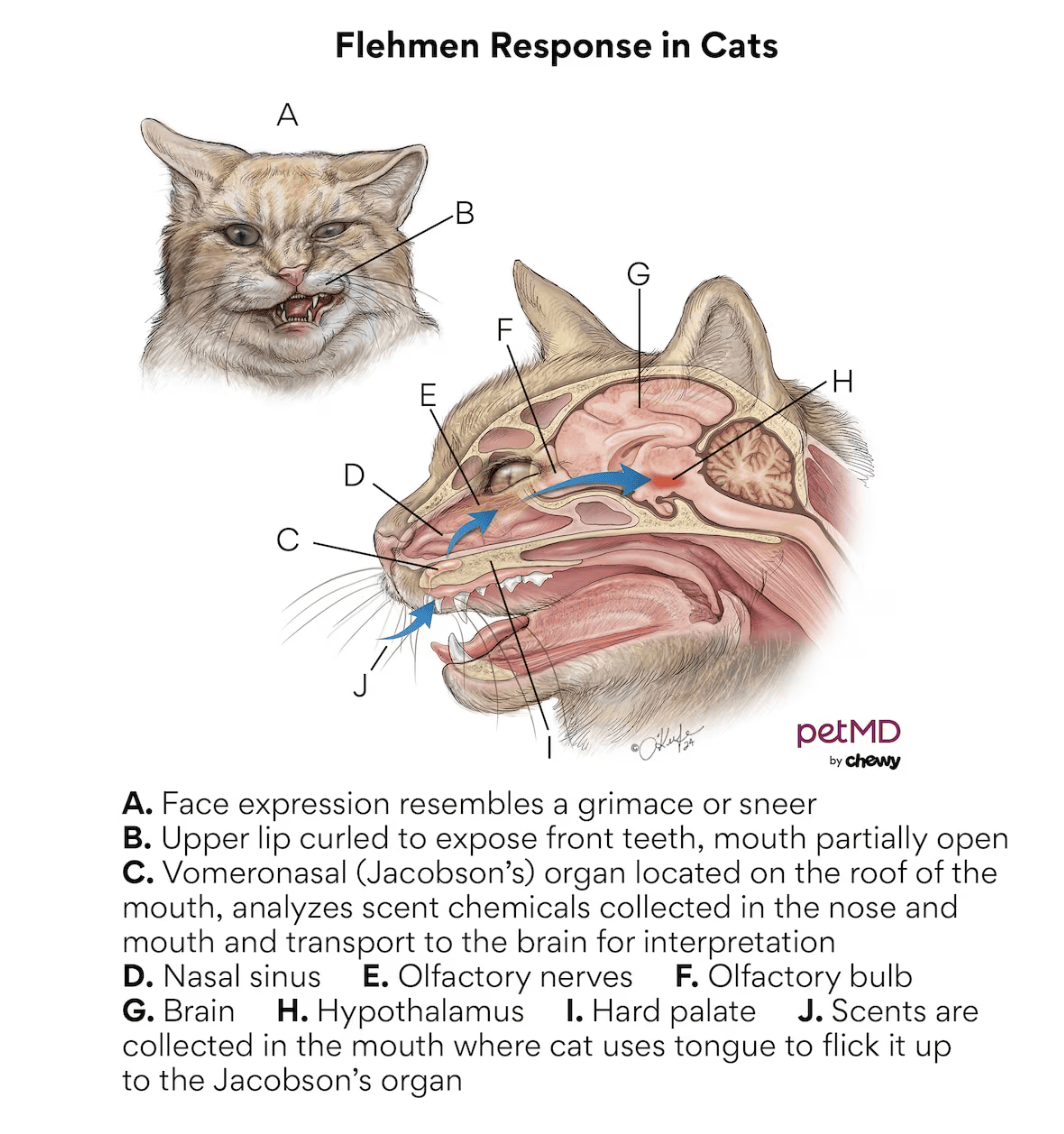
If you have a cat, you’ll probably have noticed the “flehmen response”, which is the “grimace face” a cat makes when it smells certain substances (especially cat pee). PetMD describes how it works and gives a handy diagram:
The flehmen response is a behavioral response to certain stimuli (usually odors) that allows an animal to better access the information carried through smell. It’s a voluntary response, meaning the animal deliberately exhibits the behavior (as opposed to involuntary responses, such as salivating in response to food or pupils dilating when anxious or stressed).
When a cat is enacting the flehmen response, they will typically hold their mouth open. This allows air to pass through their vomeronasal organ (also called the VNO or Jacobson’s organ).
Here’s a diagram:
Here’s a video of two cats making the flehmen response (aka “stinkface”):
And you can read the Current Biology article by clicking on the screenshot below:

Here’s something new in science papers: a graphical abstract of the results. You can see the structure of the fatty acids (click to enlarge):
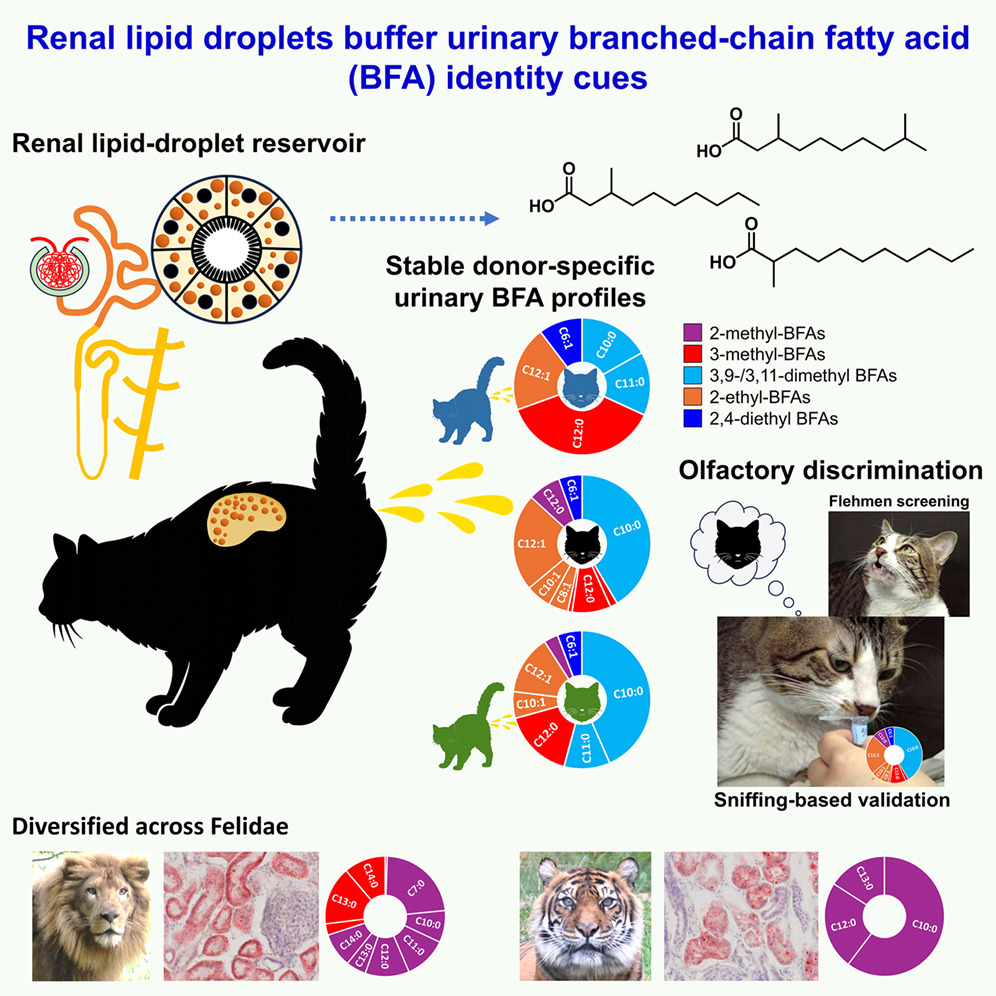
This is a good study though the work must have been odiferous! The authors showed not only how individual identification works using a combination of habituation and flehmen-response studies, but also identified the lipids that activated identification by modifying them chemically. Here’s the first paragraph of the discussion:
This study identifies a physiological architecture for durable chemical individuality in felids. Combining behavior, bioassay-guided chemistry, and tissue-level lipid analysis, we show that cats retain donor-specific urinary information across time and that this information resides in stable, behaviorally discriminable BFA compositions supported by a triacylglycerol-rich lipid-droplet reservoir in the renal cortex. Across Felidae, BFA-associated urinary and renal lipid signatures are broadly distributed but diversified in repertoire complexity, renal storage, and apparent urinary release. The central advance is therefore not simply the discovery of unusual urinary lipids but the identification of an organ-level buffering mechanism that stabilizes small-molecule identity cues.
**********************
Lagniappe: Joni and her kitty Bootsy!:
And some lovely minimalist sketches of cats, also via Facebook
h/t: Reese, Ginger K.
I read a lot of what you publish about anything, but Felid Trifecta is the only feature with which you hit a 100% read rate for this reader.
Me too!
Me three!
This is me singing. I always enjoy this feature, the number of cat related stories throughout the world is astonishing. Here’s a couple of extras:
https://www.bbc.co.uk/news/articles/c23525en474o
https://www.bbc.co.uk/news/articles/cddjlmm28l9o
Their resilience never ceases to amaze me.
Seconded!
Please continue with the Caturday felid trifecta! My household (hoomans and felines) love it!
That’s an interesting article. I am a (former) cat owner and lover but TBH I prefer other parts of WEIT, just on a time/profit analysis of WEIT.
I know a lot of other readers feel differently. It is an “editorial decision” as I tell my own editors.
You’re not paid to do WEIT, boss, and we all appreciate it. You do you. Nothing is BORING here.
Olfactory stuff is incredibly important to dogs, I’ve observed this myself and apparently they have 100x the cells/receptors in their olfactory bulb than humans.
D.A.
NYC 🗽
Keep ’em coming, Dr Coyne! We always look forward to Saturday. Thank you.
Love the article. Couldn’t get the articles open until I looked above the comments. Strange. But glad I saw it.
You’re my blue sky, you’re my sunny day
Lord, you know it makes me high
When you turn your love my way
You turn your love my way, yeah, yeah*
Cooper the Starfish looks so relaxed! It’s fun to watch cat’s sleep; in that condition they do all kinds of strange and wonderful things.
Regarding the science of cat recognition, we had a neurotic cat that habitually peed on the electric baseboard heaters in our first house. When the heat came on, the registers got HOT, and the cat urine transmitted our cat’s identity through the house. It was obviously an organic chemical of some sort that we couldn’t avoid smelling. Now I know. In consequence, my wife and I both exhibited the flehmen response. (I didn’t know it had a name, but of course it does! Everything has a name.)
Cool pencil sketches! I particularly like the one on the upper left. Our cats used to stretch like that. But is the cat stretching? Or is it getting ready to spring? There’s a certain incongruity in what the front part and rear part are doing, which is what makes this sketch interesting.
*
Verse from Blue Sky, the Allman Brothers. I believe that the singer was Dickie Betts.
The cats and I look forward to this every week!
We do too!
I always read Caterday but usually don’t comment because someone has said what I was thinking already.
The pencil sketches are lovely. I had not seen Shou Xin’s work before. Looking at his web site, some of the sketches remind me of Kwo Da-Wei (inkbrush artist mid 20th century… In my opinion, top of the field, and much copied by less skilled artists), in particular of his print “two Cats and a mouse”. Though the technique and medium are quite different, Shou’s being more dynamic, I think, but a similar eye for the essence in the behaviour and form.
Thank you for introducing me to this work. The prints appear to be reasonable in price, and the originals are not held terribly precious, unlike some current artists that price as if they have already departed the corporeal realm.
Cats + Science + Art; I love Saturday! Please don’t stop. I look forward to it every week.
Like Robert, I read parts of everything you post, but Caturday is the one post I read 100%. In a world that is so chaotic and depressing, Caturday is one of the things that keeps me half sane (along with my cats). I look forward to it each week as it’s a time I can decompress and concentrate solely on something that brings me joy. I know three other people who feel the same way, but never comment, so you must have quite a few unknown cat people who enjoy it every week.
A couple of comments: Copper’s human needs to brush him! Especially the tummy, which will soon be full of mats (and maybe necessitate a shaving). Love Joni + cat!
Over the years I’ve observed my strictly indoor cats and their flehmen reactions. Most of them don’t do it very often, but one in particular does it after sniffing the privates of others. He knows them all, but I guess he just has to check their identity cards occasionally. That was a very informative post – I had no idea about the science behind it. Thank you!
Please don’t stop the Caturdays, I never skip them, no matter how little time I have.
I love Saturday posts. Good information and fun stuff!
Me too
Enjoyed the video from Larry. Interesting about BFAs. I hope that this research can lead to a solution for feline kidney disease. Two of my 3 cats suffered from that. Always enjoy Caturday!
Like so many others, I read and enjoy all of your posts but (as a custodian of four moggies) especially look forward to the Caturdays.
The Larry video brings home that cats are, in a way, perfect animals. Beautiful, amusing, and interesting unique personalities.
The urine study is fascinating. We humans are so olfactorily deficient that there’s a whole dimension of the world that we’re oblivious to. I’d like to be a dog or cat for a day, just to know what it’s like.
I read Caturday without fail and I’m a dog person coz dogs make the best people🙂.
Many years ago I had two but then…
🎵My dogs up and died🎶
They upped and died
🎶After 20 years I still grieve🎵
I always love the Caturday posts. We’ve been catless for seven years now so I have to get my cat fix somewhere!
I always read Caturday posts! Thank you, Jerry!
I love Caturday!
Larry’s brief history of Caturday is fun. He probably should have mentioned the lolcat phenomenon, which jumped from 4chan to the wider internet, in part through the site I Can Has Cheezburger?
ICHC used to be a fun site with a sense of community and lots of reader-submitted memes. (It’s still around, but now it’s owned by some big investor and has become big and unwieldy and meh.)
Yes, the pictures at ICHCB are not as good as they used to be and it’s full of ads.
Please continue Caturday Felid, PCCE. I always forward it to many cat people and they love it too.
The olfactory recognition study was fascinating. I had one kitteh who was very territorial even after he was neutered. He sprayed a lot on my patio, which made me wonder how many other animals used it. Another kitteh displayed the flehmen response nearly every day when she smelled something she didn’t like.
The line drawings are lovely.
Always read Caturday even if I rarely comment on it. This one was especially fascinating. I grew up with cats and dogs and had the impression cats were less scent-oriented than dogs – for example, cats would recognize me visually whereas dogs were unsure until they sniffed me. But these discoveries show how important scent is to cats too. I also read that catnip activates the vomeronasal organ in a pleasantly stimulating way!
I love the Caturday posts. I especially like the posts about the interactions between cats and dogs. I grew up in a home that had both, often overlapping, and their interactions were very funny. Especially the ones with the big dog, who liked to play with the cat. When the dog was a puppy, he could run around with the cat, everywhere in the house, including under the bed. When the dog grew a bit, he could not fit under the bed, and would often get stuck there until one of his pet humans came to help. The cats understood this, and would provoke the dog into chasing them, and then proudly walk away while the dog was struggling.
All our cats and dogs got along, and it seems to me that as long as the hierarchy (cats > dogs > humans) is respected, the social system works. Mostly, we humans know our place. Sometimes, the humans or dogs get uppity, and need to be put in our place by the felines who, in optimal cases, are benevolent monarchs.
I read every one of your posts, PCC(e), and especially look forward to the Caturday ones.
βPer
Caturdays are fun!
Love Caturday. Keep it up. It is my favorite of your subjects and always brings a smile to my face! Thanks for all the work it takes.
The ink drawings were awesome!