
Today Athayde Tonhasca Júnior is back with one of his patented text-and-photo posts, which have always been very informative. Today he talks about palms and their pollinators in one area of Brazil. Athayde’s captions are indented, and you can enlarge his photos by clicking on them.
Beneficial saboteurs
It’s approaching midday somewhere in the caatinga, northeastern Brazil’s hinterland, and the temperature will soon hit the 40o C mark. All is quiet, as most animals are sensibly sheltering from the sizzling sun. The vegetation looks dead and stunted, but it is in fact quiescent, in a state of dormancy that helps plants endure the heat and drought until the rainy season arrives.
Fig.1. The caatinga vegetation in northeastern Brazil looks dead during dry season, but palm trees are green year round:

One palm tree, however, known locally as licuri (Syagrus coronata), doesn’t seem bothered by the harsh climate; it is verdant and in full bloom. The plant is monoecious, that is, it produces separate male and female flowers in the same individual. Male flowers grow at the end of large (~90 cm long) inflorescences, while the female flowers are at the base. Anthesis (the stage at which a flower is open and functional) is asynchronous: male flowers open first, releasing pollen and scent for 7 to 10 days. These flowers then shrivel and fall off. In about two weeks, it’s the female flowers’ turn; they are open for 10 to 15 days. Plants also bloom asynchronously, so at any given time of the year there are licuri flowers.
Fig.2. Licuri inflorescences © Drumond, 2007:

These flowery details may seem like too much information, but they are important for understanding the plant’s relationship with one of its most important flower visitors, the weevil Anchylorhynchus trapezicollis.
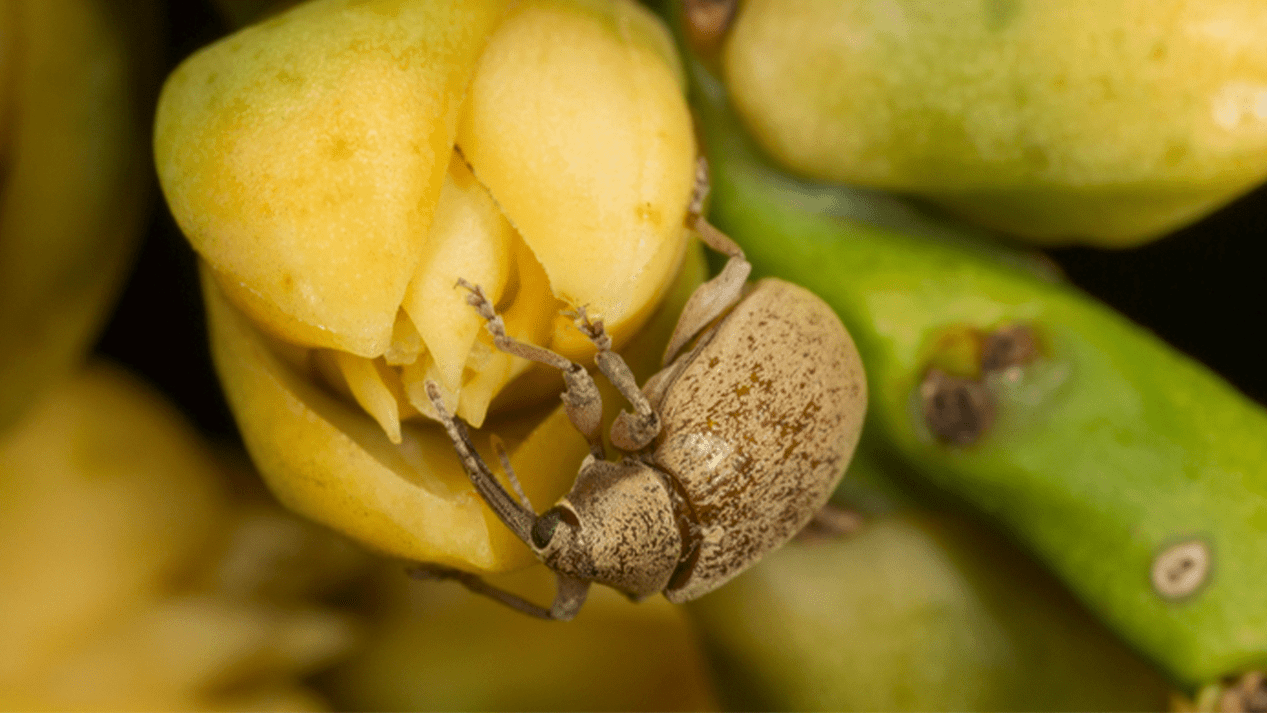
Like the overwhelming majority of the ~83.000 known species of weevil (family Curculionidae), A. trapezicollis feeds on plant tissues. Attracted by the scent of male flowers, a beetle uses its big schnozzle (in fact its rostrum, the snout-like projection from the head) to pry flowers open and take their pollen. While feeding, the beetle ends up with pollen grains attached to its body. As male flowers open at different times, there’s isn’t much food to be consumed in one sitting. The beetle is then encouraged to move to another plant, taking with it pollen that will result in cross pollination if the insect lands on a receptive female flower.
Fig.3. An A. trapezicollis in action on a licuri flower © Bruno de Medeiros, iNaturalist.Lu:
After feeding, a female beetle looks for female flowers to lay her eggs between the petals and sepals. The resulting larvae are cannibals: one larva will eat any competitor in the same flower. As they grow older, the little darlings shift their attention to developing fruits, which are aborted and fall off. Because it destroys forming fruits to complete its life cycle, A. trapezicollis is a seed predator. But for the cost of a portion of its fruits, the licuri palm is pollinated. This form of mutualism is known as brood-site pollination or nursery pollination, a trade-off association that has evolved for the yucca and the yucca moth, figs and fig wasps, and several other plant-insect partnerships.
Fig. 4. The licuri‘s trunk ends in a distinct crown of slightly arched leaves, a feature that inspired its specific epithet coronata (crowned) © Kelen P. Soares, Flora e Funga do Brasil:

Other weevils and bees also pollinate licuri, but A. trapezicollis seems to be the most important agent (Medeiros et al., 2019). This tight relationship has profound ecological consequences.
It is said that everything from a pig can be used except the oink, but licuri is not far behind in relation to its usefulness to humans. Its apical meristem (palm heart) is edible; the leaves are the source of a high quality wax, building materials, hats, baskets, sleeping mats and other handicrafts; ground-up leaves are fed to livestock in times of food scarcity; the tasty seeds (endosperm or nuts) are eaten raw or roasted, or added to confectionery and local dishes; oil extracted from seeds is used for lighting and the manufacture of soap, perfumes and other products.
Fig.5. The greenish pulp (mesocarp), brown hard shell (endocarp) and the nutritious white nut (kernel) of a licuri fruit © B. Phalan, Wikimedia Commons:


Humans are not the only creatures to benefit from licuri: many animals take the wholesome fruits. Among them, the Lear’s macaw (Anodorhynchus leari), an endemic and endangered species, for which licuri nuts represent the bulk of its nutrition.
Fig.6. Lear’s macaws, big fans of licuri nuts © João Quental, Wikimedia Commons:


There you have it: a palm tree of unordinary value, from people’s welfare and economy to endangered macaws and wildlife in general, is greatly dependent on pollination provided by unassuming weevils. And this is not an isolated case. More than 200 palm species (family Arecaceae) are pollinated by weevils, and so are many other plants from different lineages (Haran et al., 2023). The ‘million dollar weevil’ (Elaeidobius kamerunicus) illustrates well the relevance of these insects as pollinators. This beetle was introduced from Africa to Asia to help improve pollination of cultivated African oil palm (Elaeis guineensis), resulting in considerable increase in yields.
When we think of pollinators, bees, flies and moths are most likely to come to mind, as they contribute to the reproduction of crops and wildflowers familiar to us. Adding weevils to this select club may sound peculiar: after all, many weevils are pests capable of inflicting enormous damage on cultivated plants, trees and stored products (you may have had your pantry invaded by weevils). But that would be a parochial view. For millions of people in tropical and subtropical regions, palm trees are more than props in holiday brochures: they are crucial for wildlife food chains, human nutrition, building materials and commodities such as medicines, industrial products and fibre. A great deal of these benefits depends on a range of poorly known, frequently dismissed and often vilified weevils.
Fig.7. Six species of weevil known to be involved in brood-site pollination © Haran et al., 2023:

References
Drumond, M.A. 2007. Documentos, 199. Embrapa Semi-Árido.
Haran, J. et al. 2023. Most diverse, most neglected: weevils (Coleoptera: Curculionoidea) are ubiquitous specialized brood-site pollinators of tropical flora. Peer Community Journal 3: e49.
Medeiros, B.A.S. et al. 2019. Flower visitors of the licuri palm (Syagrus coronata): brood pollinators coexist with a diverse community of antagonists and mutualists. Biological Journal of the Linnean Society 126: 666-687.
Neat post! Thanks Athayde!
Very nice post!
Cool photos and information! Thanks!
An absolute marvel. I very much appreciate the posts from Athayde!
Beetle pollination is thought to be among the earliest mutualistic interactions between plants and insects, and as far as I know palms are an ancient group of flowering plants. So this seems to be a window into the Cretaceous if not earlier.
Righto, Cretaceous frequently cited. Thanks
Enjoyed this post thanks. The little creatures of this planet deserve better PR about the role they play in our ecosystem and the cycle of life.
“Rhopalostylis sapida, commonly known as nīkau, is a palm tree endemic to New Zealand, and the only palm native to mainland New Zealand”
…as an aside, I am wondering, just wondering… if the above are distantly related to licuri (Syagrus coronata), as there is a Gondwanaland connection. They do look very similar.
https://en.wikipedia.org/wiki/Rhopalostylis_sapida
..sorry to use your post but it is loosely linked to your narrative, here is a link to a doco on the “Queen of the Forest” the quality of it’s content hopefully makes up for the footage quality.
“Truly, a masterpiece” – David Attenborough
Excellent learning opportunity. Thank you, Athayde Tonhasca Júnior.