
James Blilie is back with some black-and-white photos from his perambulations and climbs. Jim’s captions are indented, and you can enlarge his photos by clicking on them. And Jim tells us he’s recovering well from a knee replacement.
Here is another set for your consideration: Black and white landscape images from those I posted on that previously mentioned FB page for B&W images.
First up are two shots from our attempt to climb Mount McKinley (as it was named at the time) in May 1987. We did not summit (“worst May weather since 1960-something”):
Rocky outcrop in the Kahiltna Glacier, scanned Tri-X Pan

Camp on the Kahiltna Glacier with the summit in the background, scanned Tri-X Pan:

Our local mountain, Mount Adams, but from the other side, the north side, 1987. I climbed it three times, always from the north. The “standard” route is on the south side. Scanned Tri-X Pan:

Skiers in Garibaldi Provincial Park, British Columbia, 1988, scanned Kodachrome 64:

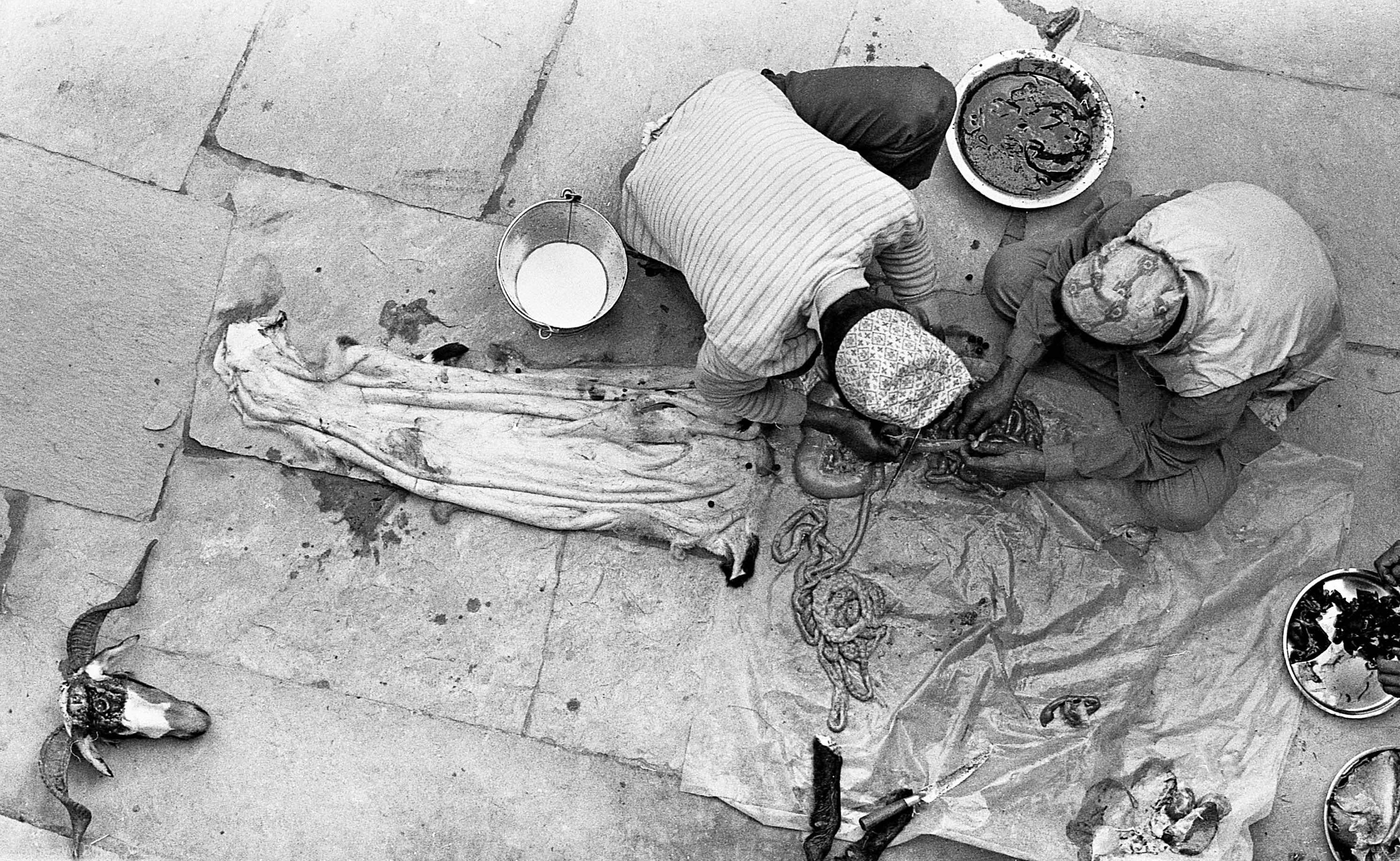
Dinner preparation, Nepal, 1991, scanned Tri-X Pan:
The Vietnam War Memorial, Washington, DC, January 1992, scanned Tri-X Pan

Letchworth State Park, New York, November 1992, scanned Tri-X Pan:

Elephants, Amboseli National Park, Kenya, 1991, scanned Kodachrome 64:

Bonneville Salt Flats, Nevada, June 2013:

Mount Hood, taken from our driveway, December 2023:

Kalaloch Beach, Olympic Peninsula, June 2025:

Equipment:
Current:
Olympus OM-D E-M5, micro-4/3 camera (crop factor = 2.0)
LUMIX G X Vario, 12-35MM, f/2.8 ASPH. (24mm-70mm equivalent, my walk-around lens)
LUMIX 35-100mm f/2.8 G Vario (70-200mm equivalent)
LUMIX G Vario 7-14mm f/4.0 ASPH (14-28mm equivalent)
Leica DG Vario-Elmar 100-400mm, F4.0-6.3 II ASPH., Power O.I.S. (200mm-800mm equivalent)The scanned images:
Pentax camera bodies: LX, K-1000, ME-Super, MX
Various Pentax M-series and A-Series lenses:
20mm f/4
20mm f/2.8
50mm f/2.0
200mm f/4
Tokina ATX 80-200mm f/2.8
Letchworth! Nice pic of the middle falls–looks like the spring melt on the Genesee, probably what it looks like right now. Question for Jim: Did you eat at the Glen Iris when you were there? It has always been one of my favorites.
Thank you. I did not. I was staying with friends (he was teaching at the University of Rochester) and we ate “in” (since none of us had much money at the time!).
Beautiful!
Stunning!
“Taken from our driveway”!!
Always wonderful, Jim Bl. thanks! I can feel the cold and hear the crunch beneath my feet on Mt McKinley. Captured reflections of visitors the full length of the Viet-Nam Memorial…amazing! And the view from your driveway? Your daily dose of Mt Hood would surely spoil me.
Thank you. I never tire of our mountain views. This is the view from our new house (built 2023-24), intentionally aligned to point straight at Mount Adams:
https://jwbliliephoto.net/PandJ-Family/2026/2026-02-19/P1130093_80.jpg
High art in WEIT! The Nepal dinner preparation is grim but honest, and that is to be sought in photography.
Super pictures! I always loved using Tri-X Pan in the good old days of B&W photography. It was fun to develop the film and make prints—the images emerged as if by magic.
Thank you. I loved the film thing at the time (I even loaded my own film cassettes from 100-foot rolls of Tri-X). I learned photography literally at my father’s knee: Watching him in his darkroom. But I could never go back to film from the convenience and flexibility of digital photography.
Gorgeous photos. I’m curious as to what you do to scan slides because your scanned elephant slide looks excellent and most of my scans are crappy.
Thank you. Excellent question. I use an Epson V500 Perfection scanner. It uses pure white, through-transmission light and can do 12,000 dpi resolution (6400 is overkill with 35mm film, 2400 is my most common resolution as a compromise between detail (hardly any compromise) and speed plus file size.) The current version from Epson is the V600.
I over-scan (I set the crop of the scanner to just larger than the slide film) and then crop back to what I want.
Learning to use the scanner SW is important. The UI is pretty crude; but it does get the job done. There are quite a few adjustments you can apply pre-scan. I mostly just use the exposure and contrast adjustments.
Then: Editing in photo SW is critical. I use Lightroom 5. You will have to do a lot of dust spotting in SW (it’s critical to get a good negative brush and brush your originals and the glass of the scanner prior to scanning). Pretty much all images need a little:
Lightening of the shadows
Increase in contrast
Increase in saturation
I made a preset in Lightroom titled “Kodachrome 64 scans” that applies this (very mild adjustments) automatically or manually.
I scanned roughly 25,000 original slides and negatives (I have about 200,000 images in my Lightroom catalog*). It was a long process over several years; but so worth it. I have multiple backups of the scans in many places, including our safety deposit box. You can’t back-up analog film originals!
(* I strongly recommend using “key words” when importing your images to Lightroom. Once you have a big catalog, it makes finding images hugely easier.)
Thanks so much for all of this helpful info
You may find this page of interest:
https://jwbliliephoto.net/Camera_Gear/Camera_Gear.html
Nice post! Thanks.
Lovely photos. I like the starkness.
Impressive B & W. Beautiful scenery.