
Today we have part 2 of Ephraim Heller’s photos of arachnids taken on a recent trip to Trinidad and Tobago (part 1 is here). Ephraim’s captions and IDs are indented, and you can enlarge the photos by clicking on them.
Spiny orb-weavers (genus Micrathena) include over 119 species. What immediately distinguishes micrathena from other orb weavers is the bizarre armature of the female’s abdomen: an array of hardened spines and conical tubercles that give these small spiders an alien appearance. These spines have evolved independently at least eight times within the genus and likely function as anti-predator defenses, making the spider difficult or unpleasant to swallow.
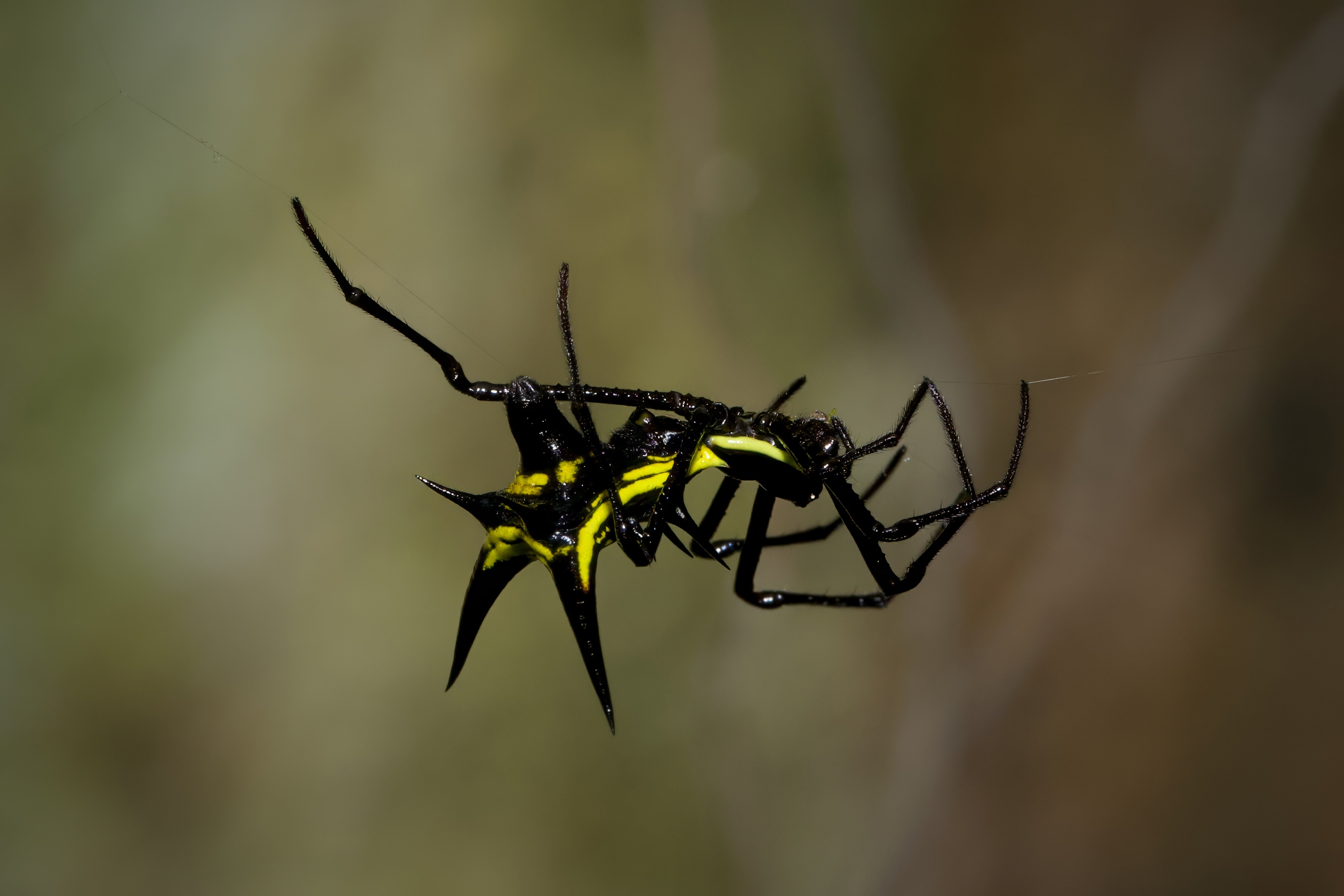
The tropical orb weaver (Eriophora ravilla) is a large, nocturnal species. What makes eriophora ravilla distinctive among orb weavers is its strictly nocturnal web-building behavior. Each evening after dark, the spider constructs an enormous orb web with a main support thread that can stretch over 18 feet, then tears down the entire interior webbing before dawn. During the day, the spider hides in a rolled leaf bound with silk, invisible to casual observers. I was attracted by the shape and coloration of these spiders:
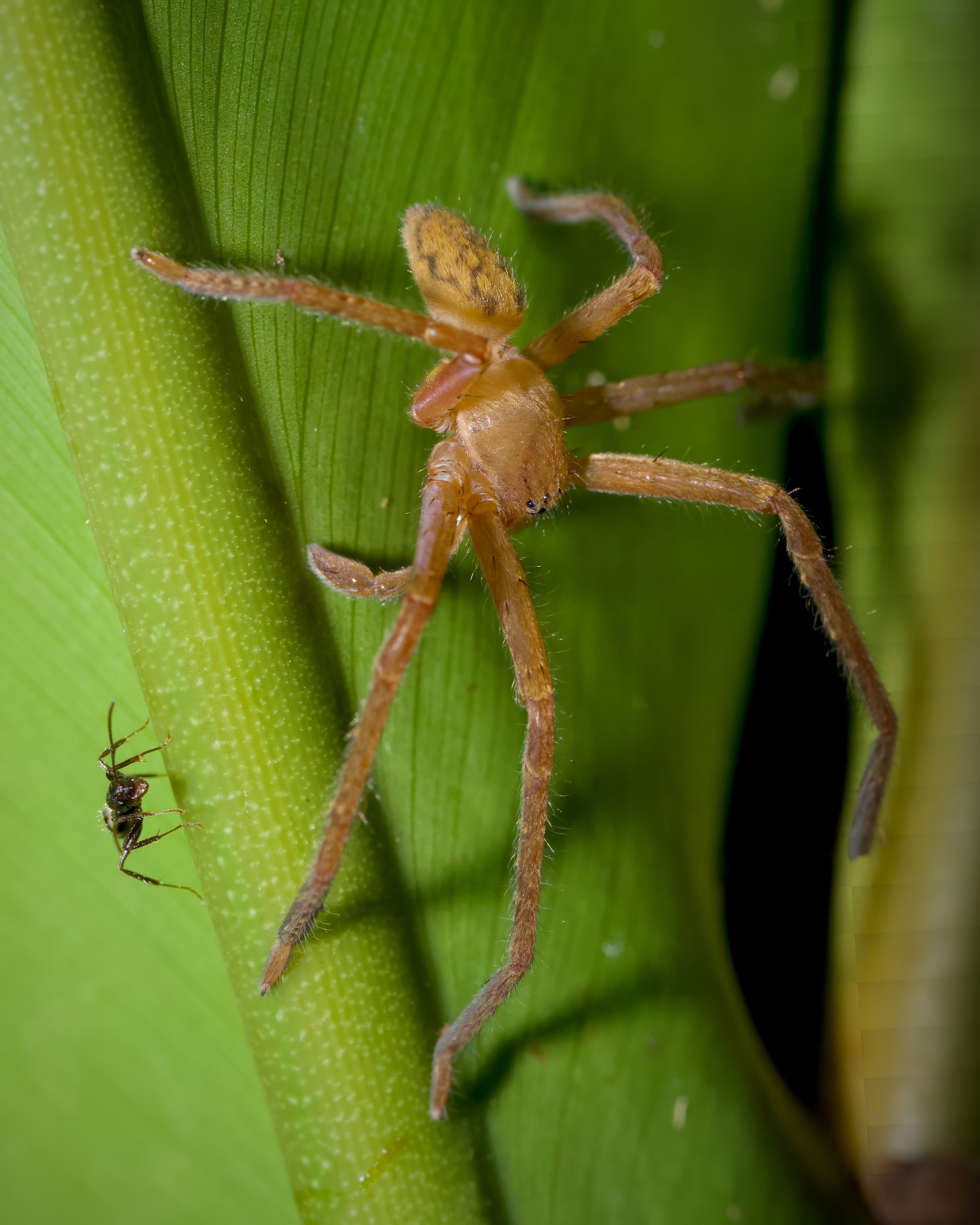
The genus Meri belongs to the family Sparassidae, the huntsman spiders. Huntsman spiders are characterized by their laterally extending, crab-like legs, rapid movement, and hunting lifestyle. They do not build webs. Instead, they actively pursue and overpower prey, relying on speed and ambush tactics. Sparassids are among the fastest-running spiders. Though their venom can cause local swelling, pain, or nausea in humans, huntsman bites are rarely medically significant. This handsome individual is perhaps Meri trinitatis:


Switching from spiders to their distant arachnid cousins, the harvestmen (order Opliones), the key differences are:
– Body plan. Spiders have two distinct body segments: a cephalothorax (prosoma) and an abdomen (opisthosoma), joined by a narrow waist called the pedicel. Harvestmen have a fused body in which the cephalothorax and abdomen are broadly joined, giving them a single, compact oval shape.
– Eyes. Most spiders possess six to eight eyes arranged in species-specific patterns. Harvestmen typically have just two eyes, often mounted on a raised turret (ocularium) atop the body.
– Venom and fangs. Spiders possess venom glands connected to their cheliceral fangs, which they use to subdue prey. Harvestmen lack venom glands entirely: they are completely harmless to humans.
– Silk. All spiders produce silk from spinnerets, whether they build webs or not. Harvestmen cannot produce silk at all.
– Respiration. Spiders breathe through book lungs and/or tracheae. Harvestmen breathe exclusively through tracheae, with spiracles located near the base of the fourth pair of legs.
– Reproduction. Male spiders transfer sperm indirectly via modified pedipalps. Male harvestmen possess a true penis and transfer sperm directly, a rarity among arachnids.
– Defense. When threatened, many harvestmen secrete noxious chemicals from specialized scent glands (ozopores) on the prosoma, producing a distinctive acrid odor. Spiders rely on venom, retreat, or urticating hairs (in tarantulas) for defense.
The harvestmen I photographed belong to the genus Phareicranaus in the family Cranaidae. Cranaids are stout, heavily armored harvestmen, very different in appearance from the daddy longlegs familiar to North Americans. I believe these are Phareicranaus calcariferus:


What makes this species notable for a harvestman is its parental care behavior. Field observations in Trinidad documented both maternal and possibly biparental care of young, a rare finding. Adult females were observed guarding clusters of nymphs, and in some cases, both a female and a male were present with young. This kind of prolonged parental investment is unusual among arachnids and speaks to the selective pressures – particularly predation by ants and fungal infection of eggs – that have driven the evolution of parental care in Neotropical harvestmen.
Finally, an unidentified harvestman:

Note: all of these photos were taken using a Nikon Z8 or Z9 camera, a NIKKOR Z MC 105mm ƒ2.8 VR S macro lens, and a Nikon SB-5000 Speedlight flash.
The tropical orb weaver wears cool shades
Indeed!
Super cool pictures and information!
Such beautiful, fragile and yet venomous creatures!
Thanks Great Photos, and I learned a good deal about spiders vs Harvestmen.
Observations of parental care amazed me. Never would of guessed!
Great stuff! I really enjoyed this.
Very nice. When we have spiders or harvestmen in our house, we leave them alone and make sure we don’t step on them. Fantastic creatures that have endlessly interesting ways to make a living.
Excellent photos! Thanks!
Fascinating creatures. Thanks!
Amazing pictures. Thanks for the information on the differences between spiders and harvestmen.
Harvestmen are sweethearts. It’s as much as sin to kill a harvestman as it is to kill a mockingbird.