
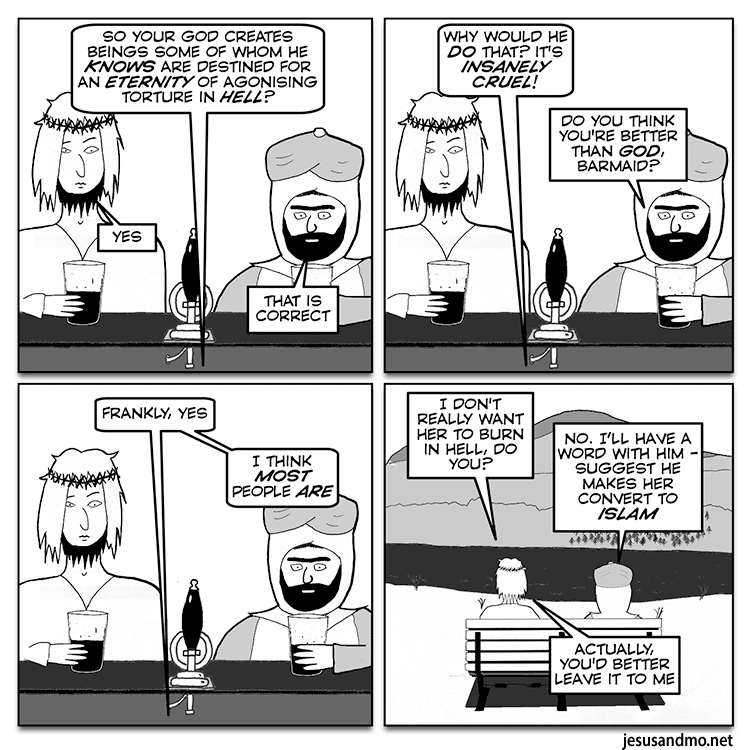
Today’s Jesus and Mo strip, called “frankly,” came with a note, “Only bad people believe in hell.” Once again we have to deal with the problem of theodicy: that most weaselly branch of theology that deals with the question of why a good God would allow evil and suffering in the world. Mo has a solution, but it applies specifically for the barmaid:
My definition of “theodicy” is “making excuses for God”.
Barmaid is demonstrating Gnosticism.
Like, 100.0% Gnosticism.
Rarely do I read of people questioning the premise that God is good. If one accepts as a premise that God is not good, then all the contorted “explanations” for evil would go away. Parsimony suggests that, if God exists at all, the latter premise is more likely than the former.
The barmaid’s initial question is one of the central obvious idiocies that religious apologists desperately try to avoid. I’ve never heard any explanation or justification of it that makes any sense; in the end they usually retreat to “well, it’s just allegory, or course no one is really tortured for eternity”. Yes, who wants to worship a god that would play such a sadistic game?
Have you ever asked a christian where hell is?
They look blank and then might say ‘somewhere’.
It’s not something they have ever thought about.
But, if you ‘go’ there there must be a place.
I think all religions scramble people’s brains.
Don’t they think it is under the ground, whereas heaven is in the sky?
An apt anagram for theodicy: the id’ocy.
In the early years of El / Yahweh he / they didn’t have a clear idea about what happened to their tribe after death and it was left a murky shadowy non existence. Thoth was that the threat of stoning to death was enough to keep folk in line. The prophets of El condemned the other gods as false and evil and scolded the Israelites for pick and mix practices to neighbouring religions. However when the Jewish scholars at Alexandria took a fancy to the Greek and Roman gods’ threat of hell they didn’t get stoned to death for unfaithfulness but rather hell became officially adopted by Jehovah.
Tartarus in Greek mythology is torture chambers of hell for fallen angels and is written of as a real thing in 2 Peter 2v4. See Wikipedia article about Tartarus Biblical pseudepigrapha. Tartarus is in Septuagint translation of Job (40:20 and 41:24) into Koine Greek, and in Hellenistic Jewish literature from the Greek text of the Book of Enoch, dated to 400–200 BC repeated in Jude 1:6-7
Theodicy is not the only ‘weasely’ theological expression, but just the tip of a very slippery, proverbial iceberg. That is to say that theology is not even a valid human intellectual endeavor, making the entire history of christology no more then, as scripture would say, chasing after wind! Which sets up the prospect of a ‘judgement’ with ‘tradition’ firmly in the divine crosshairs. Expect ecclesiastic feathers to fly!