
The meme below, from Cats Doing Cat Stuff: implies that Thaland has declared all cats as official national symbols. Well, as the articles below say, that’s not exactly true. Some cats have become national symbols, but only breeds from Thailand. Read on:

Here are two articles, the first from the Singapore-based cna news organization and the second from the Bangkok Post. Click on either to read, though the first is more informative:

 x
x
x

From cna:
Five cat breeds native to Thailand were approved as national pet symbols by the government on Nov 18, joining the Thai elephant, fighting fish and Naga among other nationally recognised emblems.
The pure Thai breeds – Suphalak, Korat, Siamese, Konja and Khao Manee – possess distinctive physical and behavioral traits that clearly differentiate them from other breeds, according to Thailand’s National Identity Committee, which had proposed their designations as national pets.
“Their uniqueness has gained international recognition, with some foreign breeders attempting to register purebred Thai cat lines and establish global breed standards,” the Thai government’s public relations department said in a report on Nov 20.
A drawing of the five lucky breeds from cna graphics:

More from cna:
Preecha Vadhana, a cat breeder who operates Bangrak Cat Farm in Bangkok, said that each of the five breeds has very distinct features, making them easily distinguishable from one another.
“But they also share similarities, particularly their structure and short coat.”
The Suphalak has a distinct copper coat and is considered a symbol of prestige and fortune. The Korat is a bluish-grey cat with large, vivid green eyes, while the Khao Manee – a rare, white species – often has eyes with two strikingly different colours such as gold and blue.
The Konja is known as a lucky black cat, unlike its foreign counterparts which are often infamous for the opposite.
Finally, the “king of cats”, the Siamese or Wichienmas, is marked by its distinct dark spots and treasured for its intelligence. It is typically the most expensive of the breeds and can cost 15,000-20,000 baht (US$465-US$620) from a local breeder, while others cost 7,000-15,000 baht.
. . . . The decision to elevate these species is not just symbolic: It is meant to help conserve rare native breeds, standardise them and protect Thailand’s ownership of them. The species will also be used more in creative-economy and tourism branding, according to the government.
Then there’s some grousing about how this recognition won’t help the hundreds of thousands of feral Thai street cats. That’s probably true, but this is just symbolic. I think the USA needs a National Cat too, and give the genetic admixture that is America, it should be a regular moggy, like a tabby.
Here’s a 4½-minute video about the recognition of National Cats:
***************************
This article from artnet (click to read) describes a new exhibition of medieval manuscripts with cat drawings at Baltimore’s Walters Art Museum. The title of the exhibit is cute: “Paws on Parchment”. Click to read, and go to the site to see some of those medieval cat drawings, none of which look like real cats!

Note that if you live near Baltimore, the exhibit runs only through February 22, so get your tuches there soon. If I lived nearby, I’d sure go.
An excerpt:
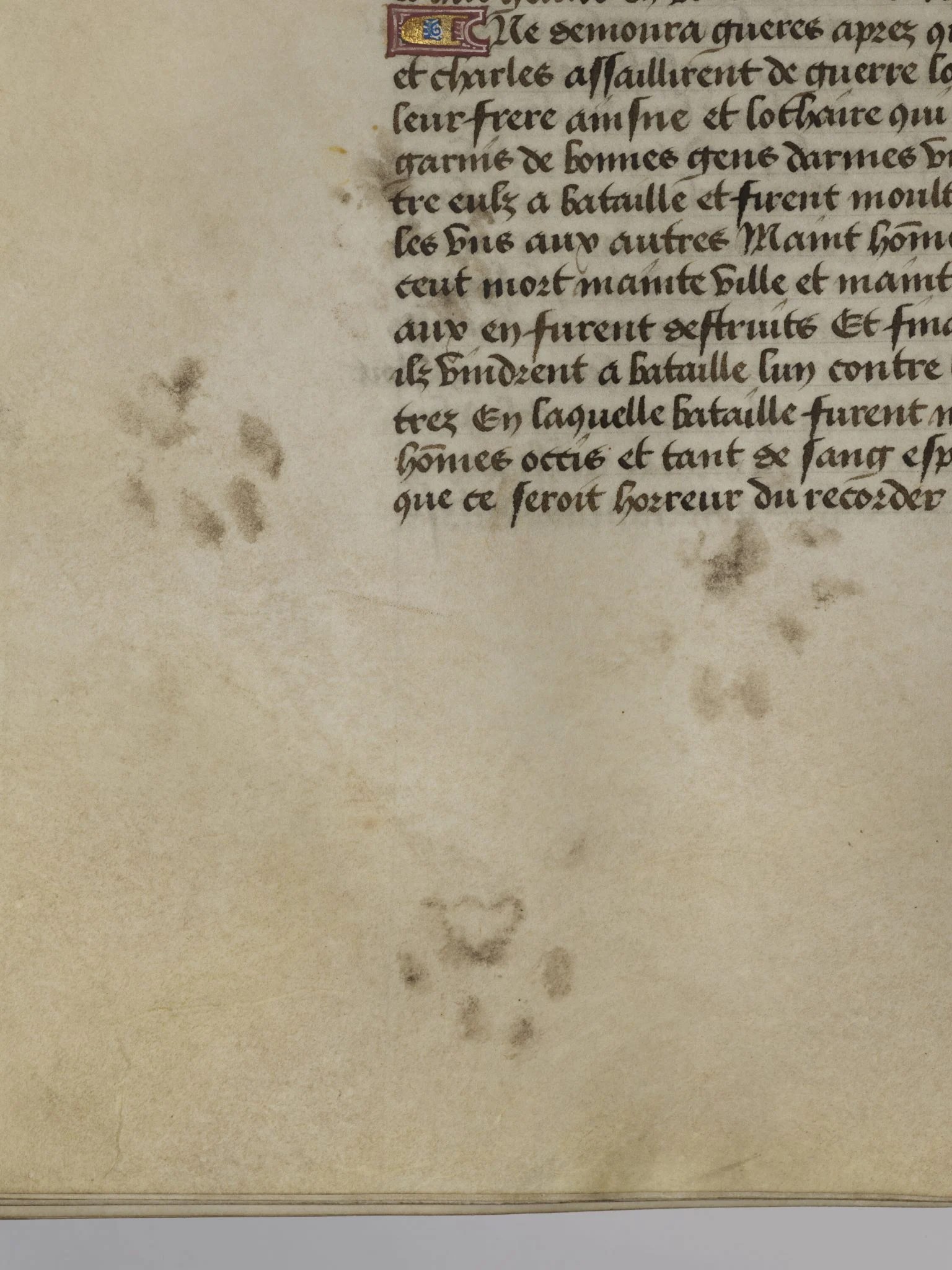
In the 1470s, a Flemish scribe left some meticulously drafted pages of an illuminated manuscript out to dry, only to find out the next day that his cat had trod over them, leaving inky paw prints on the parchment. (Contemporary writers will know the similar pain of typos and elisions wrought by a feline friend’s frenzied scamper across a keyboard.)
Now, more than 500 years later, those pattered pages are the “cat”-alyst for an exhibition at Baltimore’s Walters Art Museum. Aptly titled “Paws on Parchment,” the show explores how medieval illustrators in Europe, Asia, and the Islamic world celebrated cats in the marginalia of their manuscripts and beyond. On view through February 22, 2026, it’s the first of three exhibitions over the next two years dedicated to the depiction of animals in art.
Here is that page with the cat print on it, a cat that lived over 550 years ago!
Herbert researched the works from a lot of different angles to better understand how people felt about cats. This included primary sources like medieval poetry, moral and cautionary tales, recorded pet names, and discussions of cats in encyclopedic works like Isidore of Seville’s Etymology, from the 7th century, and in medieval bestiaries.
Pets with Purpose
She was surprised by what she found. “Many medieval people loved their cats just as much as we do,” she said. However, the reason people kept them in homes, churches, and libraries was less for company and more for the practical reason of rodent control. Their skills at hunting mice and rats were critical to protecting food stores, valuable books, and textiles—and of course, preserving their owners from the plague and other diseases carried by vermin. “Because this was their key purpose in people’s lives, they are most often shown hunting mice,” Herbert said. “While this is still something a house cat might do today, our lives and livelihoods generally don’t depend on their success.”
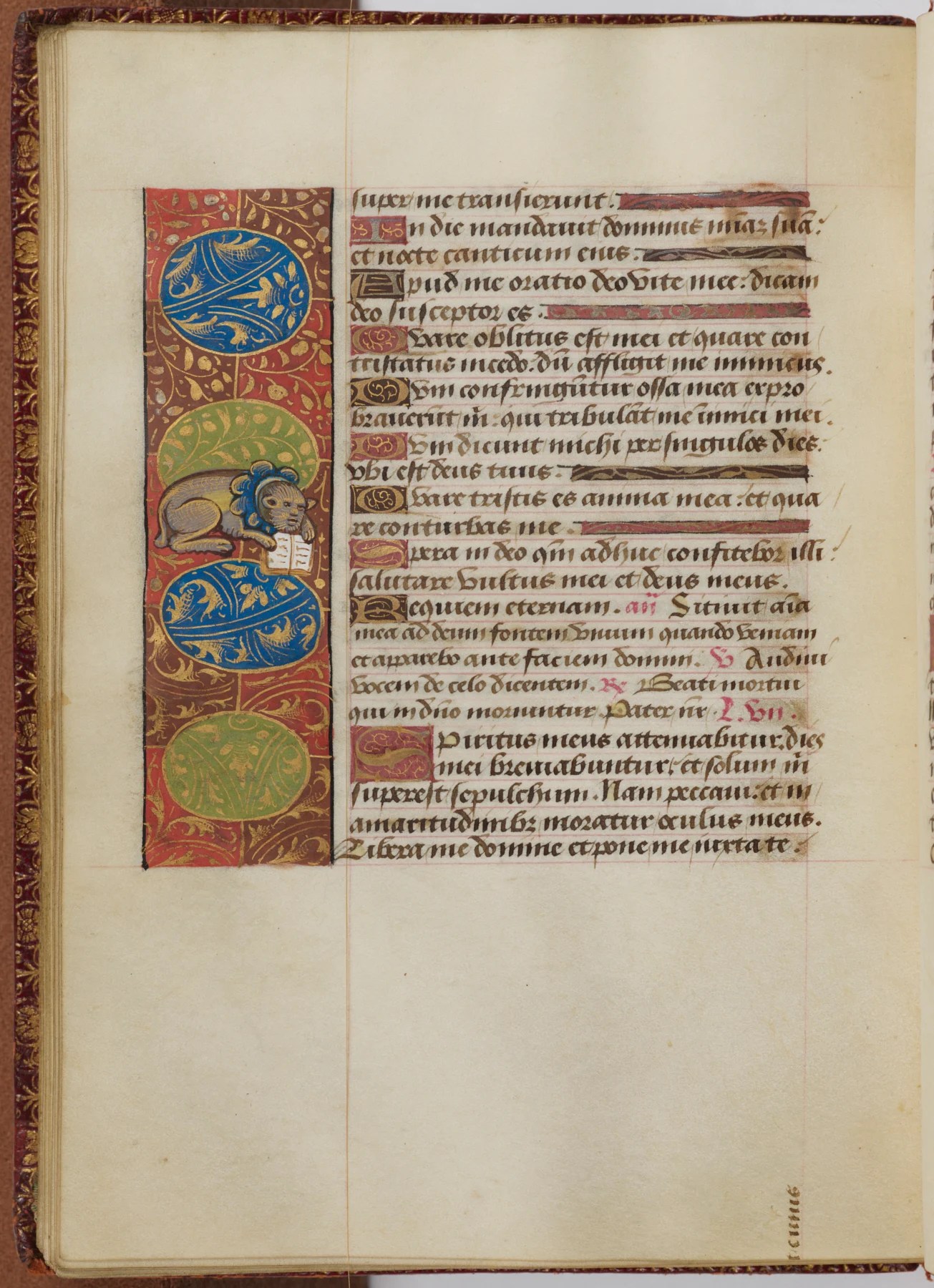
A manuscript cat that was on display. Does this look like a cat? Go to the artnet page or the Walters Museum page to see other illustrations and photos. This exhibit has been running since last August, and you have about six weeks to see it.
Here’s a FB video of cats that didn’t make the cut for the exhibit.
********************
We all know about Larry, the Chief Mouser to the Cabinet Office, who roams around in and around 10 Downing Street, but did you know that there’s an equivalent cat in Belgium. He belongs to the Prime Minister, and has the lovely name of “Maximus”, short for his full name, “Maximus Textoris Pulcher”. Click below to read the Guardian article about him:

An excerpt:
For nearly 15 years, Britain’s Larry the Cat has charmed visitors to 10 Downing Street. Now another prime ministerial pet is proving a social media hit in Belgium.
Maximus Textoris Pulcher was announced in August as an official resident at the Belgian prime minister’s office, Rue de la Loi 16 in central Brussels.
The grey rescue cat is now thought to have the second most popular political account on Belgian social media, with more than 142,000 followers on Instagram – second only to his master, Bart De Wever, who became Belgium’s prime minister in February.
The cat’s full name is a mock-grandiose title rooted in the prime minister’s love of Latin and Roman history, conveying the meaning “De Wever’s beautiful Maximus” (textoris being “of the weaver”, or De Wever).
De Wever adopted the cat, an abandoned Scottish fold, from a refuge. “I have a cat in my office, it is grey and it does not catch … mice, but I love it anyway,” he told journalists during a recent press conference.
Maximus’s posts on Instagram have lit up the Belgian internet, whether he is stretching for a toy, lolling on a windowsill or being tickled on his chest to an electropopsoundtrack.
. . . Unlike Larry, officially an apolitical cat, Maximus offers subtle observations on his country’s political life. “Another strike,” reads one Maximus thought bubble on the day Belgium began a three-day national action in November against proposed spending cuts, hinting at the exasperation of his master. In another post when De Wever’s eclectic five-party coalition was locked in budget talks, a grumpy-looking Maximus lies on the floor with a thought bubble reading: “Even on Sunday, these nuisances [cabinet ministers] are here.”
A source close to De Wever – described as “a cat person all his life” – said the account was a low-effort part of his team’s work and offered the public a behind-the-scenes glimpse of Rue de la Loi 16.
My friend Maarten Boudry, a Belgian philosopher, tells me that everybody in Belgium knows who Maximus is, and many people follow him.
Here are a couple of Instagram entries showing Maximus making pronouncements. I’ll put a translation for each:
“I’m lookng forward to 2026”:
What do you think of my Christmas sweater, Maximus?
Maximus: Gorgeous!
Maximus (thinking): Ugly…
BDW: What a lovely present, Maximus!
Maximus: Happy birthday… you old sock!
(Note that the socks bear pictures of Maximus)
**********************
Lagniappe. This cat seems to be real, or at least the same photo is everywhere. One specimen:
h/t: Peter N.,, Ginger K.
Not all Thai cats are Siamese! Who’d a thunk it? Very interesting and nice that their felines are getting recognition. BTW, the Siamese Fighting Fish (Beta splendens) is absolutely spectacular and worthy of the recognition. I often had one in my aquarium when I was a kid. (You can’t have more than one male in the same tank unless they are separated by a partition. They would tear each other to shreds.)
Agreed. The U.S. needs a National Cat, and it should without question be our beloved Tabby or perhaps the American Shorthair. From what I understand, Massachusetts established the Tabby as the official state cat in 1988.
Gotta love that illuminated manuscript with the cat prints. Typical cat behavior captured at a moment in time. They’ve always been that way. Either they get in the way while you’re working on something, or they walk on it the moment you step away. They’re cats!
Maximus Textoris Pulcher, with his ears pinned back (or maybe he doesn’t have ears), looks like one angry cat. A cat that looks like that is a cat that bites!
This just in: Skyline has been rescued and is available for adoption.
https://www.upi.com/Odd_News/2026/01/09/Dallas-bridge-kitten-rescue/3421767982915/
Maximus is a Scottish fold; their ears are folded forward and down. They’re all descended from a Scottish farmer’s cat who was born with the odd mutation. (Sadly, like many pet breeds bred for unusual, “cute” features, the genetic abnormality causes health problems.)
I’m all in favour of national cats.
And prime ministers having famous cats, too.
🐈🐈🐈
“National Cats” sounds like a good name for a jazz band.
Remember the song “Nashville Cats” by the Lovin’ Spoonful?
Thank you for a wonderful collection of cat posts! It seems that most animals depicted in medieval manuscripts have strange faces, making one wonder why the artists couldn’t draw/paint more realistic versions of the animals.
Hooray for the Belgian Prime Minister! Since the cat is a Scottish fold, the ears are supposed to be that way–Maximus is not mad, unlike “typical” cats. When the ears go back on the latter, one should watch out.
The last cat’s markings are so strange that it is probably NOT an AI generated cat!
Those kitties made my week!
The famed Cardinal de Richelieu was a cat lover. Here he can be seen with several of the many he owned :
https://fr.wikipedia.org/wiki/Armand_Jean_du_Plessis_de_Richelieu#/media/Fichier:Richelieu_et_ses_chats.jpeg
A nice little page in french (I think most browsers allow some instant translation of a page ?) : https://www.au-chat-heureux.com/blog/histoire/le-cardinal-de-richelieu-et-les-chats.html
Thanks for the cat stories. I especially love the story about the Belgium prime minister. Maximus has so much personality that he could make de Wever famous – not for being the Belgian PM, but for being his owner.
The cat with eyebrows, pencil moustache, and head of black hair has a very disconcerting appearance.
Those Thai cats are beautiful. The suphalak cat is the only cat I’ve ever seen with fur that is a true, solid brown in color.
I saw the cat with the odd markings briefly online and assumed it was AI. But it seems to be real. Many fun stories today. Now I want a Suphalak-
The British museum has a brick from the ziggurat of Ur on its web site that shows two d*g paw prints mashed into them.
Thank you for a delightful Caturday post. I’ve fallen in love with Maximus and his human.
As it happens, I spent the day at the Natural History Museum of Los Angeles, seeing a special exhibition: “Fierce! The Story of Cats”.