
We have two batches left and this is one of them (i.e., send in your photos). Today we have some photos of the Aurora Borealis (and a few other things) taken by Ephraim Heller:
I was fortunate to be in Alaska on the night of Nov. 11-12 when the aurora borealis put on the best show of the year, widely visible across North America. I photographed the event at Birch Lake, about 50 miles southeast of Fairbanks. I shot the aurora from 10pm – 3am as the temperature registered -16° F (-27° C) and I coughed with a cold. It was worth it.
“Aurora borealis” is Latin for “northern dawn.” Despite my wasted BA in Physics, I have never understood what causes the aurora. I decided to look it up and share what I learn with readers of WEIT. Real physicists and astronomers should feel free to correct my errors. Thanks to NASA and to Akari Photo Tours for nice explanations on their websites, from which I have borrowed liberally.
Our sun continuously emits a stream of charged particles (the solar wind) which flows outward through the solar system. When this plasma reaches Earth, it interacts with our planet’s magnetic field (the magnetosphere), depositing and accumulating energy there. During a geomagnetic storm, much of the accumulated energy in the magnetosphere flows down along Earth’s magnetic field lines. As these accelerated particles descend into the atmosphere they collide with oxygen and nitrogen molecules at altitudes between 100 and 300 kilometers. These collisions excite the atmospheric gases, causing them to emit photons.
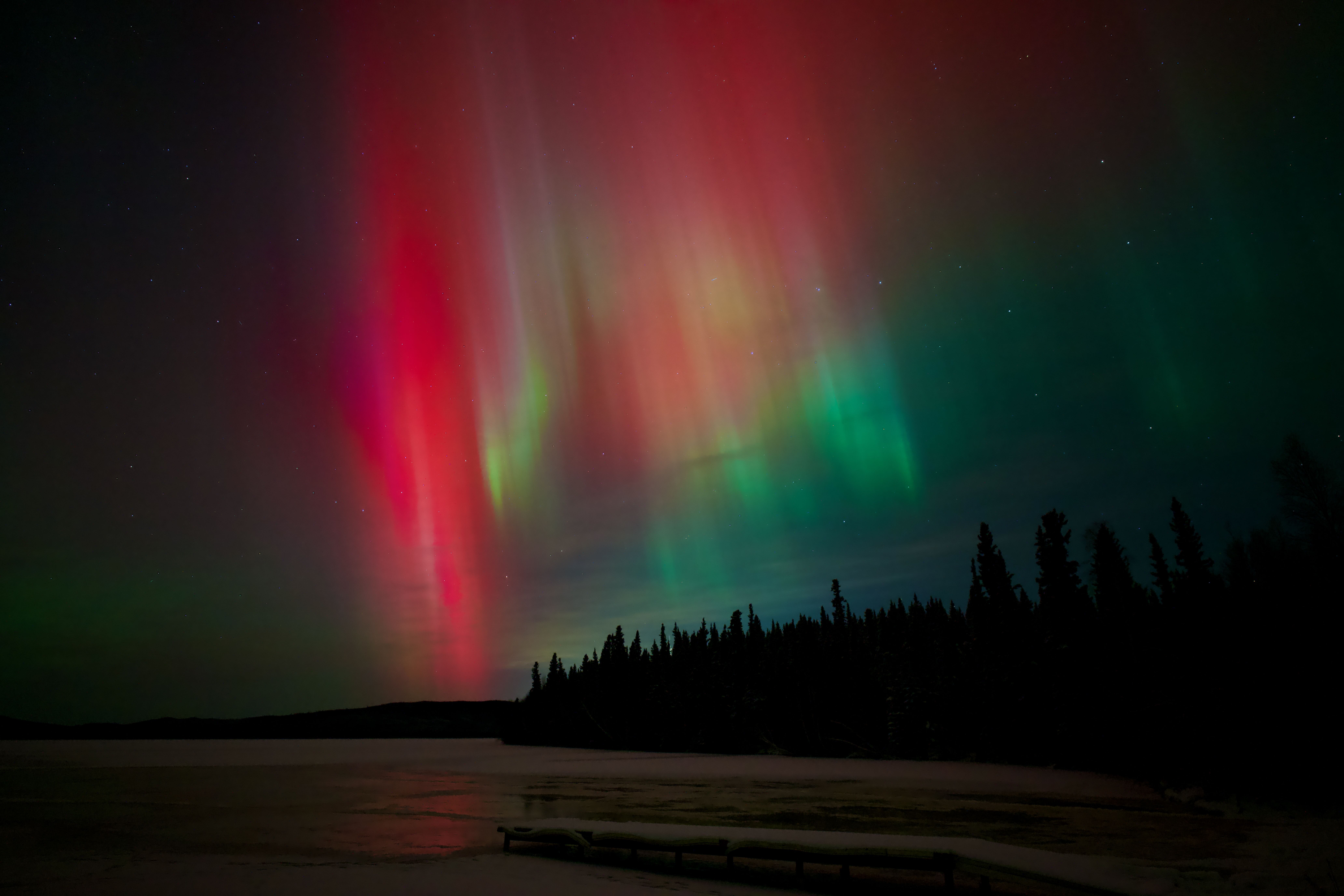
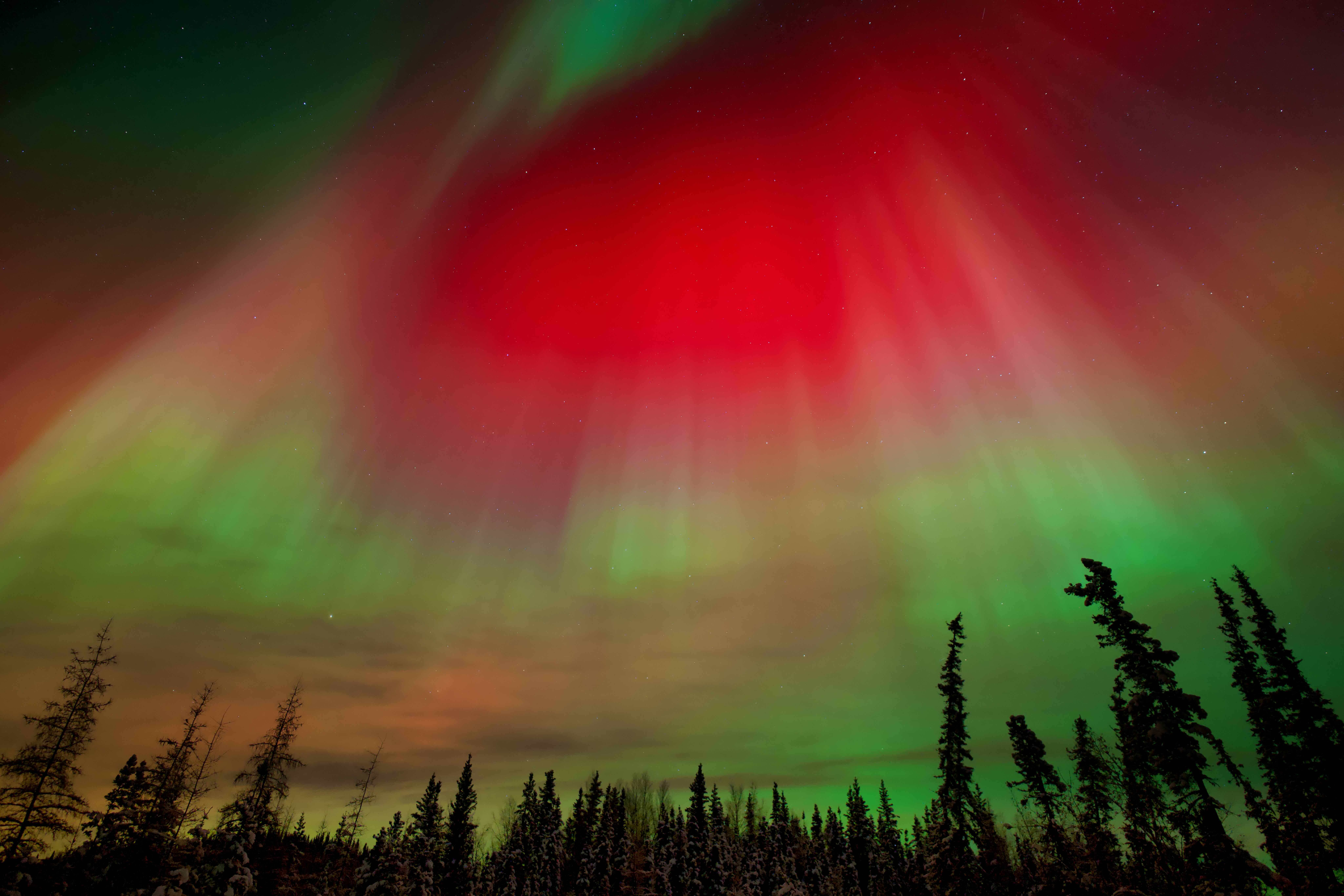
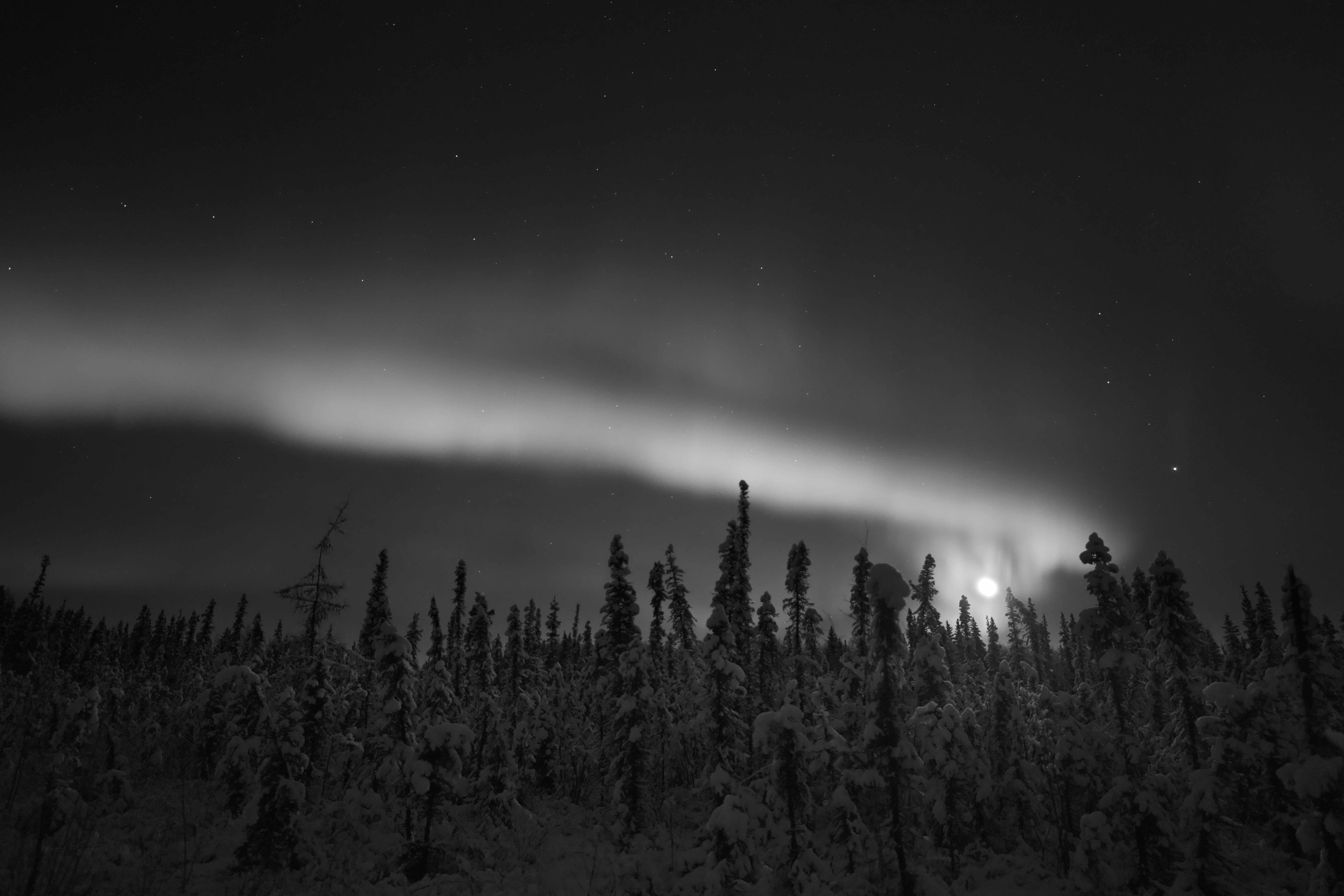
The detailed version: coronal mass ejections (CMEs) are the eruptions of plasma and magnetic field from the Sun’s atmosphere that drive the most intense geomagnetic storms. If directed at Earth, fast-moving CMEs can reach our planet in as little as 15 hours traveling at ~6.2 million mph (10 million kph).
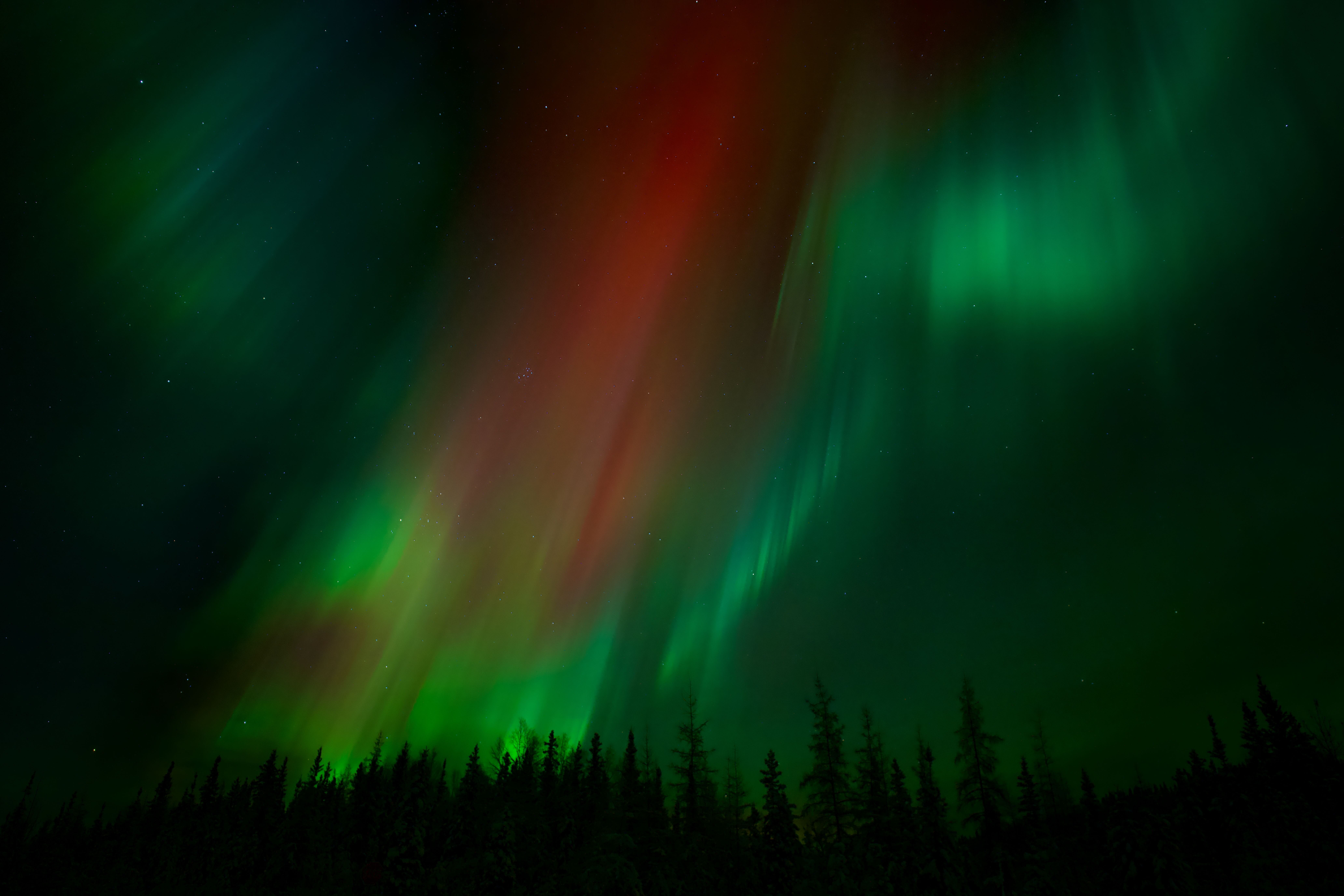
The critical process triggering auroras is called magnetic reconnection. The solar wind flows around Earth’s magnetosphere like a river rushing around a rock. This onrush of charged particles stretches Earth’s magnetosphere away from the Sun, creating a long wake known as the magnetotail. The magnetic shields of the Sun and Earth are polarized. The polarity of Earth’s magnetic shield is mostly stable, but the Sun’s can vary rapidly. When the polarity of the solar wind is opposite that of Earth’s magnetosphere, the field lines of the Sun and Earth interact strongly. The solar wind then pushes these connected field lines around Earth’s magnetosphere. Eventually, these field lines reach their limit and snap back, releasing energy. This energy accelerates charged particles – primarily electrons and protons – along Earth’s magnetic field lines toward the polar regions, injecting millions of amps into the atmosphere.
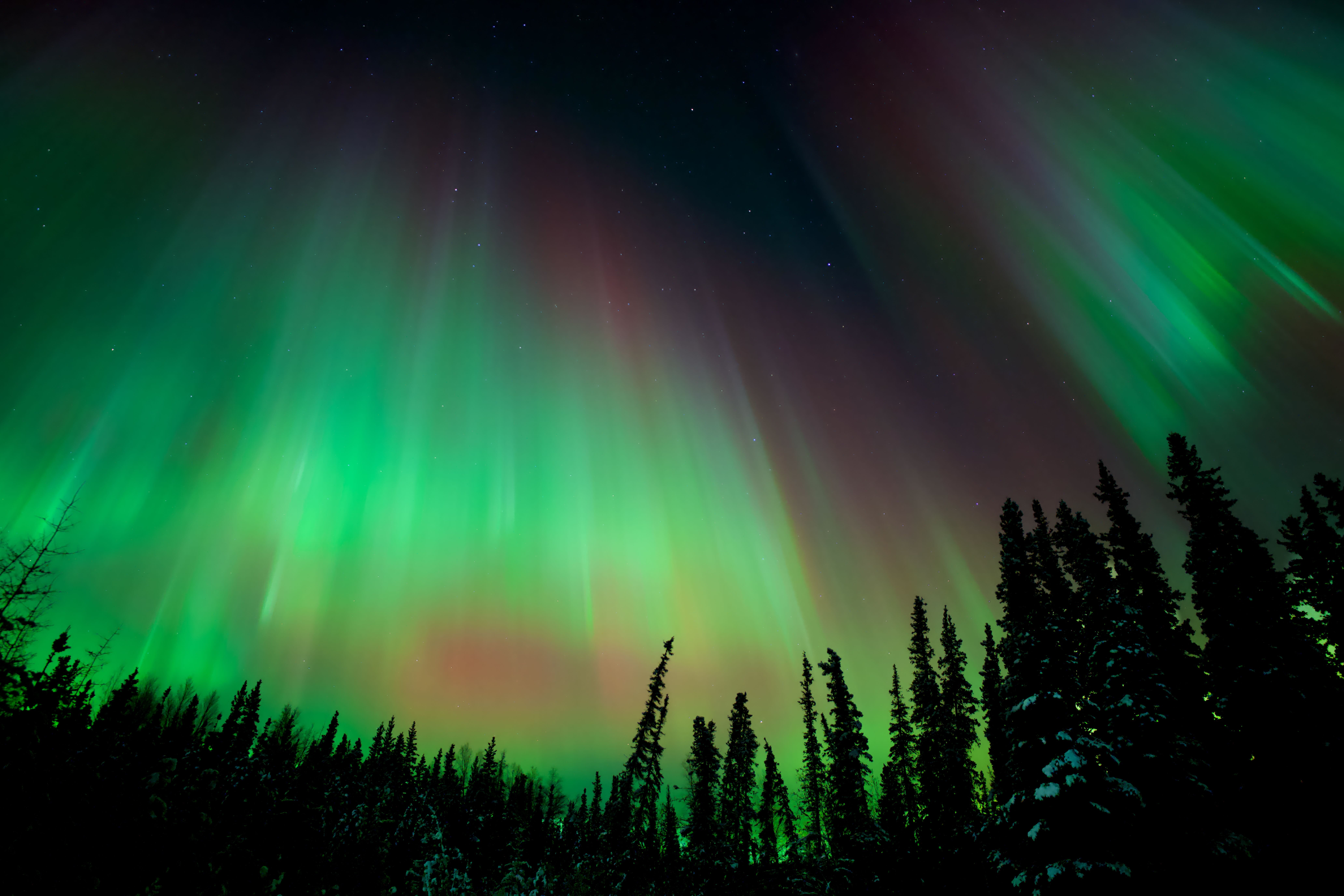
Oxygen excited to different energy levels can produce green and red. Green occurs roughly between 60 to 120 miles (100-200 km) altitude, and red occurs above 120 miles (200 km). Excited nitrogen gas from about 60 to 120 miles (100-200 km) glows blue. Depending on the type and energy of the particle it is interacting with, nitrogen can give off both pink and blue light. If it is below about 60 miles (100 km), it gives the lower edge of the aurora a reddish-purple to pink glow.
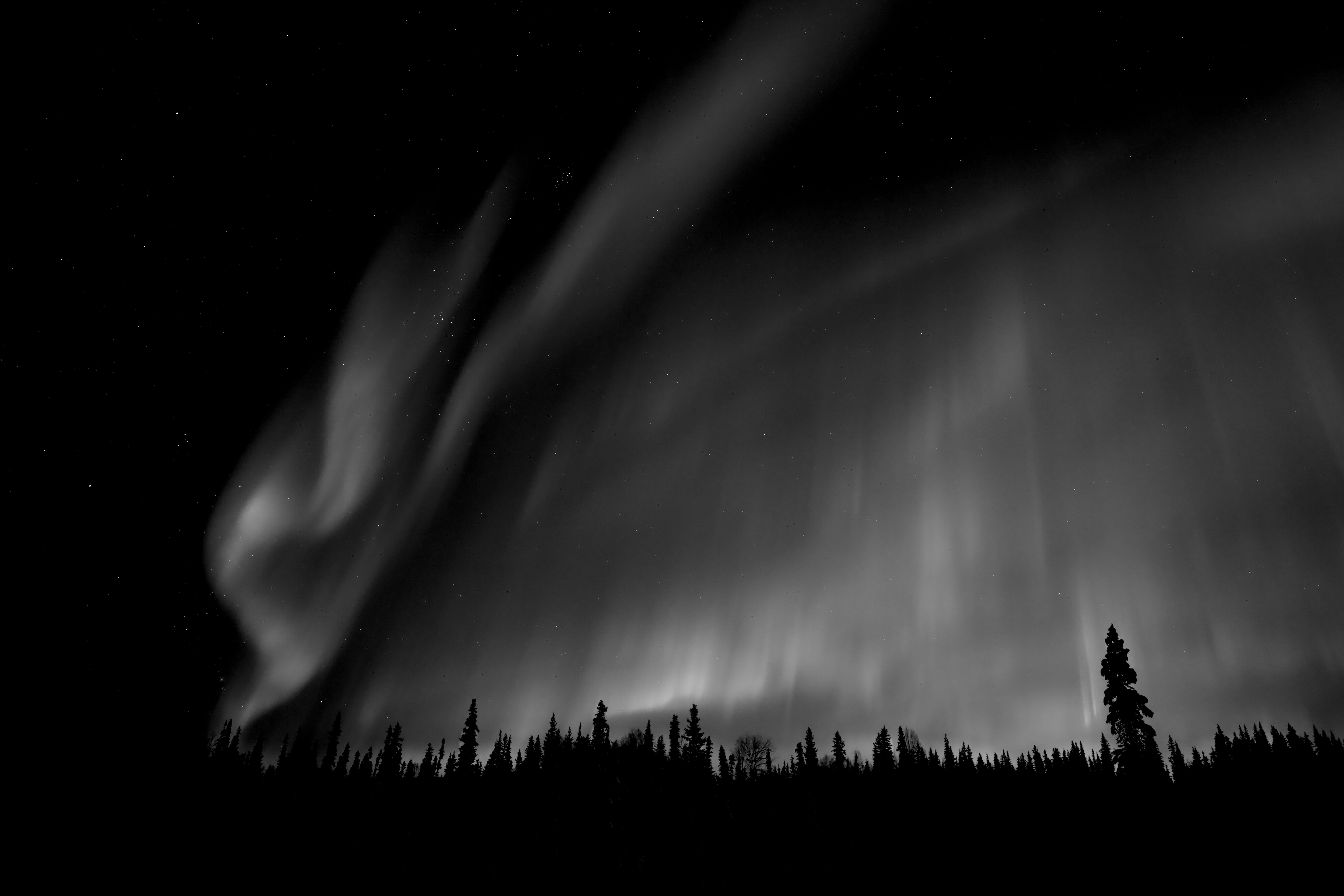
Aurora brightness depends on (i) the intensity of solar activity and (ii) the efficiency of energy coupling into Earth’s magnetosphere. The standard measurement for the intensity is the Kp index, which ranges from 0 to 9, derived from 13 magnetometer stations globally that monitor Earth’s magnetic field disturbances. A Kp index of 0 represents quiet conditions; a Kp of 9 represents an extreme geomagnetic storm capable of producing auroras near the equator.
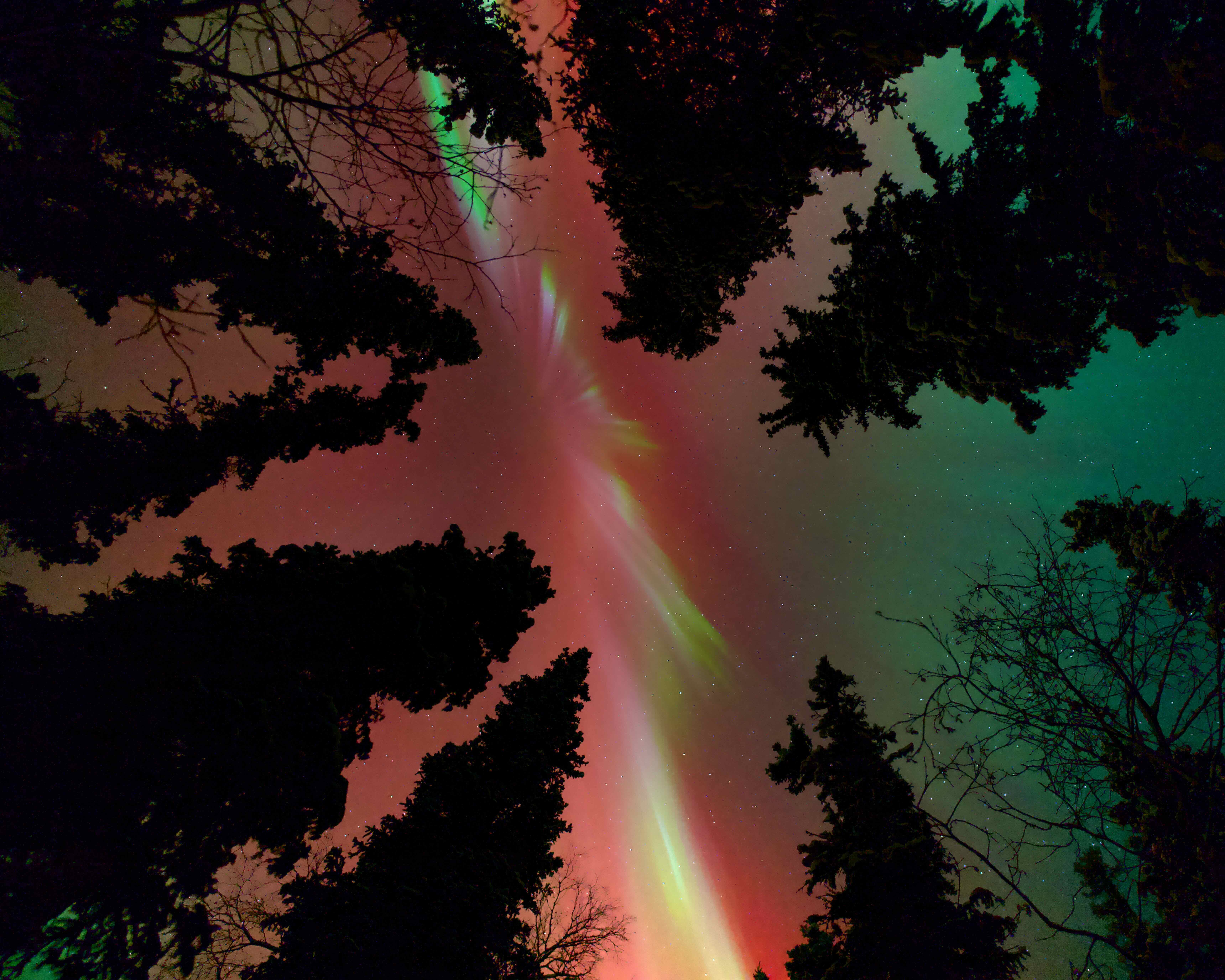
Unfortunately, the Kp index has a serious limitation: it reports a 3-hour global average so it is often too slow and too generalized to capture short-lived auroral activity, such as auroral substorms (which typically last 10 – 30 minutes). These powerful bursts can produce the brightest northern lights displays, yet they are frequently missed when relying only on KP forecasts.
Aurora intensity also depends critically on the interplanetary magnetic field’s Bz component. When the solar wind’s magnetic field points southward (negative Bz), conditions favor magnetic reconnection and enhanced energy coupling, producing increased aurora activity. When it points northward (positive Bz), reconnection is suppressed, resulting in reduced activity. Bz values below -10 nT are considered effective for driving geomagnetic storms, and values in the range of -20 to -30 nT usually indicate strong conditions for auroral activity.
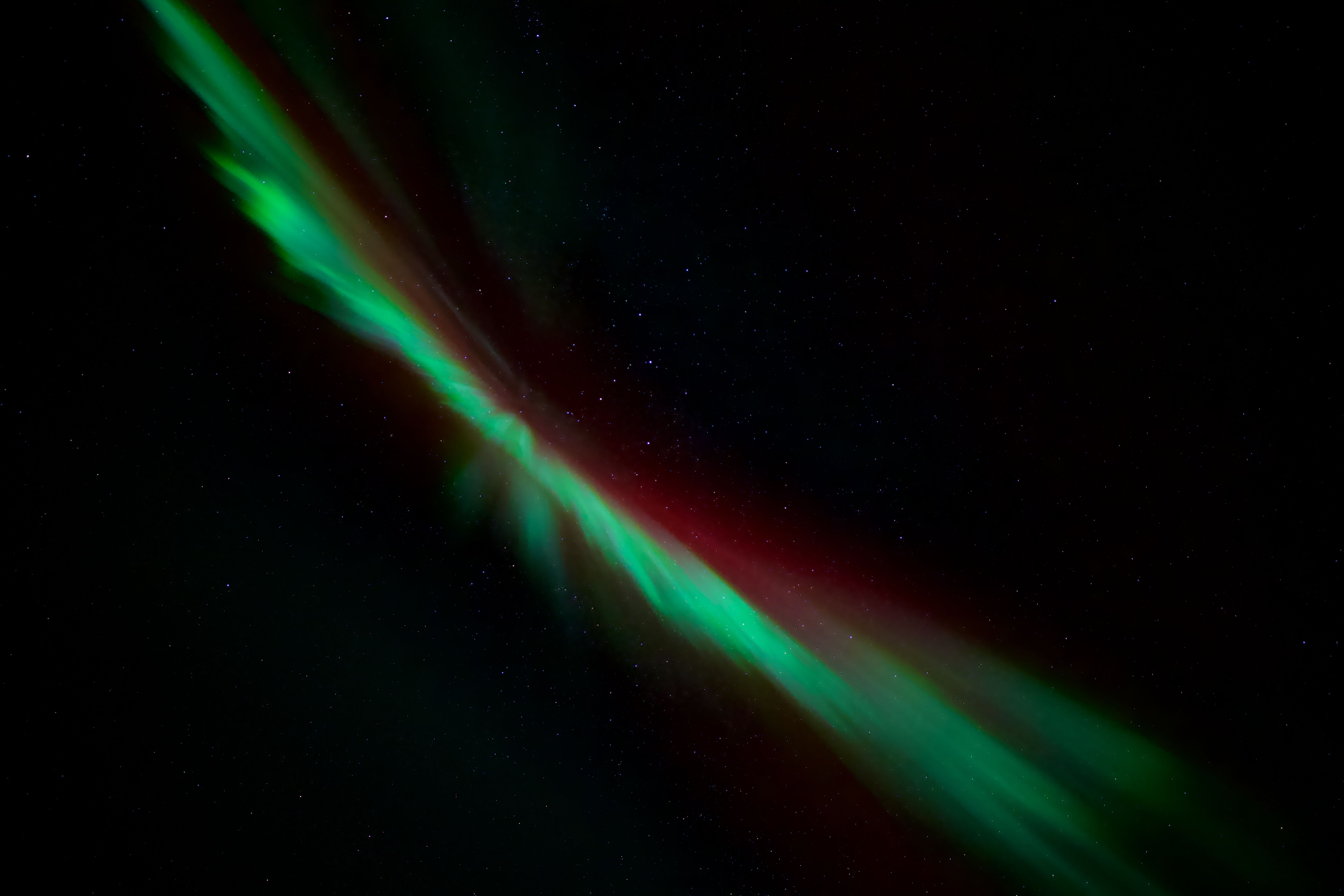
Unfortunately, there is no way to predict the Bz. So even when the Kp is high there will be no aurora if the Bz is positive… and you just won’t know until you’re standing next to a lake outside of Fairbanks in -16° F weather with a respiratory infection.
So what happened on the night of November 11-12? Two coronal mass ejections reached earth, the Kp spiked to 8.67 (almost at the maximum value of 9), while the Bz reached a remarkable nadir of -55 nT!
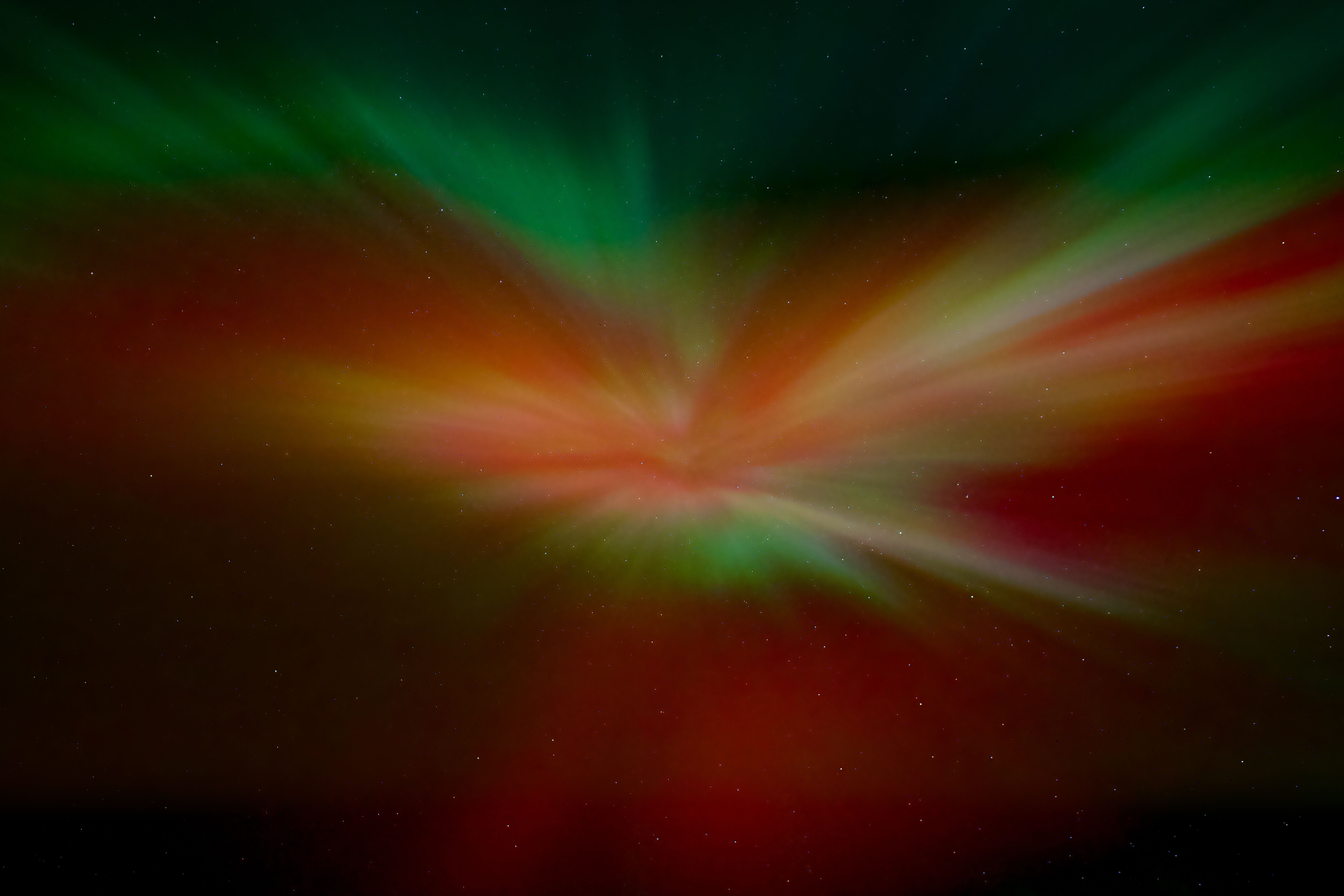
Finally, I have been asked why photographs of auroras often appear more colorful and detailed than what observers perceive with the unaided eye. This is largely an artifact of low-light aurora viewing conditions. Auroras typically produce illumination levels comparable to moonlight, near the threshold of human vision. As you all know, there are two types of photosensitive cells on your retina: cones and rods. Under well-lit conditions, your eyes use cones to process light, known as photopic vision. The cones are responsible for color vision but are not responsive to low light. In very dark environments, rod cells dominate what you see, known as scotopic vision. Colors are barely perceptible under scotopic vision, leading to almost black-and-white, desaturated vision. Your eyes adapt to a low-light environment by transitioning sensitivity from the cones to the rods, which takes 20–30 minutes to complete.
While the eye’s photoreceptors are sensitive, they cannot accumulate light over time in the manner that digital sensors can. A camera sensor employs multiple mechanisms to collect more light than the eye: high ISO sensitivity amplifies the signal, long exposures integrate light over several seconds, and the full spectral response captures wavelengths across the visible spectrum.
Consequently, a faint aurora appearing as a low-contrast feature to the eye reveals more defined coloration in a photograph. As aurora intensity increases, the eye’s color perception approaches what cameras record. Additionally, wide-angle lenses compress perspective differently than human peripheral vision, altering the apparent geometry and apparent motion of auroral structures.

For the photography geeks among you, all of these photos were taken with a Nikon Z8 camera and NIKKOR Z 20mm ƒ1.8 S lens at ISO 3200, ƒ1.8, and shutter speeds of 1.0 second (occasionally up to 2 seconds).
And since this is supposed to be a post of readers’ wildlife photos, here are two images that I made near Fairbanks:
Reindeer or caribou (Rangifer tarandus):

Muskox (Ovibos moschatus):

Nice aurora, and animal photos!
Thank you, Ephraim. Wonderful photos…thanks for braving -16F to get them! And thank you also for taking the time to put together the physics. Even with my physics degree, I did not get it all, but I understand much more than before I read it…and I think that’s the point.
Wow! Splendid explanation and photos!
Amazing photographs and explanation, the latter being an excellent use of your Physics BA! Regarding the last two photographs, how did solar emissions produce those?
I’d explain, but it’s complicated.
Wow. Wonderful images!
Curious if the aurora photos would not turn out as well if you used longer exposures?
Roger, longer exposures would certainly make the aurora photos brighter and I used 2 sec exposures when I could, but most of the time the aurora was moving quickly. Exposures longer than 1 second would have produced photos that were just colorful smudges, whereas I wanted to capture the aurora structure whenever I could. In fact, some of my 1 second exposures were still just colorful smudges because of the rapid motion.
Thanks, Ephraim 🙂 That makes sense.
I’ve dabbled in some sports photography where light constraints had me shooting wide open and at high ISO. It’s challenging enough – you had to shoot in freezing temperatures too!
For some reason, and although much of the physics went over my head, the science explanation makes the photographs even more beautiful for me.
Wonderful photos and thanks for the explanations!
It was such a unique experience to “see” the aurora down here in Oklahoma.
Wonderful photos, and thanks for the clear explanation of the physics.
Phenomenal photos and explanations. These are so great to see.
Thanks!
Beautiful, awesome photos of the Aurora Borealis!
Breathtaking shots of the reindeer and muskox!
Love the animal closeups.