
Athayde Tonhasca Júnior is back with a photo travelogue—the first of three parts. Athayde’s captions are indented, and you can enlarge the photos by clicking on them.
Chapada Diamantina, Part I
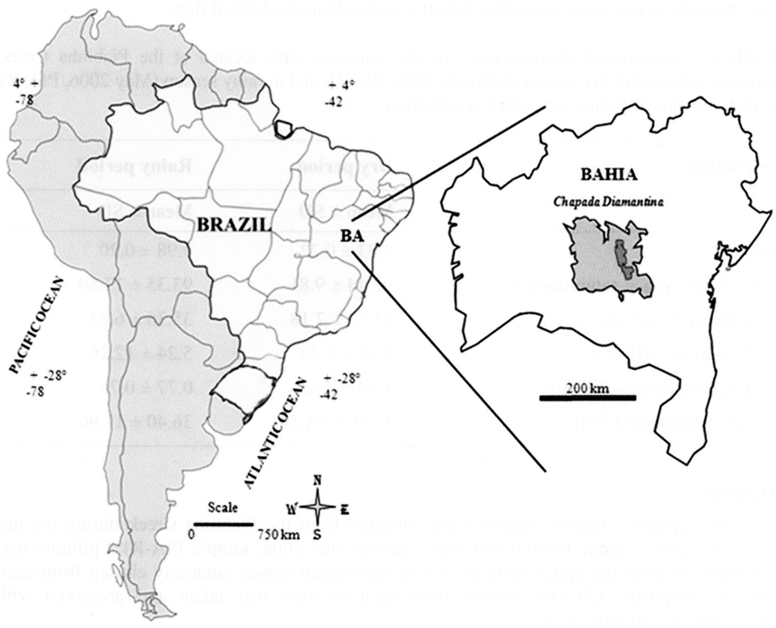
Last year I invited WEIT readers to join me in a photographic tour of Serra da Capivara, a spectacular national park sited deep in the Brazilian caatinga, a semi-arid ecosystem that hosts exceptional levels of biodiversity and endemism. Today we will visit another ecological gem in the same geographical region: Chapada Diamantina, a 38,000 km2 expanse of rocky plateaus (chapadas), caves, forests, caatinga, grassland and savanna in Bahia State.
Chapada Diamantina region, northeastern Brazil © Ferrari et al., 2009:
We begin at Lapa Doce, or Sweet Cave, located in the municipality of Iraquara, the ‘speleological capital’ of Brazil. There are 1,694 cave systems in the region: one of them, Toca da Boa Vista, is the longest cave in South America, extending for 114 km. Lapa Doce is part of a 42-km network of caves, many yet to be explored and mapped; a ~1 km segment is open to guided visitation.
The cave’s entrance is hidden at the bottom of this collapsed doline (a bowl-shaped depression formed by dissolved limestone), aka sinkhole. Note the ribbed rock surface, a telltale sign of an oceanic past:

The bottom of the doline with a typical karst formation (a landscape largely shaped by water-dissolved rock). The temperature here is considerably cooler than at ground level:

The ‘melting’ effect of water on carbonate rocks:

This sign along the path to the cave precludes blaming language barriers for inappropriate behaviour inside the cave:

Cave entrance on the right. The two figures in red are human-size dummies planted there to give us a sense of scale:

Into the cave. The path is flanked by outlandish formations such as this floating jellyfish, illuminated by our three torches:

A monster from the underworld. By slowly swinging his torch up and down, our guide Raimundo made it open and shut its maw:

Lapa Doce was formed by a subterranean river that carved the limestone. The gallery is 60 m wide and 25 m high at the widest points:

If your torch goes kaput, you will need to use the rope that borders the path (seen on the bottom right) to guide you out. With no artificial light the darkness is absolute and disorientating:

That’s a big and beautiful cave–thanks for sharing. The only cave I’ve been in (as a young kid) is Howe Caverns in New York, and I don’t think that cave is anything close to this one.
AND?!?!
THIS IS SO EXCITING I WANT TO SEE MORE!
[ … calms down a bit … ]
😃
I think “Bahia” reminds me of a Jobim or bossa nova tune… if I find it … a lovely word… I see it’s a Coltrane recording… that I will promptly add to my list…
A HA – Charlie Byrd and Stan Getz!
🎼🎶🎶
What a wonderful tour of this incredible cave. The sculptures inside are really exciting.
Thank you for the tour.
Amazing cave structures. Karst at its best!
Very cool! Looking forward to more.
I don’t remember the invite, but I couldn’t go anyway because of $%$^# work.
What wonderful photos. In my younger days used to do a bit of spelunking but never saw anything like this. If you have any more shots please send them to Jerry so we can experience more of this cave.
Incredible…and the scale! I believe that I would discard my cave claustrophobia for a tour of this place.
Simply incredible! Thanks for sharing.
Phenomenal! Great photographs of a stunning cave. I thought Melidoni Cave in Crete was lovely, but it’s nothing compared to this.
Thank you for sharing.
Thank you!