
On July 12, while heading south towards Jan Mayen Island, we got off the ship to take a long Zodiac trip along one of the most amazing animal habitats I’ve seen: Alkevfjellt (“Mount Guillemot”). It is a geological feature that happens to have provided hundreds of narrow rock shelves for one species of bird to nest on. And nest they do, by the hundreds of thousands. From Wikipedia:
Alkefjellet is a cliff in Lomfjordhalvøya in Ny-Friesland at Spitsbergen, Svalbard. Alkefjellet is a bird cliff facing towards Hinlopen Strait.
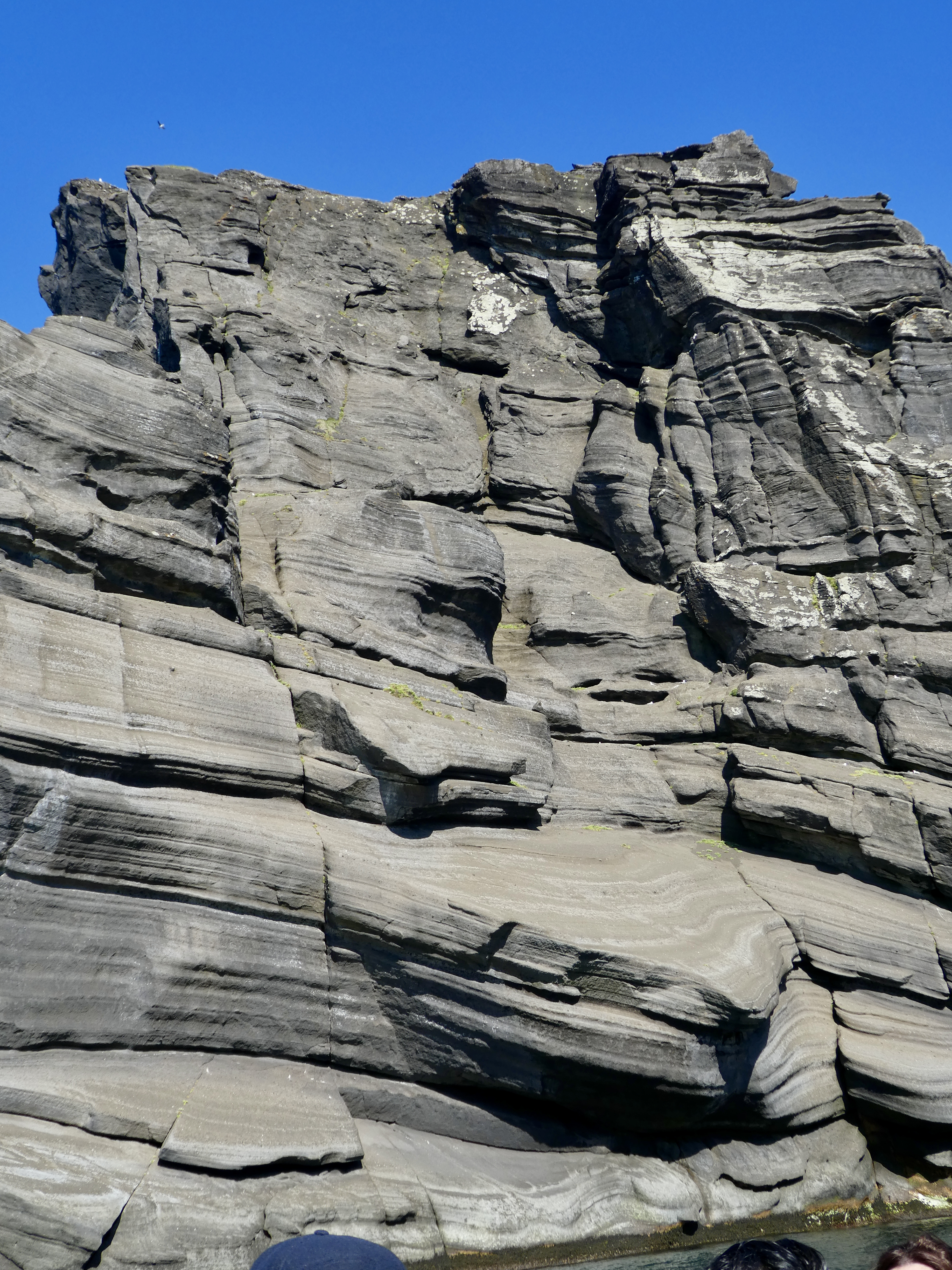
Alkefjellet (‘mount guillemot’) is the nesting location for over 60,000 breeding pairs of Brünnich’s guillemots. The cliffs are made of basalt columns up to100 m high, interspersed with a dark layer – a dolerite intrusion. The molten rock, as it intruded caused the limestone in the contact zone to re-crystalize and form marble.
Here’s the ship’s map of our trip again (in this post we’re at number 6), and then a map of the Hinlopen Strait where the cliffs are

You can see that Svalbard is not an island but an archipelago, and we’re in a strait separating two islands.

First the bird:
The thick-billed murre or Brünnich’s guillemot (Uria lomvia) is a bird in the auk family (Alcidae). This bird is named after the Danish zoologist Morten Thrane Brünnich. The very deeply black North Pacific subspecies Uria lomvia arra is also called Pallas’ murre after its describer.
This species was first described by Linnaeus. There are four subspecies, and the one on Svalbard is U. l. lomvia, Here’s a photo of some thick-billed murres in breeding plumage, which is the stage when we saw them:

. . . . and its range:

We cruised along the base of the cliffs in the Zodiac; photography was a bit hard because the water was choppy and it’s hard to photograph birds on a cliff when the boat is rocking and focus changes. Plus there were so many birds (I would guess over 100,000) that it smelled TERRIBLE from guano. But you ignore the smell when there’s a site like this.
Further, we had to be constantly aware of them pooping on our heads. I mostly knelt in the bottom of the rubber boat, and once when I got up from the edge to kneel down, a juicy murre poop landed exactly where I was sitting one second after I left. I was lucky, though a woman next to me was not so lucky and got a good dose of murre excreta on her head.
The birds have only, it seems, about a foot to nest, and I think they incubate eggs right on the rock ledge, without a nest. Wikipedia says this:
Thick-billed murres form vast breeding colonies, sometimes composed of over a million breeding birds, on narrow ledges and steep cliffs which face the water. They have the smallest territory of any bird,[requiring less than one square foot per individual. A breeding pair will lay a single egg each year.[Despite this, they are one of the most abundant marine birds in the Northern Hemisphere.
Here they be:
The cliffs. There must have been more than a mile of breeding birds along the ledges. It’s impossible to estimate numbers; there might have been close to a million.
First, approaching the “bird cathedral,” you see a place without many ledges to give you an idea of the geology:
The birds:


These are nest sites! Look how crowded they are:

Less than a square foot per pair! They go out fishing, with one pair staying on the egg, so, as you cruise around, the air above is filled with thousands of wheeling, calling murres. See video below.


Two videos from the ride (filming was tough in a boat with nine other people, all trying to film or photograph):
Thousands wheeling above in the blue air:
This short video shows why I call it a “bird cathedral”. Truly a stunning site. A few days later we saw another murre cathedral on Jan Mayen Island.
Looks like apartment living – I can relate. Thanks for the great photos! But did you mean the title of the post to be “packed with murres” instead of “guillemots”? [oh never mind sorry I see the common names include both…]
I’m not a big bird guy, but color me impressed!
D.A.
NYC
Amazing how the flood laid down all those layers like that.
Very stinky! What a cool trip.
Magnificent! The waters around there must be a seafood fest, to enable such a high concentration of birds to feed not only themselves but their chicks.
Cool photos! Thanks for sharing your travels! Lucky you!
Thanks so much for sharing this experience – again IMHO I think it must feel almost ethereal or otherworldly to behold these enormous features right within a short distance. Priceless.
I can’t even make a guano joke! 😆
Thank you for your incredible photos. What a beautiful place.
So… when young birds are ready to leave their nest, they have to leap into the unknown from those very high ledges..? Courageous!