
If you think about it, you’ll realize that, at bottom, all morality is based on people’s preferences. Despite the argument of Sam Harris that what alternative more “well being” is more moral, that, too, is a preference. (How, for example, do we balance the “well being” of animals and humans who eat them?) Objectively, is abortion moral? I could go on and on, but won’t.
And a God is not an objective arbiter of morality, either, as the Euthyphro argument shows.
Jesus and Mo, of course, don’t realize this, as we see in this week’s strip, called “hearts”:
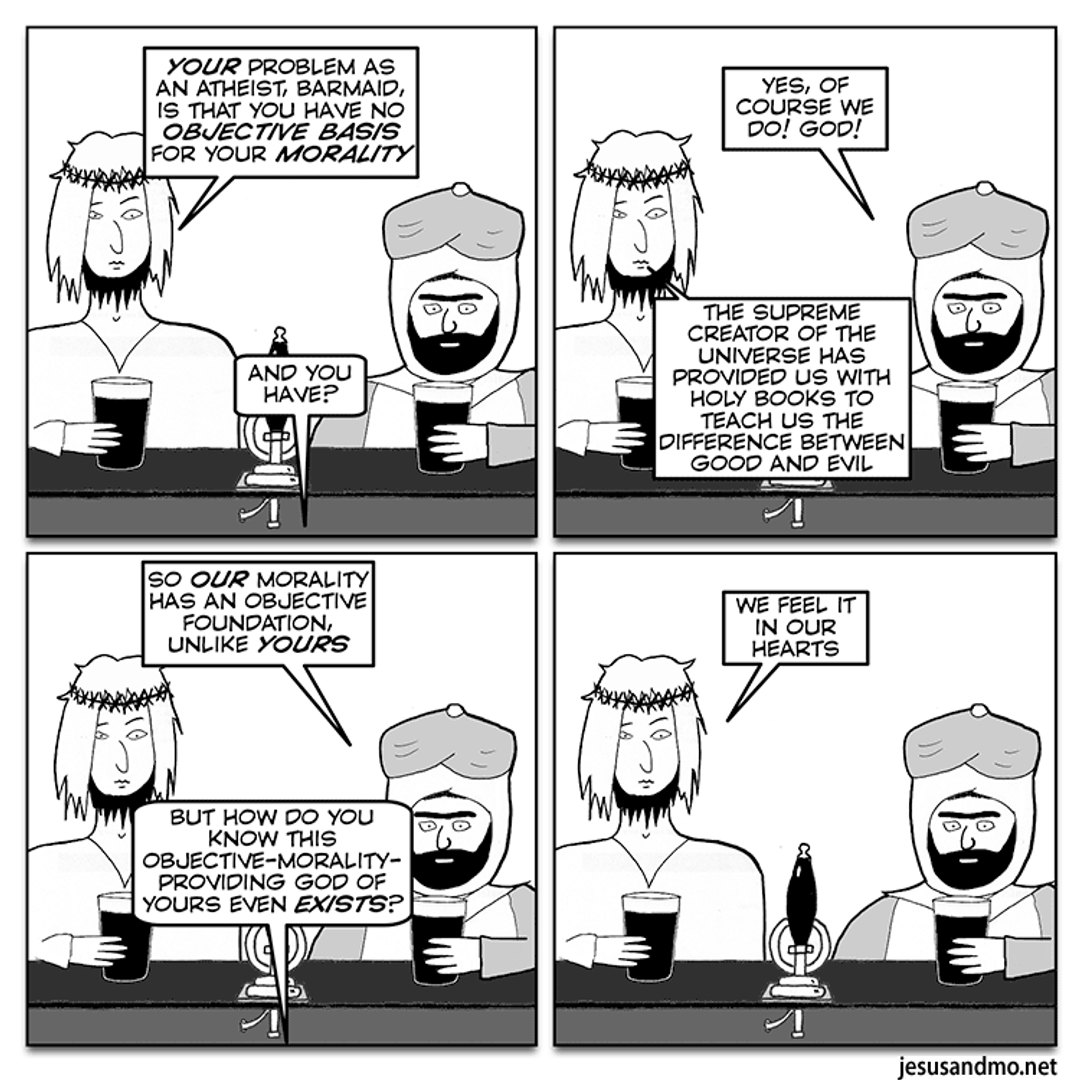
“…provided us with holy books to teach us…” and depending on which version of which translation and what the “scholarly authorities” say about them, anybody can apply their own objective foundation of “the true morality” as a tool for saving the world from “atheist heathens” like the barmaid./s
Not to mention that the different holy books disagree with each other, so even before the questions of translation and interpretation, you have to decide on which holy book you’re going to accept.
And the holy books disagree with themselves as well.
And different manuscripts of the same holy book disagree. Good thing that the various copyists, translators, etc. were divinely inspired (possessed?) to be error-free. Bah, humbug.
In no way have the religious hoodwinked the masses more successfully than in convincing them that the whim of a mercurial and puerile personality should be viewed as an objective basis for morality.
That’s the alleged whim of some mercurial and puerile personality, eh. (And no need to diss Mercury; among the gods he was one of the more reliable ones, despite moving quickly. 🙂)
Yes. Even if there were a God or gods, its morality would be subjective, with no obvious reason why we should be obliged to its preferences. That religious people argue that God’s subjective morality is objective is bewildering.
Exactly … I would go a little bit further … certain actions having a ‘morality’, is like objects having a ‘colour’.
This may be simplifying (or complicating), but for a while now I’ve had the idea that social animals express a sense of morality. Only what they think of as right or wrong can be wildly different. Among dogs, for example, one dog may react to the mere site of another dog as highly immoral, and so they need to bark at it in alarm. Or do worse. Our current dog is quite the opposite. Every strange dog is a potential playmate, and he is very confused when their morality does not see things that way.
I think it’s clear from work by Frans de Waal and others that chimpanzees have a moral sense.
What you mean is that chimps appear to approve of some acts and disapprove of others. This could be similar to an evolved substrate of human morality, but that still doesn’t make morality “objective” in our own species. After all, you can’t equate “evolved” with “moral”.
Agreed, I agree that the chimpanzees’ (evolved) moral sense is subjective, just as our human (evolved) moral sense is subjective. In DofM, Darwin argued that our moral sense evolved as a re-purposing of prior aesthetic senses (re-purposed for the role of facilitating social cooperation), where aesthetic sensibilities are the epitome of things that are subjective. I think he was entirely right.
To put matters in simple terms, the source of morality is human interaction. People have emotions. They become upset when family and friends are murdered, goods are stolen, and lies spread harm. This pattern can be objectively demonstrated around the world, and requires no appeal to arcane explanations. People share common preferences. Their subjectivity can produce an objectively observed pattern. But the subjectivity remains the base. Arguments about morality consist of demonstrations why one preference tops another.
I would even go so far as to assert that the fact that 99.9999% of us don’t want our neighbour to bash our head in is in fact an objective basis for the moral position that one should not bash one’s neighbour’s head in.
Coel mentioned Frans de Waal. I heartily recommend checking out his book, Good Natured: The Origins of Right and Wrong in Humans and Other Animals. It’s all about the evolution of a moral sense, with accounts of animal studies (de Waal’s own as well as others.) And you’re right: it does seem to be we social species that evolve such a thing.
Jesus and Mo pretend “objective” is a synonym for “authoritative.” It ain’t.
Would that my fellow atheists pay more attention to the words believers misuse. “Supernatural?” No. “Super-” implies “above” and “better than,” when believers mean the natural is unable to provide answers to vexing questions. “Anti-natural” is the correct word because it exposes the bias of the believers. “Groomer?” No. A “groomer” is an indoctrinator, and believers exist to indoctrinate. They are the groomers.
The mistakes go on and on.
“Anti-natural”
What an apt word! Thanks for sharing it. I hope you won’t mind if I use it, should the opportunity present itself.
Go right ahead. I didn’t coin the term. It was used back in the late eighties by an atheist acquaintance. Accurate terminology often lacks the play deserved.