
Yes, it’s Jesus and Mo on Friday, for, as the artist notes, “Trying to reinstate the Friday Flashbacks. This one from seven years ago today.”
And it’s a good one. As happens so often, Mo gets all balled up in his beliefs, “begging the question” in the literal sense. (The three-word phrase means, as you surely must know by now, “assuming that which is to be proved,” not “asking the question” or “raising the question”
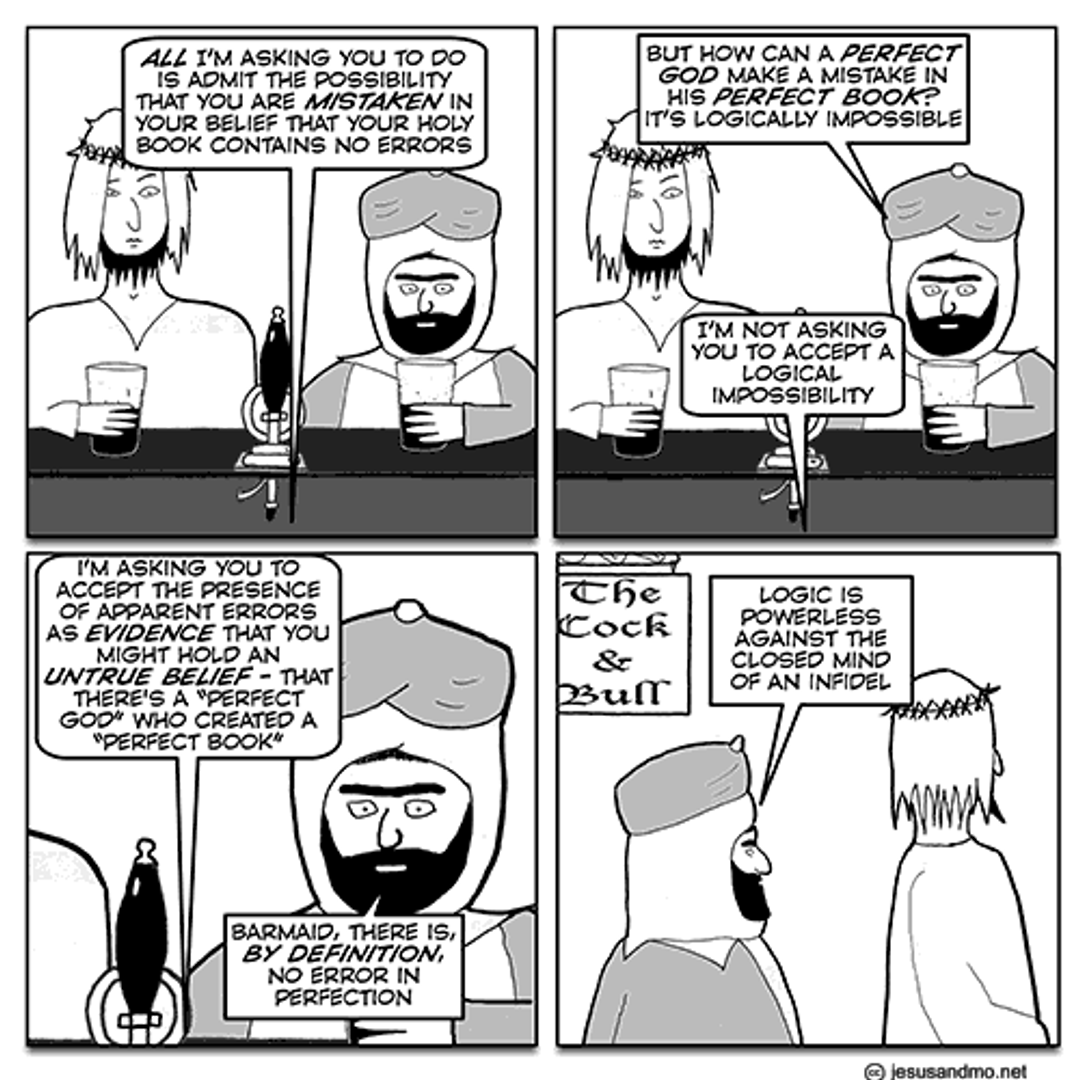
Great cartoon. Fanatics believe anyone who doesn’t agree with them is “closed-minded” but simply cannot see that their own beliefs are entirely contrary to a rational analysis of the available evidence.
It is the status of the apparent errors question (in the Bible) – that once announced is therefore determined – which is problematic. If the case is opened and closed within the same thought, it has been prejudged and deemed resolved in favor of the sceptic, which only then jumps the logical shark and infers the resolution of the secondary and tertiary steps and their (preferred) conclusions: errancy, inauthenticity, and non-existence of (Ghost) authorship.
Whether the existence of apparent errors is unresolvable in its own right is where the argument lies, and is prior to beginning, much less reaching conclusions on the subsequent though related questions. Without accepting the premises of the apparent errors issue as already settled (so not longer apparent but actual), the fact of the argument itself cannot even partially undermine any of the other interrelated though discrete cases (inerrancy, authenticity, inspiration) which have their own set of intricate contentions.
That seems to be written in theologian-speak. Does it amount to: “One can’t just assert that there are indeed errors in the Bible, that also needs to be argued”?
Haha, yes that is part of it. The cartoon seems to jump from asserting the errors to accepting that as proof of an untrue belief and/ or that there is a perfect God – two statements which have related bases and connections to the first.
Please work on writing simple, easy to understand English before you post again. The comment above is wordy and all but incomprehensible.
WTF?
Just so!
It is too easy to fool yourself, as Feynman pointed out.
https://www.goodreads.com/quotes/193533-the-first-principle-is-that-you-must-not-fool-yourself
https://speakola.com/grad/richard-feynman-caltech-1974
Perfect lunatic logic is a thing… to behold.
A thousand yes-yes-yes on this — one of my pet peeves is the misuse of the phrase:
“begging the question” in the literal sense. (The three-word phrase means, as you surely must know by now, “assuming that which is to be proved,” not “asking the question” or “raising the question”
The hardest myth to recognize is the one you live in.
This is just Anselm of Canterbury’s ontological argument for the existence of G-d.
This argument will be familiar to many, but AFAICT, science offers at least a plausible explanation for all intersubjectively verifiable (i.e. “objective”) phenomena observed in the space-time continuum. Apparent miracles, like all real things, can ultimately be shown to unfold by chance and necessity out of the Big Bang, so Occam’s Razor seems to shave away any requirement for a sentient “higher power” that dynamically intervenes on any scale. We simply have no need of that hypothesis.
Again AFAICT, theism therefore entails a presupposition of the deity’s existence: a claim that “nothing makes sense without God!” When reminded that science has imperfect but adequate models for everything that’s actually happened since the Big Bang, theists suppose a Creator existing “before” or “outside” space-time (i.e. supernatural), Who is responsible for packing the primordial singularity with E=mc^2, quantum randomness, and information for evolving therefrom, even into us. “Deism” is a weak form of theism, allowing for a Creator who willed the Big Bang into being, then retired, and has not intervened subsequently. But Occam’s Razor tells us even a Deist is “multiplying entities unnecessarily”. Why propose a “first cause uncaused” so complex it resembles a human mind, independent of a physical substrate, if it’s wholly inaccessible to observation? Deists still have to explain how God came into being! Turtles all the way down?
More fundamentally, how would our existence be different if there is some sort of super-sentience “existing” outside space-time? As R. Dawkins put it 30 years ago,
“The universe we observe has precisely the properties we should expect if there is, at bottom, no design, no purpose, no evil and no good, nothing but blind, pitiless indifference.”
Just so!