
Today we have a diverse set of photos from Amy Perry of Indiana. Amy’s captions and IDs are indented, and you can enlarge her photos by clicking on them. After this we have only one batch of photos left.
All photos were taken at Ritchey Woods, a state-designated nature preserve owned by the city of Fishers, a suburb of Indianapolis. The preserve is surrounded by commercial and residential development and an airport and is a treasured haven for families, dog walkers, runners, and birders and other nature lovers. The majority were taken with my iPhone 11 in the past year; a few plant photos were taken by the park naturalist, probably with her iPhone around 2019.
Common box turtle (Terrapene carolina) sitting just as royally as you please on a bridge:

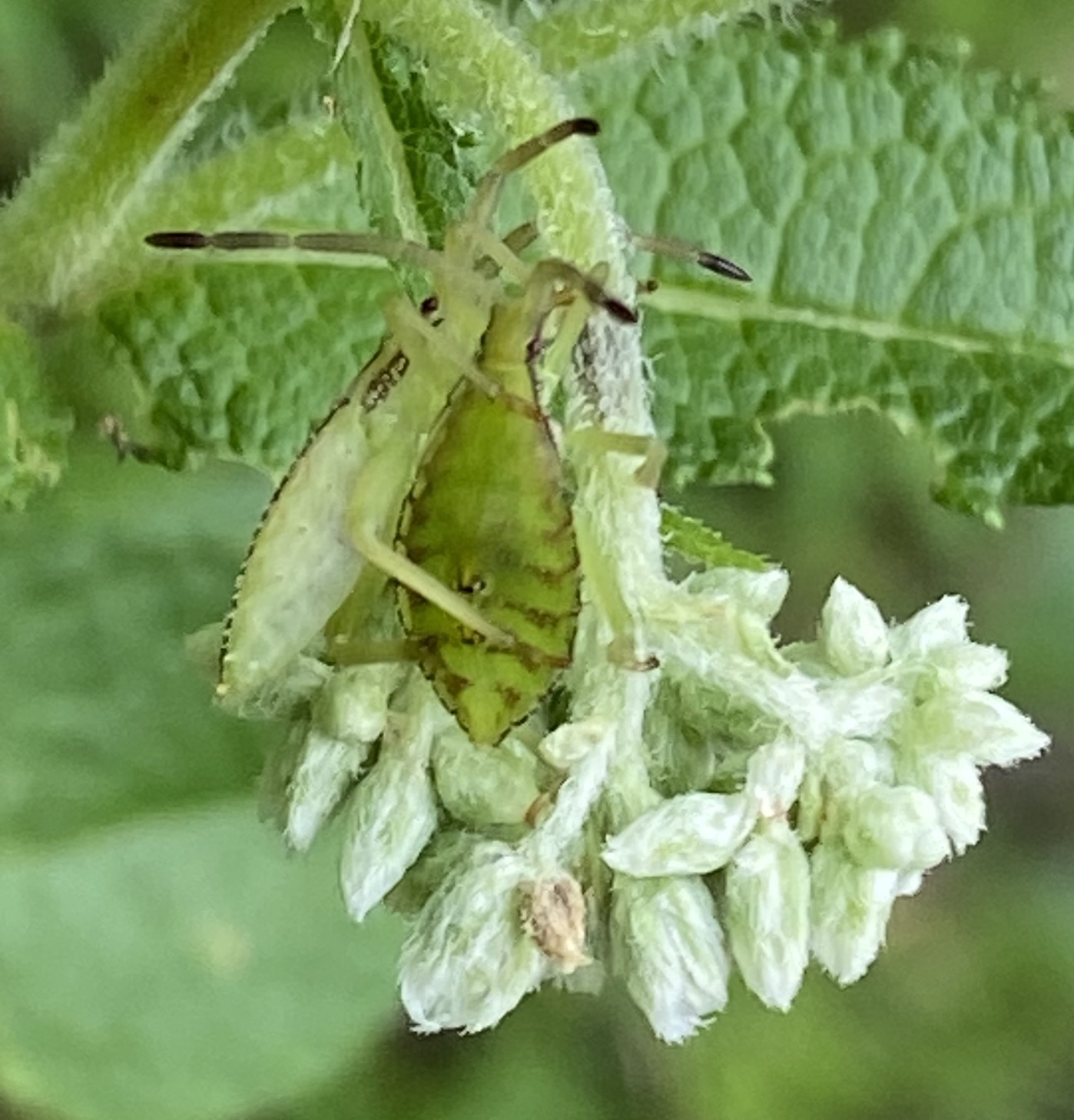
Insects mating. Haven’t been able to identify the species [Readers?]:
Milkweed tussock or milkweed tiger moth caterpillar (Euchaetes egle) on, unsurprisingly, milkweed, probably Asclepias syriaca:

Trout lily (Erythronium americanum). Spring ephemeral. Also called yellow adder’s tongue and yellow dogtooth violet. One of the few yellow spring ephemerals, in my experience. Most are white. Spring ephemerals bloom before the tree canopy leafs out, as they take advantage of the sunlight that the trees block after the leaves appear:

Dutchmen’s Breeches (Dicentra cucullaria). Spring ephemeral:

Shagbark hickory (Carya ovata). I like species that have an obvious identifying characteristic, such as the shaggy bark here. It’s a bonus if the common name and/or Latin name also reflects the identifying characteristic:

Spring beauty (Claytonia virginica). These beauties carpet the forest floor during April. The pale pink stripes are said to guide insects to the nectar or pollen. The blooms close if the temperature goes below 45 degrees F. Spring ephemeral. I just learned that another common name is Fairy spud, which seems apt:

More spring beauty, to show the attractiveness of their natural massed growth. They are at the foot of a sign marking a border of the nature preserve:

Skunk cabbage (Symplocarpus foetidus). This is the spathe. Grows in January and February in moist soil. Sometimes the energy radiated by the growth actually melts the surrounding snow or ice. True to its name, it has a strong, unattractive odor:

Virginia bluebells (Mertensia virginica). Often the blossoms are pink when they first bloom and then turn a lovely blue. Spring ephemeral:

Callery pear (Pyrus calleryana). Ending on a depressing note. These trees have a lovely oval shape but are invasive. Also called Bradford pear. This species is not on the state’s official invasive list, but plans are in the works to have it added soon. The official invasive list prohibits the sale, purchase, transport, or giving of invasive species within the state. When several species were added a few years ago to the list, this one was discussed, but so many nurseries had it “in the pipeline,” that conservationists decided to take a small victory and wait to add it later:

The bluebells look like hummingbirds would be getting nectar from them … they are shaped like another plant I know attracts hummingbirds…
Such an interesting set! The insects are juvenile True Bugs, or Hemipterans. I can’t identify other than they are in the vicinity of squash bugs / leaf footed bugs. Plant suckers. I don’t think they are mating.
And you photographed what I’d been wanting to see for years – flowering skunk cabbage! The color and scent and metabolic heat they generate is used to attract carrion feeding flies which are fooled into pollinating them.
Thank you for the info on the insects. The park naturalist at the time, Danesa Stolz, photographed the skunk cabbage. It’s a fascinating plant.
I appreciate the identifications Amy.
I’ve often seen Dutchmen’s Breeches and Spring Beauties in the woods on my family’s farm near South Bend. I never knew what they were called though. I always thought the flowers of Dutchmen’s Breeches looked like sci-fi space ships.
Nice set! There were box turtles everywhere when we lived in rural southwestern Virginia. When it rained they came out of hiding and were commonly seen crossing the road. When we saw one, we stopped the car to usher it across safely.
Nice pictures. Ritchey Woods is the place from which I and several family members watched the total eclipse of the sun last year!
Thanks for sharing these pics. I love Virginia Bluebells, my property is carpeted with them in the spring, it’s just wonderful. I’ve never seen a skunk cabbage, I must find out more info on that. And of course Box turtles are another favorite, but unfortunately one of my dogs loves them, too, and will often bring me one on our long walks in the woods. I can’t yell at him to drop them if he’s too far away, as they always land upside down and I may not find it. So I let him get close enough to me to see the turtle and then yell at him to drop it so I can safely return it to wherever he picked it up. 🙄
I love the spring wildflowers! That’s a great shot of the combined blue and pink on the bluebells.
Callery pears do look pretty in the spring, but in addition to their invasiveness as Amy mentioned, they are fragile and tend to snap during storms, and they are notoriously stinky when they are flowering! It surprises me that it was once such a popular ornamental.
Thank you for these! Spring is really lovely there.