
Today we have some lovely mushroom pics taken by Ronald Kleinknecht in the Pacific Northwest. His captions and IDs are indented, and you can enlarge the photos by clicking on them.
I took these photos over the past few years in and around my home area of Bellingham WA. Our region is heavily forested, both in town and in our county which includes part of the North Cascades National Park and the Mt. Baker Wilderness Area. With ample precipitation, this locale provides excellent mushroom and fungi foraging.
This beauty, The Prince (Agaricus agustus), is my all-time favorite to eat. Agustus means “noble or majestic,” and so it is. These are typically found along a trail or path in a mixed conifer and hardwood forest:
The Pacific Golden Chanterelle (Chanterelles formosus) is a close second for tastiest mushroom in my opinion. These are very popular here in the fall and retail for upwards of $50/lb.:

This Oyster mushroom (Pleurotus pulmonarious) is one of many “oyster” species, named for its shape rather than its taste. Oysters are plentiful in the spring and are delicious in soups:

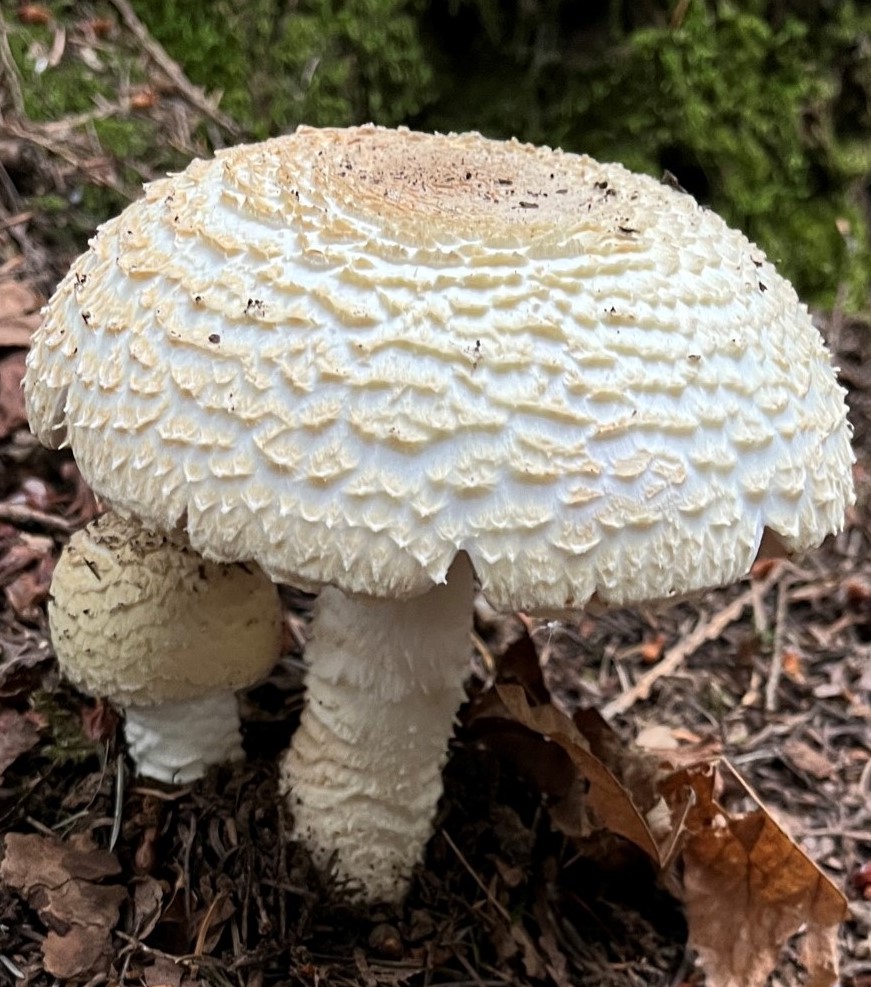
The Shaggy Parasol (Chlorophyllum olivieri) is another edible fungus that I especially enjoy in soups. It is quite common around here from spring into fall:

Red Cracking Bolete (Xerocomellus defractus) is a colorful mushroom in the Boletales order that differs from the previous gilled mushrooms in that they have spongy undersides made up of tubes, rather than gills where spores develop:

These gem-studded Puffballs (Lycoperdon perlatum) have little spikes on rounded heads that are “gem-like.” Their spores develop inside and when touched they puff out of a hole in the top. A drop of rain is sufficient:

The Russulas are also called Brittle Gills. Throwing one at a tree trunk will shatter it into many pieces. This one is a Shrimp Brittle Gill (Russula xerampelina) as it smells like seafood:

Sulfur Tufts (Hypholoma faciculare), although attractive, are very bitter and poisonous, causing severe GI distress and even paralysis:

Smoky Gilled Woodlover (Hypoloma capnoides) is related to H. faciculare. While attractive and edible, it is not very tasty:

The Scarlet Elf Cup (Sacroscypha coccinea) is an attractive little fungus with its bright Red body. It is used by some to add color to a salad but has little taste:

If you think you see a discarded orange peel while walking in the woods, it might be an Orange Peel Fungus (Aleuria auranitia). It is edible but don’t bother:

This Panther Cap, (Amanita panterina) is young and has not yet opened its cap. It is of the same genus as the prototypical toadstool, fly agaric with the large red cap covered with white dots. They are both toxic:

This dog vomit Slime Mold (Fuligo septica), also called scrambled eggs, is not technically a fungus although it has been classified as such historically. It is one of the most interesting of all organisms here as it is a single cell and is capable of mobility, learning, memory, and information transfer. (see link below):

Comment on camera: I used to lug my Canon 80D with big lenses around when foraging, but have now opted for the much more portable iPhone 13, which seems to do just fine for close ups like these.
Links:
- Here is an interesting recent review and analysis of wildlife definitions, some of which consider fungi as wildlife.
- And a review of slime molds.
I like how this seems like a sort of gastronomic—naturalist jaunt and then right at the “dog vomit” part – surprise! Links to the literature on information science, single-celled organism, etc.
Very interesting! Although I doubt I could get myself to eat wild-picked mushrooms, save for morels (they even grow in my yard). But I know people who do it regularly.
Beautiful and often tasty; best if they don’t kill you. My wife’s favorite (non)mushroom is the the Dog Vomit Slime Mold. She never fails to point it out on hikes. What’s not to like?
Thank you for showing these wonderful and enchanting photos.
On the podcast BBC Radio 4 In Our Time with Melvin Bragg, there is a wonderful talk on Slime Moulds. (Thank you for the link on slime molds you provided.)
One of Bragg’s guests is the wonderful Merlin Sheldrake who wrote Entangled Life. I highly recommend the book and the podcast.
Here’s the link to the In Our Time episode: https://www.bbc.co.uk/programmes/m002691y
I’m always astonished that when the programme is broadcast on BBC Radio 4 it goes out live – how Melvyn Bragg manages to do that with such different subjects and guest experts each week is incredible! He’s 85 now (he’s presented the programme since 1998) and still as sharp as a tack.
There’s more about the radio series here: https://en.m.wikipedia.org/wiki/In_Our_Time_(radio_series)
Great shots and notes, thanks!
Sweet pics of our fellow opisthokonts. Thanks.
If you think you see a discarded orange peel while walking in the desert, you’re probably right. People think they’re biodegradable and therefore not litter, but here they dry to a leather-like consistency and for all practical purposes never go away.
Thanks to all for your generous comments.
Relevant:
https://xkcd.com/877/
Thanks for posting. Enjoyed that walk I see quite a few species on my local forest tracks that I walk, note to self, pay more attention.
Wonderful photographs. Thank you.
Beautiful photos and informative notes – I would never be brave enough to forage for fungi!
“There is a fungus among us.”
I’d like to plug a thriller by Cornell physicist Paul McEuen called “Spiral” in which fungi play an important role. It is a fun read–highly recommended.
https://ezramagazine.cornell.edu/SPRING11/CornellBooks.html