
The Fibonacci series is defined thusly:
. . . . the series of numbers where each number is the sum of the two preceding numbers. For example,
0, 1, 1, 2, 3, 5, 8, 13, 21, 34, 55, 89, 144, 233, 377, 610, …
Mathematically we can describe this as:
xn= xn-1 + xn-2
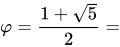
It is the basis of a spiral figure, too, though it’s not quite the same as the “Golden Spiral,” which itself is defined as “a logarithmic spiral whose growth factor is φ, the golden ratio. That is, a golden spiral gets wider (or further from its origin) by a factor of φ for every quarter turn it makes. And that factor is one that satisifes the quadratic equation
φ²=φ+1
1.618033988749…. (this is an irrational number, like pi or e.

But we’re talking about the Fibonacci spiral, which is this:
Another approximation is a Fibonacci spiral, which is constructed slightly differently. A Fibonacci spiral starts with a rectangle partitioned into 2 squares. In each step, a square the length of the rectangle’s longest side is added to the rectangle. Since the ratio between consecutive Fibonacci numbers approaches the golden ratio as the Fibonacci numbers approach infinity, so too does this spiral get more similar to the previous approximation the more squares are added, as illustrated by the image.
And how it’s constructed: you see here the rectangle with added squares, and how a spiral that touches each junction between the squares becomes the Fibonacci spiral.

But on to the cats, which, according to this article from Bored Panda, occasionally form themselves into something approximating a Fibonacci spiral:


And one from reddit:

***************
I thought of cheetahs as a solitary cat, but Wikipedia says that this is not exactly true:
Cheetahs have a flexible and complex social structure and tend to be more gregarious than several other cats (except the lion). Individuals typically avoid one another but are generally amicable; males may fight over territories or access to females in oestrus, and on rare occasions such fights can result in severe injury and death. Females are not social and have minimal interaction with other individuals, barring the interaction with males when they enter their territories or during the mating season. Some females, generally mother and offspring or siblings, may rest beside one another during the day. Females tend to lead a solitary life or live with offspring in undefended home ranges; young females often stay close to their mothers for life but young males leave their mother’s range to live elsewhere.
Some males are territorial, and group together for life, forming coalitions that collectively defend a territory which ensures maximum access to females—this is unlike the behaviour of the male lion who mates with a particular group (pride) of females. In most cases, a coalition will consist of brothers born in the same litter who stayed together after weaning, but biologically unrelated males are often allowed into the group; in the Serengeti, 30% of members in coalitions are unrelated males.
Here’s a BBC Earth video showing a group of cheetahs filmed in Maasai Mara park in Kenya. There are eight: five males (clearly from a “coalition), one female, and her two cubs. The males are obviously competing with each other for access to the females. What beautiful cats!
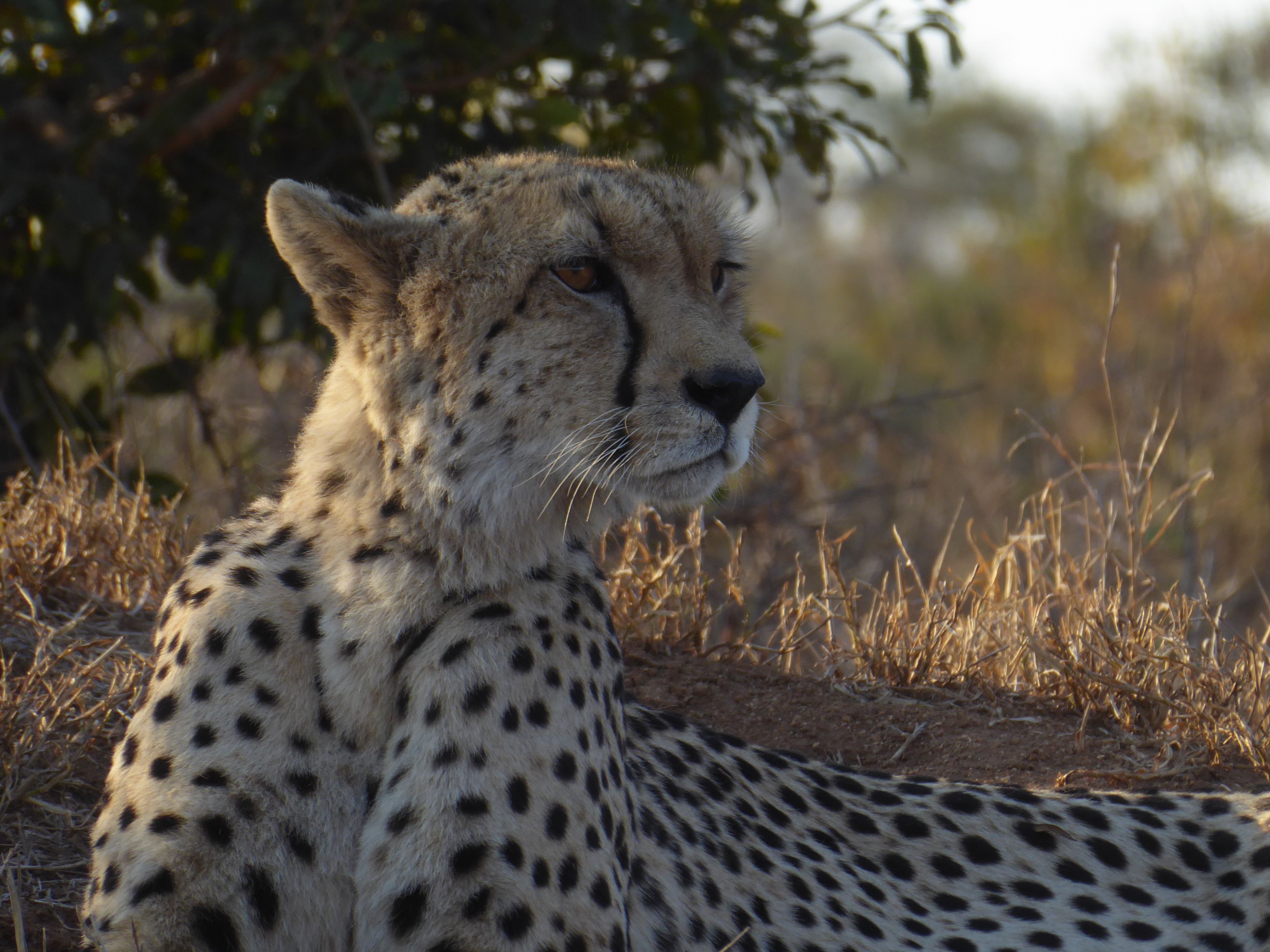
Just to throw this in, here’s a wild cheetah that I photographed when I visited Manyeleti Game Reserve earlier this year. You can see how tame they can be around humans from this photo, taken with a zoom lens on a point-and-shoot camera from an open vehicle. Clearly the cats are used to the human presence.
***************
Everywhere She Travels, a lovely website written by Canadian traveler Caitlin Mundy, has a guide to the friendly cats of Istanbul, I will just use Catlin’s text and illustrate her words with my own photos of Istanbul, taken in April, 2008. Catilin’s text is indented.
This is all true!
If you’re heading to Turkey for your next trip, I sure hope you’re an animal lover! In particular, a cat lover. Not only will you find lots of cats wandering all over the streets of Istanbul, affectionately nicknamed Catstanbul, but you can find them in cities and towns all over the country too! From the back corner of a mosque, to perched on top of a pole, walking on a ledge, or sitting in a store window, cats are everywhere. Seriously, you’d be hard pressed to make it more than 10 minutes without seeing one. And not only are there a lot of them, they might just be the friendliest cat population in the world! Just bend down near one, and chances are it will be running over for pets. So, if you have a love of animals, then Istanbul is certainly a special place to visit.
If you want to see a wonderful movie about the cats of Istanbul, find the movie Kedi (“cat” in Turkish), which has a Rotten Tomatoes rating of 98% from the critics. Somehow filmed at the level of a cat’s eyes, it is a mesmerizing documentary—even if you don’t like cats.
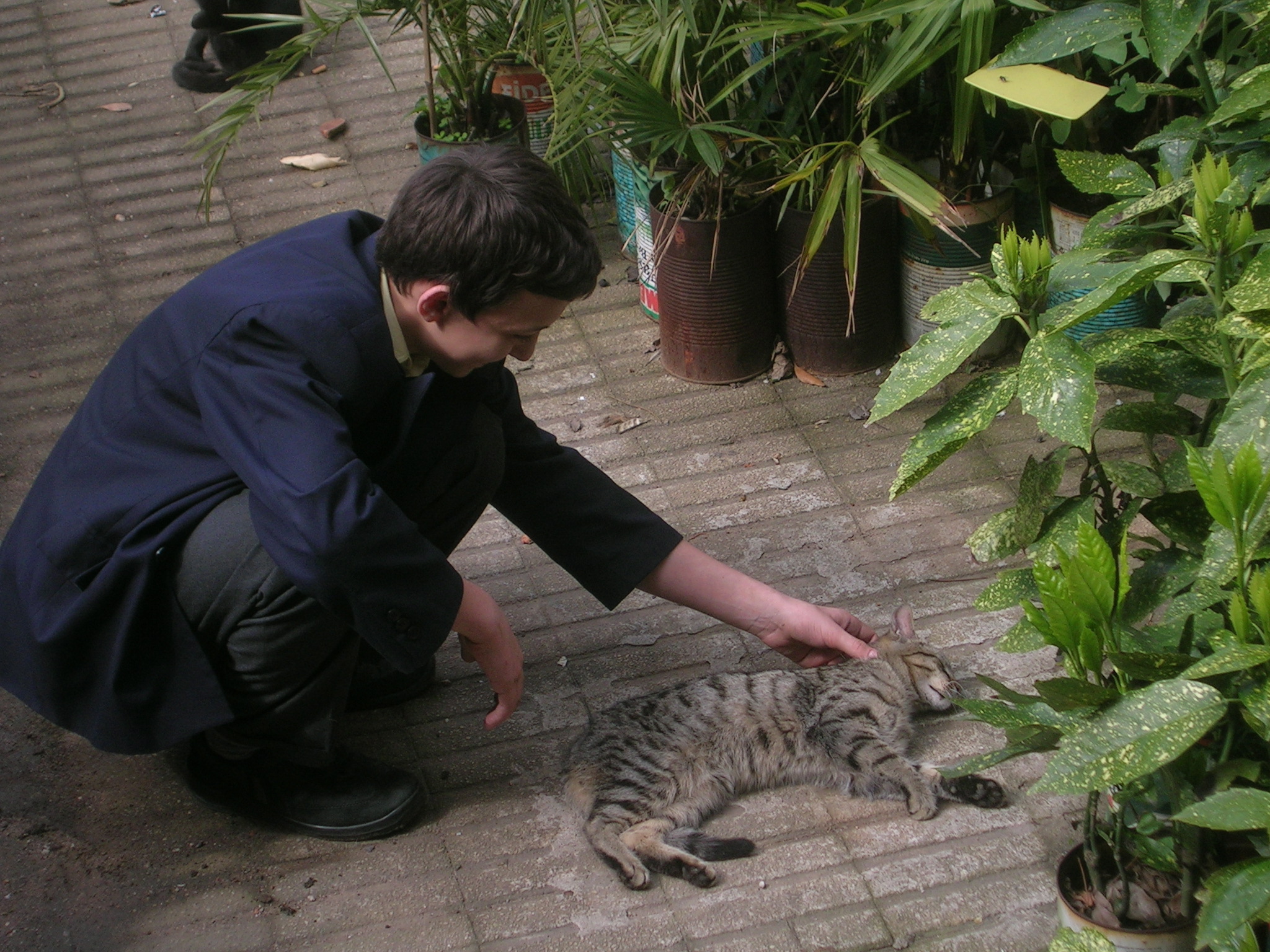
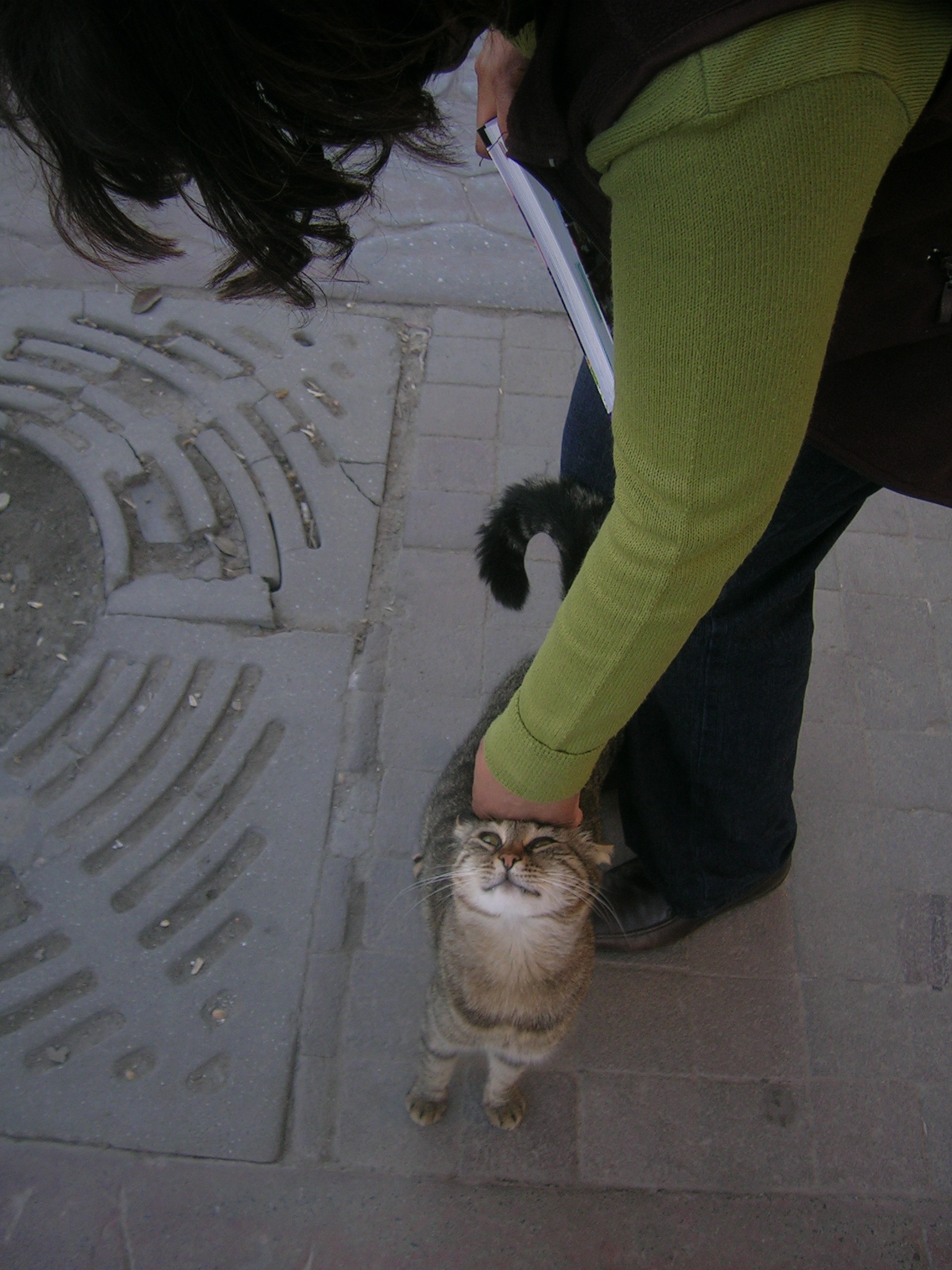
Another time cats love to approach people, is when they are sitting at a restaurant. Several times throughout the 5 days I spent in Istanbul a cat wandered up to me while I was sitting at a restaurant and made his/herself at home. This was always a welcome surprise for me, though it did make eating a little difficult sometimes.
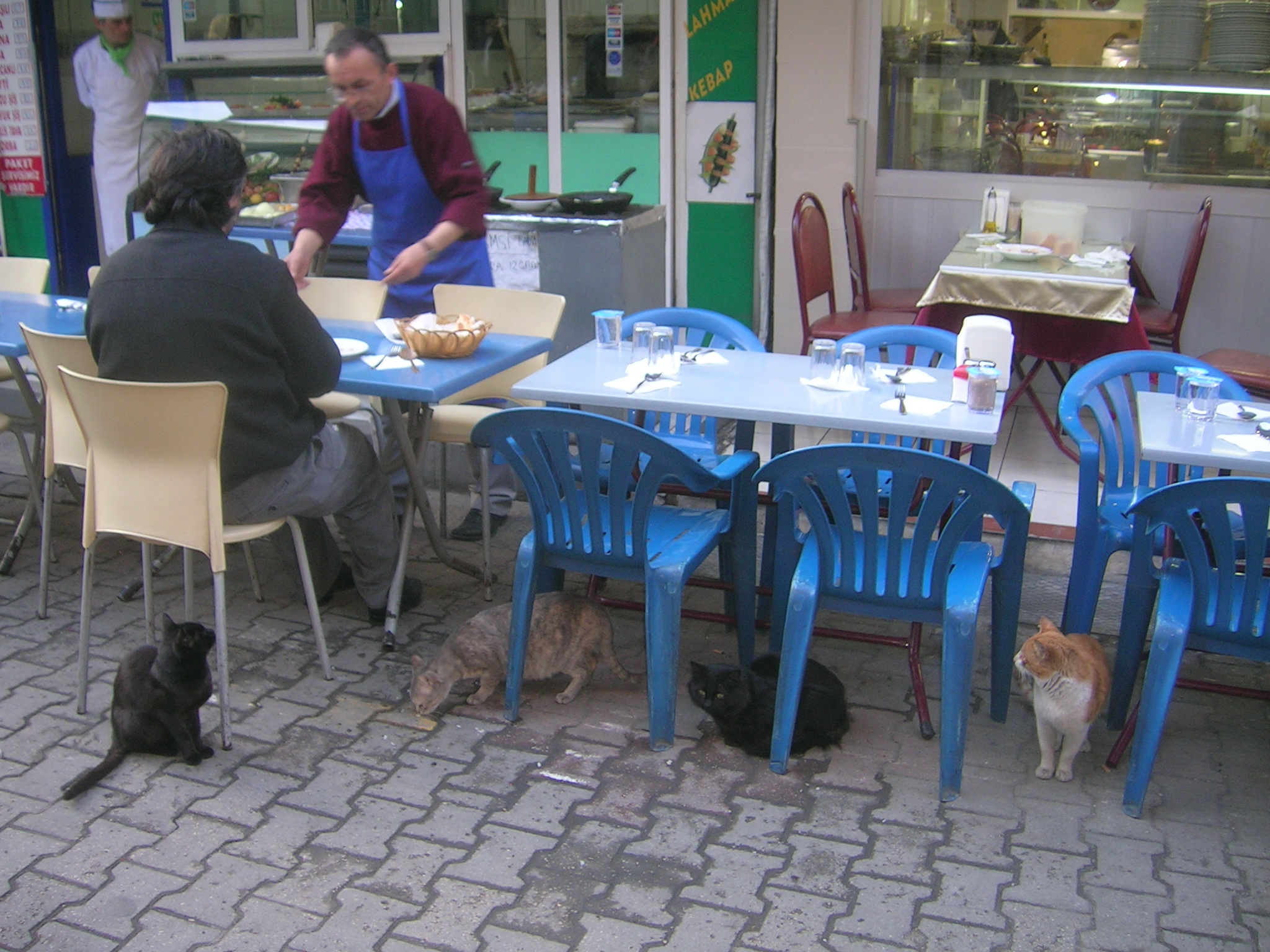

I believe this is a Turkish Van cat with odd-colored eyes:

On my first night in Istanbul, I met some girls at Cheers Hostel who had been in the city for a few days at that point. I decided to join them in visiting the Hagia Sophia at night, to avoid the long daytime lines. While wandering around, I noticed a sweet cat cuddled up under a table. My first (of many) indoor cat sightings! I went to find my new friends to point her out. Look how cute, there’s a cat in here! I said. They smiled politely and told me they weren’t surprised. There are cats everywhere here. As an avid cat lover myself, this came as great news. And throughout my trip, I made sure to pet and photograph as many cats as I could.
I did, too! In the Hagia Sofia they might have seen Gli, who died in 2020, and whom I was fortunate enough to meet (and feed; see below):


Now you might wonder, with so many stray cats, what kind of shape could they be in? The answer is excellent. Walking around Istanbul on my first full day, I immediately noticed how healthy all the cats looked. If I had seen any one of them on the street somewhere else, I would have guessed they were a well loved pet cat way before I would have guessed a stray. But, in a way, they’re both. They may be strays but they are definitely well loved too and seem to be, in general, quite happy cats.
To pull from the popular saying it takes a village to raise a child, in Turkey it takes a village to care for a cat. And it’s true, the whole community seems to step up and look out for these cats! From restaurant owners, to friendly neighbors, and people out for a walk, it seems like just about everyone has a sweet spot for these adorable Turkish cats.
The first clue of this is the abundance of water bowls, small containers of cat food, and little cat houses found outside restaurants, in public parks, and next to people’s homes. These cats are certainly not going hungry or lacking a cozy place to curl up for a nap.
. . . .With all the kindness shown to these beautiful felines, it makes sense that they are friendly in return! I mean, if you are used to receiving pets, treats, and love from humans, why wouldn’t you seek them out? One of my first moments interacting with a cat in Istanbul started with me trying to take a photo. The sweet little white and black cat was standing on a rock near the river, so I bent down to get a good shot. She immediately ran over, climbed onto the purse hanging off my shoulder, made herself comfortable and started purring. After a few moments of crouching down and petting her, I moved over to the rock. We sat there together for at least 20 minutes, while I fantasized about bringing her home with me.
Yep, this is me with a friendly Istanbul moggy!

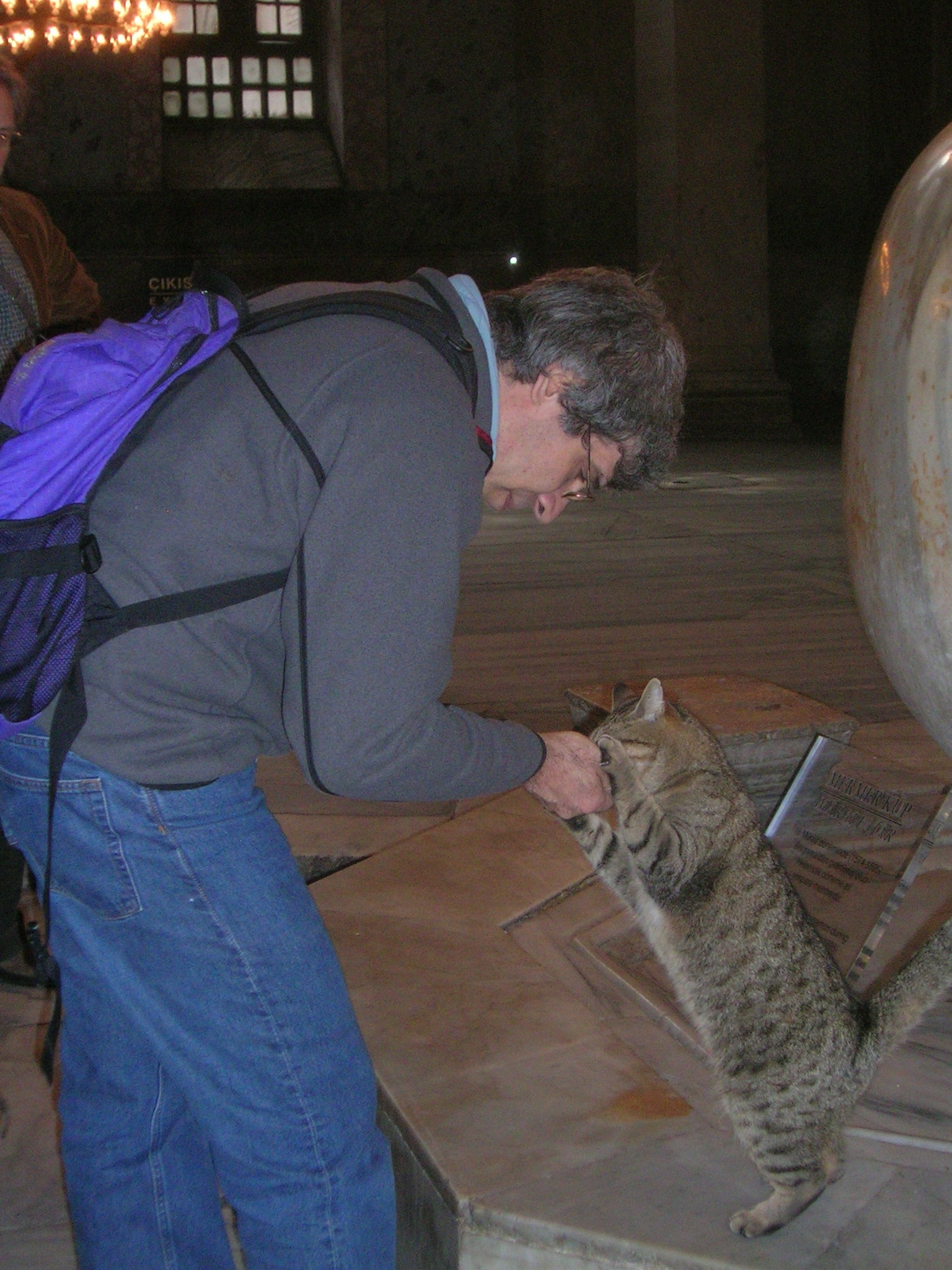
Me petting Gli, the late but very famous cat who dwelled in the Hagia Sofia. Like many residents, I carried a bag of dry cat food around with me, and Gli got some:
And of course I was lured to this rug shop, and the rest is history: I bought several small rugs from this guy, which were beautiful (like the cats):
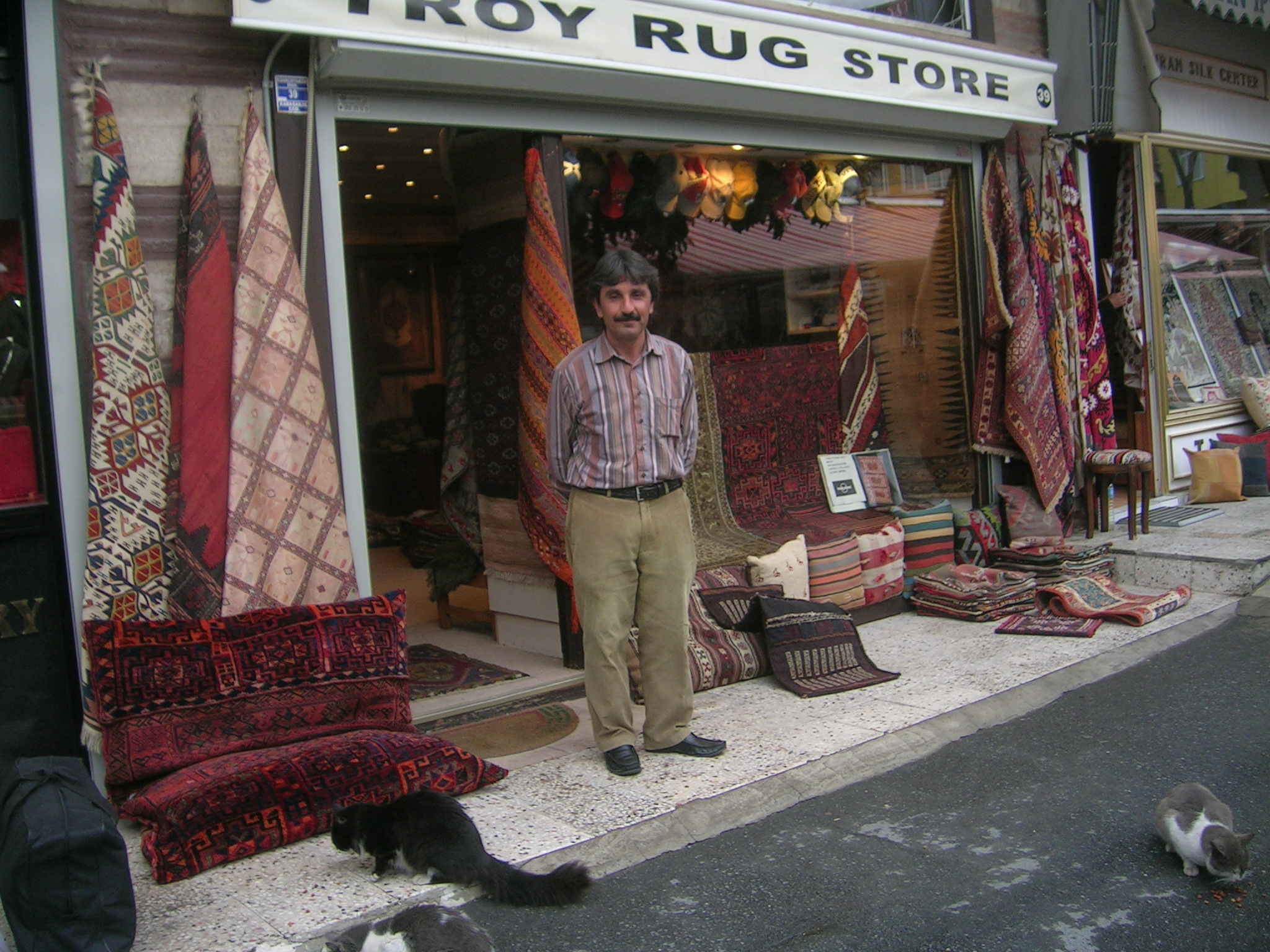
Having cats around your store is a sure way to lure in ailurophilic tourists!
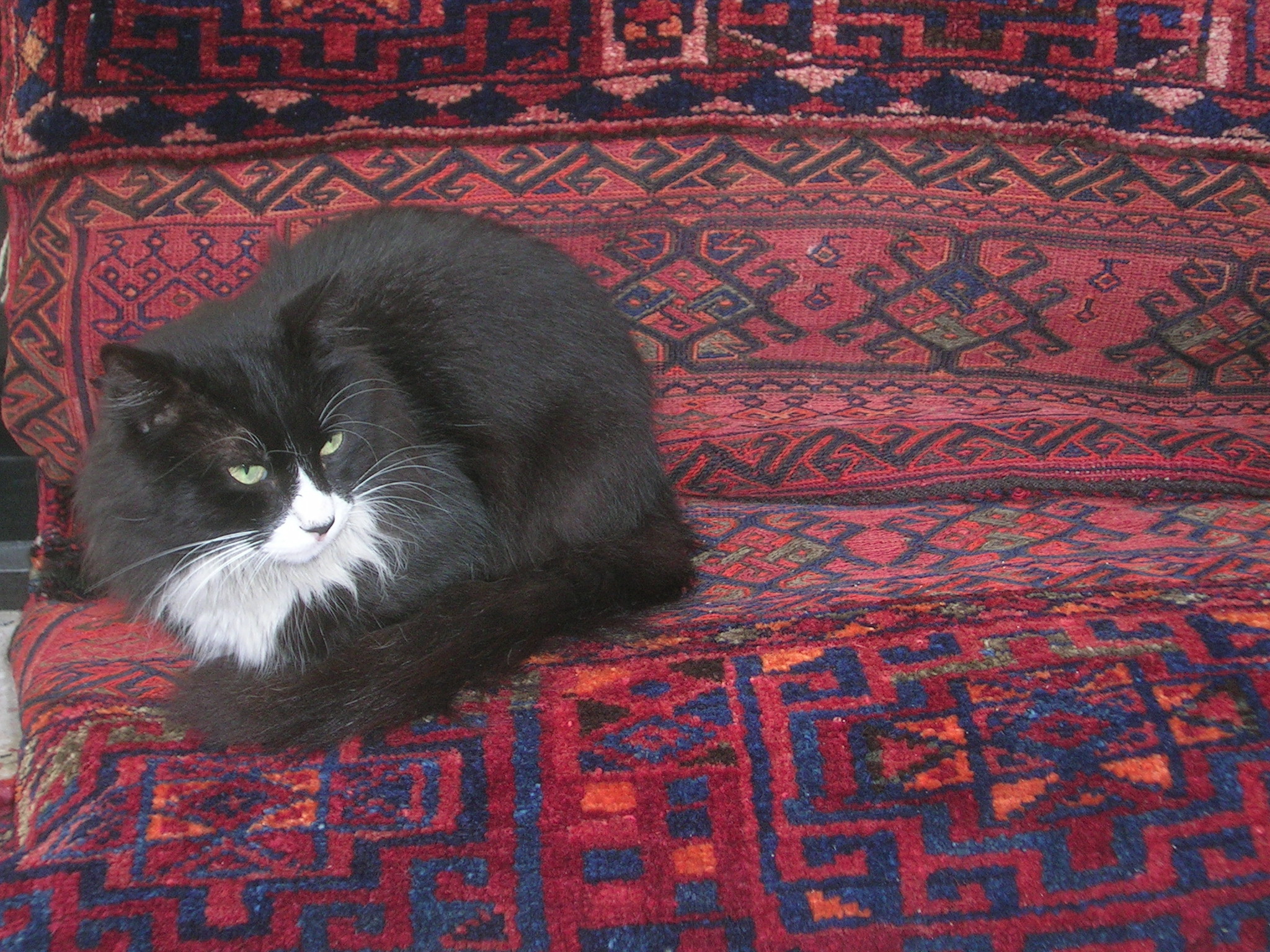
Part of the affection towards cats in Istanbul, and Turkey as a whole, can be attributed to Islamic culture. In Islam, cats are admired for their cleanliness. Since they are seen as clean animals, they are welcome in people’s homes, as well as into mosques. In fact, it’s even considered acceptable to use water from a bowl a cat has drank from for religious purposes, or to eat food from the same bowl as a cat.
The connection between Islam and cats dates back to the time of the prophet Muhammad. Muhammad is said to have been a cat lover himself. In particular, he had a cat named Muezza who he loved dearly. A famous story about Muezza says that one day she was sleeping on the sleeve of Muhammad’s prayer robes. Instead of disturbing her in her slumber, he simply cut off the sleeve of his robe before going to pray. Clearly this story has set a precedence for how cats are treated, even today.
Mosque cats (see Gli above):
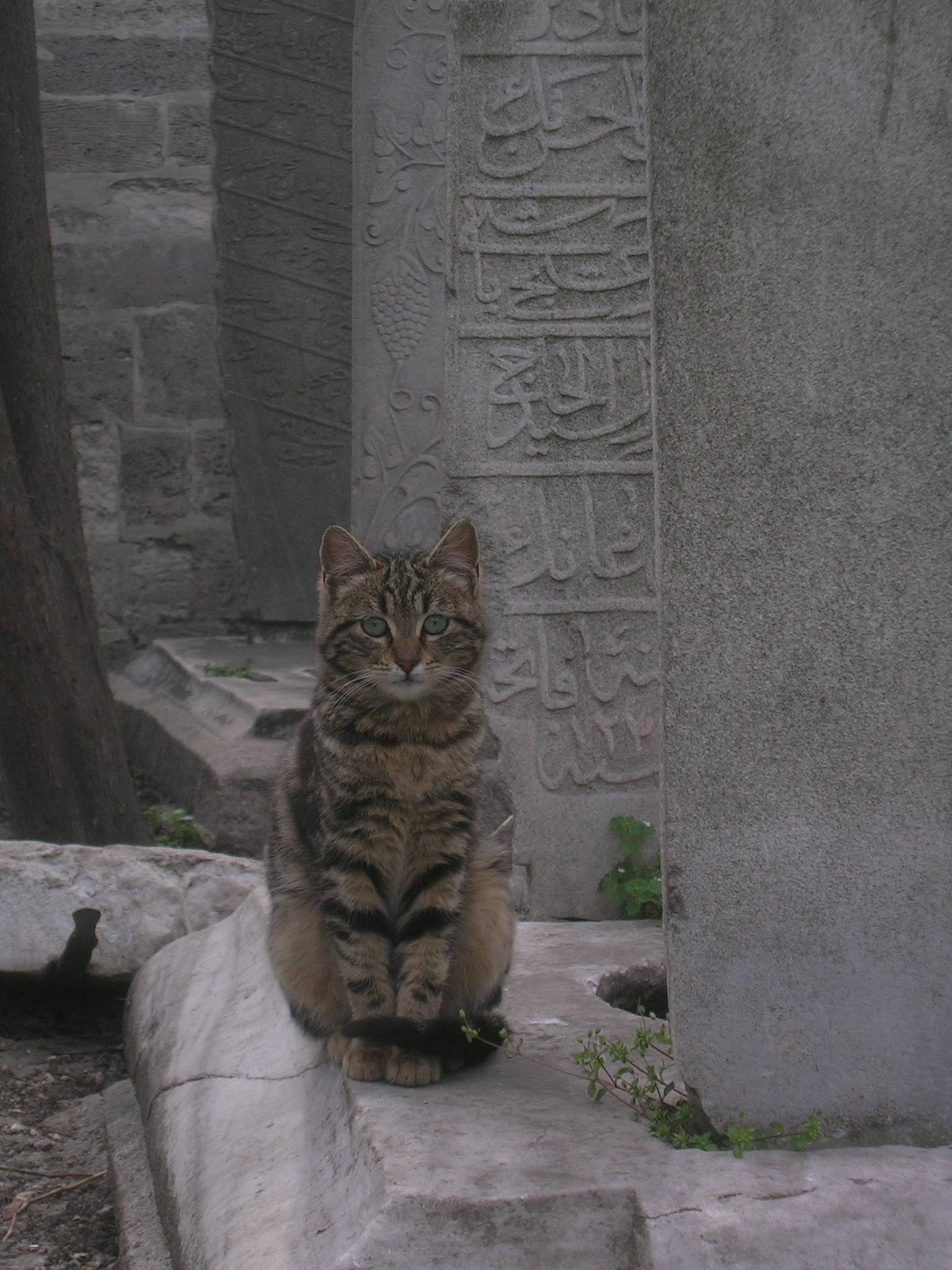
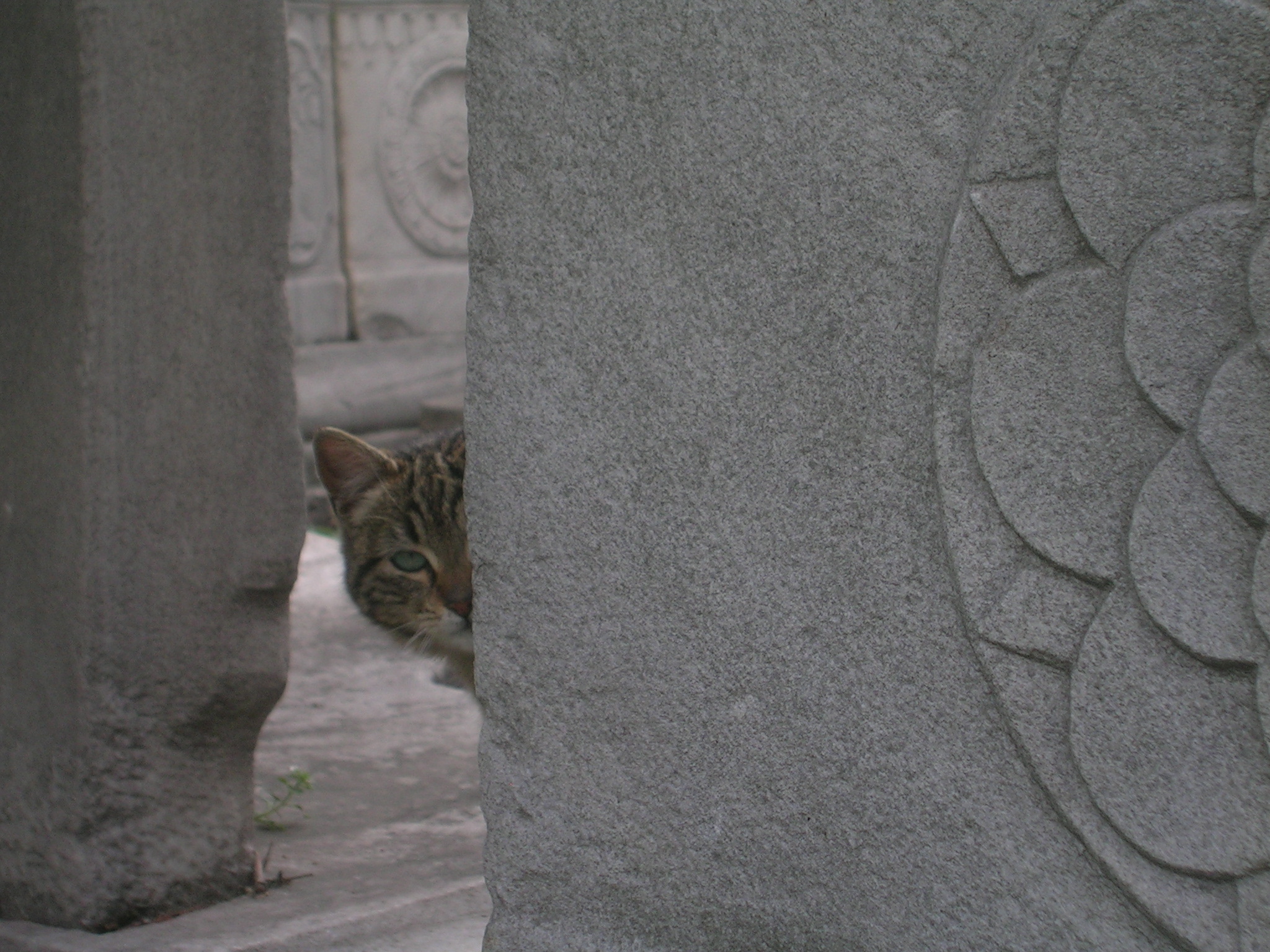
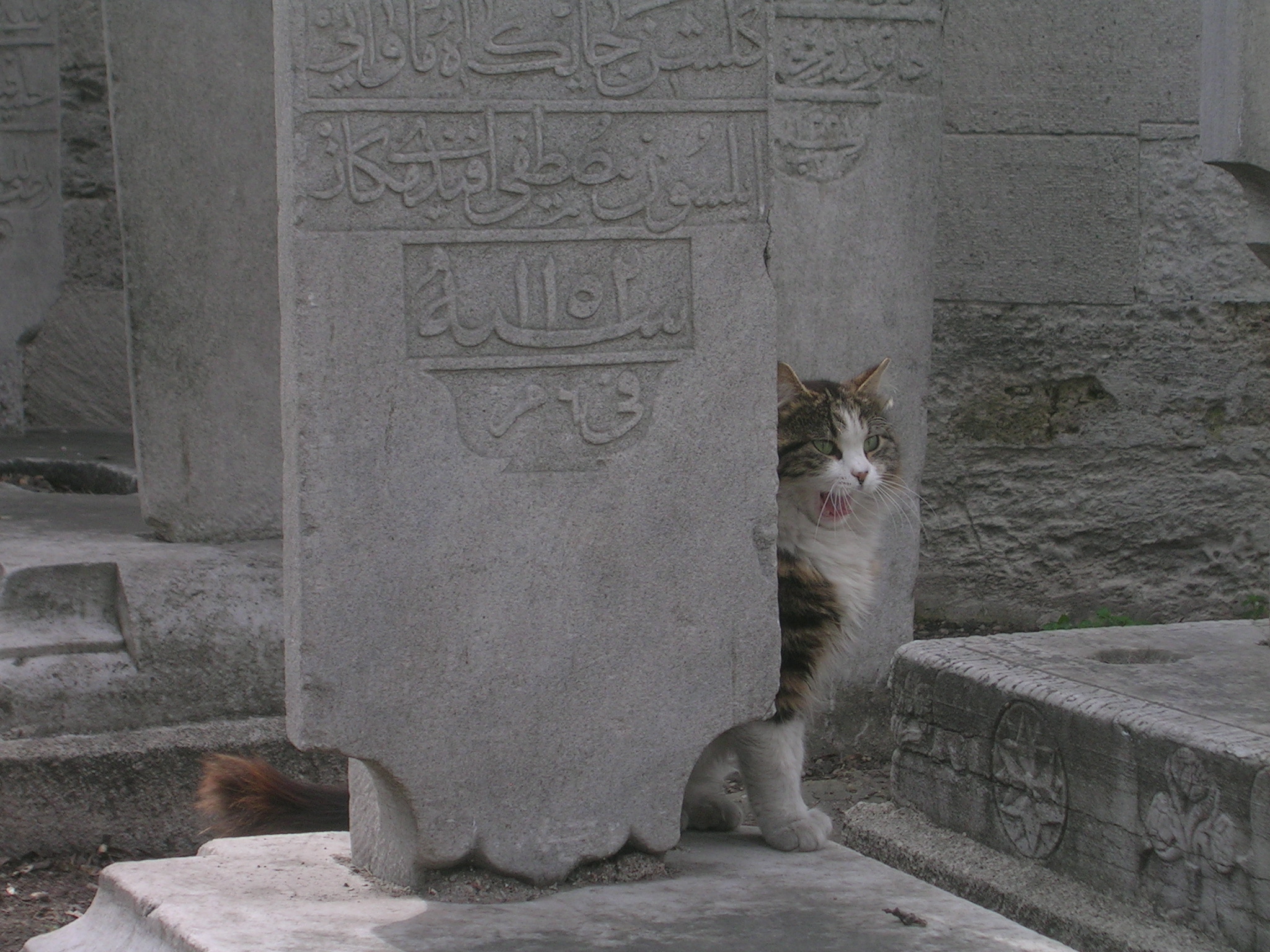
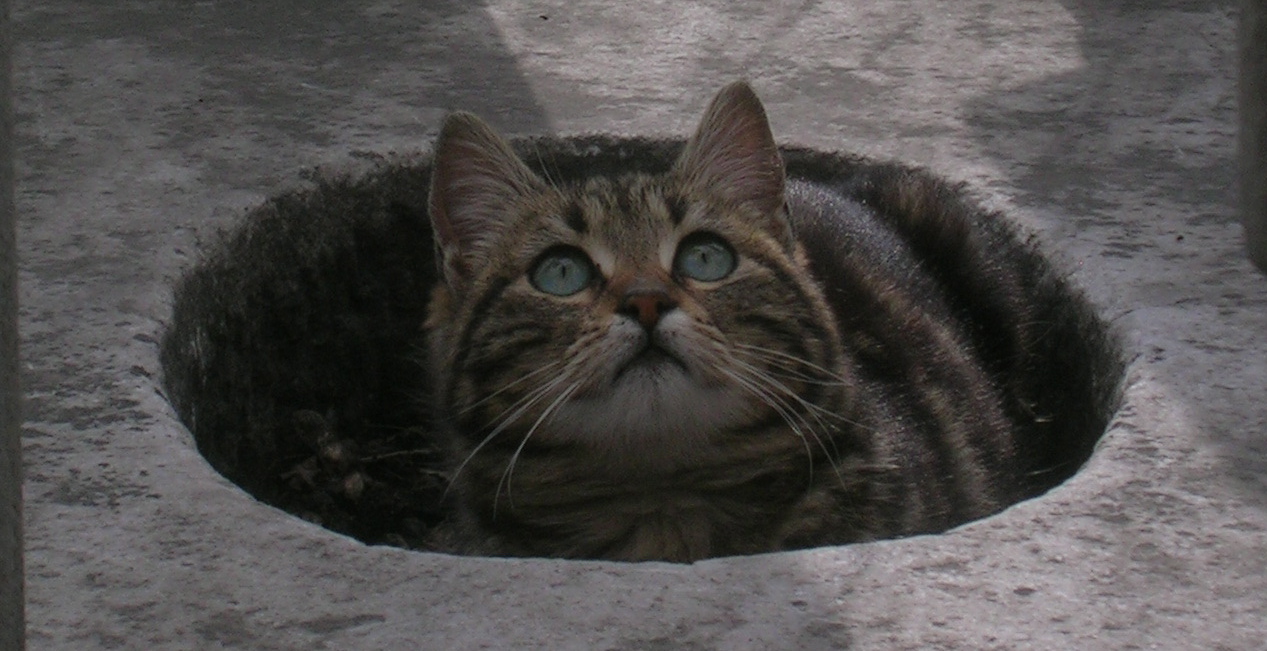
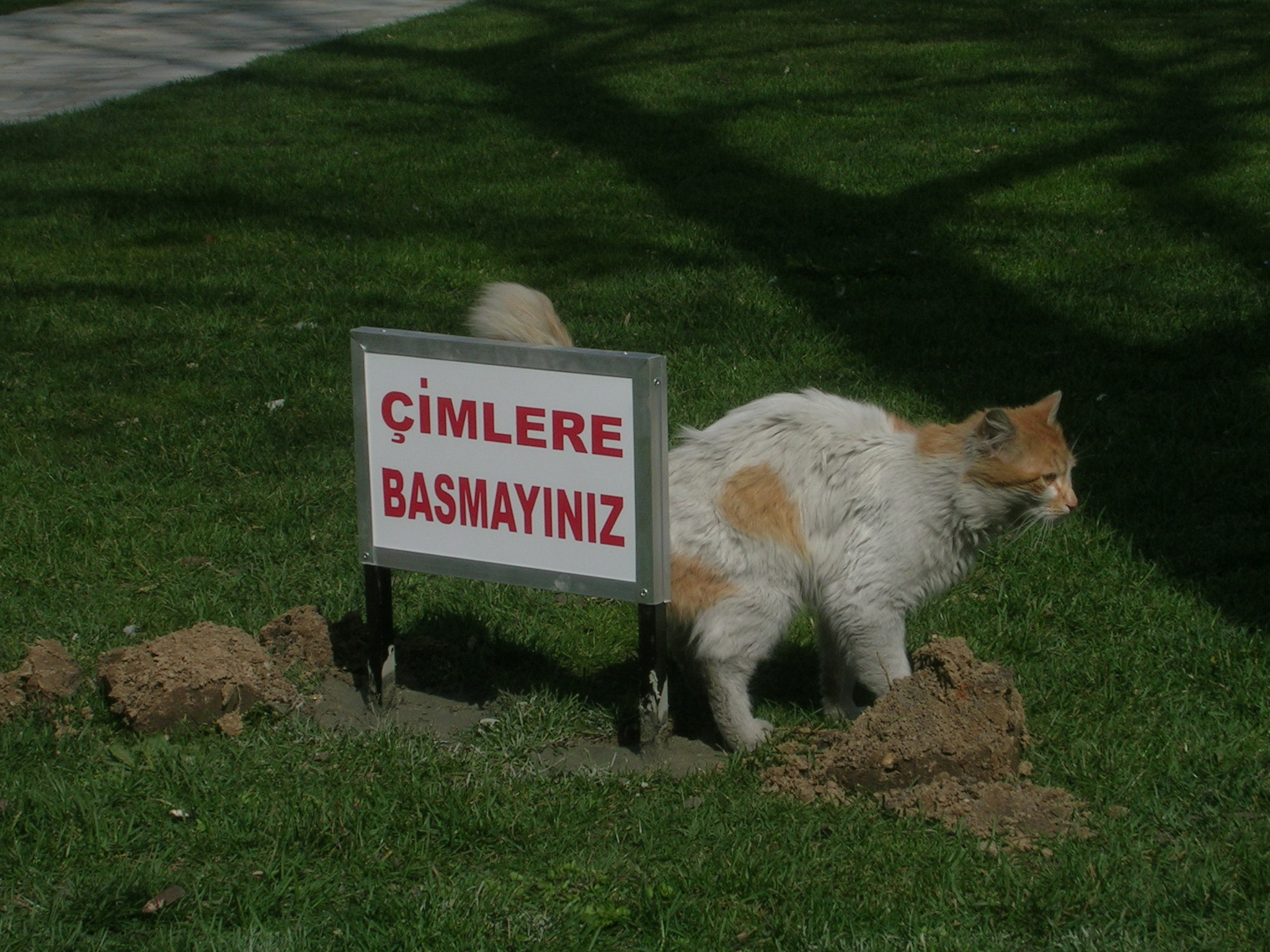
This cat doesn’t look like it’s in as good a shape as the others (you’ll notice the rest of them, which are feral, are nonetheless looking good). This was on the grounds of a mosque, and the Turkish reads “Do not step on the grass.” But of course that doesn’t apply to cats, nor does it apply to urination!
h/t: Michael
In the 90s I had a Turkish friend in grad school who told me about the famous cats of Istanbul. Apparently the tradition of caring for cats is many decades, perhaps centuries, old in that city. The yogurt merchants put our bowls of yogurt for the cats, the butchers give them tidbits of meat, and etc. In hot weather people make sure water is available for the cats. Basically everyone in the city just regards the cats as pets that are everyone’s. Even though the cats mostly live outside, they do not act like feral cats. They approach people with friendly attitudes since they are accustomed to friendship and care from the humans, not to mention treats of food.
“Basically everyone in the city just regards the cats as pets that are everyone’s.”
It seems as if it would be hard to have your own personal pet cat in Istanbul, since the fact that other people could be counted on to feed and pet your cat whenever it went outside would sort of divide its loyalties.
Of course, I can see how wanting a cat to be attached to you exclusively – or to you mainly – might be kind of selfish. After all, a cat would probably be happier and more content with lots of people who love it than with just one.
Nice to see all those happy cats!
Istanbul sounds idyllic, for both cats and people who love them.
I am curious about a couple things though. One is whether Istanbul is a safe place for cats, in terms of automobiles. Another is whether over-population ever gets to be a problem.
Most cats I see are on side streets that have few or no cars, or in mosques. I am not sure about overpopulation; they may have a spay/neuter program but you’d have to look that up.
Istanbul also has stray dogs, and these have been known to attack and kill cats.
Not for long! https://www.theguardian.com/world/article/2024/jul/30/turkey-approves-massacre-law-remove-millions-street-dogs
Sadly, my own experience of the attitude towards cats in Turkey is less positive than our host’s. When I was there in the late 80s (’89, I think) my then girlfriend spotted some scrawny kittens and tried to feed them, but was volubly discouraged by the locals. (My very rudimentary Turkish wasn’t up to understanding what they were shouting at her.)
https://x.com/nekosanpoch/status/1856576576617402877 🇹🇷🐱
https://www.instagram.com/reel/DCWAOjMiiOn/
https://youtube.com/@nekosanpoch
This YouTube channel will be offering “Istanbul Cat Videos” every Saturday. 🐱✨
Unfortunately there are no English subtitles… 🔤
https://x.com/tbsnewsdig/status/1855544346034020520 🇯🇵📺🐱
https://youtube.com/watch?v=Bj06hNUJ-SU
There’s a company in Japan where you can work with cats. 🇯🇵🏢🧑💻🐱
Love the Fibonacci cats! Actually all the cats! 🐈 🐈🐈
I and some friends were eating at a sidewalk restaurant in a narrow street in Istanbul once when a cat was lying on the sidewalk across the street. A dog came along and started bothering the cat, so the waiter went out and flicked a towel at the dog and chased it away, then petted the cat. Istanbulars do love cats.
Great caturday posts today. Cats AND math. Top notch. 🙂
Like PPC(E) in the third world I routinely travelled with a few cans of cat food for the locals. In (RICH!!) Qatar I saw the worst looked after cats, Lebanon the best.
I’ll say though… while Islam does indeed respect cats, their treatment of d*gs is TERRIBLE. No (even avid) cat lover can condone this.
In fact recently in Ergo’s Turkey there was a concerted, cash-rewarded dog killing government program. Much of it deeply cruel, details of which I’ll spare you.
Which was so heartbreaking – indicative of both the Religion of Peace and Turkey’s current dictator’s mindset.
I’ve had cats and dogs, btw. Currently I happen to own the world’s cutest dog. To wit:
https://whyevolutionistrue.com/2020/06/10/photos-of-readers-93/
all the best,
D.A. & “Aussie”
NYC
I’m not a d*g person, but I’m glad to hear that Aussie is still going strong.
Aw darn. The pictures aren’t showing up for me
Love the cats of Turkey… all the photos and hearing about your experience there. I’ve always wanted to visit Turkey, but it doesn’t look like I’ll get there (at least, not in this life).
That picture of Professor Ceiling Cat with the black moggy is particularly delightful imo.
Regarding cat cleanliness, I applaud any technological development which advances (how does one best say it?) best practices for minimizing feline odiferous production. I can’t blame a cat for “working like a dog” to maintain optimal cleanliness.
I’m reminded of a joke: a cat was accidentally given a laxative. The cat’s human last saw the cat disappearing into the distance in the company of five other cats: two digging, two covering, and one scouting for new territory.
https://x.com/CourrierJapon/status/1621516459078995970 🇯🇵🗞
https://courrier.jp/news/archives/314782/ 🇺🇸🏫👨🏫
https://courrier.jp/news/archives/314892/ 🇺🇸🏫👨🏫
Here is a Japanese web media that has an interview article with Professor Jerry Coyne. 🐱✨
https://x.com/LEXPRESS/status/1604394505465126913 🇫🇷
https://x.com/LEXPRESS/status/1604552321198956545 🇫🇷
The original interview is in this French article. ✨🐱✨