
I’ve always longed to go to Zion National Park in Utah, as it’s renowned for its beauty. My friend Phil Ward and I drove there for most of the day yesterday. First, a bit about its geology from Wikipedia:
The nine known exposed geologic formations in Zion National Park are part of a super-sequence of rock units called the Grand Staircase. Together, these formations represent about 150 million years of mostly Mesozoic-aged sedimentation in that part of North America. The formations exposed in the Zion area were deposited as sediment in very different environments:
- The warm, shallow (sometimes advancing or retreating) sea of the Kaibab and Moenkopi formations
- Streams, ponds, and lakes of the Chinle, Moenave, and Kayenta formations
- The vast desert of the Navajo and Temple Cap formations
- The dry near-shore environment of the Carmel Formation
Uplift affected the entire region, known as the Colorado Plateaus, by slowly raising these formations more than 10,000 feet (3,000 m) higher than where they were deposited.[54] This steepened the stream gradient of the ancestral Virgin and other rivers on the plateau.
Click the photos to enlarge them. You will find that there are more pictures of chipmunks and people feeding them than there are of the landscapes. Shoot me–I love chipmunks (and all animals).
First, I affirm my credentials as a Zionist. I’m wearing a hat that someone gave me, and it reads, à la the Larry David show, “Curb Your Antisemitism”:

The landscape is stunning, so let’s just look at some photos.

Sandstone cliffs, red but topped with some white sediments:

Even though it’s dry here, plants and even trees manage to eke out a living on the bare rock:

Some of the cliffs are topped with plateaus:

A panoramic view. Definitely click once or several times to enlarge:

There are all kinds of wave patterns in the sedimentary layers:

We had a mild hike up Canyon Overlook Trail (1 mile long) to get to this stunning viewpoint looking down into Zion Canyon.

Below, my friend Phil Ward at the overlook. He’s a Professor of Entomology at the University of California at Davis, and I’ve known him since he arrived there in the early 1980s. His speciality is ants, and although one is not allowed to collect in National Parks without a permit (I used to get one to collect flies in Death Valley), he never leaves home without his ant-collecting kit, which includes ant bait, and that includes cookie crumbs. It turns out that although we couldn’t collect ants, we used the bait to collect chipmunks (see below).

There were at least four species of flowers along the trail. This one is a California fuchsia (Epilobium canum):

Life is ubiquitous and tenacious, even in environments as dry and hostile as Zion. Where water seeps through the rocks, plants and mosses about, and I think this is maidenhair fern (Adiantun pedatum aleuticum).

A great treat awaited us at the overlook. Because many tourists linger there for the view, the local chipmunks have learned to hang out there to beg for noms. They are lovely, tame, as fast as quicksilver, and will even dive into your backpack if you leave it open. Phil gave me some ant bait (crumbled cookies), and, sure enough, the chipmunks went all over me to get them. (This reminds me of the Botany Pond Squirrels climbing up m leg for nuts.)

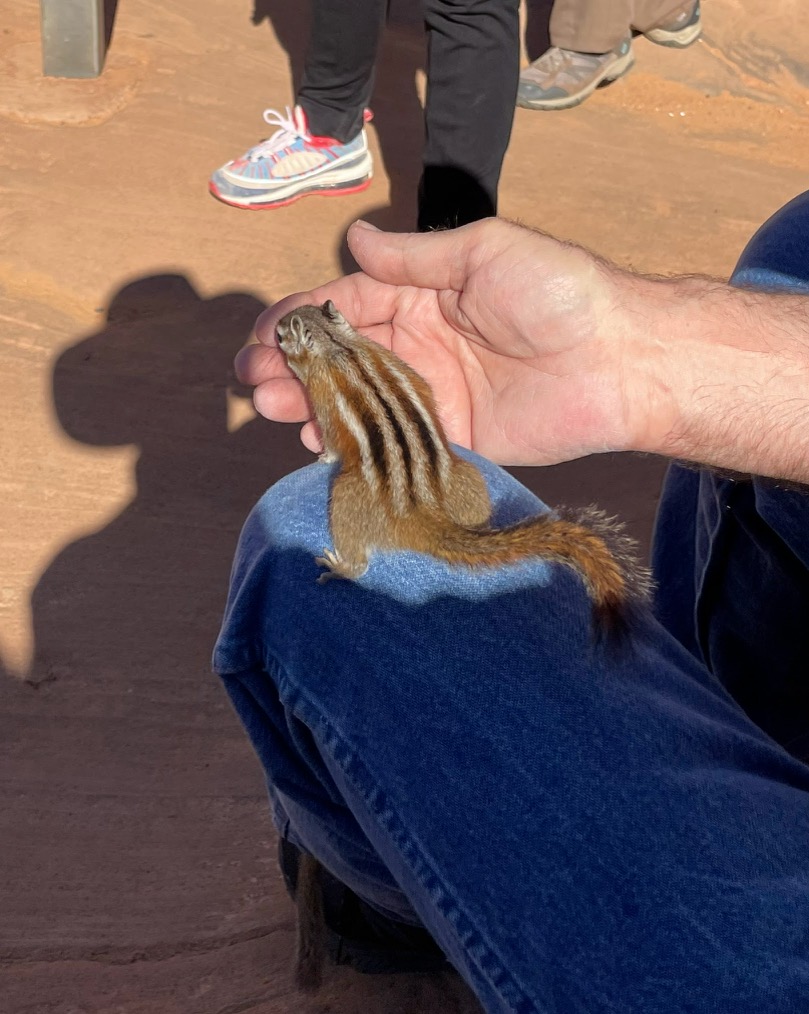
There are three species of chipmunk in Zion; I believe this one is the Uinta chipmunk (Neotamias umbrinus). It’s related to the East’s common Eastern chipmunk (Tamias striatus), and used to be considered the same species, but now it’s been placed in a different genus.
The visitors were entranced by these rodents (they are as light as a feather, and when they climb upon you, it’s barely detectable). And so people pulled out their hiking food and gave some to the ‘munks. Sometimes three or four chipmunks would climb on a person at once. This woman is obviously delighted.

I love people being happy when interacting with animals.

A close-up of a nomming chipmunk:

This woman was part of a group of visiting British tourists. Since chipmunks are exclusively North American, it’s likely that this is her first close encounter with one. Like everyone, she was delighted when they took food. (And yes, I know you’re not supposed to feed the wildlife, but seriously, how can you resist?)

A two-fisted feed:

Look how happy she is! (And, I’m sure, so were the chipmunks.)

A closeup. Phil and I discussed the evolutionary significance of the striping pattern; Phil thought it may be camouflage, but it seemed to me to not yield a very cryptic pattern. Perhaps, I thought, it was for members of the species to recognize each other, but I’ve always been wary of “species recognition” traits because it’s hard to see how they’d evolve (the trait and recognition of the trait must evolve simultaniously). In the end, we decided, “Well, we’re evolutionary biologists, and we could make up a hundred explanations, but how would we test them?”

Look at these little beauties, with their racing stripes, fluffy tails, and huge black eyes!

And a top view. As I said, they are so light—Uitna chipmunks weigh about 67 g, or 2.4 ounces—that you can barely feel them when they climb on you. And, like squirrels, when they take a tidbit from your hand you can feel their tiny claws.

Today, we go to Bryce Canyon National Park, famous for its geological “hoodoes“, tall and thin pillars of rock very different from what you see in Zion. Here’s a picture from Wikipedia:

Beautiful photos, sir. My wonderful wife and I have lived 7-8 hours driving time from Bryce and Zion for four years, but–embarrassingly–have still not made the trip.
So awesome
Yes, awesome! Magnificent! It’s Nature!
+1. Unbelievable! Soak it all in if you can.
What a gorgeous area! The exact opposite of Las Vegas. Perfect time to go there, right after Las Vegas.
Love the hat!
Yes, doing it the other way around (first Zion, then Vegas) might be an unpleasant shock.
Fantastic. Those big wavy features in the rocks are remnants of Mesozoic terrestrial dune sands—giant dunes as in today’s Sahara. (At least that was the interpretation a few decades ago when I was paying attention to the literature.) The other deposits are mostly nearshore sediments deposited under water.
I had the good fortune of spending an entire month on the Colorado Plateau doing geological field work at my undergraduate field camp—a rite of passage for geology students at that time (1977). The month was spent far from civilization on giant ranches or public lands. We lived in tents, and a food truck daily went to the nearest town to provide us with provisions. We did spend one night each week in a hotel to shower. Leadville, Colorado was one of our overnights. So was Moab, Utah. I really didn’t know where we were exactly most of the time, but we spent a good deal of time in Utah. Many of the geological formations you describe are extremely widespread in the region, being traceable for hundreds of miles. My field trip experience was unforgettable, even though most of the rest of my career as a geologist was spent in classrooms and in front of a computer.
Comment by Greg Mayer
Norm–
I concur on the wavy deposits being dunes. They look like deposits I’ve seen and read about in Bermuda, which during glacial low sea-level times was much larger and had lots of dunes.
GCM
Great pix, thanks!
I think it was a good choice to focus on the chipmunks!
When it comes to famous landscapes, let’s be honest: unless a person is a professional photographer, it’s unlikely they’ll be able to offer any images that are any better than what’s already available on the internet.
On the other hand, who knew about the chipmunks of Zion? Not me! The happiness of people interacting with these adorable rodents is just infectious.
Beautiful pictures!
I used to feed chipmunks in my last house. If you give them peanuts in shells they will stuff two in their cheeks and when they bound away you can hear the peanuts rattling around.
Gorgeous pictures. Thanks so much. I was there with my parents in about 1955, but don’t remember much. My pictures from the time were all in b&w.
Cool! I don’t remember the ‘munks when I was there. I wish I had that encounter.
I speculate the the stripes are a kind of deception to momentarily throw off predator perception that their target is moving, and so throw off their aim when trying to catch them. Imagine you are a hawk, rapidly descending to nab one of these critters. Of course you need to aim for the head or just behind the head. The bold stripes will definitely be a point of focus, however. But once the chipmunk starts to dart forward, one should of course slightly adjust the aim at the last moment. But the stripes will conceal this forward movement for a split second so you don’t adjust aim in time and then it’s too late to get the most effective spot, resulting in a greater frequency of escaped prey.
This could be tested with human subjects and with trained hawks, using both striped and un-striped models.
I experience this very issue when trying to catch striped garter snakes, which I try to do on a regular basis (even though they sometimes bite, and they will poop on me). Their longitudinal stripes make it cussedly hard to aim my hand to just behind the head once they start moving!
Indeed – “go-faster” stripes like boy-racers put on cars!!
I was going to say something like this myself, and it was also due to my experience with garter snakes.
The stop-start movement you see with chipmunks would aid in the effectiveness of the stripes in fooling predators.
Great pics and love the hat!
Very cool travelogue there and you’re looking tanned. 🙂
Funny – as an Aussie new to the USA in 1992 chipmunks amazed me. One “climbed” me in the Georgetown campus. They have the same effect on foreigners that kangaroos have on visitors to Australia.
Enjoying “our” trip out west.
D.A.
NYC
Young wild pigs have the stripes like that, they lose later.
Chipmunks can carry diseases like plague, Leptospirosis, hantavirus etc!
https://www.scientificamerican.com/article/plague-still-exists-heres-where-and-how-it-spreads-in-the-u-s/
Antibiotics are effective against both plague and Leptospirosis. Hantavirus is a little more worrisome, although it’s still very rare. Personally, I’d risk it to feed the chipmunks.
Antibiotics and a bit of luck reduce the mortality in the Black Death to about what an unvaccinated elderly person would risk from getting Covid. And we moved heaven and earth to keep that from happening. You make it sound as if recovering from sepsis is just a matter of taking a couple of antibiotics tablets and being good as new. If you’re over 65 or 70, you probably won’t regain independent living and will be a burden to your relatives.
Epizootics of plague in rodents become dangerous for humans when the rodents are killed off in large numbers and their now-hungry fleas feed on us an an opportunistic substitute. Hanta is more dangerous for people who have to clean out rodent-infested buildings and inhale dust containing rodent feces.
Animal fanciers are “different”, I guess. I wouldn’t take any risk at all to be exposed to vermin, especially in the southwest desert country, much less let them crawl all over me in a most unnatural way. Can you swat them away or will they bite, resentful? Wild animals are meant to be afraid of people and feeding them reduces that healthy fear (healthy for them and for us.) Larger animals will be aggressive pan-handlers if they associate you with junk food and you don’t have any. This results in their having to be shot in the name of public safety. I’ll bet that woman in the sports bra would change her tune if one crawled down into her cleavage and didn’t want to be evicted!
A (ok maybe a bit naff) Ennio Morricone, soundtrack would not be amiss to this post of geological outrageous structures.
We’ll title it “A fistful of Munks” 😋
Thanks for these photos. A few years ago I went on a swing through these National Parks and I still shake my head in wonder at all the natural beauty. Though unfortunately I didn’t have any close encounters of the chipmunk kind. I’ll have to go back!
Remembering this beauty is a great place to turn when I can’t take any more of the current political insanity. But the way things are going, the next thing I’ll expect to see in the papers is that a group of Palestinian protesters are demanding that the name of the National Park be changed. Even though the name is actually Mormon related, that probably wouldn’t matter to those idiots.
Great photos! Thanks.
Wonderful, thanks!
A wonderful place, and wonderful pictures. I wish we had room for a National Park that size over here in the UK.
I too wondered whether the chipmunks’ stripes might be an anti-predator disruptive pattern. What’s their natural ground habitat? Would stripes work there?
Looking forward to the next installation!
Why do you suppose you’re “not supposed to” feed wildlife in a National Park?
I think it’s against the rules. They don’t want animals to become so tame that they get endangered by approaching humans. But I don’t think this is much of a danger with chipmunks!
You might stop at Kodachrome State Park for a different set of hoodoos. If you are driving to Salt Lake City, stop at Hells Backbone Grill in Boulder.
Chipmunks were introduced to me with the explanation that “they basically just failed at being real squirrels, and are overcompensating by sticking on some racing stripes”, which frankly has prevented me from taking them seriously ever after.