
Today’s Jesus and Mo strip, called “choice,” came with a question, “What’s your favorite verse in the Qur’an?”
Mo’s upset because the Qur’an states that Jesus wasn’t killed on the cross, but ascended alive to heaven, hauled up to be with God. This shows that both religions can’t be true, but of course they can both be false.
Meanwhile the barmaid has a bit of fun.
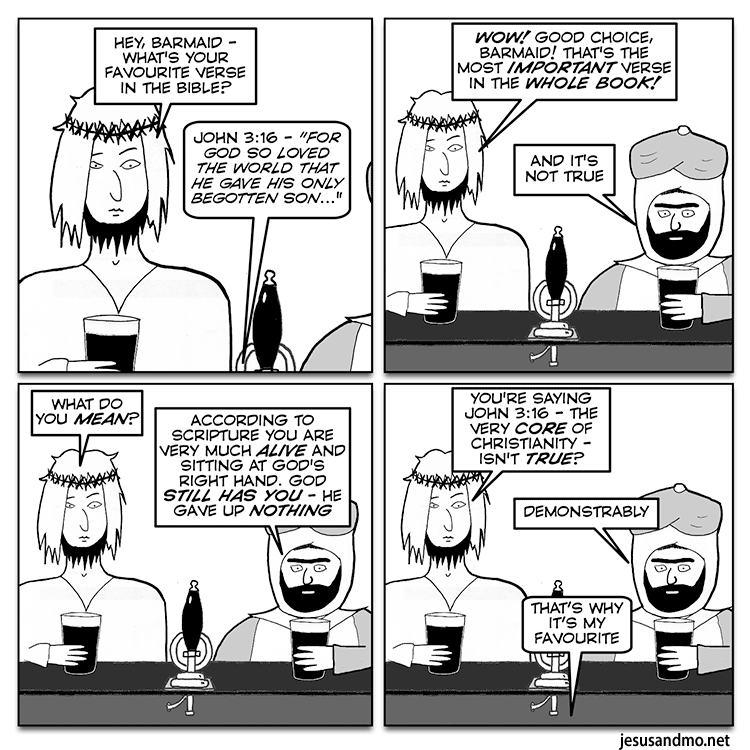
Good one!
My favorite Bible verse is Matthew 6:5,
Isn’t it widely accepted by historians that Jesus existed and was crucified? In that case, most historians probably think that the Koran is wrong in saying that Jesus was not crucified.
God didn’t give up much: he did not suffer on the cross or in any other way because God can’t suffer. It’s a heresy (patripassionism?) to say that He suffered on the cross. But Jesus did suffer, which means that God let his son take the pain of crucifixion. But god lets people suffer all the time 🙂
Religious people are fun, especially when they get into a terrific flap about things that hurt their sensibilities.
Ouch. I might be wrong about the Koran getting it wrong: it looks like the majority of historians also goofed. So the Koran is definitely better, and consequently probably truer.
Most historians will never have considered the issue of Jesus’s existence, since the origins of Christianity are very much a special topic distinct from mainstream history. The evidence that Jesus was a real person is weaker than generally supposed (and the evidence that he wasn’t is stronger than often supposed).
Hear hear. And that evidence is readily available, for instance here: http://www.jesuspuzzle.com/jesuspuzzle/index.htm
The best and most persuasive current mythicist is Richard Carrier, but his two lengthy books on the subject are quite expensive. However, most of their arguments are featured somewhere on his site: https://www.richardcarrier.info/
For a more, shall we say, conversational approach: https://www.jesusneverexisted.com/
That looks like an interesting site (Richard Carrier). I’m inspired to investigate it.
I’ve read Richard Carrier’s books about the Jesus myth. They are based on some pseudo mathematical application of Bayes’ Theorem. He had to make so many unjustified assumptions that I think his argument is worthless.
The evidence of Jesus’ [i]existence[/i] is really not bad in historical terms. Were it anybody other than the founder of Christianity, historians would have no trouble in tentatively accepting his existence on the evidence we have.
The problems really start when we try to understand Jesus’ life. When we examine the sources, we find that many of the things written about him can’t be substantiated, or are obviously fiction. Personally, I accept that Jesus was an apocalyptic preacher who was eventually executed by the Romans and who founded the cult that eventually became Christianity. I think that is a reasonable position to hold and it explains the evidence that we do have in a parsimonious way.
A lot of the mythicists seem to be driven by the goal of sticking one on the Christians. They expend a lot of time and energy trying to explain away the evidence with fanciful talk of mystery cults and so on. I think they would be happier if they accepted the historical consensus and directed their energy towards other things.
I dare you to tell Carrier to his face (or on his site) that his books are based on pseudo mathematics and unjustified assumptions.
If you can’t cope with Bayesian probabilities, have a look at the first reference above. Earl Doherty has his critics, but his arguments do have the merit of being coherently set out and easy to follow.
The Barmaid plays a choice hand by mentioning the go-to verse as a means of causing Mo to insist it is demonstrably false. Many a Three-Stooges type scene are based on the benefits of pitting one against the other (while Curly-Joe is checking the plumbing upstairs) to the perpetrator’s doubly-triply satisfactorily beneficient experience.
Invoking the Holy Trinity of Mo, Larry, and Curly opens up new vistas of theological inquiry.
To be fair, if the story is true (a huge IF), then God have up his son for an Easter long weekend and also had him horribly tortured. And if the trinity thing is true (an even bigger IF and seemingly inherently self-contradictory), then God sacrificed his own weekend and comfort to atone for our sins which otherwise he felt duty bound (to whom?) to torture us all for eternity.
The Christian thesis is completely incoherent. According to Christians, sins must be accounted for but God wants us to escape the accounting and dreamed up a convoluted scheme involving sacrificing himself (in human form).
On the assumption that God is the highest authority there is, why did he make up the rule that we must pay for our sins? Why can’t he bend or break it? How can one person’s death be enough to account for all of our sins and is a temporary death good enough? If it isn’t, then God essentially played a trick on himself by coming back alive, and if it is, why not just let as all die as punishment and resurrect us.