
Both of these items come from the eagle-eyed Matthew Cobb, who somehow finds time to trawl Twi**er and the Internet when he’s not teaching, doing science, or writing books. Plus he’s got two daughters, a wife, and three cats.
At any rate, he found this raccoon on Twi**er, and it’s a very sad one, watching its cotton candy (“candy floss” to the Brits) dissolve away when dunking it in water, as raccoons tend to do. It looks extremely puzzled. (By the way, nobody’s quite sure why raccoons “wash” their food in water before nomming it.)
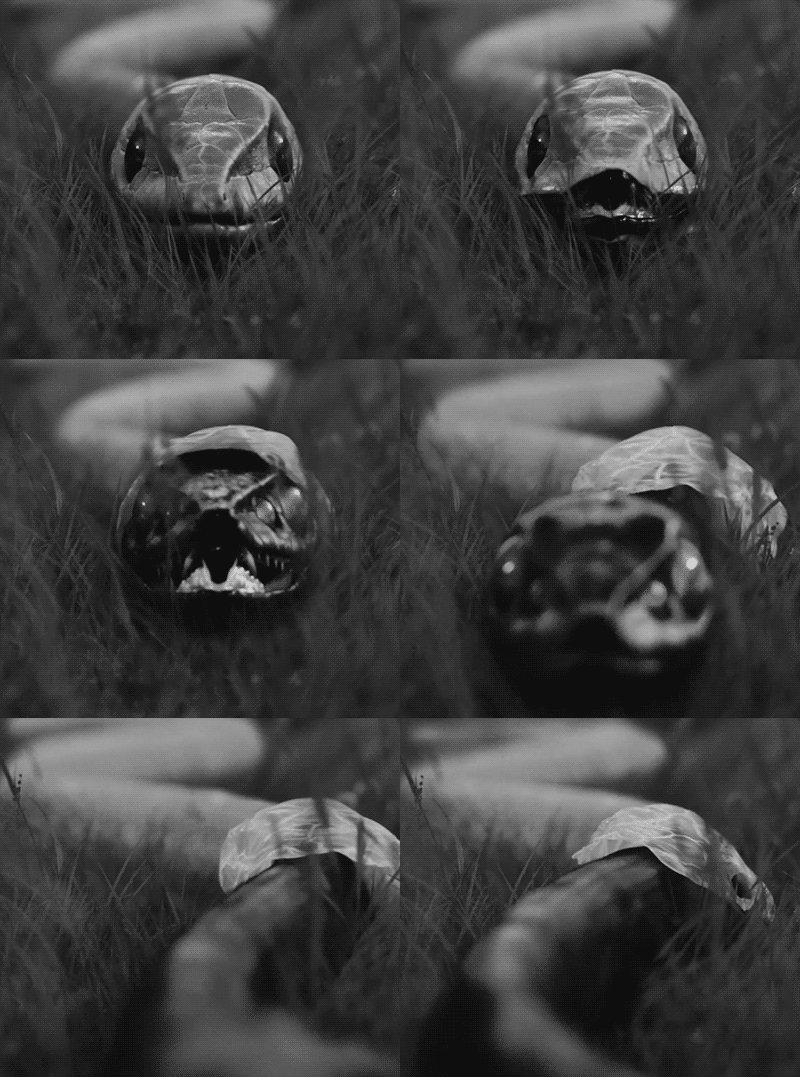
And Matthew found gif of a molting snake (which looks like it’s exiting a turtle shell) on Tumblr:

The raccoon cracks me up.
Nagini is back in business.
Ha! That was my first thought too! 🙂
Well, because evolution produced a raccoon with this behavior and that raccoon (and it’s descendants) outcompeted raccoons that *didn’t* wash their food. Or alternatively, evolution produced a raccoon with this behavior and because the behavior didn’t negatively impact its survival, it spread through the population.
Oh, you want why the behavior provided an advantage. I don’t know. Nobody’s quite sure about that. 🙂
It strikes me that since, in humans, washing ones’ hands is a good way to stop the spread of many diseases, maybe the survival advantage to washing food has nothing to do with the food, and everything to do with a behavior that results in the animal giving its paws a rinse several times a day.
I have not thought of it before, but maybe a mutation for OCD was fixed in an ancestor of all raccoons today.
You may have something there. Maybe applicable to cats with all the washing they do?
I thought “the laws of physics” were supposed to be sufficient explanation for any behavior.
Mwaw, poor raccoon! 🙁
Raccoons can detect the sweet flavor, right? Looks like he got a little nom before it disappeared, making it so sad 🙁
I know I felt bad for the poor racoon too. I wanted to say, “don’t worry chum” and give him a different candy that doesn’t dissolve in water so easily – maybe toffee because you get the added bonus of watching the racoon chew it.
Raccoons are known to eat a lot of freshwater mollusks and crayfish. Washing them is a good way to get the unpalatable sand out.
They eat worms too, re sand, I see.
But the behavior seems a lot more complicated than I got from Jerry’s description, according to a well referenced piece in Wikipedia:
“In the wild, raccoons often dabble for underwater food near the shore-line. They then often pick up the food item with their front paws to examine it and rub the item, sometimes to remove unwanted parts. This gives the appearance of the raccoon “washing” the food. The tactile sensitivity of raccoons’ paws is increased if this rubbing action is performed underwater, since the water softens the hard layer covering the paws.[128] However, the behavior observed in captive raccoons in which they carry their food to water to “wash” or douse it before eating has not been observed in the wild.[129]
Naturalist Georges-Louis Leclerc, Comte de Buffon, believed that raccoons do not have adequate saliva production to moisten food thereby necessitating dousing, but this hypothesis is now considered to be incorrect.[130] Captive raccoons douse their food more frequently when a watering hole with a layout similar to a stream is not farther away than 3 m (10 ft).[131] The widely accepted theory is that dousing in captive raccoons is a fixed action pattern from the dabbling behavior performed when foraging at shores for aquatic foods.[132] This is supported by the observation that aquatic foods are doused more frequently. Cleaning dirty food does not seem to be a reason for “washing”.[131] Experts have cast doubt on the veracity of observations of wild raccoons dousing food.[133]”
[ https://en.wikipedia.org/wiki/Raccoon ]
IANAR (I Am Not A Racoon), but two references that claims it is not wild behavior seems compelling. (Admittedly, they can derive from the same source, see the link.)
I can say that quite a few items like the racoon are posted on a relatively small # of web sites that I visit regularly. I saw the racoon one posted somewhere (don’t remember where), but I know that many things like this are posted on the CNN web site and the IFLS web site.
In fact, sadly, that sort of thing makes up a good % of what is on CNN.
That snake is a good one because it seems terrifying because for some reason my brain thinks it sees fangs for a moment. But then you realize it’s just a cute snake that is all smooth now!
The snake is a clip from Darren Aronofsky’s movie “Noah”
I’m not sure if anyone has mentioned this yet, but that snake gif is actually a special effect from the Aronofsky film ‘Noah’. It’s the serpent that tempted Adam and Eve. If you look closely you can clearly see its second face has a rather demonic looking second set of eyes.
I thought it looked unusually wicked.
Snakes as a rule don’t bother me, but that one was creepy.
Deceptive that snake, very deceptive. More to the point, it was the people telling that story about an imaginary snake that were deceptive.
And, anyway, that is not how a snake sheds its skin. That way is impossible, even to a non-herpetologist like myself – although I like snakes because of the beauty of their movement. It’s a slow process.