
by Matthew Cobb
A piece of Roman tile, dating back 2000 years, was dug up in the English city of Gloucester in 1969. It lay unremarked in the Gloucester City Museum until an archeologist noticed that when the clay was drying a cat walked across it, leaving its trace…
http://ichef.bbci.co.uk/news/660/cpsprodpb/1270C/production/_84523557_84523550.jpg
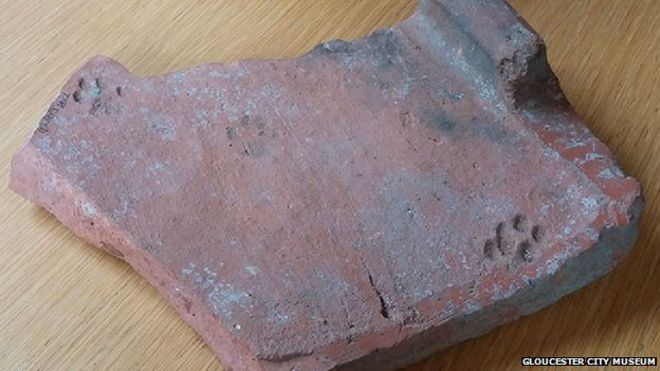
According to the BBC website:
The tile, a type called tegula, was used on the roof of a building in what became the Berkeley Street area of modern Gloucester, a spokesman said.
Councillor Lise Noakes, from Gloucester City Council, said it was a “fascinating discovery”.
“Dog paw prints, people’s boot prints and even a piglet’s trotter print have all been found on tiles from Roman Gloucester, but cat prints are very rare,” she said.
Cats are way too prissy to walk on wet clay🐯
My take is that they know to value their paw prints. \uuuu/ (Signed by Web Cat.)
Yet, some few must have a sense of history. This one might have been wondering if she would be remembered in the 21st century.
Maybe this one was nice and warm. You know, cat on a hot kaolin roof.
The brick could’ve been attractively warm but it also had to be just soft enough to make the tracks. As we all know, cats consider hard, edgy things as the most comfortable ground (and most of all, as resting places).
So, a Roman tile and a roamin’ cat, and anonymous as it was we are thinking of it around 1800 years later. Was it a stray? Was it a pet with an affectionate staff? Was it carrying a mouse or moving its kittens? Did it have a name?
I didn’t know that there were domesticated cats in England that long ago.
Given that the article says cat prints are rarer than other domesticate prints, I would guess most cats living with humans in such settlements were of the ‘mousers that live out in the barn/grain storage’ variety.
That makes sense. I’ll bet a good mousing cat was a prized commodity back then.
Still, I suspect if someone was willing to do the research…check diaries, and authors personal notes of the time…you might find record of a more intimate relationship with cats. There are many historians on this forum who might have relevant info.
I wonder if it was a Scottish Wildcat – Felis silvestris? During that era their range was much larger than what it is today.
I was thinking that too. Touch not the cat bot the glove.
Can you imagine the language as dear moggie trotted across the wet times? In Latin, of course …
Probably like what is in Asterix & Obelix
That is so cool! I love Asterix and Obelix.
Yeah I bought a couple of their collections. There is a site that translates and explains the Latin as well.
Here is another Roman cat’s pawprint brick:
http://www.theatlantic.com/technology/archive/2013/02/1-kitty-2-empires-2-000-years-world-history-told-through-a-brick/273320/
this one, amazingly, found in Washington State (!) and it also seems to be of British origin (via the Hudson Bay Company). Maybe there were more cats in Britain than elsewhere in the Roman empire. Or maybe the horrible damp climate led cats to seek out brickyards with their constant kilns running 🙂
The funniest internet comment I ever read was a picture of this brick and the statement:
“I’m crying because I just realized that this kitty is probably dead by now”
lololol, ‘probably’
Well, maybe she once refused to get up from Jesus’ lap, and was cursed to eternal wanderings.
sub
“The paw print shows that cats were exactly the same as they are today. No evolution in so many years. There you go, another fossil evidence that evolution is not true”. Said the ignorant.
Thanks, now I’m imagining some monstrous proto-cat with modern-shaped paws.
And the clever felid did not even have to blow colored water at its paw in front of a cave wall.
sub