
by Matthew Cobb
There are a few people out there who seem to doubt that many dinosaurs had feathers (I’m looking at you Steven Spielberg) and that birds are just one kind of feathered dinosaur that survived the end-Cretaceous mass extinction around 65 million years ago. To settle the question once and for all, here are some pictures.
Just look at this lovely wryneck, posted by @skokholmisland yesterday (Skokholm is an island off the south-west coast of Wales, less well-known than its neighbour, Skomer – I visited it on a field course when I was at school).
Doesn’t it look all reptilian?

And if you are still a doubter, here’s a fantastic illustration by paleoartist Mark Witton (you can buy copies of Mark Witton’s fantastic art here), of Therizinosaurus as a terrifying giant pigeon:

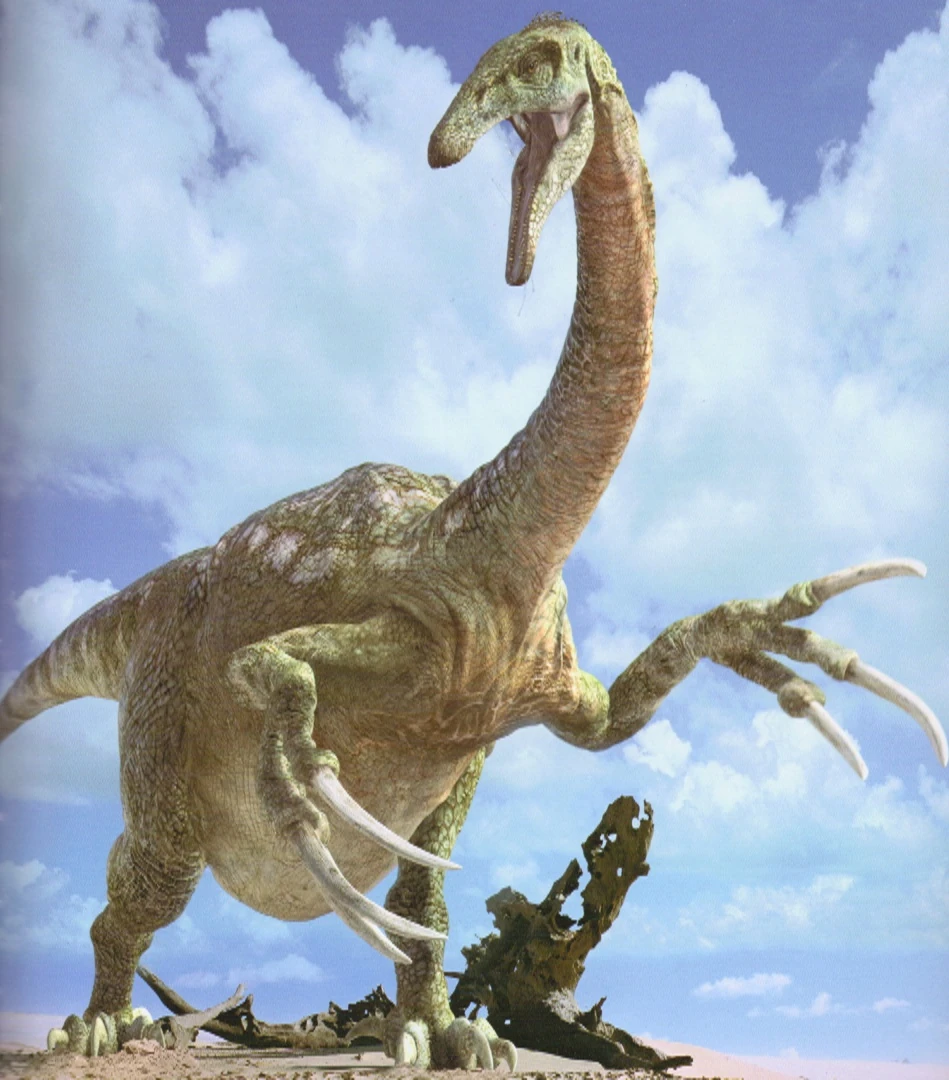
Here’s a typical illustration of Therizonosaurus, taken from Walking with Dinosaurs. Frankly, once you’ve seen the feathered version, this looks like something you’d find in the poultry aisle at the supermarket, plucked and trussed. There’s clearly something wrong.
The makers of the forthcoming Jurassic World have declined to put feathers on their CGI dinosaurs, apparently claiming that ‘feathers aren’t scary’. Really? If Mark’s Therizinosaurus reconstruction doesn’t scare you, I give you this baby bittern:

I envisage some filmmaker will come up with the idea of the pigeons at Trafalgar Square, due to some highly peculiar retromutation, regaining the size and outlook of their predecessors.
Wouldn’t they simply be cute with those feathers, trying to drown you in megatons of poo? Or biting off your arm.
Archaeopteryx!
Very much like the Paleo art of Luis Rey and Julius Csotonyi too. Rey does some really vivid pictures of feathered theropods.
Yes, both are great.
Rey:
https://luisvrey.files.wordpress.com/2014/06/deino-newb.jpg?w=640
(“The Deinocheirus Saga continues…”)
Csotonyi:
http://media4.s-nbcnews.com/j/MSNBC/Components/Photo/2012/October/121024/121025-ornithomimid-kb-1130a.grid-8×2.jpg
(“Dinosaurs looking love grew alluring feathers, scientists say”)
/@
Rey has a stunning one of a Deinonychus that almost looks like a turkey with added skin flaps etc! A very intimidating turkey though!
https://luisvrey.files.wordpress.com/2012/06/deino11.jpg
(From his WordPress site.)
/@
Even the crappy Dinosaur Island gets this right! (With a nice dig at JP!)
/@
PS. Here’s a lovely feathered T. rex by Mitch Byrd:
http://cdn.comicartfans.com/Images/Category_5892/subcat_101286/Byrd-Dino.jpg
/@
* Oops! 403 error!! Try this:
https://s-media-cache-ak0.pinimg.com/736x/df/d2/ea/dfd2eaa015a5cb027c3eafb596b800cd.jpg
A not so lovely one by Twitter user @nebu_kuro:
https://s-media-cache-ak0.pinimg.com/736x/c9/7c/1a/c97c1aef444927e865744681ec254804.jpg
/@
BUDGIESAURUS
More like a Bubosaurus, since owls’ bodies are so much smaller than they appear to be because of the thickness of their feathers.
/@
* Like this:
https://s-media-cache-ak0.pinimg.com/736x/38/98/15/389815df705445ff7abc520d70caa6b0.jpg
http://craphound.com/images/Va73u.jpg
I was completely unaware of this. I can’t decide whether that makes owls less weird, or more so.
Anent the baby bittern:
Fear the fuzzy! FEAR it!
The obvious question isn’t whether dinosaurs were feathered – now we’ve discovered that ornithischians as well as theropods had ’em, it’s not even a debate – but did they taste of chicken?
Possibly more like ostrich.
/@
I agree. I ate ostritch once. It was more like beef than chicken. Though chicken as we usually know it isn’t like chicken either, as I discovered when I was in Rarotonga (the chickens there are not merely free range but wild, and the locals catch them when they want a poultry dinner.)
Chicken hadn’t been invented yet.
http://www.slate.com/articles/life/food/2012/09/tasting_like_chicken_its_evolutionary_origins_.html
Why be so fuzzy? … oh, okay.
“The makers of the forthcoming Jurassic World have declined to put feathers on their CGI dinosaurs”.
I didn’t know that. But as I remember it, they have recently. Which is rather good faith attempt, seeing how the Jurassic Park started in the Juras… before it was known that birds are dinosaurs and that feathers are earlier.
O gimme a break. I and many others were writing about this back in the 70s.
Really! Had there been found feathers in fossils back then? Seems to me news reports made it sound as if recent feathered dinosaur finds were somehow groundbreaking – which should not be surprising, since the media consistently report established science that way.
On the run, but I remind you of the little theropod Archaeopteryx, discovered in the 19th century and originally dubbed a “bird” because the observers of the time could not imagine a non-avian entity with feathers.
Also, the well feathered and likely flight endowed Archeopteryx was a Jurassic species.
Strictly, the binomial Archaeopteryx lithographica was applied to a single feather found in the Solenhofen limestone in 1856 or ’57. A year and a bit later, the skeleton (with feather impressions) which was assigned to that existing taxon was dug up.
The possibility remains that there was another feathered dinosaur in the area at the time, and that it was the source of the A.lithographica feather. Which would open a storm in a teacup to dwarf the Apatosaurus/ Brontosaurus bun fight.
Not having seen any of the films end-to-end, let alone with a notepad and pencil, I have certainly heard charges that JP 1, 2 and (are we on 3 now, or 4?) all contain more Cretaceous dinosaurs than Jurassic ones. For an entertainment company, technical accuracy has never troubled them over much.
“In space, if no one can hear you scream, then they can’t hear your (non-existent) laser bolts or your exploding star ship either.”
Creighton always said that he chose the name because it sounded cool and rolled off the tongue easy rather than for paleontological accuracy (otherwise he could have just called it Mesozoic Park).
To be fair, JP was the name of the theme park in JP, so it was maybe a MC’s comment on the paleological sloppiness of the InGen people behind the park.
/@
I personally think that many dinos were not completely feathered since there are many skin impressions from various species, and these do not show feathers.
The examples I can think of are hadrosaurs and carnotaurs, and you could make the case that they were among the animals too big to need feathers for insulation, since sheer size alone could help conserve heat due to the low surface-area-to-volume ratio. So some large dinosaurs were definitely scaly.
On the other hand, the whole integument doesn’t have to be scaly. I’ve seen depictions of tyrannosaurs where only the arms and a few other small patches retain feathers, and Yutyrannus huali definitely had feathered parts.
/Carnotaurus/ was only half the size of /T. rex/, and /T. rex/ had feathers… but as you say, it needn’t have had feathers everywhere.
We came across this this weekend in Wales at Dan-yr -Ogof, the National Showcaves, which have a huge variety of life-sized dinosaur models of differing quality (including 1970s and 2010s /Iguanodon/ reconstructions side by side without any commentary). Anyway, in the museum they had a featherless animatronic /Carnotaurus/ and the plaque noted that we had impressions of its skin that had “knobs” (iirc) “instead of feathers” — but it seems like a stretch to say that just because we have some unfeathered skin samples that /Carnotaurus/ was totally featherless …
/@
PS. A feathered Carnotaurus sastrei:
http://fc04.deviantart.net/fs70/i/2012/263/5/3/carnotaurus_sastrei_by_xezansaur-d5fcctq.jpg
by Xezansaur on DeviantArt.
Speaking of dinosaurs, what’s this about Brontosaurs and Apatosaurs now considered to belong to different species?
http://www.scientificamerican.com/article/the-brontosaurus-is-back1/
YES! I was gladdened to hear of it.
Brontosaurus wins by a neck!
/@
The girl who took the bittern’s picture is more interesting to look at than the bittern itself.
http://featuredcreature.com/american-bittern-plumper-lunking-camouflaging-weirdo-bird/
Meh. She has no feathers.
It’s akin to the greek statues whereby they were painted in dayglow colors back in the day, something totally alien to us rubes until you see CG renderings of the art in question.
Feathers all the way down
I found out something about why the hornbill has its ‘horn’. From an entry in Tetrapod Zoology:
“One of the primary roles of the casque is as a social signaller. It only develops once the bird reaches sexual maturity, and is typically larger in males. In the Black-casqued hornbill Ceratogymna atrata the casque works as a resonating chamber (Alexander et al. 1994). Perhaps the most remarkable casque is the one possessed by the Helmeted hornbill. Composed of a solid block of bone, it accounts for about 11% of the bird’s weight [world-famous photo of sectioned R. vigil casque shown here by Matt Wedel]. Perhaps, by adding weight to the bill, it helps the bird use its bill as a hammer. More remarkable is the fact that Helmeted hornbills use their crests in aerial jousting: males engage in prolonged, noisy head-butting matches while in flight (Kinnaird et al. 2003).”
Remember too that a variety of pterosaurs had similar bony crests, possibly for similar reasons.
I have a correctly feathered Velociraptor mongoliensis that I got from here after coveting the one Julius Csotonyi’s wife gave him (he posted it on FB).
I love dinosaurs (and their modern versions), but they are so wacky looking sometimes.
There are really two main reasons for non-feathered dinos in Jurassic World: A) the previous movies didn’t do that and B) it’s more expensive and time-consuming to make feathered dinosaurs than dinosaurs with lizard skin.
(A) is not strictly true. The “velociraptors” acquired /some/ feathers in JPIII.
I guess the filmmakers could justify the lack of feathers by appealing to the “filler” frog DNA; maybe the “feather” genes were replaced or “switched off” in some way.
/@
Actually, they said exactly that some time after 3 was released.
Ah… I can’t honestly say whether or not I’d read that before…
/@
I think it was brought up the last time Jurassic World was being discussed here.
Yes, by me!
Also in a comment that mentions feather “velociraptors”!
/@
I guess Alfred Hitchcock didn’t get the memo.
Nor the people of world cultures who regard crows and ravens as birds of ill-omen.
Toucans look like goofy happy things until they start reaching into weaver nests and eating chicks whole. Try annoying a cassowary or swan and see what happens. There were birds on New Zealand that could eat people, and probably did. And let’s not get started on vultures and condors, which are as repellent to some African peoples as hyenas are.
Heck, even garden birds look scary from the viewpoint of their prey. Just watch Hopper’s death scene in A Bug’s Life: the bird in that is like a hyperactive T. rex that can fly.
Besides, wasn’t it one of the scary things about the Jurassic Park raptors that they weren’t sluggish ectotherms, but fully agile, screeching, warm-blooded, and active endotherms, like birds?
And aren’t birds, when you get down to it, a flurry of slashing claws, stabbing beaks, and pummelling wings that can come at you from anywhere and lunge at your face? In flocks?
I just assume such people who claim birds aren’t scary have no imagination.
Or have never tried eating a picnic on the beach on Lindisfarne while being mobbed by hungry gulls …
/@
+1
A lovely tale here from a former young earth creationist.
http://genesispanthesis.tripod.com/inspiration.html
He talks about seeing confirmation of the discovery of a feathered dinosaur in National Geographic.
“I simply stared at the page for a few moments, muttered “oh shit!” to myself a few times, and got up to check the N.G.News web site. This wasn’t just some artistic depiction of what a reptile/bird might look like – and it was no hoax. It was a small dromaeosaurid (“raptor”) with killing claws, razor-sharp teeth, and a pair of wing-like arms complete with plumage. My heart sank, and my gut churned”
He ends with these words to himself:
“Welcome to the real world.”
sub
What we need is a 21st century equivalent of what the old Jurassic Park represented, not this Jurassic World B-movie throwback.
What Jurassic Park did was hit the public imagination in the solar plexus and shouted in its ear “Here are the new dinosaurs, the best depictions of dinosaurs palaeontology knows, and you’re not going to forget it!”
After Jurassic Park, you got raptors and T. rexes and spitting frilled dilophosaurs, but more to the point you got a new cultural understanding of what a dinosaur was supposed to look like. Reptilian kangaroos gave way to Muggle-dragons that were awesome and varied.
Now nearly two decades on, and we’ve still got those dinosaurs, and palaeontology has moved on, and feathers are still an uncommon sight in popular culture’s imagined dinosaurs. Jurassic World is going to reignite interest in the old Jurassic Park model of dinosaurs, and maybe add a few names to the public lexicon, but it’s biggest contribution is basically going to be making up a completely fictional dino.
There needs to be a dinosaur movie that shows the most up-to-date feathered dinosaur ideas in all their avian glory, not just as a footnote to the traditional pop culture idea but front and centre, and loud and proud. We need another film that hits the public imagination in the solar plexus and shouts in its ear “Here are the new dinosaurs, the best depictions of dinosaurs palaeontology knows, and you’re not going to forget it!” We need feathered dinos to be the next thing for another couple of decades.
Just in:
http://cdn.zmescience.com/wp-content/uploads/2015/04/82209019_82209018.jpg
Tyrannosaur injuries reveal cannibalistic past
/@