
by Matthew Cobb
What are these?

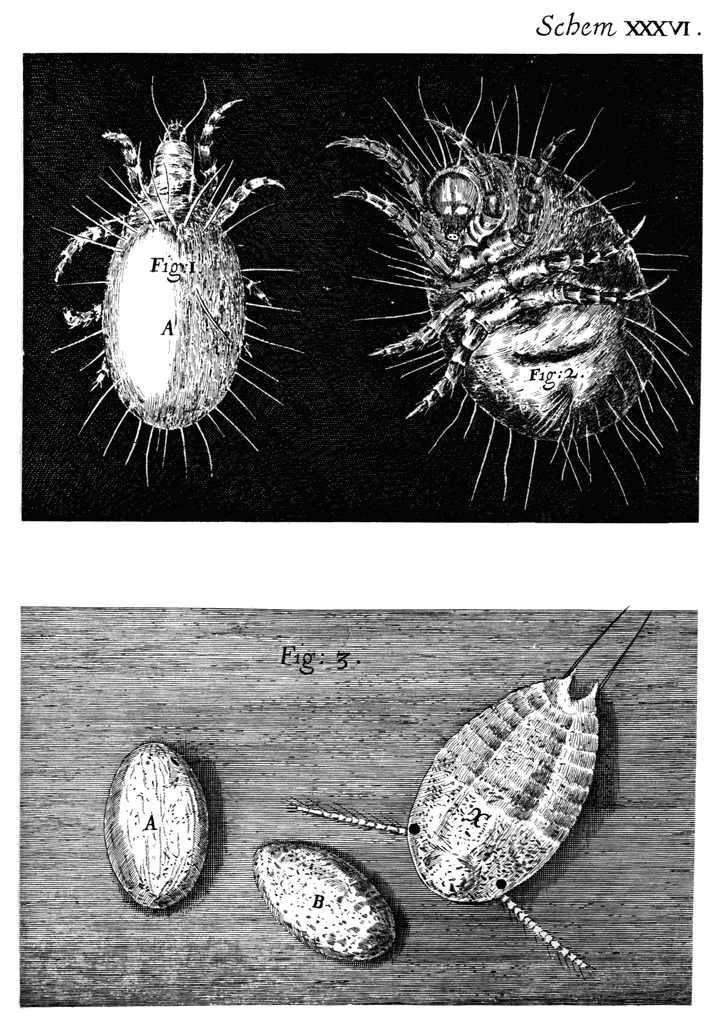
Masters student Daniel Llavaneras spotted these odd structures on the back of a 3cm-long beetle he had captured in the Andes and preserved in alcohol. His initial assumption – like mine when I saw the picture – is that they were some kind of fungus, a bit like Robert Hooke’s famous 17th century illustration from Micrographia:

But when he looked closer, he could see that on the underside of the round structre there were eight pairs of folded up legs (those are the squiggly looking things):

As Daniel describes on his neat blog, he did the sensible thing (are you reading this, Jerry?) and took to Twitter asking what they might be. The answer came back that they were deutonymphs of a Uropodina mite. (A deutonymph, as any fule kno, is a non-feeding stage of some kinds of mite, which will then go through a final molt and turn directly into the adult.) (To bring the story full circle, Hooke also drew a picture of a mite, but not a uropodine deutonymph).
So if these deutonymphs aren’t eating, what were they doing on the back of the beetle, and what’s the stalky thing?
Many small animals hitchhike on larger animals as a way of moving about from one food source to another. This process, which is called phoresis, may be relatively benign (using a butterfly to take you from one plant to another), or it may be more sinister (hitching a ride on the butterfly so you can then parasitise her eggs when she lays them). This is particularly common in mites, apparently, and especially in those species that live in temporary, unstable microniches or ‘merocenoses’ (such as decaying wood, dung patches or animal nests). The niche won’t last forever, so those animals that exploit such a niche need to find a way to get to the next patch. It’s too far to walk, so it’s easiest to hitch a ride.
The stalky thing is technically known as a pedicel and is effectively made of a kind of glue, which the mite secretes from near its anus; the glue sticks to the host, and the mite then walks forward, gradually lengthening the gluey link. When host and hitchhiker arrives at their destination (the next merocenose), the mite simply walks off, breaking the pedicel. This has recently been described by Jason Dunlop in Baltic amber that is about 45 million years old, so this is a very old and apparently successful adaptation for the mite (the article has been submitted to Naturwissenschaften).
Daria Bajerlein and co-workers from Adam Mickiewicz University in Poznan, Poland (which seems to be a centre of studies of the anatomy and ecology of these mites) have recently published a nice comparative study of the pedicel in four different species, and found that the pedicel differs in shape and size. Sometimes it’s a stalk, sometimes it’s a spiral. Bigger mites produce bigger pedicels (presumably because they are heavier). Barjerlein et al (2013) write:
The pedicel is a temporary structure that connects the phoretic deutonymph with its carrier. One terminus of the pedicel is attached to the deutonymph and the other to the body surface of the carrier. The pedicel is comprised of a substance produced by a gland that occurs in the rear part of the deutonymph body, close to the postcolon–anal atrium border (Bajerlein and Witaliński, 2012). Material for the pedicel is secreted outside of the anus as a fluid, but it hardens in contact with air.
Here’s some cool pictures from their paper showing the mite Uroobovella nova under a light microscope (A – the asterisk shows the cuticle of the hapless beetle host) and under a scanning electron microscope (one of the most amazing inventions in the history of science). (B) shows a mite with the squiggly pedicel and the attachment to the carrier’s cuticle. (C) shows some old pedicels, still attached to the cuticle of the carrier, and (D) shows a close-up of the connection to the carrier, in which you can see that the patterns in the cuticle have been repeated in the glue-like material of the pedicel.

Barjerlein et al speculate that the pedicel may have evolved as part of competition with other, more rapidly moving mites that hitch a ride on smoother parts of the beetle’s body:
Macrochelids and parasitids, which are relatively large and move very quickly in contrast to uropodines, attach themselves to setae using chelicerae or claws. After finding a carrier they climb onto it quickly and occupy preferred body parts of the carrier which become unavailable for slow-moving Uropodina. Possibly, competition for attachment site combined with the unpredictable roughness of the surface of the carrier were the main factors determining the evolution of the pedicel. Deutonymphs of uropodines were forced to infest setae-uncoated body parts of the carriers that were not yet occupied by other mites. For example, as elytra of most aphodiid, histerid and hydrophilid beetles are not covered by setae or other protrusions, formation of the pedicel has become an evolutionary necessity enabling phoretic dispersal. Pedicel production is probably costly, but permits deutonymphs to use other animals for transportation which may be vital for slowly moving mites living in unstable and patchily distributed microhabitats.
This hypothesis may also help explain another feature of Uropodina phoresy: phoretic deutonymphs preferably use beetles for dispersal and are not found on flies that also breed in habitats such as dung or carrion. Flies move faster in comparison to beetles making them difficult for uropodines to infest and are moreover heavily covered with bristles, impeding attachment of the pedicel.
Finally, Daniel notes in his blog that many mites show highly specific host preferences (perhaps a consequence of their host inhabiting a very particular merocenose). Another paper by Bloszyk et al (2006) – from the same univerisity in Poznan – reports:
A survey of soil fauna in Poland revealed 30 cases of centipedes carrying mites of the sub-order Uropodina. The 155 phoretic deutonymphs collected belonged to two species of Uropodina – Oodinychus ovalis (C.L. Koch, 1839) and Uroobovellapulchella (Berlese, 1904). These mites displayed a high degree of selectivity in their choice of carrier. The only species of centipede transporting mites was Lithobius forficatus (Linnaeus, 1758), despite the presence of 30 other species in the same habitats. It is possible that the large size and relatively fast speed of movement of this centipede make it a very good mite carrier. The majority of the mites were located on the sides of the centipedes, on segments near the anterior end. The high selectivity in the choice of carrier as well as the point of attachment suggests adaptation by the mites for phoresy by L. forficatus.
Here’s a picture from Bloszyk et al (2006) showing Oodinychus ovalis deutonymphs transported by the centipede Lithobius forficatus:

Bajerlein et al suggest that pedicels in different species have different internal structures and made be made out of slightly different stuff. It would be interesting to know whether there has been any divergence in the material used to make these structures over the 40 million years or so.
h/t @dllavaneras @CMBuddle
References:
This is fascinating. To my non-biologist eye the first photo looked like a row of ticks, albeit ticks with re-fueling lines 🙂
I thought they looked like brachiopods, which didn’t seem very likely, even if this was an aquatic insect. I don’t think they come this small either.
Pardon the nitpick, but something seemed wrong about “merocenose” so I looked it up. Sure enough, “merocenosis” seems to be preferred by at least one source, which defines it as a colony of organisms inhabiting a merotope (microhabitat).
I’m sure you’re right Gregory. I had never come across the term before and was trying to singularise it and failed (lack of Greek or whatever). Interestingly, it isn’t in the OED, in any of its versions. Anyone with Greek able to hazard a guess at the etymology?
I love it when biologists talk dirty.
I cannot wait until I get a chance to mention anal pedicels of phoretic uropodines in casual conversation.
Do you get invited to many dinner parties?
:p
only extremely filthy ones, oddly enough.
Well, hit me with a living glue stick – I didn’t see that coming!
Big fleas have little fleas,
Upon their backs to bite ’em,
And little fleas have lesser fleas,
and so, ad infinitum.
…or so ‘twould seem….
b&
Blind snakes that I study (burrowers with a conical tail tip) sometimes have uropodine mites attached near the tail tips.
Matthew Cobb has a way with words, getting us hooked (weakly) with strange words, and then give us (relatively painlessly) the definitions along the way. Though still dense at the end.
Here comes another science popularizer .. a rare bird ..
Fascinating!
When I learn about such unusual and specific adaptations, I often wonder how IDers would react to such information… after all, this behavior must have been programmed by God himself, who was evidently concerned about how these mites would get from one place to another: “Hmm, how about if I have them secrete a sticky substance from near their anus? Then they can use that secretion to attach themselves to another critter? Gee, that oughta do it!”
Thanks also for what I assume was a Doors reference in the title…
LS
sub
Reblogged this on Mark Solock Blog.