Signature in the Cell: Meyer responds in the TLS

January 13, 2010 • 1:26 pm

by Matthew Cobb

The letters page of the Times Literary  Supplement continues the debate over Signature in the Cell, with letters from author Stephen Meyer, defending his thesis, and from Thomas Nagel, who originally reviewed the book (more or less favourably). I’ll leave you to draw your own conclusions. I would simply point out that Meyer’s use of the fact that scientists have been unable to fabricate RNA replicators “capable of copying more than about 10 per cent of their nucleotide base sequences” as some kind of argument against pre-biotic evolution (and therefore in favour of supernatural intervention in the evolution of life) misses out the key point that explains so much of evolution: time. If 10% efficiency is all we’ve managed in a few years in the lab, I reckon that’s pretty damn good, and indicates what could easily happen in the tens of millions of years that evolution has to play with.

Sir, – I’ve been honoured by the recent attention my book Signature in the Cell has received on your Letters page following Thomas Nagel’s selection of it as one of his Books of the Year for 2009 (November 27). Unfortunately, the letters from Stephen Fletcher criticizing Professor Nagel for his choice give no evidence of Dr Fletcher having read the book, or of his comprehending the severity of the central problem facing theories of the origin of life that invoke undirected chemical evolution. In Signature in the Cell, I show that, in the era of modern molecular genetics, explaining the origin of life requires – first and foremost – explaining the origin of the information or digital code present in DNA and RNA. In his letters to the TLS (December 2 and 16, 2009), Stephen Fletcher rebukes Nagel (and by implication my book) for failing to acknowledge that “natural selection is a chemical as well as a biological process”. Fletcher further asserts that this process accounts for the origin of DNA and the genetic information it contains. Not only does my book address this very proposal at length, but it also demonstrates why theories of prebiotic natural selection involving self-replicating RNA catalysts – the version of the idea that Fletcher affirms – fail to account for the origin of the genetic information necessary to produce the first selfreplicating organism.

“Ribozyme engineering” experiments have failed to produce RNA replicators capable of copying more than about 10 per cent of their nucleotide base sequences. (Wendy K. Johnston et al, “RNA-Catalyzed RNA Polymerization”, Science 292 (2001): 1319–25.) Yet, for natural selection to operate in an RNA World (in the strictly chemical rather than biological environment that Fletcher envisions), RNA molecules capable of fully replicating themselves must exist. Everything we know about RNA catalysts, including those with partial selfcopying capacity, shows that the function of these molecules depends on the precise arrangement of their information-carrying constituents (ie, their nucleotide bases). Functional RNA catalysts arise only once RNA bases are specifically arranged into information-rich sequences – that is, function arises after, not before, the information problem has been solved. For this reason, invoking prebiotic natural selection in an RNA World does not solve the problem of the origin of genetic information; it merely presupposes a solution in the form of a hypothetical, information-rich RNA molecule capable of copying itself. As the Nobel laureate Christian de Duve has noted, postulations of prebiotic natural selection typically fail because they “need information which implies they have to presuppose what is to be explained in the first place”.

STEPHEN C. MEYER

Discovery Institute, 208 Columbia Street, Seattle, Washington 98104.

Sir, – Stephen Fletcher is surprised that I would recommend a book (Stephen Meyer’s Signature in the Cell) whose conclusions I disagree with. I’m afraid I do that frequently; but let me explain this case. I believe that neither theism, nor atheism, nor agnosticism is clearly ruled out either by empirical evidence or by a priori argument: all are rationally possible positions. If one is a theist, the question arises, what belief about God’s relation to the natural order is compatible with the scientific evidence? Deism, the view that God is responsible for the existence of the universe and its laws, but that He never intervenes, is one possible answer. Defenders of intelligent design claim that the appearance of life as a result only of chemical processes would require accidents so improbable that an interventionist answer is more likely. I am interested particularly in the negative part of this argument – scepticism about the reducibility of biology to chemistry. Though I do not share the motives of intelligent design’s defenders to identify problems with the reductive programme, the problems seem real. Atheists, too, face the question of what conception of the natural order is compatible with their beliefs.

Fletcher says I have been duped, and his reference to Uri Geller suggests that Meyer’s book is a deliberate hoax – that he has offered evidence and arguments that he knows to be false. Like any layman who reads books on science for the general reader, I have to take the presentation of the data largely on trust, and try to evaluate more speculative arguments as best I can. Meyer’s book seems to me to be written in good faith. If he misrepresents contemporary research on the origin of life, I will be grateful to have it pointed out to me. But the RNA world hypothesis Fletcher offers as a refutation is carefully described by Meyer, who argues that while it might help solve some problems (in virtue of the catalytic properties of RNA), it simply pushes back to a different molecule the basic question of how such an extremely complex replicator came into existence, thus allowing natural selection to begin.

Fletcher’s remarks don’t address this problem. He should really hold his nose and have a look at the book. It also should be properly reviewed, since it can’t be adequately assessed in the Letters column. I recommended it in one paragraph, speaking as a grateful reader, but the book deserves a review from someone with the relevant scientific credentials.

THOMAS NAGEL
29 Washington Square, New York 10011.

Odd pollinators

January 12, 2010 • 6:33 am

by Matthew Cobb

Insects and plants are intimately linked in terms of their ecology and evolution. Insects and vascular plants both first appear in the fossil record around 400 MY ago, at the beginning of the Devonian, as terrestrial ecology changed to allow the colonization of the land.

Then about 20 MY later, the first arboreal plants appear, and insects developed wings (probably from ancestral gills – the same genes are now involved in the development of arthropod gills and insect wings). However, things really went crazy in the middle of the Carboniferous, when seed plants first appeared, and the insects underwent a massive diversification, or “radiation” as paleontologists call it.

In this period, all of the major insect groups appeared, with only one (the Palaeodictyopterida – they looked a bit like dragonflies) disappearing between then and now. Insects even breezed through the end-Permian mass extinctions around 248 MY ago, when around 95% of marine species disappeared, profiting from the changed ecosystem to undergo a further wave of radiation.

By the time the flowering plants (“angiosperms”) appeared around 100 MY ago (flowers are a relatively recent invention), the insects were established as one of the dominant features of the terrestrial ecosystem, and quickly took advantage of the new plant arrivals. Although insects (and their larvae) munch through plants, the relation can also be mutually beneficial, especially with regard to pollination. Flowering plants generally provide a sucrose reward (nectar) for insect visitors, which in turn inadvertently carry off pollen to other plants of the same species, spreading the genes about. This mutually beneficial relation is shown by the parallel radiation of angiosperms and lepidopterans (butterflies and moths).

Darwin famously predicted that the comet orchid, which has an amazingly long “nectar spur” (the structure holding the nectar – it can be over 30cm long), must be pollinated by an insect with an equally long proboscis. He was right – it turned out to be the nocturnal hawk moth, with a 35cm long proboscis.

But what happened before there were flowers? Did insects simply eat the gymnosperms and ginkos that covered the Earth, or were they still involved in pollination – and how? Were all plants simply wind-pollinated?

Two recent discoveries give some insight into this. First, back in November, a stunning set of fossils was described in Science, showing in exquisite detail the mouthparts of some Mecopterans – scorpion flies. Nowadays they are a pretty insignificant bunch of around 600 species (and, of course, they are not flies…) [see comment #3 below!].

Source: Science

The fossils (and contemporaneous amber specimens) showed long, flexible probosces, and sucky ends that the insects could have used to suck up nectar-like substances produced by gynmosperms. The authors, led by Dong Ren of Capital Normal University, Beijing, conclude:

The presence of scorpionfly taxa suggests that siphonate proboscides fed on gymnosperm pollination drops and likely engaged in pollination mutualisms with gymnosperms during the mid-Mesozoic, long before the similar and independent coevolution of nectar-feeding flies, moths, and beetles on angiosperms.

Now another insight into unusual pollinators has come from Reunion Island, down in the south Indian Ocean, next to Mauritius (despite its distance from Europe, Reunion is part of France). Writing in the Annals of Botany, Claire Micheneau describes how she set out to find out how an unusual orchid,Angraecum cadetii (related to Darwin’s star orchid), was pollinated. [See also this BBC page.] They discovered that the animal responsible was an unusual – and unnamed – cricket with unusually long antennae:

These crickets, which are nocturnal foragers, reached flowers by climbing up leaves of the orchid or jumping across from neighbouring plants and probed the most ‘fresh-looking’ flowers on each plant.

They even provide a video, which should be visible below (although perhaps not to readers outside the UK; try here if not):[vodpod id=ExternalVideo.914857&w=425&h=350&fv=embedReferer%3D%26embedPageUrl%3Dhttp%253A%252F%252Fnews.bbc.co.uk%252F1%252Fhi%252Fsci%252Ftech%252F8391540.stm%26config_settings_language%3Ddefault%26config%3Dhttp%253A%252F%252Fnews.bbc.co.uk%252Fplayer%252Femp%252Fconfig%252Fdefault.xml%253F2.18.13034_14207_20091118114410%26domId%3Demp_8392952%26playlist%3Dhttp%253A%252F%252Fnews.bbc.co.uk%252Fmedia%252Femp%252F8390000%252F8392900%252F8392952.xml%26holding%3Dhttp%253A%252F%252Fnewsimg.bbc.co.uk%252Fmedia%252Fimages%252F46844000%252Fjpg%252F_46844152_cricket_512.jpg%26config_settings_autoPlay%3Dfalse%26config_settings_showPopoutButton%3Dfalse%26autoPlay%3Dfalse%26config_plugin_fmtjLiveStats_pageType%3Deav2%26config_plugin_fmtjLiveStats_edition%3DDomestic%26fmtjDocURI%3D%252F1%252Fhi%252Fsci%252Ftech%252F8391540.stm%26config_settings_showUpdatedInFooter%3Dtrue]

This is the first time that a cricket has been described as a pollinator, but it gives some indication of the variety of ways that pollination could have taken place even before flowers.  Orthopterans (crickets and grasshoppers) appeared at the same time as the gymnosperms; although people generally assumed the insects would have eaten the plants, the example of the scorpion flies suggests they might also have played a role in pollination.

[First posted at z-letter.com]

In the Galápagos

January 11, 2010 • 2:30 pm

Internet time here is very limited, and there’s no opportunity to post photos, of which I have many, but let me just say that, after 2.5 days, the islands have met and exceeded every expectation that a jaded old evolutionist would have.  There are a gazillion things to see and do, much enhanced by the obliging employees at Lindblad, and the experience is limned by the extraordinarily tame animals.  Though I haven’t knocked a hawk off of a tree with the barrel of my shotgun, as Darwin did, I’ve almost stepped on both sea lions and iguanas.  The experience would be much poorer, I think, if it were not filtered for many of us through the lens of Darwin.

“In Praise of Darwin”

January 11, 2010 • 12:05 am

by Greg Mayer

Jerry previously commented on Steven Shapin’s summary in the London Review of Books of the 2009 Darwin commemorations, finding Shapin’s piece “long and pretty lame“, and especially criticizing his swipe at adaptation. New York Times blogger Ross Douthat, however, finds Shapin’s piece “wonderful“, and evidently sympathizes with Shapin’s unease over Darwin and evolutionary biology:

But Shapin’s essay is more than just an attempt to explain last year’s Darwin-mania. It’s a clear-eyed and wide-ranging tour of what “Darwinism” means today — at once an unchallenged scientific paradigm and a wildly contentious theory of everything; a Church militant warring against creationists and fundamentalists and a debating society of squabbling professors; a touchstone for the literary intelligentsia and a source of secularist kitsch.

Fellow conservative blogger Andrew Sullivan is disappointed by Douthat’s “sneering tone” and “smears”, and praises Darwin as

one of the most revolutionary and influential thinkers of the past two hundred years

Commenter Ajay at the Times replies a bit more concretely, and poses an apt question for Douthat:

If by “an unchallenged scientific paradigm” you mean that Darwinism has been widely challenged historically, continually falsified and continually triumphant – then yes, you’re absolutely right. What planet do you live on?

[It’s clear that Ajay meant “tested”, rather than “falsified”.]

If you want to know what sort of Darwin commemorations were held around the world during the past year, sans Shapin’s commentary, the most extensive list, which includes talks, symposia, books, articles, exhibitions, films, etc., is that compiled by John van Wyhe of Christ’s College, Cambridge, and posted at the marvelous Darwin Online, which I’ve had occasion to note before. Some Darwin commemorations, included in the list, are continuing into 2010. John also includes a summary of some of the 1909 centennial events and publications.

Man overboard!

January 10, 2010 • 4:34 am

By Matthew Cobb

Over at the Times Literary Supplement this week, Richard Fortey wearily reviews Andrew Parker’s The Genesis Enigma: Why the Bible is scientifically accurate. Fortey is a trilobite paleontologist who has written some great popular science books. Professor Parker has previously written a couple of popular science books, revolving around the evolutionary importance of vision. In The Blink of an Eye (2003) was a rather overstated and speculative account of the role of vision in the Cambrian Explosion (which I have nevertheless referred to in my teaching), while Seven Deadly Colours (2005) provided a fascinating look at the role of colour in evolution. In 2000 Parker was named as a ‘Scientist for the New Century’ by The Royal Institution. He is now at Green-Templeton College at Oxford (no relation to the Templeton Foundation).

Since then, Parker has got religion. He apparently had a revelation in the Sistine Chapel, and realized that our (or rather, his) scientific understanding of evolution “corresponds precisely with the creation account in Genesis”. Never fear, however – Parker hasn’t gone completely loopy and turned into a New Earth Creationist. As he states: “Needless to say, the ‘seven day’ creation story, where the universe and life were supposedly created in seven actual days, along with other irrational ideas will not be entertained in The Genesis Enigma, with its logical and commonsense rationale.” That’s alright then.

The “logical and commonsense rationale” of The Genesis Enigma consists of looking at Genesis and matching it up with our understanding of evolution. As Fortey points out in his generally excellent review*, this is often just bizarre. For example: “Let there be lights in the firmament of the heaven to divide the day from the night, and let them be for signs and for seasons, and for days and years” (Genesis 1: 14) is taken by Parker to refer to the appearance of vision in animals, rather than the appearance of the sun and the stars…

Parker sums up his view thus: “In fact the order and sequences of events in the entire Genesis creation account is astonishingly accurate. (…) The parallel uncovered is even more extraordinary given that there’s no way the accuracy of the Genesis creation story could be the result of a lucky guess. It appears that the author of the creation account had predicted precisely the true history of the earth and life. The Genesis Enigma will explain that no human could have constructed a creation story in this way, particularly in Biblical times.”

Leaving aside the patently absurd idea that the old folk texts we now call “Genesis” had a single author, this raises two alternatives. Either Parker thinks omnipotent God whispered in the ear of “the author”, or it was written by a space alien. I hope Professor Parker will not consider me rude if I say I really can’t be bothered to find out which of these barmy alternatives (or any others his fevered imagination may have conjured up) he finally plumps for. As Leon Trotsky once said: “Man overboard. Sail on.”

[* My only quibble is when Fortey writes: “The best that can be said of The Genesis Enigma is that it has its heart in the right place, seeking out some middle ground between science and religion.” As Parker inadvertently shows, that mythical middle ground is always situated in the territory of the believers.]

A scientific Caturday felid: how it got its coat

January 9, 2010 • 8:20 am

by Matthew Cobb

We have discussed the evolution of mammalian coat colour several times on this blog, including here, here and here. It still remains a mystery, mainly because although we know a lot about the patterns involved, and can guess about some of their adaptive advantages, their genetic bases are largely unknown. Using a mixture of classic pedigree studies and molecular genetics, a new paper in Genetics (abstract only unless you have a subscription) has examined the genetic bases of stripes and spots in the domestic cat.

Source: Genetics.

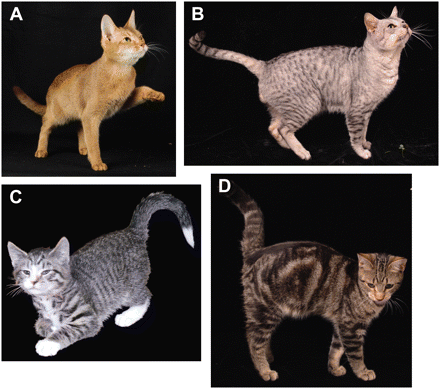
Previous attempts to unravel the genetics of coat colour in domestic cats had come up with the following hypothesis, based on tracking coat patterns down the generations. The character(s) producing the classic tabby (like my cat Pepper) – D in the figure above – is/are recessive to all other forms (the is/are ambiguity is because we have (or had) no idea about the number of genes involved). The dominant form is the unmarked (Abyssinian) form (A), which is dominant over the spotted coat (B), which in turn is dominant over the striped coat (like my cat Ollie – C).

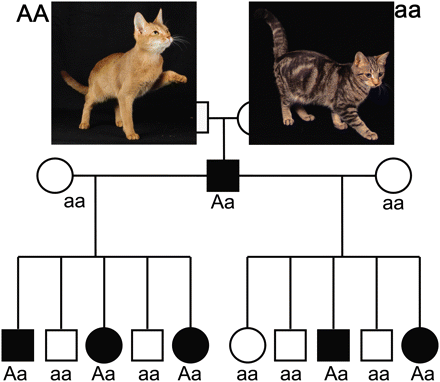
To see how many genes are actually involved in determining cat coat patterns,  the researchers, led by Eduardo Eizirik, now at the Pontifíca Uniservidade Católica de Rio Grande do Sul (Porto Alegre, Brazil), set up a series of mating crosses. The figure below shows the way they studied the basis of the spotted and “ticked” (Abyssinian) variants. They crossed homozygous individuals (aa or AA, respectively), then “backcrossed” their heterozygous offspring (Aa – called the F1 generation), to each of the parental types (only aa in this example) and tried to make sense of what happened in the third generation (or backcross – this is the bottom line on the figure). This is essentially the same procedure used by Gregor Mendel with his peas, over 150 years ago, which led to the foundation of genetics.

Source: Genetics

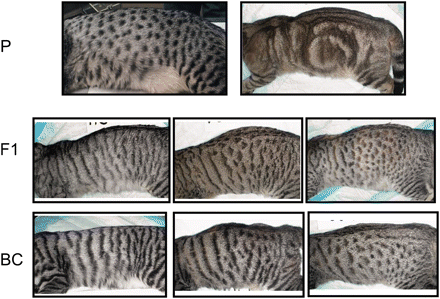
The figure below shows what happened when they tried to work out what genes are controlling the “spotted” coat variant, by crossing it to the tabby version (top line). The offspring (F1) showed a range from stripes to spots to tabby blotches (not shown). The backcross animals sometimes showed complete stripes, including the “mackerel” variant (bottom left).

Source: Genetics

They then used “microsatellite” genetic markers – small sequences of DNA that can be used to track and identify regions of the genome that may be responsible for the character under study. They were able to identify at least three different genes responsible for coat patterns – Tabby, which has two alleles or versions (one producing the mackerel pattern, the other the blotched); Ticked, which has an Abyssinian and a non-Absyssinian version, and one or more genes that alter the mackerel stripes and may also produce the blotched pattern. Furthermore, Ticked can alter the wayTabby is expressed.

In other words, it’s complicated. Which is hardly surprising, in a way – if it was straightforward, cat breeders would have figured it out long ago. What this study has shown is that there are genes involved in coding colour and pattern, that they are not necessarily the same, and that they affect the way each others’ expression. Exactly how this happens – or indeed, what these genes actually do – is unknown. They have yet to be identified at the molecular level.

Intriguingly, some of these genes may have equivalents in other animals, and may help in precisely identifying the genes involved in cat coat colour. For example, a human gene that may be similar to Tabby may be involved in the rare Hermansky-Pudlak syndrome type 2, where patients have reduced skin pigmentation.

Once the genes involved in determining coat colour and pattern in cats have been identified, we will be able to have a stab at understanding how they do what they do what they do. It will also give us the opportunity to study these genes in the 37 felid species that are still roaming the planet. In turn, that may help us understand apparently simpler patterns, such as those seen in tapirs, raccoons and badgers.

Of course, just because different species have similar patterns, that doesn’t mean that they will necessarily use the same genes to produce them. Natural selection “cares” about the phenotype, not the genes that underlie that phenotype. There is more than one way to skin a cat.

[First posted over at the Z-letter.]