Where did bedbugs come from?

February 10, 2015 • 9:00 am

Human bedbugs, Cimex lectularius, are “true bugs,” that is, insects in the order Hemiptera. They are an infernal pest, sucking the blood out of people and leaving a nasty, itchy rash. (I was bitten only once, but it was in a fleabag hotel in Peru, and there were many bites all over me, with the rash persisting for about three weeks.) Fortunately, bedbugs aren’t known to carry any diseases.

Still, they’re annoying, as you’ll know if you’ve followed the news over the past couple of years. Having been nearly eradicated by 1940 following applications of DDT, bedbugs started making a comeback when we declared a DDT moratorium, and the bugs are now common in American cities and a devil to eliminate.

Here’s a human bedbug sucking blood from the arm of a volunteer (photo from Wikipedia)

1024px-Bed_bug,_Cimex_lectularius

But where did bedbugs come from? Well, it’s long been known that their closest relative seems to be the bat bug, a similar insect that lives on bats, sucking their blood in the caves. The batbug also happens to be classified as the same species as the human bedbug, Cimex lectularius. The morphological differences between the two forms are trivial, but you can still tell them apart with a microscope. Below is a diagram and some text from Bad Bed Bugs highlighting the diagnostic differences:

The trick to identifying a bat bug is by looking at the length of hairs on the upper covering of the thorax. The picture above is the joining of one half bat bug (left side) and one half bed bug (right side). You’ll notice that the length of the bat bugs hairs is longer than the width of its eye. The bed bug however, has hairs that are smaller than the width of its eye.

batbug

There are other differences, too: as Carl Zimmer notes in a new piece in the New York Times, the human variety has longer and thinner legs than the bat variety, perhaps because the bat variety needs a firm grip on their cave-hanging hosts.

There also appear to be physiological differences. As a new paper in Molecular Ecology by Warren Booth and colleagues (reference and free link below) notes, each type does better  in terms of longevity and reproduction when it feeds on its own host. A batbug forced to ingest human blood does okay, but not as well as on a bat, and vice versa. Finally, the daily rhythm (“diurnal cycle”) differs between the two forms: batbugs feed during the day, when bats are asleep in their caves, while human bedbugs feed at night, when humans are asleep in their beds.

One problem with these data, which are used by both Zimmer and Booth et al. to imply genetic differentiation, is that we don’t know whether these differences are evolved genetic differences between the forms, or are only developmental/physiological responses to feeding on different species. It’s possible that if you transferred a batbug to humans, it will develop longer legs, change its feeding cycle, and get physiologically acclimated to human blood in a generation or so, and that this is not due to evolutionary (genetic) change, but could be a purely developmental  (“plastic”) response.

That’s not a far-fetched interpretation. Human head and body lice, which are not different species, also transform their physiology and morphology as a result of acclimation and not genetics, and even Anolis lizards change the shape of their legs if they’re forced to climb on thin branches rather than clamber on tree trunks or the ground.  The only way to determine if the morphological differences between bedbugs and batbugs are due to genetic/evolutionary change is to rear them over several generations on a common diet, and see if the differences persist. If they do, they’re genetic.

The reason Zimmer and Booth et al. dwell on this is because bats have been suggested to be the vector that gave us human bedbugs. Bats, so the theory goes, were originally afflicted with batbugs, and early humans lived in caves alongside the infested bats. Batbugs then found a juicy new source of food nearby, a few individuals colonized humans, and the rest is history: the human bedbug.

Booth et al. wanted to see how much genetic differentiation there really is between human bedbugs and batbugs, and so their paper reports an extensive genetic analysis of several hundred of individuals from both forms of the bug. The researchers looked at mitochondrial DNA, nuclear DNA (in the form of microsatellites), and at genes that had evolved in human bedbugs to resist DDT.

What they found was that batbugs and human bedbugs do indeed show significant genetic differentiation—in all three types of genes investigated. Bedbugs and batbugs clearly form two distinct genetic lineages. This is shown by statistical analysis of bugs taken from the two hosts; the figure below shows the genetic differentiation for nuclear DNA among samples of both forms taken in Europe. Brown dots are individual human bedbugs, blue are batbugs, and you can see how well separated they are (see the caption below the figure).

Bedbug
(Caption from paper, Fig. 4) Results of Factorial Correspondence Analysis showing genetic differentiation based on microsatellite allele frequencies for individual C. lectularius collections sampled across Europe. Samples clustered by host: brown (dark) squares represent human-associated samples, blue (light) squares represent bat-associated bed bugs.

There is, however, still some evidence of gene flow between the two forms, perhaps occurring when a batbug finds itself on a human and mates with bedbugs, or vice versa. Although most human bedbugs show the DDT-resistant form of “pesticide genes”, a few don’t, and those “susceptible” genes may have come from the batbugs, which never experienced DDT. Still, what we have here are two closely-related but genetically distinct lineages, and that is the big lesson from the paper of Booth et al. But they want to say more, and that is what Carl Zimmer highlighted in his NYT piece (see question #2 below).

Two questions remain:

1. Were batbugs the ancestors of the human bedbug? It seems likely, although neither Zimmer nor Booth et al. explicitly give the information that is be crucial for ansering this question: Are the batbug and bedbug more genetically similar to each other than either is to any other species in the genus? If the batbug is the ancestor of the bedbug, then the two forms have to be “sister taxa,” that is, each other’s closest relatives. Now this may indeed be the case, and may be cited in one of Booth et al.’s references, but I didn’t look them all up. I’ll take it for granted that both Zimmer and Booth et al. know that these are in fact sister taxa.

But one problem remains: do they only look like sister taxa because there has been gene flow between batbugs and human bedbugs, making them look as if they evolved recently when in fact they didn’t? This is a problem with trying to suss out the evolutionary history for any pair of species that live in the same place and occasionally hybridize. Fortunately, it can be taken care of. For example, if bedbugs and batbugs had distinct forms of genes (as they do), but those forms are still more similar to each other than to the gene forms of other species or populations in the genus, then that would imply that they are indeed sister taxa. Neither the authors nor Zimmer discuss this, but it may be such a well-known result that neither thought it necessary to mention it explicitly.

Also, the human bedbug is genetically depauperate compared to the batbug, and that’s what one would expect if only a few individual batbugs originally colonized humans, going through what we call a “population bottleneck.” The genetically depauperate nature of the human bedbug compared to the batbug also implies that if there was a colonization from bats to humans, it happened only once or a very, very few times. If colonization was frequent, human bedbugs would be much more genetically variable among populations than we see. If the bat transfer theory is correct, the colonization of humans by batbugs must have occurred in the distant past when humans lived in caves along with bats, and that would probably be about 50,000 years ago in Eurasia. (No molecular dating of the divergence was reported.)

But what the authors and Zimmer find most exciting about the study is encapsulated in the second question:

2. Are these forms on the road to becoming different species? Are we seeing, in the form of batbugs and human bedbugs, two groups that descended from a common ancestor (on bats), and are now in the process of becoming different biological species? Indeed, Zimmer calls his piece, “In bedbugs, scientists see a model of evolution.” What he means by that is “a model of how new species form.”

We evolutionists, by and large, conceive of species as being different groups that cannot exchange genes because of biologically-produced “isolating barriers” that prevent the formation of fertile hybrids. Bedbugs and batbugs do appear to have such barriers: they don’t do well on each other’s hosts, they are active at different times of day, they seem to maintain differences in appearance, and, of course, the DNA data show a lack of genetic exchange. Now, as I said, we don’t know whether the differences in activity period, ability to thrive on the host, or morphology are based on differences in genes (we can’t assume blithely that they are), but the DNA data clearly show that these lineages don’t exchange genes very often. Could it be that we have a case of speciation in action due to host shift by the batbugs?

The answer is that we don’t know for sure. What we see are two diverged lineages, but we can’t know whether they will continue their evolutionary divergence and go on to form two “full species”, totally incapable of exchanging genes, that deserve different Latin names.  It’s possible that they will maintain their status as somewhat distinct lineages, but that gene flow will be enough to keep them from achieving full reproductive isolation.

There are in fact many known cases of groups that are similar to these bedbugs in having achieved partial but not full reproductive isolation, so to imply that these bugs are unique, or that we have here a rare model of speciation in statu nascendi, is incorrect. In the book Speciation that I co-wrote with Allen Orr, we discuss many cases of “host races” in insects that show significant genetic divergence of forms living on different plants (aphids and the”true” fruit flies [tephritids] are two examples), but in which there is still gene flow between the forms. They are not considered “full species” since reproductive isolation is incomplete. In all of these cases we simply have no idea about whether they’ll go on to evolve into fully isolated species. We’d have to wait around for a couple of hundred thousand years to find that out.

The fact is that most populations of a species showing some reproductive incompatibility probably do not go on to form full species. Either they fuse back into one species, or one form goes extinct, or they maintain their status as incompletely isolated forms. To ask the question, “Are these going to become full species?” is to ask a question that can’t be answered.

Nevertheless, there is of course a lot of interesting information about batbugs and bedbugs in the paper of Booth et al., regardless of their unknown evolutionary fate. At least we know (probably) where an annoying human parasite came from, and something about the evolutionary differences between them.  That might not help us eradicate bedbugs, but isn’t it fascinating to contemplate that our affliction with that creature is a remnant of our evolutionary history as cave-dwellers?

________________

Booth, W. et al. 2015. Host association drives genetic divergence in the bed bug, Cimex lectuarius.  Molecular Ecology, online.

Felid Face of the Day

November 26, 2012 • 11:09 pm

by Greg Mayer

Not only did we find much commendable in Andrew Sullivan’s coverage of the pollsters vs. pundits dispute, but Andrew has now taken to posting felid pictures, too! He’s always been a diehard goggieophile.

A cat gazes upward toward cichlid fish caught in Lake Managua, Nicaragua on 26 Nov. 2012. By Hector Retamal/AFP/Getty Images.

Plus, there’s relevance to readers of WEIT, or, even more so, Jerry’s first book, with Allen Orr, Speciation: the cichlid fishes of the Nicaraguan Great Lakes have undergone rapid diversification, and are the subject of studies of the process of speciation.

h/t Andrew Sullivan

Speciation observed – again

October 19, 2012 • 3:59 am

By Matthew Cobb

Some religious folk accept that micro-evolution can be observed – shifts in allele frequency due to natural selection – but argue vociferously that no one has ever seen one species evolve out of another. We know that one reason for this apparent lack of evidence for speciation is due to the time-scales involved. Most speciation of animals takes thousands of years, we think, and we have not yet been able to accumulate enough data.

That doesn’t mean that the creationist argument is right, of course. Just as we know what the life-cycle of a star is without ever having seen their billion-year history unfold before our eyes, so too we know all the essential steps in speciation, because we can observe the various intermediate stages right now, and, in the case of organisms, we can see the intermediate forms in the fossil record.

However, biologists should not cede an inch of ground to the creationists, no matter what brand of sophisticated creationism™ they may propound. As Jerry makes clear in Why Evolution Is True, we can observe speciation directly in front of us, in the shape of allopolyploid evolution in plants. This occurs when a plant doubles up its number of chromosomes due to some error during the formation of the male and female gametes. The result is an organism that cannot sexually reproduce with others of its species. Because plants can reproduce by selfing, this new plant can reproduce with itself and may go on to produce a new species.

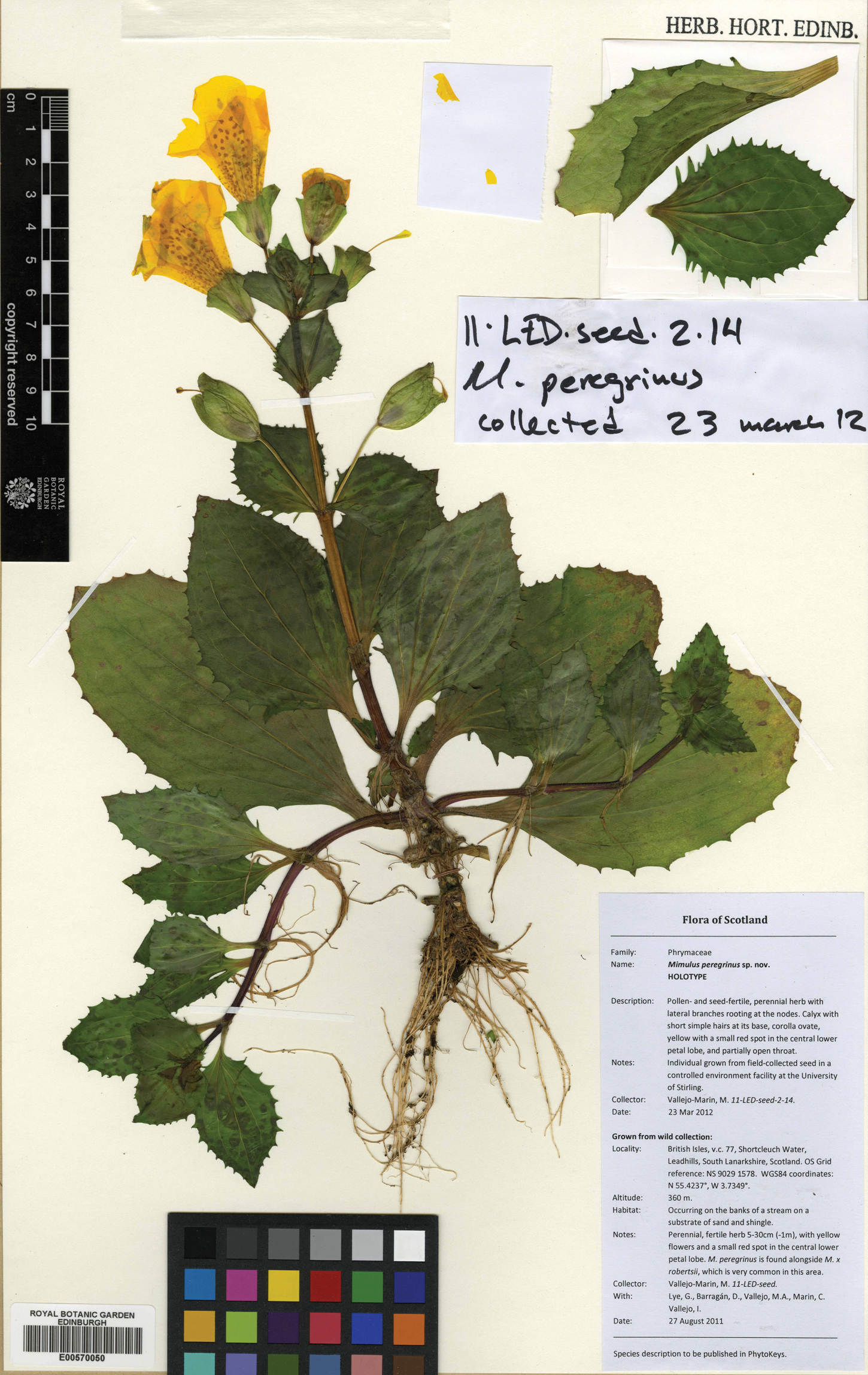
The latest example of this well-known phenomenon has just been described in the pages of PhytoKeys, an open access biodiversity journal. Mario Vallejo-Marín of the University of Stirling in Scotland, describes Mimulus peregrinus, a new British species that has recently appeared, apparently by chromosome duplication in a sterile hybrid:

Type specimen of Mimulus peregrinus. From here.

Mimulus plants were introduced into the UK in the 19th century. The two main established species are  M. guttatus and M. luteus. M. gutattus has 14 pairs of chromosomes, while M. luteus would appear to have undergone chromosome duplication – it has 30 or 31 pairs. These two species can cross, but their hybrids, which are triploid (ie they have three copies of each chromosome, rather than two) are sterile.

Vallejo-Marín reports that the new species, M. peregrinus has six copies of each chromosome (you can identify the chromosomes by their shape and distinctive banding, and count the amount of DNA in the plant, which shows up as a threefold higher than M. guttatus) – and apparently developed after a chromosome duplication event in a triploid hybrid. These six copies can now pair up quite normally during the creation of the haploid gametes, producing gametes that each have 46 chromosomes (as against 14 in M. guttatus). The new plant, which is known only from the banks of Shortcleuch Waters, Leadhills, South Lanarkshire, has yellow flowers and rather spikey leaves.

Flowers of Mimulus peregrinus and related plants, including two interspecific hybrids (B and C). Two flowers are shown for each type. A Mimulus guttatus B Mimulus × smithii (Mimulus luteus luteus × Mimulus luteus variegatus) C Mimulus × robertsii (Mimulus guttatus × Mimulus luteus), and D Mimulus peregrinus. Scale bar = 1 cm. Taken from Vallejo-Marín (2012) 

It is clearly different from the two other Mimulus species that are already present here, and from their triploid sterile hybrid. These new plants are inter-fertile, and isolated from other closely related species. They form a new species, one that has popped up on the banks of this stream in Scotland:

Shortcleuch Waters – the creationists’ nightmare

There is nothing particularly amazing or new about this process – it has been known for decades – but it is striking. Mimulus peregrinus is yet another nail in the creationist coffin, and yet another example of why evolution is true.

Reference:

Mario Vallejo-Marín (2012) Mimulus peregrinus (Phrymaceae): A new British allopolyploid species. PhytoKeys 14: 1–14.
h/t @AdamRutherford and @byMJWalker (you see, Jerry, Twitter is useful!)

Clouded leopards and the species problem

January 25, 2011 • 10:48 am

by Greg Mayer

Alert WEIT-blog reader Dominic has drawn my attention to a not yet published study of clouded leopards, that I’d seen mentioned by the BBC, but I had not seen the actual paper (well, actually, nobody has seen the actual paper— more below on this).

Clouded leopard by Vearl Brown, from Wikipedia.

There are two issues here, both of which we’ve considered before here at WEIT. First is the species concept issue, which both Jerry and I mentioned recently (links to Jerry’s posts in mine). The second is a scientific nomenclature issue, one that arose in the infamous Darwinius case.

The species concept issue also comes in two parts. First, are the mainland clouded leopard (Neofelis nebulosa) and the insular clouded leopard (Neofelis diardi) distinct species? And, second, among the insular clouded leopards, are the Bornean and Sumatran populations distinct? The first issue was the focus of two papers in 2006 which raised the insular leopards to full species status. Normally, the raising of insular forms to full species status on the basis of being different from the mainland form raises a warning flag for me, but there is an additional consideration which I think in this case supports the raising to full species status. This is that the islands of Borneo and Sumatra are on the Sunda Shelf, and thus were connected to the mainland as recently as about 10,000 years ago (see Harold Voris’s superb series of paleo-bathymetric maps of the Sunda Shelf for details). So, the insular and mainland forms were in contact very recently, and one good explanation for why this contact would not have led to an erosion of the genetic differences between them is that they were reproductively isolated (i.e., different species). There are other possible interpretations, but the recent contact combined with observed differences certainly makes the 2-species taxonomy reasonable.

The new, unpublished, paper argues not for a new species, but for dividing the insular form into two subspecies, one from Borneo and one from Sumatra. (A subspecies is recognized when there is a particular pattern of geographic variation within a species, namely that there is a geographic segment of the species’ range within which individuals can be distinguished from individuals from other parts of the range. Basically, if you can tell where an individual is from by the way it looks, or, if you tell me where the individual is from, I can tell you what it looks like, then you can name a subspecies.) This seems perfectly reasonable to me.

The problem is that they describe a new subspecies in the paper (rather than reviving a previously described one), but they have also posted a pre-print online and allowed press coverage. Online posting does not constitute publication in the formal sense, and their paper will soon be published on paper. But by generating press coverage (the BBC has included the new name in its coverage) and posting online, they increase the chance that the name will be formally published before their paper appears in print, either accidentally, or on purpose by an unscrupulous individual wanting to steal credit for their work (it does happen). This was part of the problem with Darwinius: the name Darwinius was bandied about before the name was published.

The authors are actually compounding a problem they created for themselves earlier: they published the new name in 2007 (I have not seen this paper), but now consider their proposal at the time nomenclaturally defective, and the name not nomenclaturally available from that publication. (The technical term for what they now regard their 2007 effort is a nomen nudum: a nude name, i.e. a name without a proper description accompanying it, and thus not available for use as a scientific name). The nomenclature of this name could be confused. I hope their paper appears soon.

One thing highlighted by this paper that I want to unreservedly endorse is the use of camera traps for the study of elusive large mammals. These traps have helped with studies of a number of species, including several big cats: jaguars (including Arizona jaguars), Saharan cheetahs, Asiatic cheetahs, tigers, as well as clouded leopards. The BBC, NYT, and other media often highlight the results of these studies. Recently, camera traps revealed an unexpected high-altitude population of tigers in Bhutan, in a valley where three big cats– leopard, snow leopard, and tiger– all live together.

____________________________________________________________
Buckley-Beason, V.A. et al. 2006. Molecular evidence for species-level distinctions in clouded leopards. Current Biology 16:2371-2376. (pdf)

Kitchener, A.C., M.A. Beaumont, and D. Richardson. 2006. Geographical variation in the clouded leopard, Neofelis nebulosa, reveals two species. Current Biology 16:2377-2383. (pdf)

Wilting, A., V.A. Buckley-Beason, H. Feldhaar, J. Gadau,  S.J. O’Brien, and K.E. Linsenmair. 2007. Clouded leopard phylogeny revisited: support for species recognition and population division between Borneo and Sumatra. Front. Zool. 4:15. (not seen)

Wilting, A., P. Christiansen, A.C. Kitchener, Y.J.M. Kemp, L. Ambu, and J.Fickel. 2011. Geographical variation in and evolutionary history of the Sunda clouded leopard (Neofelis diardi) (Mammalia: Carnivora: Felidae) with the description of a new subspecies from Borneo. Molecular Phylogenetics and Evolution in press. (pdf)

Tuataras and the species problem

January 23, 2011 • 11:14 am

by Greg Mayer

Tuataras are very interesting animals: endemic to New Zealand, and the sole survivors of an ancient and once more widespread order of reptiles, the Sphenodontida, whose closest relatives are the squamates (lizards+snakes). I noted some of their distinctive traits in an earlier post. When a friend went to New Zealand for a visit during the holidays, I asked him to get a picture of a tuatara if one came his way, and he obliged.

Tuatara at a North Island, NZ, zoo.

Tuataras are also of interest with regard to the ” species problem”, which Jerry recently addressed with respect to how many species of elephants there are (with follow-ups here and here). Ernst Mayr defined species in 1942 as

Species are groups of actually or potentially interbreeding natural populations, which are reproductively isolated from other such group.

This definition, known as the biological species concept, is the one Jerry argued in favor of in his posts (and more extensively in Speciation, his book with Allan Orr). Through most of the 20th century, a single geographically variable species of tuatara, Sphenodon punctatus, was recognized. In 1990, on the basis of morphological and, primarily, allozyme differences, Charles Daugherty and colleagues argued that a second species, S. guntheri, occurring on islands in eastern Cook Strait (see map), should be recognized. (Allozymes are proteins which are different alleles at the same genetic locus, and which are usually distinguished by protein electrophoresis.)

Distribution of tuataras, from Wikipedia. Circles, Sphenodon punctatus; squares, Sphenodon guntheri.

At the time, this bothered me, as I saw it as an application of the old morphological species concept, extended to genetic data: if you can tell them apart, they are different species. This is also what Jerry argued against in the case of elephants: an arbitrary amount of morphological or genetic difference, or inferred time of separation based on the amount of genetic difference, is not a sound basis for a species concept.

Recently (2010), however , further studies of tuataras have been made, including study of their DNA, and the authors of this work conclude that, as had been held earlier, a single geographically varying extant species of tuatara should be recognized (the status of the extinct tuataras from the New Zealand mainland is still up in the air). So we’re back to S. punctatus as the sole surviving species in the Sphenodontida.

This turnaround in tuatara taxonomy is also a nice example of something Jerry considered in a previous post: scientists changing their mind in the light of new evidence, and not being shy about saying so (something which, of course, should not be rare). Two of the authors of the 1990 resurrection of S. guntheri, Charles Daugherty and Jennifer Hay, are also authors of its 2010 sinking.

If you would like to sample more things tuatara, Hillary Miller, a post-doc at the Allan Wilson Centre for Molecular Ecology & Evolution in New Zealand, has been running, unbeknownst to me at the time of my initial post, an interesting series of posts on tuataras at her blog, The Chicken or the Egg.  (Allan Wilson a New Zealander who was a graduate student and later professor at Berkeley, was a pioneer in the application of biochemistry to evolutionary questions.) See also Victoria University of Wellington’s Tuatara Biology page.

______________________________________________________________

Daugherty, C.H.,  A. Cree, J.M. Hay & M.B. Thompson. 1990. Neglected taxonomy and continuing extinctions of tuatara (Sphenodon). Nature 347:177-179. (abstract)

Hay, J.M., S. D. Sarre, D.M. Lambert, F.W. Allendorf & C.H. Daugherty. 2010. Genetic diversity and taxonomy: a reassessment of species designation in tuatara (Sphenodon: Reptilia). Conservation Genetics 11:1063-1081. (abstract)

Hybridization and parthenogenesis in whiptail lizards

November 19, 2010 • 12:26 am

by Greg Mayer

Not much in the way of culinary pleasures here. (Although Jerry’s piece on the Inquisition killed my appetite, anyway). Reader Pete Moulton asked for some references on hybridization and parthenogenesis in whiptail lizards (Cnemidophorus [or Aspidoscelis] and related teiid lizards), in particular C. (A.) uniparens.

Desert grassland whiptail, by Davepape from Wikipedia.

A. uniparens is a triploid unisexual. It resulted from a cross of two bisexual species (A. inornata [mother] and A. burti [father]), which produced a diploid unisexual, which then backcrossed to inornata to produce the triploid uniparens. The unisexuals reproduce clonally, i.e. offspring are exact genetic copies of their mothers, except for new mutations. Courtship and ‘pseudocopulation’ between parthenogenetic females promotes reproduction. The situation is summarized nicely by Cole et al. (2010):

The natural origin of diploid parthenogenesis in whiptail lizards has been through interspecific hybridization. Genomes of the parthenogens indicate that they originated in one generation, as the lizards clone the F1 hybrid state. In addition, hybridization between diploid parthenogens and males of bisexual species has resulted in triploid parthenogenetic clones in nature. Consequently, the genus Aspidoscelis contains numerous gonochoristic (= bisexual) species and numerous unisexual species whose closest relatives are bisexual, and from whom they originated through instantaneous sympatric speciation and an abrupt and dramatic switch in reproductive biology.

The selection of papers below includes both classics and recent papers, with a preference towards ones where online full text was available (see pdf links below). These papers are all about whiptails of the family Teiidae. Laurie Vitt and Jana Caldwell, in their fine text Herpetology (Academic Press 2009), record about 50 species of  parthenogenetic lizards (adding in a few they missed) in eight families (including the whiptails), and one species of parthenogenetic snake.

Wright, J.W. and C.H. Lowe. 1968. Weeds, polyploids, parthenogenesis, and the geographical and ecological distribution of all-female species of Cnemidophorus. Copeia 1968: 128-138. no pdf (A classic on unisexual ecology.)

Parker, E.D. and R.K. Selander. 1976. The organization of genetic diversity in the parthenogenetic lizard Cnemidophorus tesselatus. Genetics 84:791-805. pdf (A classic on unisexual genetics.)

Crews, D. and K.T. Fitzgerald. 1980. “Sexual” behavior in parthenogenetic lizards (Cnemidophorus). Proceedings of the National Academy of Science USA 77: 499-502. pdf (A classic on unisexual behavior.)

Reeder, T.W., H.C. Dessauer, and C.J. Cole. 2002. Phylogenetic relationships of whiptail lizards of the genus Cnemidophorus (Squamata, Teiidae) : a test of monophyly, reevaluation of karyotypic evolution, and review of hybrid origins. American Museum Novitates 3365:1-62. pdf (In this paper, the genus Aspidoscelis is resurrected for part of the genus Cnemidophorus; because there is such a huge literature under the name Cnemidophorus prior to 2002, both names must be used when searching the literature. The part on hybrid origin begins on page 25.)

Cole, C.J., L.M. Hardy, H.C. Dessauer, H.L. Taylor, and C.R. Townsend. 2010. Laboratory hybridization among North American whiptail lizards, including Aspidoscelis inornata arizonae × A. tigris marmorata (Squamata: Teiidae), ancestors of unisexual clones in nature. American Museum Novitates 3698:1-43. pdf

The American Museum of Natural History’s Digital Library has pdf’s of all the Museum’s publications, and it has been a center for studies of parthenogenetic lizards. More papers can be found by going to the Digital Library site and searching on ‘Cnemidophorus’, ‘Aspidoscelis’, and ‘parthenogenesis’.

UPDATE. The numbers of parthenogenetic species of lizards and snakes compiled by Vitt and Caldwell and given above refers only to obligately (or nearly so) parthenogenetic species, not facultatively parthenogenetic ones (like Komodo dragons, boa constrictors, and some other snakes; they have a separate discussion of the facultative species in their book).

That lizard was delicious– what kind was it?

November 18, 2010 • 11:21 am

by Greg Mayer

That’s more or the less the question Ngo Van Tri, a Vietnamese herpetologist, must have asked himself after having a meal like that shown below, which surely rivals anything Jerry’s had in Colombia.

Leiolepis ngovantrii. From Lee Grismer, via The Independent.

Tri contacted Lee Grismer of La Sierra University and his son Jesse Grismer, a graduate student at Villanova University, both herpetologists. They went to Vietnam and found that it was an undescribed species, which they named Leiolepis ngovantrii in Tri’s honor, in a paper (whose title oddly brings to mind the 2003 Red Sox) published this past spring in Zootaxa (abstract only).

All new species are interesting, but new ones are found all the time. What makes this one especially of note (besides being discovered on a dinner plate) is that it is a parthenogenetic species– consisting only of females, and reproducing asexually. This is a rather unusual mode of reproduction in vertebrates, but a fair number of lizards, including species in the families Teiidae, Lacertidae, Geckonidae, and (like Leiolepis) Agamidae, reproduce this way. Most parthenogenetic lizard species have arisen by hybridization between two sexual species. The Grismers, using mitochondrial DNA, have been able to identify the maternal parent species of L. ngovantrii, and also of the three other parthenogenetic species of Leiolepis, showing that parthenogenesis in this genus has arisen in the usual way for lizards. It’s also known to occur spontaneously in normally sexual species, such as the Komodo dragon, Varanus komodoensis.

The unusual method of discovery has attracted some media attention.

(And, I should mention that Lee Grismer is the author of one of the best “Animals of___” books ever: the magnificent Amphibians and Reptiles of Baja California, Including Its Pacific Islands and the Islands in the Sea of Cortés, University of California Press, 2002).

Grismer, J. and L.L. Grismer. 2010. Who’s your mommy? Identifying maternal ancestors of asexual species of Leiolepis Cuvier, 1829 and the description of a new endemic species of asexual Leiolepis Cuvier, 1829 from Southern Vietnam. Zootaxa 2433:47-61.

h/t: Steve Orzack, Fresh Pond Research Institute