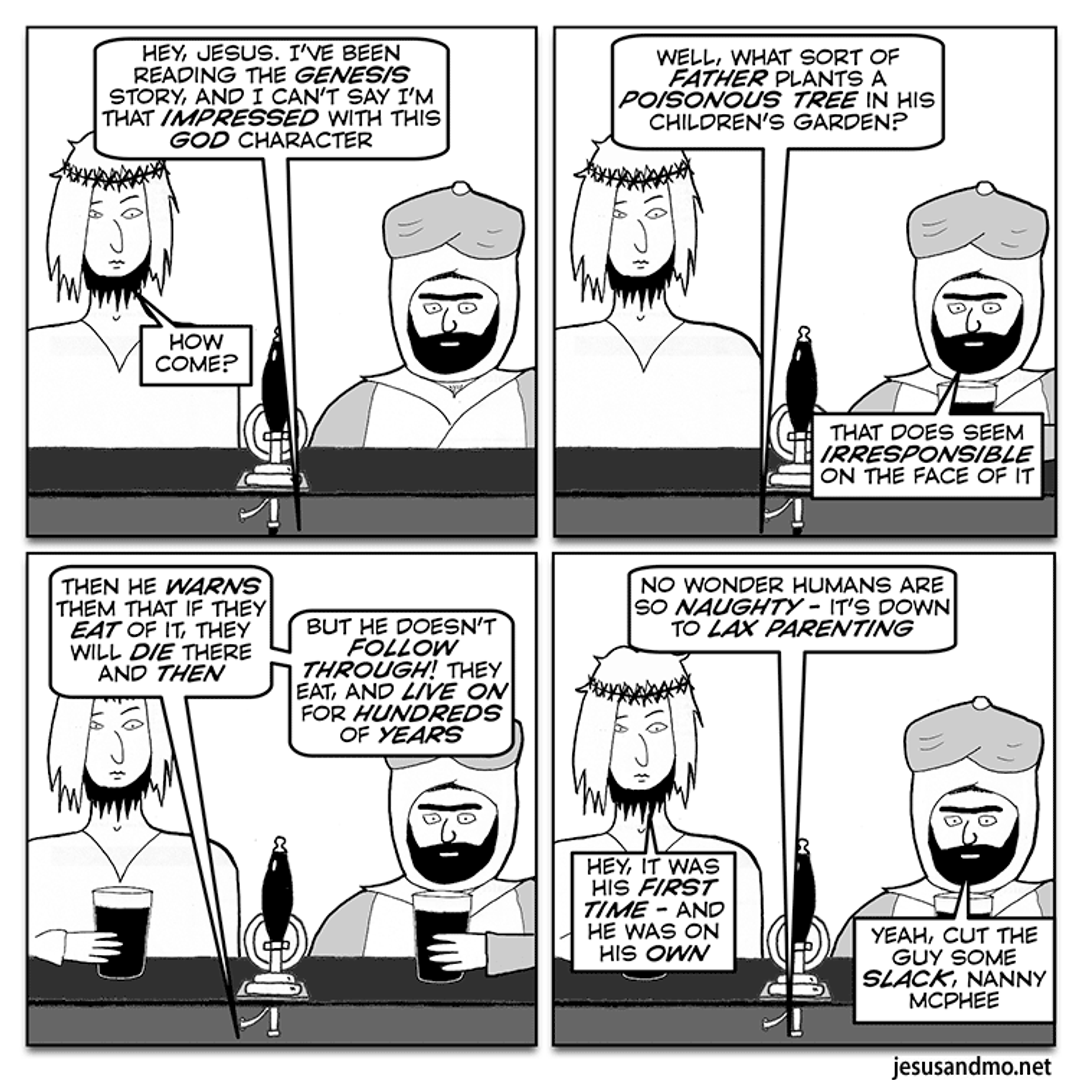
Today’s Jesus and Mo strip, called “tree2,” is actually described as “A resurrection from 2006.” The barmaid, ever critical, points out that God is not a helicopter parent.
Why Evolution is True is a blog written by Jerry Coyne, centered on evolution and biology but also dealing with diverse topics like politics, culture, and cats.

Today’s Jesus and Mo strip, called “tree2,” is actually described as “A resurrection from 2006.” The barmaid, ever critical, points out that God is not a helicopter parent.
The Jesus and Mo artist sent this cartoon with the caption: “A Chrismassy Friday Flashbacck today, from 9 years ago.” Jesus is beefing about the nonexistent “war on Christmas” in the UK:

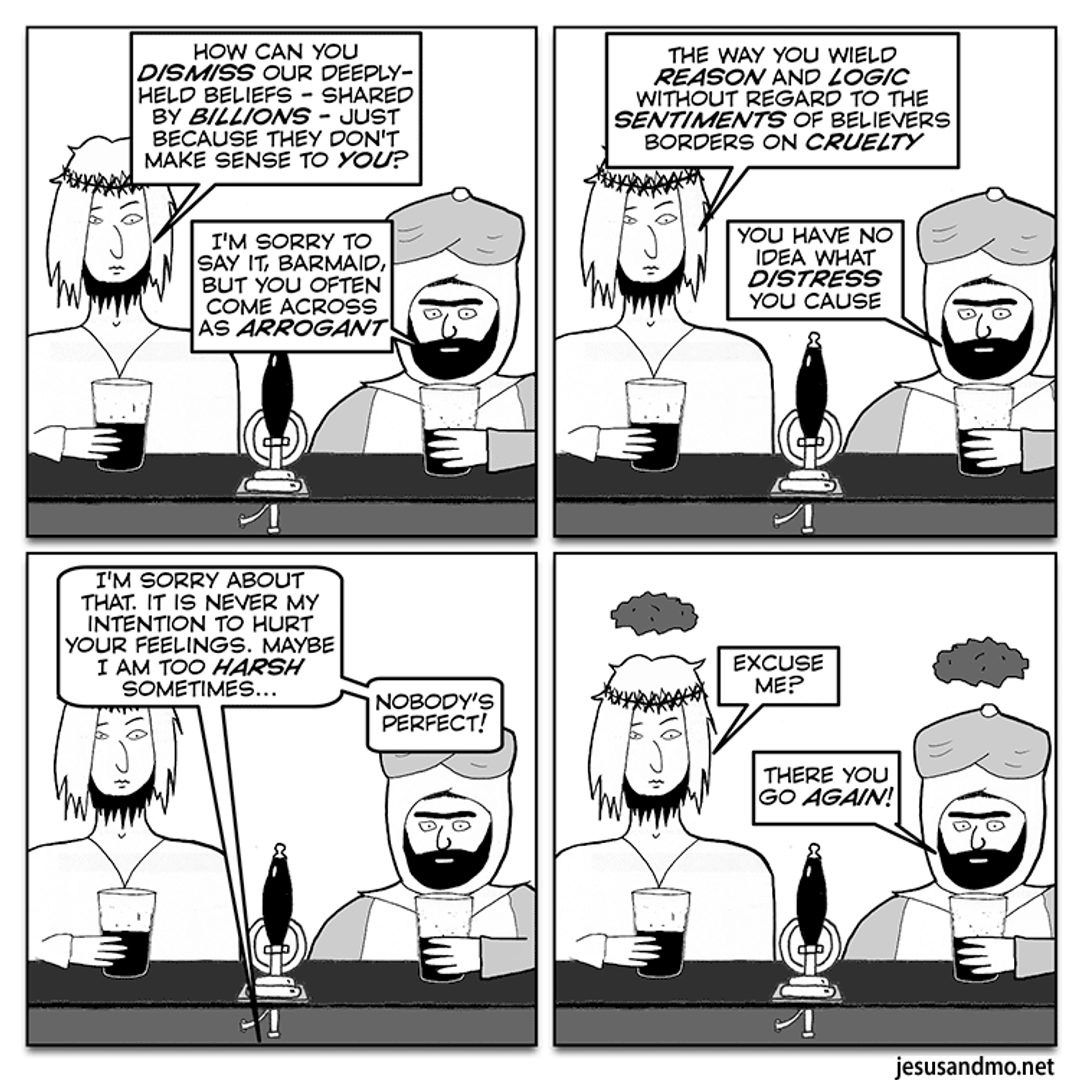
The latest Jesus and Mo strip, called “cruelty”, came with the note, “Those poor boys. Has she no feelings?”
The barmaid stymies the boys with her humility, for neither of them could ever echo her sentiments.
Today’s Jesus and Mo strip, called “tricksy”, features a trademark tendency of Mo: he criticizes something, and then Jesus then points out Mo’s hypocrisy, for what he’s criticized is also true of Islam. Poor Mo, blinded by faith!
As the artist commented, “That’s exactly what you’d expect from Mo.”
Remember, the strip has been going 20 years, and you might donate a few bucks to support the artist.

Today’s Jesus and Mo strip, called body2, is the very first strip. As the email noted:
It’s Jesus & Mo’s 20th birthday sometimes around now. I don’t remember the exact date because it wasn’t originally in this format. Thanks to all our readers! If you want to give us a birthday present, the best thing you can do is became a patron here: https://www.patreon.com/jandm
Do subscribe!
And see Mo get out of trouble:

In today’s Jesus and Mo strip, called “appeal”, the boys once again tune up their instruments for a song. The song also came with an appeal to pity from the artist (see below):
I worked so hard to get this comic out today, I nearly gave myself an aneurysm.
Here’s what Wikipedia says about “appeal to pity” (I hadn’t heard about this:
An appeal to pity (also called argumentum ad misericordiam) is a fallacy in which someone improperly appeals to pity or similar feelings like empathy, as a method of persuading someone to agree with a conclusion. It is a specific kind of appeal to emotion. This fallacy can happen in two ways: 1) when an appeal to pity (or a similar emotion) has nothing to do with the actual point of the argument, or 2) when the emotional appeal is exaggerated or excessive compared to the situation being discussed. Not all appeals to pity are logical fallacies. When the feelings of pity are directly related to the conclusion and help support the argument logically, they can be reasonable. For instance, appealing to pity when asking for help.
Examples
- “You must have graded my exam incorrectly. I studied very hard for weeks specifically because I knew my career depended on getting a good grade. If you give me a failing grade I’m ruined!”
- “Ladies and gentlemen of the jury, look at this miserable man, in a wheelchair, unable to use his legs. Could such a man really be guilty of embezzlement?”
You can guess how it applies to the duo’s new song:

Today’s Jesus and Mo strip, called “joy2,” came with the artist’s comment, “I also prefer it.”
This bears on a dispute I’m having with a famous thinker (not Sam Harris), who maintains that ethical precepts are objective, not subjective, using the argument that there’s no justification for treating anybody differently from how you’d wish to be treated (a Rawlsian form of the golden rule).
Sam Harris proposed an objective system of ethics in his book The Moral Landscape, arguing that the moral thing to do in any situation is the thing that increases the overall well being of conscious creatures (note that, since he refers to a “landscape,” he means overall well being, not the well being of individuals acting or being acted on). Sam thinks that what is ethnical can be determined, in principle, scientifically.
This is a form of utilitarianism, and is a valuable aid to our thinking about how we judge what is right and wrong, but I’ve criticized it, and so have many philosophers (see Russell Blackford’s critique here). In the end, while I think Sam’s criterion for ethical or unethical acts generally conforms to our own notions of right and wrong, it has too many problems to serve as a “scientific” way to decide ethical questions. And I still believe that, at bottom, what’s right and wrong depends on subjective preferences. Though these preferences will coincide for many, they won’t for many others, and thus morality cannot be reduced to a “science”.
If you agree with Sam, then tell me why it’s moral to eat meat given that the well being of a conscious pig or cow cannot be judged against the well being of a human. (Remember, we have to know which creatures are conscious, too.) And if it IS immoral, why are you eating meat?
But I digress. Here the boys go after the barmaid’s view of why we have morality in general.
