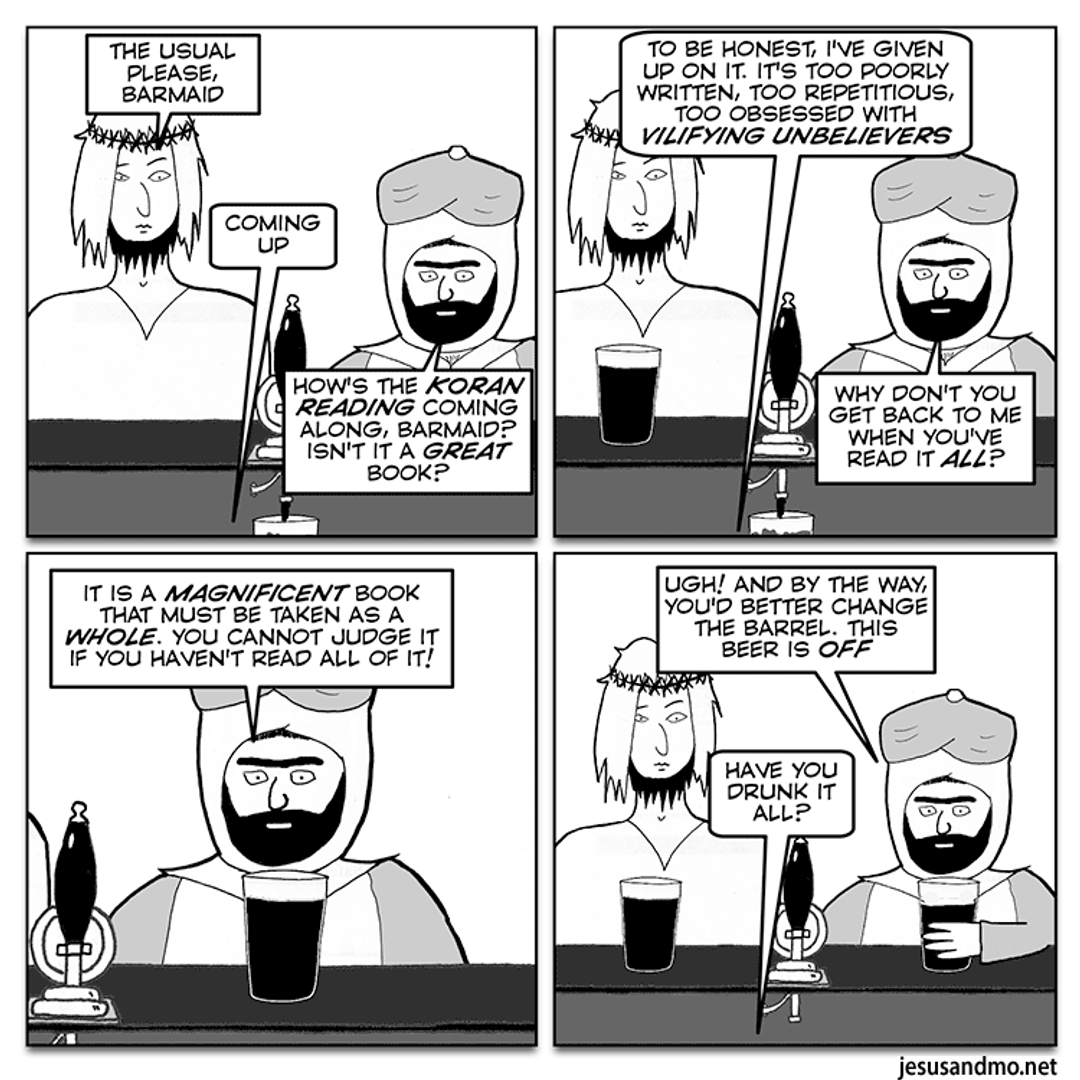
Why Evolution is True is a blog written by Jerry Coyne, centered on evolution and biology but also dealing with diverse topics like politics, culture, and cats.
The latest Jesus and Mo strip, called lead, says in one email that it’s new and in another that it’s old. Well, I haven’t seen it, and the accompanying note says this:
A comparison that has been made before and is hard to ignore.
We have another “Friday Flashback from 9 years ago.” The concept of substitutionary atonement—something that Hitchens used to beef about—has always confused me, as it simply makes no sense. By killing his own son, who is really part of himself, God gave us all the possibility of going to Heaven. Whaaaat?
This week’s Jesus and Mo strip, called “bite2”, is new but came out a bit late on Wednesday. In response to last week’s criticism of Islam, Mo now gets the chance to make fun of Christian ritual. He does a good job, but Jesus gets the last word.
Today’s Jesus and Mo strip, called “rock2“, comes with a note that says this: “An oldie from 2006 today. Next week’s will also be a resurrection.” The artist must be on hols.
Is Mo right about the black silk and the meteorite? Well, at least half right. The Kaaba is indeed covered with a cloth made of silk, but the meteorite is questionable. Here’s what Wikipedia says, along with a picture. (The stone is called Ajar al-Aswad.)
The Black Stone (Arabic: الحجر الأسود, romanized: al-Ḥajar al-Aswad) is a rock set into the eastern corner of the Kaaba, the ancient building in the center of the Masjid al-Haram in Mecca, Saudi Arabia. It is revered by most Muslims as an Islamic relic which, according to tradition, dates back to the time of Adam and Eve.
The stone was venerated at the Kaaba in pre-Islamic Arabia. It is sometimes considered a baetyl. According to tradition, it was set intact into the Kaaba’s wall by Muhammad in 605, five years before his first revelation. Since then, it has been broken into fragments and is now encased in a silver frame on the side of the Kaaba. Its physical appearance is that of a fragmented, dark rock, polished smooth by the hands of pilgrims. It has often been described as a meteorite, but it has never been analysed with modern techniques, so its scientific origins remain the subject of speculation.
Muslim pilgrims circle the Kaaba as a part of the tawaf ritual during the Hajj and many try to stop to kiss the Black Stone, emulating the kiss that Islamic tradition records that it received from Muhammad.While the Black Stone is revered, theologians emphasize that it has no divine significance and that its importance is historical in nature.
Saudi Press Agency (SPA), CC BY-SA 4.0, via Wikimedia Commons
This post-Easter cartoon of Jesus and Mo is presented as a “Friday Flashback: from 8 years ago, now that ‘Easter’ is over”. Note that ‘Easter’ is in quotes. Mo continues to tease Jesus about Christian doctrine.
In which the boys return to the devilishly tricky P of E.
I assume the artist means “problem of evil”, which of course clever theologians have found a way to rationalize (there’s nothing these people can’t explain). But Mo is unable to come up with his own theodicy.