Why Evolution is True is a blog written by Jerry Coyne, centered on evolution and biology but also dealing with diverse topics like politics, culture, and cats.
My degree of anxiety about the new ducklings decreases asymptotically as they age. The first week I get nervous, for they are at their most vulnerable, but as they age over the next several weeks I relax (a bit!) and am never fully complacent until they can fly, which is about two months after they hatch. They appeared on Sunday morning, which means they hatched on Saturday, so today the four ducklings are four days old. My first task of the day is to count them.
And they’re doing well: they are plump, lively, and eating well. Their mother, aka Miss Duck, is still being the perfect mom, watching over them and warming them when they’re wet. (It’s a bit chilly today: about 68°F). Here are the quadruplets getting warmed.
Since there’s no significant news today, allow me to bore you with my latest duck pictures, as I’m chuffed that all the babies are in their fourth day, having survived two nights without attrition. They look healthy, are eating heartily, and are lively, swimming around between bouts of napping with Miss Duck, their mom. All these photos are from this morning.
Feeding time (four—count them, four:
Their adorableness abides:
A postprandial stretch:
And an early morning nap, with Miss Duck being nearby. (I’ve already fed them twice):
And naptime turns into a huddle underneath mom. One underneath:
Two underneath (look at those fat little tummies!):
All underneath and getting warm. Miss Duck is proving to be a great mom.
Well, we have another brood of four ducklings in Botany Pond, and this time I’m hopeful they’ll grow up and fledge. Yes, it’s a late brood, but in two months they’ll be ready to fly, and the weather is good in mid-September.
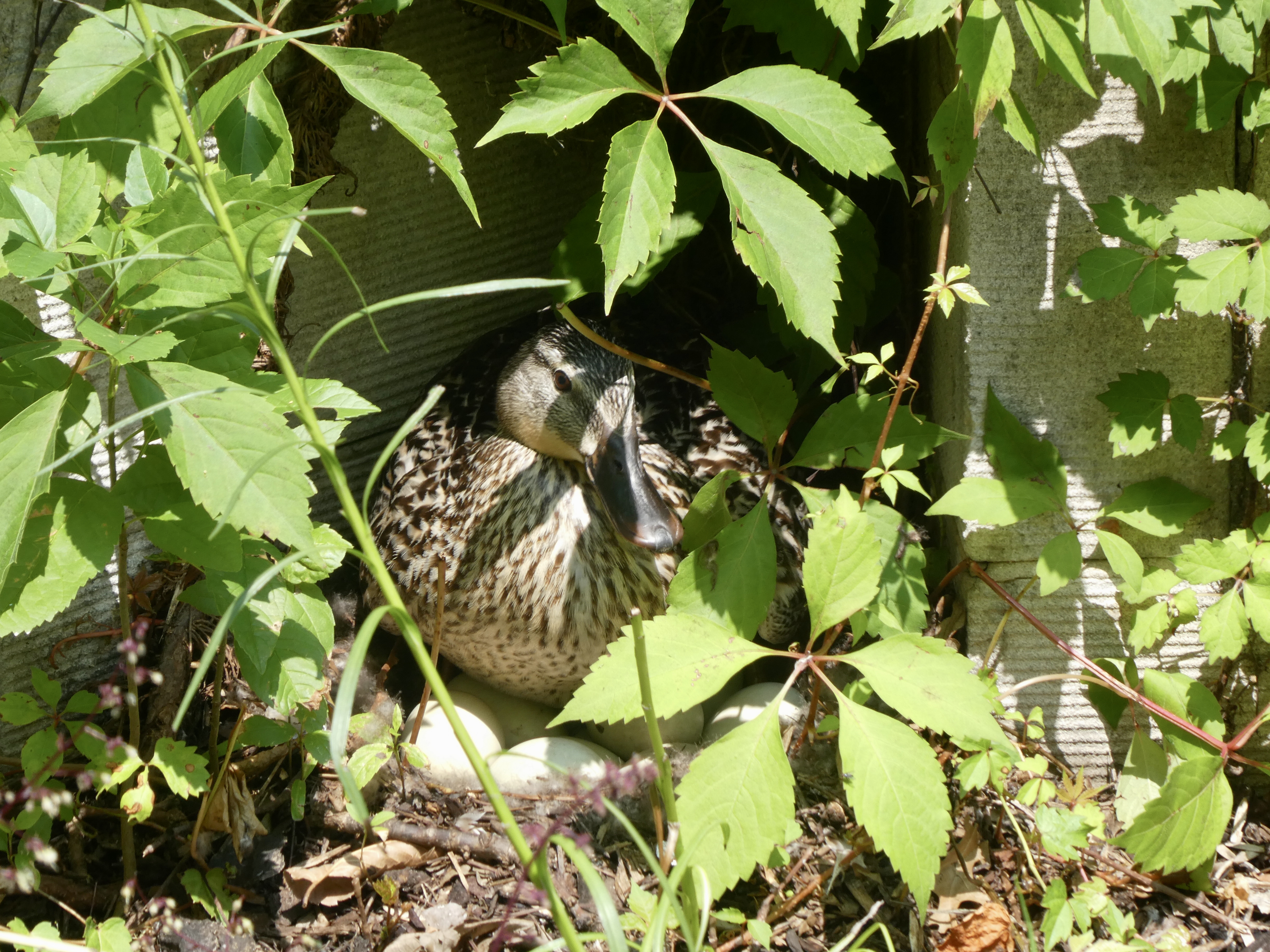
The story: four days ago an undergraduate alerted me to the presence of a nesting hen up against the student union building next to my own building. The hen had cleverly positioned her nest in a cranny in the building where it couldn’t be seen. A few shots.
I’ve circled the nest; you can see how hidden and inconspicuous it is. She must have been there for nearly month, unnoticed by anyone, when I came upon her, for her eggs hatched about a day after this and the incubation period is 28-29 days.
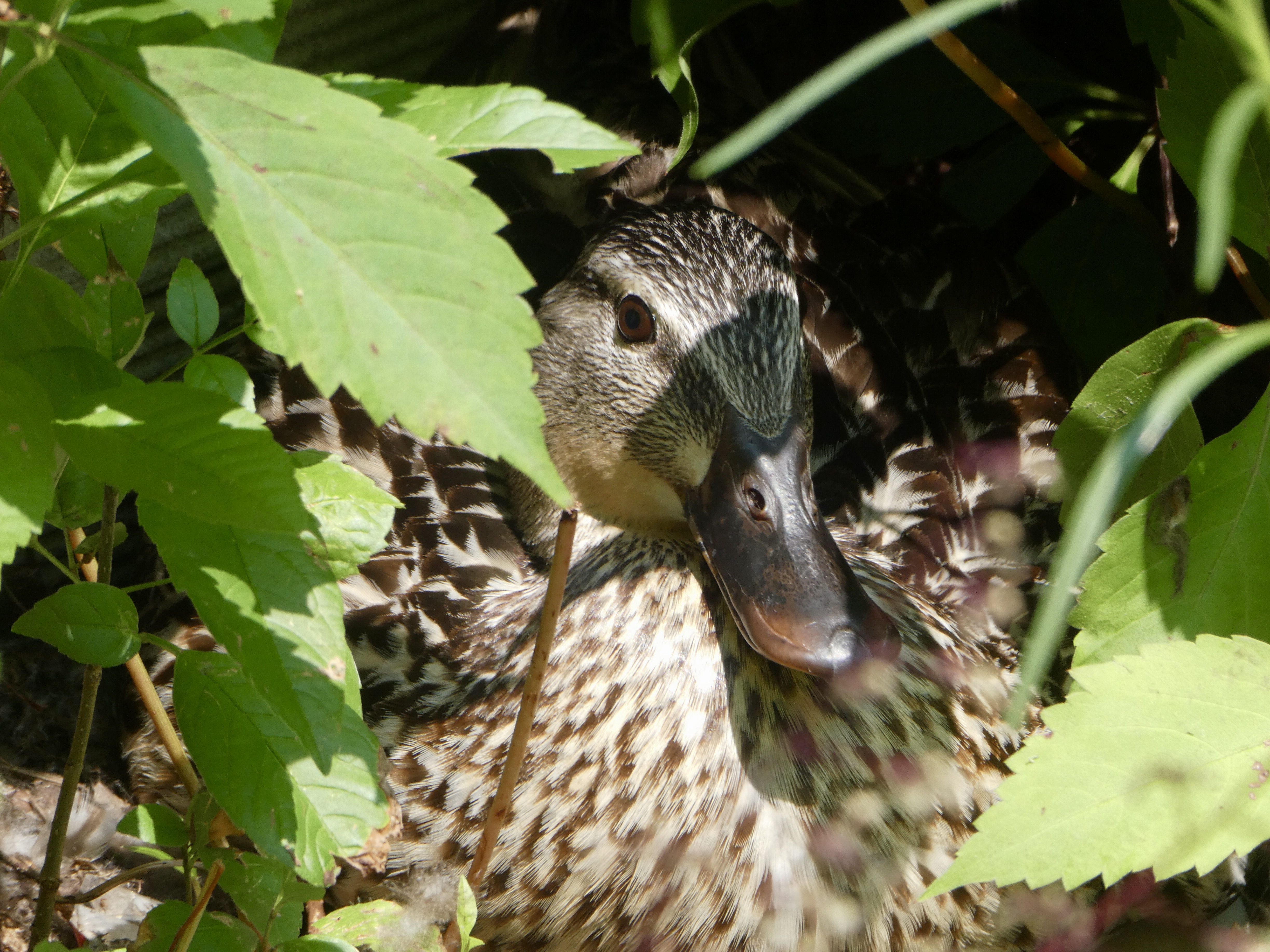
Here she is sitting on her eggs. It looks like a big pile o’ eggs, but in reality there were only five. It had been hot, and I hadn’t seen her in the pond, so not only was I unaware of her presence, but she must have gone without food or water in the blistering heat. I put a dish of cool water near her, and she didn’t seem very skittish.
She is a lovely hen; there’s something appealing about her face. As I’ve run out of duck names, I call her ‘Miss Duck”. She may be identical to Margot, as I haven’t yet checked bill photos, but I think she’s new. Also, unlike most hens, she nested on the ground rather than on a windowsill (wild mallards are ground-nesters).
Yesterday (Sunday), I looked at the pondcam and saw a blob at the south end of Botany Pond, apparently followed by several smaller blobs. I went downstairs, and, sure enough, there was a duck with four ducklings. I went immediately to the nearby nest to see if there were any orphans hanging about, but no: there were broken eggshells and one unhatched eggs, which I kept warm for a day and a half though it didn’t hatch. This was Miss Duck in the pond, and she had laid five eggs.
The nest after hatching:
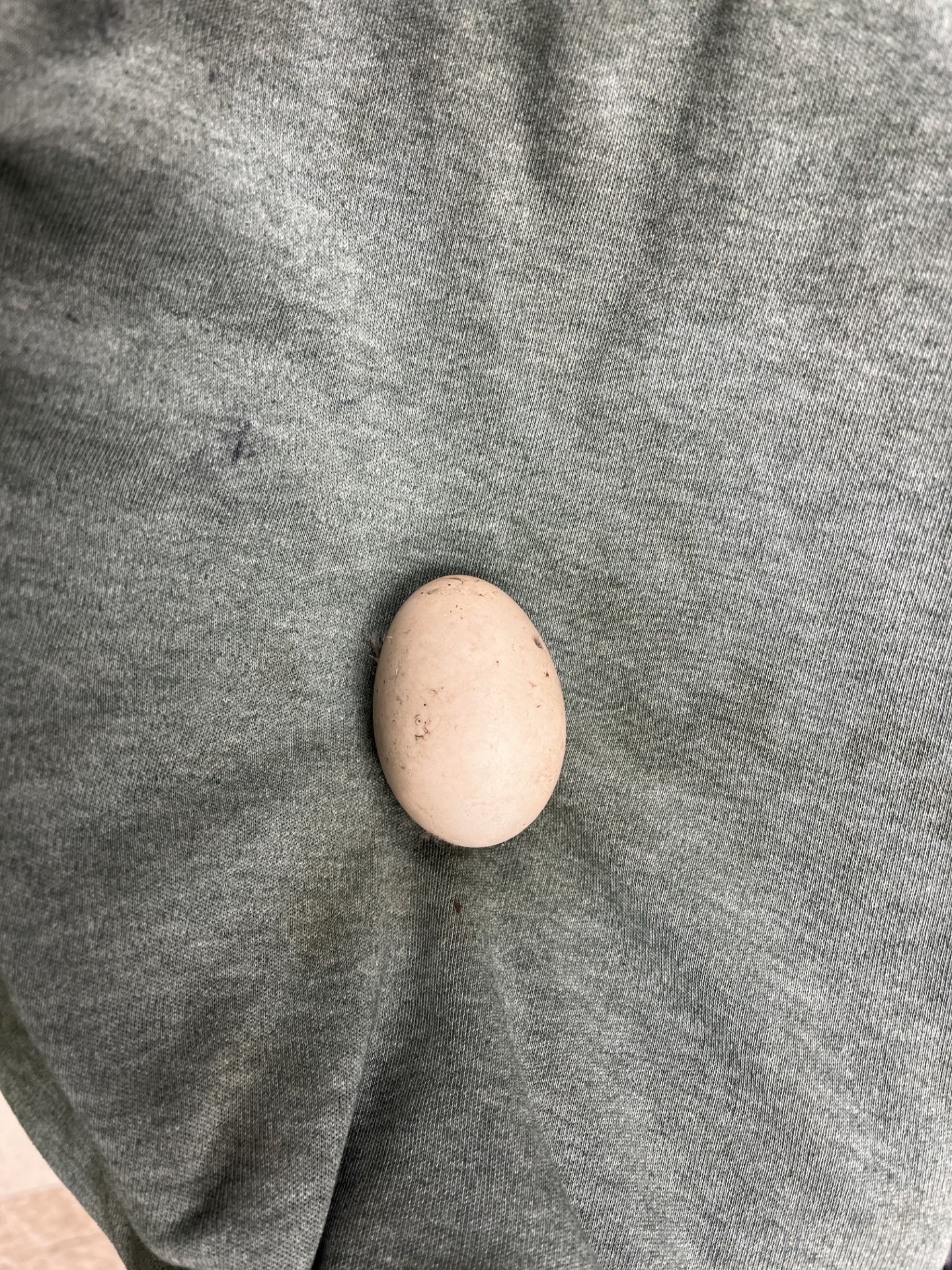
The one egg I saved, which was apparently infertile (I didn’t open it). It’s really light green, the normal color of mallard eggs, but the light in the lab makes it look pale orange.
And now the happy family. The babies are adorable, and Miss Duck is much tamer than the others we’ve had. The splash of water is made by a fish, which somewhat startled Miss Duck.
I don’t know how she got to the pond; when I looked yesterday, it was about 6 a.m. Since the ducklings could not climb the stairs up through the breezeway, they must have been led around Erman, the building perpendicular to the one above, and then north again through the fence to the water. Miss Duck is smart.
Four is a small brood but she may be a young hen. Here are the babies, who, if they live, I’ll name after World Cup players. Aren’t they adorable? I think this is one of the best duckling photos I’ve ever taken:
More ducklings:
Since the dreaded Aggressive Drakes are gone, I have great hopes for this brood. The only problem is the algae: I don’t want the ducklings entangled in it and am asking Facilities to somehow remove surface algae without disturbing the ducklings.
They started eating yesterday. Miss Duck had Big Duck pellets, while the babies nibbled at Little Duck Pellets and crushed mealworms. This morning they were all still there, and were in the channel, where I fed them. Miss Duck has an endearing habit of quacking quietly when I greet her before feeding, and she’s learning my whistle.
Here they are yesterday on the rocks, sunning, drying off, and sometimes lying under mom’s belly:
I don’t think I could take another lost brood, so please cross your fingers that these little ones will grow up and fledge, and will not encounter ensnaring algae.
I have named the ducklings though I can’t distinguish them. With Matthew’s help, and because the ducklings hatched during the semifinals, I will name them
Messi (the GOAT),
Rodri (best player),
Kylian (golden boot), and
Erling (Norwegian star)
As you read yesterday, I was all happy and hopeful that the new brood from hen mother Margot would thrive and grow in Botany Pond. Well, once again it was not to be. Sometime in the morning, only a few hours after they entered the pond, they all disappeared. I had no idea what had happened, but kept watching the pond.
A few hours later, an undergraduate named Gabby, who loves the pond, emailed me that four ducklings were huddled together on a rock in the channel, and one was floundering in the thick algae in the channel. I ran down to the pond with my net and a “duck box”: a small box lined with old but clean teeshirts which I keep ready to harbor rescued ducklings.
Sure enough, I found five ducklings. Four were standing on the rocks in the channel, completely sodden. Another was nearby, trying to swim through a thick mat of algae and failing. Two others we later found dead on the rocks in the main pond.
What happened? I think the ducklings simply got mired in the thick algae floating on the pond surface, or dove and surfaced within it, coating themselves with algae and becoming wet (ducklings have no inherent oil in their feathers as they get it from being underneath mom). All the live ones were completely soaked, and I feared for their lives.
The next six photos are by Gabby, the undergrad who discovered the mishap and emailed me. The first is the duckling mired in algae, which I picked up and dunked underwater to free it from the stuff:
Four completely soaked ducklings:
It was pitiful:
They were so wet that their skin was visible:
These were only one-day-old babies, and I had to get them dry immediately. I put them in a “duck box” and took them to my office, where I had to dry them off. The box was put by a space heater underneath my desk, which keeps them warm and helps them dry off. This is before drying:
It took me an hour and a half to dry them off. I alternated among the ducklings so I didn’t handle each one for a long time. I used the lab equivalent of Kleenex—Kimwipes—to gently stroke them and blot them. Those who looked poorly I put in the rolled-up tee-shirt, making a pouch to keep them close to my body.
I then left them for an hour, giving them a little shallow dish of water into which I crumbled baby duck food. When I looked again, they were all pretty dry, fluffy, and also vigorous. None of them looked close to death. At 2 p.m., right before the World Cup Game, I drove them to Dorothy, the local representative of the Chicago Bird Collision Monitors, who would keep them until they go to the Willowbrook Wildlife Sanctuary, where they’ll be tended well. I was satisfied that none of them had been fatally soaked.
I saved five but two died before I could get to the Pond. That makes seven, and Margot had nine or ten. I don’t know what happened to the others; I did a sweep of the pond several times and they’d all disappeared.
I blame the algae for this one. Without it, I think the brood would have grown up fine and fledged in September. Nearly the entire bottom of the pond is covered with a thick mat of algae, and much of the surface is, too, which I’ve circled in this photo:
The reason there’s algae is that the sun beats heavily on the pond, facilitating the plant’s growth. If there were trees to shade it (several were removed) or water lilies to float on top (they planted a few in pots, but they are not going to spread as the bottom is gravel), we wouldn’t have this problem. Every two weeks, at great expense, the University has to pay for two guys to go into the pond and haul up great armfuls of algae, but it’s a losing battle. They can never remove more than a fraction of the growth.
One of the algae-removal guys told me that this was predictable and the University should have known this beforehand; and I think that’s true. Whoever decided to put a gravel bottom on the pond, and then plant a few measly containers of grass and water lilies thinking they’d spread, was completely out of their depth.
I don’t know if they can get rid of the algae and prevent its future growth, but this design error cost the lives of four or five ducklings yesterday, not to mention the separation of Margot from her brood and the great joy that a brood of ducklings brings to the University community. I am angry and very sad at the same time. The three previous broods were either saved and rehabbed (one brood) or walked out of the pond when Mom was harassed by drakes (two broods). That could not be helped, but the algae could have been. I am powerless to do anything about it, but yesterday marked the end of an annus horribilis for ducks. I’m not looking forward to next year.
Today’s photos and videos come from reader/physicist/origami master Robert Lang in California. Robert’s captions are indented, and you can enlarge the two DUCK photographs by clicking on them.
The creek named Arroyo Seco runs from Red Box Saddle in the San Gabriel mountains down past the Jet Propulsion Laboratory (JPL), through western Altadena and Pasadena, and then on to Los Angeles, joining the Los Angeles river near downtown L.A.; the historic Pasadena Freeway (now State Highway 110) follows its channel much of the way. True to its name, it’s dry much of the year, but above JPL, it runs year-round, providing lush, verdant and shady hiking any time of year. Since the Eaton Fire resulted in the closure of much of the front range of the San Gabriels, the still open Arroyo Seco and its Gabrielino Trail have been my go-to spot for a quick, regular getaway.
It’s also been a regular source of wildlife sightings, some of which have made it to RWP (for example, here, here, and here), but today I have an offering particularly near and dear to our host: ducklings and their momma!
This was at Brown Mountain Dam falls, which is about 3.5 miles up the trail from JPL. The dam was built in the 1940s, and quickly filled up its basin with sediment (there is now a forest of full-grown trees at the level of the top of the dam), but it provides a 40’ waterfall with a deep pool at the base and is a popular destination for bikers, hikers, and runners, especially on a hot day. Today, it had some unusual visitors: a momma mallard (Anas platyrhynchos) and her seven ducklings, who followed her up the creekbed to the pool where they then proceeded to feed, play, and shower under the falls.
. . . is dire. It is in fact so dire that although I have movies and photos of Vashti and of the last hen and her brood of nine, I am not mentally prepared to put them up, as they evoke bad memories and deep sadness. (As you may recall, both broods left the pond, almost certainly because they were harassed by drakes.) Vashti came back and re-nested in her old nest (!); she’s now sitting on a brood of seven eggs. The second hen, who was never named, has also returned but hasn’t (yet) nested, but is accompanied by an aggressive drake.
I have been keeping a careful eye on what is going on in the pond, and I’m quite worried about Vashti, whose brood is set to hatch within two weeks. Once a day I call her down to the pond for a feeding and a bath. She stays for about 15 minutes, gobbling up a big meal, preening for a while, and then quickly flying back to her nest to incubate the eggs. But over the past week or so, the damn drakes have been chasing her when they see her, driving her out of the pond, quacking and hiding nearby. It is only with considerable effort that I can get her away from the drakes so she can eat and go back to her nest. Note that the drakes aren’t trying to attack her; they want to mate with her. And she doesn’t want to mate!
What this means is that when she finally comes down with ducklings, she and her brood will be mercilessly harassed, just like the last hen and her brood. And that means that in all likelihood they will flee the pond, which means certain death for the ducklings.
I thus have a hard choice: let them come to the pond and take their chances, or arrange for the brood (and mother, if all possible) to be captured and either taken to a distant body of water or to a wildlife rehab facility. The first alternative is unpalatable, as it involves the death of the entire brood, but I think it’s likely if I don’t intervene. Lately I have been moving towards to the second alternative: letting Facilities and the Chicago Bird Collision Monitors take over and recover everyone if they can. Getting the ducklings is relatively easy, though they’ll be in the water very quickly after they jump. But getting Mom is a job for pros, as she can fly away.
My priority is to save lives, not entertain the University community with the sight of ducklings—ducklings who won’t last on the Pond more than a day or two.
It’s always been a great joy for me to help rear the babies up to fledging, but compared to the loss of lives, that is a selfish attitude. I think I will go by the words of Maimonides, “If you save one life, it is as if you saved the world entire.” To me that means that I could save an entire life for each duckling rescued. It’s a hard decision and a sad one, but if the goal is to save lives, the strategy is clear.
The good news is that all five turtles put in the pond last fall survived the winter. Here they are sunning on a rock yesterday. There are four red-eared sliders and one yellow-bellied slider—two subspecies of a single species.
Welcome to Friday, April 24, 2026. Today I fly back to Chicago. Normally I would look forward with joy to returning, ready to help Vashti rear her brook of seven ducklings to maturity. This is not to be, however, and I am heartbroken to know that I’ll face an empty pond.
To some it may sound stupid that I’m mourning the loss of our brood of ducklings, but, as the old Jewish saying goes, “Whoever saves one life saves the world entire.” What that means is that if you save the life of any creature, you have saved the world for that creature, who now gets to experience a world it would otherwise lose. That is our situation—seven times over.
Truth be told, I am not energized to write today, and it may be a while before I am. As always, I do my best.
Here, in memoriam to our brood, are three photos taken by Peggy Mason and one by another student. They were sent to me as I didn’t see the brood myself. Whatever happened to them, I hope they found safe harbor.
Readers are welcome to mark notable events, births, or deaths on this day by consulting the April 24 Wikipedia page.
The 10-day ceasefire between Israel and Lebanon, due to expire Sunday, will be extended for three weeks, President Donald Trump said Thursday during the second round of peace talks at the White House.
The announcement of an extension, which had been requested by Lebanon, came as Trump and Vice President JD Vance joined participants of the talks in the Oval Office. Led by Secretary of State Marco Rubio and State Department Counselor Michael Needham, Israel and Lebanon were represented by their ambassadors to the U.S. The U.S. ambassadors to Lebanon and Israel also participated.
Israel and Lebanon had agreed to the extension of “an additional three weeks of, I guess no firing, ceasefire, no more firing. And we’re going to be working with Lebanon to get things straightened out in that country. I really believe it’s something we can do pretty easily,” Trump told reporters admitted to the Oval Office where participants were seated on sofas.
The Israel-Lebanon ceasefire has been only tenuously observed, with reduced but continued attacks by Israel and Hezbollah.
Hezbollah has not officially recognized the pause in hostilities and on Thursday launched its first missile attack on northern Israel since the ceasefire went into effect April 16. The Israel Defense Forces said the missiles had been intercepted.
Israel has continued sporadic bombing attacks in what it says is “self defense” permitted under the ceasefire, and tens of thousands IDF troops occupying southern Lebanon have continued attacks against alleged militants and their infrastructure.
Each side has accused the other of violating the ceasefire.
Note that the talks are with Lebanon, not Hezbollah. The Lebanese government cannot stop the terrorism of Hezbollah, which is why Iran wants these negotations to be part of its own cease-fire settlement. The negotiations will not be successful because Hezbollah’s aim is to destroy Israel, and, Hezbollah has ignored the UN Security Council’s Resolution 1701 from 2006, ordering the group to cease hostilities and disarm. What is Trump thinking? Until Lebanon gets control of Hezbollah—a very slim possibility—there will be no peace between the two countries.
For the first time in the history of the IDF, a part of the defense budget had to be devoted to buying a statue of Jesus. But it was the right thing to do.
The first point is the most obvious: it is a blatant moral failure to desecrate another faith’s holy items. As a matter of history Jews should know how that feels. The conduct of an IDF soldier destroying a statue of Jesus in southern Lebanon is entirely unacceptable, particularly for a military operating as an occupying force.
But if morality didn’t stop this soldier’s actions, I should think practicality would.
If you were to ask any Jew to identify the single most lethal antisemitic trope in history, the answer would undoubtedly be the accusation of being “Christ killers.” Knowing that history, how any Jewish soldier could think that taking a sledgehammer to a statue of Jesus—and filming it—was in any way a good idea simply baffles me.
Thankfully, out of both moral necessity and practical reality, the IDF has taken swift action. The soldier who smashed the statue, along with the soldier who photographed the act, have been dismissed from combat duty and sentenced to jail. Six other troops who were present at the scene and did not act to stop the incident or report it are also under investigation. The IDF has also organized a replacement for the broken statue, which it has returned to the village.
The unfortunate truth is that soldiers will inevitably do destructive, foolish things. That cannot always be prevented. The ultimate measure of an army’s morality is not whether bad actors exist within its ranks—it is how the system holds them accountable.
Here, courtesy of Amit Segal at the site, is an IDF photo of their replacement statue, which has been installed. Although the entire world, including the MSM, has been tarring the whole IDF, and by extension Israel, for breaking the statue, please read the last paragraph above.
And a bit from today’s report, suggesting that Iran’s titular leader may in fact be dead, an ex-ayatollah:
In early April, a joint U.S.-Israeli diplomatic memo, reported by The Times, claimed that Mojtaba is physically incapacitated, completely unconscious, and hidden in a specialized hospital. The memo also noted ongoing preparations for a massive mausoleum in Qom—a subtle hint that the regime is preparing for a funeral.
This week, The New York Times published a detailed investigation based on leaks from “senior Iranian insiders,” claiming the Supreme Leader is sequestered in a highly secure medical hideout. These officials concede he is severely mutilated—awaiting a prosthetic after three leg surgeries and suffering from facial burns that render him largely mute—but insist he remains “mentally sharp.” Conveniently, because all modern electronics are banned around him to prevent Israeli tracking, he is entirely isolated, relying on a slow human chain of motorcycle couriers to communicate with the IRGC generals who are now effectively running the state.
But within Israeli intelligence, a much colder, simpler theory is taking root: Mojtaba is already dead. All that fantastic, detailed intel—even the candid admissions of severe injury in The New York Times—is carefully calibrated Iranian disinformation.
*Over at Quillette, Belgian philosopher Maarten Boudry writes about his awakening on October 7, 2023 in a piece called “What do you think decolonization meant?” (article is archived here).
I was terribly wrong to be so insouciant, as I discovered when 7 October happened. I’m not Jewish and don’t have a personal connection to Israel, so initially I didn’t follow the news very closely. I had relegated the attack to the—regrettably vast—mental category of jihadist terrorist attacks across the globe, failing to grasp that this was, in fact, a full-blown invasion. In my naivety, I assumed that after the massacres in Paris, Brussels, Nice, Berlin, and countless other Western cities, everyone had finally woken up to the true nature of jihadism. When a bunch of Allahu Akbar-chanting fanatics slaughtered innocent young people at a music festival, just as they had done at the Bataclan in Paris, it seemed inconceivable to me that any of my colleagues and friends would condone, rationalise, or even celebrate such acts. And yet that is precisely what happened.
To my horror, within days—even hours—of the attack, when the Israeli army was still fighting off the invaders, I started seeing reactions of excitement and gleeful jubilation on social media. Not from the usual religious maniacs praising Allah, but from left-wing activists at prestigious universities. Academics started breathlessly applying the same framework of decolonisation that I had foolishly brushed aside as amusing but harmless virtue signalling. As the writer Najma Sharif famously posted on X that day, racking up tens of thousands of likes and reposts: “What did y’all think decolonization meant? vibes? papers? essays? losers.”
It was as though she was talking about me. I was one of those “losers” who had been foolish enough to think that decolonisation amounted to little more than papers and essays, along with some harmless but well-intentioned proposals to diversify the philosophy curriculum. If only. What I came to see in the wake of 7 October was something far less benign. Decolonisation operates as a rigid, almost Manichaean ideology that neatly divides the world into evil perpetrators (Western colonisers) and innocent victims (the colonised, indigenous peoples). In this worldview, there is no room for moral ambiguity. Those on the wrong side of the divide are irredeemably rotten and deserve everything that’s coming to them, while those on the side of the angels are completely absolved of any wrongdoing. If they appear to commit atrocities, these are reframed as understandable—perhaps even inevitable—responses to prior injustice. In fact, the more extreme the violence, the greater the wrongs they must have endured.
At one point, many on the Left considered Israel an admirable success story of decolonisation—of an indigenous people driving out the Western colonisers and achieving self-determination in their historical homeland. For a variety of complex historical reasons, however, the Jewish state is now firmly relegated to the side of the oppressors. In fact, Israel is regarded as the settler-colonialist enterprise par excellence, and Palestinians as paragons of victimhood. And that is all the latter-day activists need to know to reach their moral verdicts—which explains why those verdicts came rushing in mere hours into the unfolding event.
That mindset was on full display in a joint open letter at my own Ghent University, published just three days after 7 October. It pointedly refused to condemn Hamas, shifted all blame for the massacre onto “Zionists,” and praised Palestinians for their “tenacity and fierce resistance to racism and settler colonialism,” which the signatories found immensely “inspiring.” The ideological rationale is right there in the letter: “Decolonization is not a metaphor, nor is it only a theory to be used for intellectual clout. It is about supporting the right for self-determination of Palestinians to live freely and with dignity.” It was signed by two thousand academics and students.
An even more revolting open letter at the University of Amsterdam, again with hundreds of signatories, rejoiced that 2023 “will no doubt be the year admired, recorded and studied for the way in which Palestinians steadfastly resisted colonialism, occupation and survived genocide.” The text echoes the same jargon and turns of phrase, as if its authors’ minds had been hijacked by the same zombie virus: “We must stress that decolonisation is not an abstract theory, it is an action, it is a way of being. […] Decolonisation is not a metaphor. […] It is the UvA’s ethical duty to support decolonial endeavors that aim to end colonialism.”
Every one of these academics would describe themselves as “progressive” or “left-wing.” And yet here they were, rallying to the defence of a reactionary death cult that had just committed the largest antisemitic pogrom since the Holocaust, livestreaming their atrocities with GoPro cameras, sadistically calling family members on the victims’ cellphones, ecstatically calling home in triumph to boast of how many Jews they had killed with their bare hands.
If there are two words that describe this species of “progressive”, they are “anti-Enlightenment” and “Manichean”.
The Food and Drug Administration on Thursday approved a gene therapy that can cure a rare, inherited form of deafness. The treatment is the first to restore normal hearing in children who were born deaf.
The maker of the therapy, Regeneron, plans to provide it free to any child who needs it. “We wanted to make a statement,” Dr. George Yancopoulos, Regeneron’s chief scientific officer said on Thursday morning.
The therapy called Otarmeni, is intended for children with otoferlin deafness, a rare form of hearing loss caused by a mutation in a single gene. The mutation destroys a protein in the inner ear that is needed to transmit sound to the brain.
. . . Although otoferlin deafness accounts for just 2 percent to 8 percent of congenital hearing loss, the new treatment “is groundbreaking,” Dr. Dylan Chan, a pediatric otolaryngologist at the University of California, San Francisco, said.
He added, “This is the first time in history that there has been a medical therapy that has enabled deaf children to hear.”
. . .Researchers chose to focus on otoferlin deafness because its cause was straightforward. The otoferlin gene is expressed only in the hair cells of the inner ear. The inner ear structures, including the hair cells, are intact. So to allow patients to hear, doctors simply needed to deliver a working copy of the otoferlin gene.
Otolaryngologists had long thought that injecting a medicine into the inner ear would inevitably damage the delicate cells and membranes of the cochlea.
But children with otoferlin deafness are already unable to hear. Even if an attempt at gene therapy damaged their inner ears, they could still receive cochlear implants.
. . .Kerri M., whose baby, Miles, had otoferlin deafness, said gene therapy “completely changed our lives.” She spoke on condition of anonymity because she wanted to protect her son’s diagnosis from appearing on the internet.
Dr. Shearer said Miles’s hearing loss was so profound that he could not hear a jet engine if it were next to him.
Miles was given the Regeneron therapy on May 19, 2025, when he was 13 months old. At his last visit, his hearing was normal.
. . .Most children who received the gene therapy have had hearing restored, but not all have been as fortunate as Miles. So far, Dr. Chan said, about 80 percent of the patients who have been treated successfully in clinical trials were able to hear well without needing cochlear implants.
Most still needed a hearing aid, but about 30 percent of those who could hear after the treatment were like Miles — their hearing was in the normal range.
The next target for the scientists working on gene therapies to correct deafness is mutations in the GJB2 gene. It causes the most common form of congenital hearing loss in children and accounts for about 20 percent of cases.
This is remarkable, and heartening that the company that created the cure is supplying it for free. Of course most genetically-based diseases are not this easy to remedy, but we are on a thresh0ld of successful gene therapy.
*As usual, I’ll steal a few items from Nellie Bowles’s news-and-snark column in The Free Press, called this week “TGIF: We live in the world we’re in.” The first story about bannng tobacco sales in the UK is true:
→ New job opportunity for Americans: The United Kingdom passed a bill this week to ban the sale of tobacco to anyone born after 2008. The goal is to create a “smoke-free generation.” Anyone born after 2008 will never be able to buy cigarettes or vapes or any tobacco product in the United Kingdom. Ever. Might as well call them the loser generation. Taking cigs away from Brits is like grabbing spaghetti out of an Italian’s mouth. If there’s no cigarette, what are young Brits meant to do with their hands after making a wry and devastating observation? Wave? That’s for the Yanks.
For a kid from the UK, coming to New York and trying a vape is going to be the equivalent of an American going to Amsterdam to try crack and prostitutes. Me, I’m going to travel to London with strawberry vapes sewn into my Levi’s, like an American hero. They said artificial intelligence would take all our jobs, but they didn’t consider that cigarette smuggling would employ 15,000 Americans each year. British teens: Call me!
→ What’s going on with Ilhan Omar’s net worth?: Rep. Ilhan Omar has revised her net worth. Earlier, she filed paperwork reporting her and her husband’s net worth at between $6 million and $30 million. Now, she’s filed new paperwork reporting their net worth to be between $18,004 to $95,000. An easy enough mistake to make! Zeros are confusing. Responding to a letter from the Office of Congressional Conduct, her lawyer said: “As the busiest of people, it is very common for members and their spouses to rely on learned professionals like accountants to make calculations and determinations that appear on public filings. While the error is, of course, unfortunate, there is nothing untoward, and nothing illegal has occurred.” The busiest of people. So busy, somewhere between the personal training and CAIR meetings, they forgot how many more millions they made. Apparently the confusion comes from her husband being involved in so many businesses. All you need to know is that there was some backlash and the husband is worth nothing now. As a scholar of LLCs, my wild guess, if there is a noncriminal explanation, is that the money was put into a new trust or something. So it’s not hers anymore, per se, not exactly.
→ Carrying knives “for a good reason”:
A Kuwaiti man, on trial for allegedly trying to break into the Israeli embassy in London while armed with two knives, regaled the court with tales of his treacherous boat crossings in which he put his “life on the line.” As noted by the BBC: “His defense case is likely to be that he was not trying to enter the embassy for a terrorist purpose, and that he was carrying the knives ‘for a good reason’ unrelated to his activities that day, jurors have been told.” Unless there’s a fish market inside that embassy, I got a few questions about what constitutes a “good reason” in the UK.
Meanwhile in Dobrzyn, Andrzej sounds a familiar note:
Hili: We have to work again?
Andrzej: That’s our lot.
From Masih, with the President mis-sexed in the English translation (there are subtitles):
The President of the German Bundestag [Julia Klöckner] declared with clarity and courage: [S]He does not recognize a regime that blinds women and pierces the bodies of protesters with buckshot. And he made this statement from the podium of the President of the German Bundestag. These remarks were made in tribute to the efforts of Masih Alinejad, for raising global public awareness of the fully armed governmental violence, through which she has become the extension of the voice of millions of Iranians who do not recognize this regime.
The original:
رئیس مجلس آلمان، با صراحت و شجاعت اعلام کرد:
او رژیمی را که زنان را نابینا میکند و بدن معترضان را با ساچمه میدرد، به رسمیت نمیشناسد.
و این حرف را از جایگاه رییس مجلس آلمان زد.
این سخنان در تقدیر از تلاشهای مسیح علینژاد بیان شد، برای آگاهسازی افکار عمومی جهان از خشونتهای… pic.twitter.com/kPQyKTzCHE
— United Against Gender Apartheid (@UAGApartheid) April 23, 2026
From Luana, though the community notes say the quote was mistranslated. The apparently correct translation, which you can see here, is even better.
The first recorded appearance of a cat in Japan is described arriving as an imperial gift, written down on March 11, 889 AD by 22-year-old Emperor Uda on his diary: pic.twitter.com/fw1MsR4PSY
And a turkey named JERRY who loves and protects ducks:
The turkey you see here is Jerry. He never seemed to like living with other turkeys but LOVES the ducks, so we let him move in with them a few years ago. They all get along, in fact Jerry puffs up to protect them whenever a raptor is in the neighborhood. Sometimes found family is the best family! ❤️