Caturday felid trifecta: Shrine honors felids on a Japanese “cat island; cat festival in Belgium; religious kitties; and lagniappe

July 6, 2024 • 9:30 am

From the AP News, we hear about a shrine on the Japanese island of Tashirojima, population 50 humans and 100 cats. (Click the screenshot to read). Here’s a map of its location from Wikipedia:

Click on the AP headline to read about this place:

An excerpt:

On a small island off Japan’s northeastern coast, visitors make offerings at a shrine for unlikely local guardians: cats.

The “Neko Jinja,” or Cat Shrine, mythologizes cats as guardian angels of Tashirojima, where cats outnumber humans.

Legend says the island used to be famous for sericulture and farmers would keep cats because they would chase away rats, protecting the silkworm cocoons from the rodents.

Fishermen on the island have also traditionally believed that cats bring good luck, including large hauls of fish.

Another legend says fishermen used to watch the cats’ behavior for tips on the coming weather before heading to sea.

The islanders have long coexisted with the cats. One day, however, a fisherman accidentally injured a cat while working. Feeling sorry for the injury, the islanders built the shrine for cats.

Here’s that shrine, but first a note from Wikipedia:

There is a small cat shrine, known as neko-jinja (猫神社), in the middle of the island, roughly situated between the two villages. In the past, the islanders raised silkworms for silk, and cats were kept in order to keep the mouse population down (because mice are a natural predator of silkworms). Fixed-net fishing was commonly practiced on the island after the Edo period, and fishers from other areas would come and stay on the island overnight. The cats would go to the inns where the fishers were staying and beg for scraps. Over time, the fishers developed a fondness for the cats and would observe the cats closely, interpreting their actions as predictions of the weather and fish patterns. One day, when the fishers were collecting rocks to use with the fixed-nets, a stray rock fell and killed one of the cats. The fishers, feeling sorry for the loss of the cat, buried it and enshrined it at this location on the island.

There are at least ten cat shrines in Miyagi Prefecture. There are also 51 stone monuments in the shape of cats, which is an unusually high number compared to the other prefectures. In particular, these shrines and monuments are concentrated in the southern area of the island, overlapping with the regions where silkworms were raised.

The shrine:

ja:user:ダダ, Public domain, via Wikimedia Commons

Tashirojima is part of the city of Ishinomaki in Miyagi prefecture in the Tohoku region, which became well known after a tsunami devastated the area following a massive magnitude 9 earthquake on March 11, 2011.

Over 100 cats inhabit Tashirojima, along with about 50 humans, according to the city’s website.

Wikipedia adds that there are no dogs, and gives this info:

Along a paved road running about 2 kilometers (1.2 miles) between the island’s two ports, cats groom themselves and mingle with other cats.

There are a few cafes and inns, but no car rental shops, gas stations or public transportation. Tourists are expected to walk up and down the island’s hills while visiting.

Most of the cats are used to tourists, who can be seen petting the friendly animals throughout the island.

A photo from the AP of direction signs—and a cat, of course (credit: HK Photo; Hiro Komae)

From Wikipedia:

By 2015, the human population numbered around 80, while the total cat population exceeded that by several hundred, with at least 150 cats permanently residing in one of the villages. A vet traveled to the island every two months to examine the village-dwelling cats. While the cat population is mostly made up of crossbreeds and mixed-breed cats, one distinct breed commonly seen on the island is the Japanese Bobtail.

In Japanese culture, cats are considered to bring good luck, said to bring money and good fortune to all who cross their path. Some even claim that it was the cats who kept the majority of the island from being destroyed during the Tohoku earthquake and tsunami in 2011.

Another photo from the AP article: cats being fed at a cat cafe (credit HK photo, Hiro Komae):

From Wikipedia:

Since 83% of the population is classified as elderly, the island’s villages have been designated as a “terminal village” (限界集落genkai-shūraku) which means that with 50% or more of the population being over 65 years of age, the survival of the village is threatened.  The majority of the people who live on the island are involved either in fishing or hospitality.

The island is also known as Manga Island, as mangaka Shotaro Ishinomori planned to move to the island shortly before his death. There are manga-themed lodges on the island, resembling cats.

Here’s one of the lodges from the Manga Island site, which gives useful information about how to visit:

. . . and more cats on Tashirojima (photo: Hiro Komae):

****************************

Here’s a NYT article about an annual parade in Belgium for cats; the article is also archived here.  Click to read:

An excerpt:

A 7-year-old girl hawks cat-themed souvenirs in Flemish outside her parents’ shop. Two women in matching cat print dresses wander down a crowded street looking for a place to buy stuffed plush kitties. In every store and restaurant window, a cat figurine or statue signals allegiance to the feline persuasion.

This is Kattenstoet, Belgium’s cat-themed parade and festival.

JAC: I believe “Kattenstoet” means “Cat festival”.  And Ieper used to be known as “Ypres,” site of an infamous battle in WWI.

Tucked among rolling farmland in the West Flanders region near the border with France, Ieper, Belgium, has not always had such an adoring relationship with cats. In the Middle Ages, when the city’s main industry was cloth making, they used cats to keep wool warehouses free of mice and other vermin. But when the felines began reproducing too quickly, town officials developed a ghastly solution: During the second week of Lent, on “Cat Wednesday,” cats were tossed to their deaths out of the belfry tower onto the town square below. At the time, the animals were seen as a symbol of witchcraft and evil, so their deaths were celebrated.

The last live cat was thrown in 1817, but Ieper (also called Ypres in French) developed Kattenstoet in 1937, a tradition to both acknowledge the city’s gruesome history and celebrate cats. The parade, which was held on Sunday, May 12, is filled with elaborate floats, costumes and performances. Afterward, a person dressed as a jester tosses stuffed animal cats from the belfry, down to the onlookers below.

UGH. Do they have to toss the stuffed cats?

One woman, wearing cat ears while sitting on the curb eating a Belgian waffle, said she had traveled from Tokyo to catch the parade. Another, who identified herself as Beth from Northamptonshire, England, said she’d grown up coming to Ieper with her family to visit the British war memorials, but this was her first time attending Kattenstoet. Though she only owns one cat, a Maine Coon named Kimber, she has him and six of her former feline friends tattooed on her left arm.

There’s a lot more, and photographs (which I dare not show because the copyright Pecksniffs will get me), but look at the archived version.  Here’s a photo from Wikipedia:

User cirdub at flickr.com, CC BY-SA 2.0, via Wikimedia Commons

. . . and a video of the 2018 parade; watch for the people dressed as cats:

**************************

From Bored Panda we have a panoply of religiously-themed cat photos. I’ll show a few; click the headline below to see them all.

*********************

Lagniappe: From the Pittsburgh Post-Gazette, a 9-year-old girl sets up a lemonade stand, with proceeds going to rescue cats. Click to read, and I’ll give an excerpt:

When Steve the cat passed away last month at the age of 16, 9-year-old Ivy Larson wanted to do something to honor him.

She set up a lemonade stand in front of her father’s house on Mount Washington and donated the proceeds to Nose 2 Tail, a cat rescue based near her mother’s home in McDonald.

good cat

“I wanted to help the cats there,” Ivy said. “I love cats … and Nose 2 Tail is right near my house.”

So the dogs didn’t feel left out, she also had homemade dog treats for the dogs that walked by her lemonade stand.

Joe Larson, Ivy’s father, said that the neighbors and community have been wonderfully supportive and gave generously in Steve’s honor.

They raised $150 and plan to have another lemonade stand on the Fourth of July on Hallock Street, Mount Washington, from noon-3 p.m. You can also contribute online in Steve’s honor at nose2tailcatrescue.org.


h/t: Laurie Ann, Ginger K.

Caturday felid trifecta: Cat rescue in Ukraine; Max the Cat gets an honorary doctorate; pictures of destructive moggies; and lagniappe

June 29, 2024 • 9:30 am

The rescue of a cat from the seventh floor of a wrecked building, a cat who had been there for two months (it must have had a source of water). This was a complicated affair, involving a drone, a fire truck with a crane, and a lot of nice people. But it all ends well (all the animal stories I show do!).  “We don’t care if it’s an animal or a human being,” one rescuer said, “Every life matters to us.”

The YouTube notes:

Shafa, a cat in Borodyanka, was rescued from a severely war-damaged building.

*******************

As the AP reports, Max the cat, a beloved felid at Vermont State, has now officially received a degree. Click to read, but the full story is below:

The tail:

 A Vermont university has bestowed the honorary degree of “doctor of litter-ature” on Max the cat, a beloved member of its community, ahead of students’ graduation on Saturday.

Vermont State University’s Castleton campus is honoring the feline not for his mousing or napping, but for his friendliness.

“Max the Cat has been an affectionate member of the Castleton family for years,” the school said in a Facebook post.

The popular tabby lives in a house with his human family on the street that leads to the main entrance to campus.

“So he decided that he would go up on campus, and he just started hanging out with the college students, and they love him,” owner Ashley Dow said Thursday.

He’s been socializing on campus for about four years, and students get excited when they see him. They pick him up and take selfies with him, and he even likes to go on tours with prospective students that meet at a building across from the family’s house, she said.

“I don’t even know how he knows to go, but he does,” Dow said. “And then he’ll follow them on their tour.”

The students refer to Dow as Max’s mom, and graduates who return to town sometimes ask her how Max is doing.

Max won’t be participating in the graduation, though. His degree will be delivered to Dow later.

. . . and a local news report:

*******************

From Bored Panda, fifty—count them, fifty—destructive moggies. I’ll give a few, but click below to see them all:

Sources are given at the bottom of the photos:

I’d still eat the tortillas. Wouldn’t you?

However, I’d just sacrifice that beef cheek:

And the classic object of destruction:

********************

Lagniappe: Orange kitties from the FB page Food Trend:

h/t: Ginger K., Greg, Wendy

Caturday felid trifecta: the rambunctious ginger tomcat; Kitty Snows finds a home; the cat who saved Tom Nichols; and lagniappe

June 22, 2024 • 9:45 am

We have some essays as part of today’s trifecta, so I hope you’re not averse this morning to reading.

First, an article from the BBC about “adventurous” ginger tomcats. Now I’ve heard before about this association in moggies between coat color and adventurousness, but has it been scientifically tested? I don’t think so. Nevertheless, the article is good reading, as it shows cats doing un-catlike stuff.

As with all the headlines, click to read:

As you see, the evidence is scant:

The purring hospital helper. The railway station and supermarket regular. If there’s a cat hanging around a public space craving a stranger’s pat, the chances are it’s a ginger tom.

Owners often find themselves apologising to neighbours for feline acts of trespass or burglary.

Biologist and cat behaviour expert Roger Tabor, from Brightlingsea in Essex, says the “archetypal ‘big old ginger tom’ is the classic cat next door” and their behaviour could be down to the Vikings.

“The scientific consensus has been there are some breed temperament differences, such as lively Burmese or placid Persians, but not differences on colour,” he said.

“However, studies of owners’ perceptions tell a different story, with calico and grey cats being ‘aloof’ and the ginger cat being seen as ‘friendlier and more affectionate’.”

“To be a ginger cat, a female kitten has to inherit two copies of the ginger gene, but males only have to inherit one,” Mr Tabor explains.

“Measurements have also shown that generally male ginger toms are heavier than most cats of other colours. Male ginger cats tend to be both taller and broader than most other moggies – apart from the North American Maine Coon.”

So could their size and apparent fearlessness be the reasons behind this outgoing behaviour?

Who knows? But here are three ginger toms who are working cats. Photo credits in the photo:

Nala, the no-fuss stationmaster

Another ginger cat who seems to seek out human company – and in the busiest of places – is Nala, a cat who greets commuters daily at Stevenage railway station in Hertfordshire.

Named by his owner’s children after the lioness who befriended Simba in Disney classic, The Lion King, Nala is in fact, a tom.

Like Henry, Nala seems more than happy spending his days perched on top of ticket machines, seemingly unfazed as commuters stream past in a hurry.

Be sure to click the link to see more on Nala. Here’s another:

The busy bookworms

Three-legged ginger tom Jasper rose to fame in 2017 after his owner started taking him to work at the University of Cambridge’s Marshall Library of Economics.

Its “tea with Jasper” events proved incredibly popular with students who credited meeting the cat as helping reduce exam stress.

“Meet Jasper” events still take place at the library.

And not to be outdone, the University of East Anglia in Norwich has its own ginger bookworm, Sylvester.

Sylvester is often out and about in the campus grounds and buildings and this clever kitty regularly attends lectures or can be found asleep on the library information desk.

Like many of these sociable types, he also has his own Facebook group where students and staff proudly post photographs of their encounters with him.

. . . and one more:

Ernie, the artful burglar

Most owners have come to embrace their felines’ sense of fun, but one still getting to grips with it is Sydney Reid, owner of ginger puss Ernie, in Godmanchester in Cambridgeshire.

“Ernie is a total menace, we’ve had a pure white, a pure black, a tabby, a tuxedo – and Ernie – and he’s the only one to cause such problems within the neighbourhood – what is it about ginger cats?” she said.

Ms Reid said Ernie had become a bit of a chunky chap after “breaking and entering” other homes to steal food, for which she has apologised.

“We once had a neighbour knock on our door to let us know he’d taken an entire resting roast chicken off her kitchen side and out her kitchen window.”

There’s a dubious theory advanced, and of course it came from Scientific American:

“The perception that ginger toms are friendlier and more confident with people may make them less fearful of wandering around pavements and roads,” cat expert Mr Tabor said.

That outgoing nature could be one of the reasons ginger cats were apparently so popular with Vikings, he said.

“This was proposed by Neil B Todd almost 50 years ago in Scientific American, where he mapped the strong presence of the feline ginger gene on places that had Viking settlement in Europe and the UK.

“He believed the Vikings carried ginger cats from Turkey and around the Black Sea to Scandinavia and their settlements in Britain.

“York, once a Viking stronghold, still has a higher population of ginger cats than London.”

He added: “Vikings may just have liked the distinctive fur, but I would suggest that the perceived friendly, less-fearful nature of the ginger cat could be why it boldly strolled onto their boats.

Now cats almost certainly came to America with Europeans, but the Viking theory, especially for ginger toms, should be taken with many, many grains of salt.  Here’s another one, advancing a Viking-Maine Coon theory with somewhat more credibility, but I’m not sure how much credibility

The generally accepted hypothesis among breeders is the Maine Coon is descended from breeds brought overseas by English sea-farers or 11th-century Norsemen (the Vikings). The connection to the Norsemen is seen in the strong resemblance of the Maine Coon to the Norwegian Forest Cat, another breed that is said to have traveled with the Vikings.

Geigl’s [Eva-Maria Geigl,is an evolutionary geneticist at the Institut Jacques Monod in Paris] is the first large-scale study of ancient feline DNA – sequenced the DNA of 209 ancient feline specimens, which lived between 15,000 and the eighteenth century. The specimens were found in archeological sites in Europe, the Middle East and Africa.

Geigl released her findings last fall.

The study, reported in Popular Science Magazine and Science Alert, reveals cats likely experienced two waves of world-wide expansion.

When the team looked at mitochondrial DNA – genetic information passed from the mother only – they found wild cats from the Middle East and Eastern Mediterranean shared a similar lineage, suggesting they spread through agricultural communities, attracted by the mice, which ate the grains produced by farmer

The second wave of expansion has been attributed to ancient sea-farers, who encouraged their presence aboard ship to keep the rodent population in check. Geigl cites cat remains found in a Viking site in northern Germany.

Now there is evidence that the Norse did come to America, as evidence by the L’Anse aux Meadows site in Newfoundland, dated about 1014, but we don’t know about the cats, and Geigl’s study has apparently not been published.

********************

From reader Debra, who, having sent the link notes:

“This is a real soap opera but the former feral cat is cared for. I’m glad to see the new D.C. law called the Animal Care and Control Omnibus Amendment Act. The animal has the status of a person. It doesn’t matter who has ownership of the animal but what is the best situation for the animal.”

Click to see the Washington Post article:

. . . . Over the next 2½ years, Kitty Snows got to know her neighbors, and they got to know her. She began to accepthand-fed treats and gentle pats on the head. She crashed college house parties near the George Washington University campus.She slipped into homes and napped on couches. The Foggy Bottom Association sold her likeness on T-shirts, mugs and trucker hats.In December 2022, she won the association’s Appreciation Award for “community service and the joy she brings to many who cross her path.”

And then, this February, Kitty Snows vanished.

Her caretakers batted around theories. A neighbor had recently spotted a red fox, which preys oncats. A black cat would face grim odds whilecrossing nearby K Street or Virginia Avenueon an ink-dark night — did Kitty Snows become too adventurous or insouciant? The city had recently experienced a rash of petnappings, though the scrappy feline did not have the pedigree or street value of, say, a French bulldog.

The neighbors mined social media for information. They posted “Missing Kitty Snows” signs. They set up a phone line for tips.

One citizen shared a possible lead by text message: “I watched the little black cat with the short tail enter into a cat trap and then the trap close.”

. . .Her absence was out of character, so the neighbors assembled an informal search party. While on a walk the early evening of Feb. 13, Denise says she ran into neighbor Tom Curtis, one of Kitty Snows’s many caretakers. She brought up the cat’s disappearance. Tom blithely responded that he had trapped Kitty Snows and, for her own health and safety, relocated her roughly 1,000 feet southwest to Watergate West. A resident was caring for her, 14 floors above the streetshe once ruled. Tom assured Denise that Kitty Snows was thrilled to trade her blue collar for a white one.

Denise was relieved. Kitty Snows was alive! But soon Denise’s head caught up with her heart, and she was struck by a realization.

This man has stolen our cat.

Now they think she’s in the Watergate apartments, home of the late Christopher Hitchens.  A cat matching her description lives there was treated by a vet for a nose infection due to allergies, and the vet said that it’s better that the cat remain indoors. As you’ll see in the story, the people of Foggy Bottom got a lawyer, and now there’s a big fight about who “owns” the cat. (I think it’s better off indoors.) It’s a long article, and I haven’t found it archived, but perhaps the link above will work for you. In the meantime, here’s a local news story about the elusive Kitty Snows:

*******************

This is a beautiful Atlantic article by Tom Nichols, described by Wikipedia as “an American writer, academic specialist on international affairs, and retired professor at the U.S. Naval War College. His work deals with issues involving Russia, nuclear weapons, and national security affairs.”

If you don’t subscribe to The Atlantic (click on screenshot below), you can find the article archived here.

An excerpt:

Almost 15 years ago, I was in bad shape. I was divorced, broke, drinking too much, and living in a dated walk-up next to a noisy bar. (It was only minutes from my young daughter, it had a nice view of the bay here in Newport, and I could afford it.) The local veterinary hospital was a few doors down; they always kept one or two adoptable animals in the window. One day, a gorgeous black cat, with a little white tuxedo patch and big gold-green eyes, showed up in a small cage. I stared at her for a while. She stared back patiently.

You know, of course, what happened. Nichols took the cat in and named it Carla:

I was still deeply depressed, but every night, Carla would come and flake out over my keyboard as I struggled to work. That’s enough of that,she seemed to say. And then we would go into the living room, where I would sit in a chair and Carla would sit on the armrest. (We’ve now both seen almost every episode of Law & Order.) Slowly, she added routine to my life, but mostly, we had lots of hours of doing nothing—the quiet time that can feel sort of desolate if you’re alone, but like healing if you have the right company.

Soon, I started to see daylight. I met a woman named Lynn. I laid off the booze. I got help of various kinds.

Lynn started to come to the apartment more often, but Carla gave her a full examination before bestowing approval: That cat was not going to let some newcomer waltz in and wreck the careful feline therapy she’d been providing. Finally, Carla climbed on the pillows one morning and curled up around Lynn’s head. Okay, she was saying. Lynn can stay.

And so Nichols also adopted a girlfriend.  And then things got even better:

. . . Lynn and I soon realized that this was no ordinary cat. I’ve had smart cats, and some who were lovable but not very bright. Carla was not a prodigy, but she had a unique presence that even strangers on social media could see when I posted clips or pictures. I can attribute this only to an emotional intelligence, the bond that some animals have with people that lets them suss out who’s who and how we might be feeling. If you were sad, or sick, she was there. If the human vibes were happy, you could hear her purr from a room away.

Eventually, Lynn and I bloomed from friendship into love. Slowly, I put my life back in order, and Carla clearly thought that me getting on my feet was mostly her doing. It wasn’t that simple, but I will say this: A man blessed with a concerned doctor, a dedicated counselor, a wise priest, a few good friends, and a great love in his life can overcome much. But a man with all of those and a marvelous cat can really cover a lot of distance.

I finally bought a house, and Lynn and I married. Just as she had done with the apartment, Carla inspected the new digs and said: I approve. Instantly, it was her house.

One night Carla jumped insistently on the bed, and, waking up Lynn, they smelled smoke and discovered there was a fire.  It consumed nearly a quarter of their home, but everybody, including Carla, survived.

. . . The fire marshal later told us that if Carla hadn’t bought us that extra time, the fire—which hadn’t immediately tripped the smoke alarms, because it was caught between the floor and ceiling—would have broken through and engulfed the house (and us). He told us that cats are usually casualties of house fires because they hide out of fear and can’t be found in time. Carla, however, alerted us and then waited for us to come get her.

They had many good years thereafter with Carla, but then, of course, the inevitable happened, for cats don’t live as long as people.

The next day, our vet confirmed that there was little more we could do for Carla without tormenting her. I held her on my shoulder one last time as they gave her the first shot. Lynn and I stroked her head and whispered to her during the second shot, and our tears soaked her fur. And then she was gone.

We haven’t yet gotten used to a house without Carla in it. Like many who’ve lost a pet, we both still think we see her out of the corner of our eye. I still automatically look into my daughter’s room to see if she’s there. We still expect her at dinner, and Lynn still waits for her to come and say: Time for bed, let’s go. Eventually, we’ll welcome new animals into our home, and I’m sure we will love them. But Carla was a little friend unlike any I’d ever had—and I doubt I will ever owe another cat the debt that I owe her.

Here’s a six-minute MSNBC television interview with Nichols about the cat. It pretty much tells the whole story if you want to skip the article, but the article has a lot of other stuff about Carla’s personality and presence:

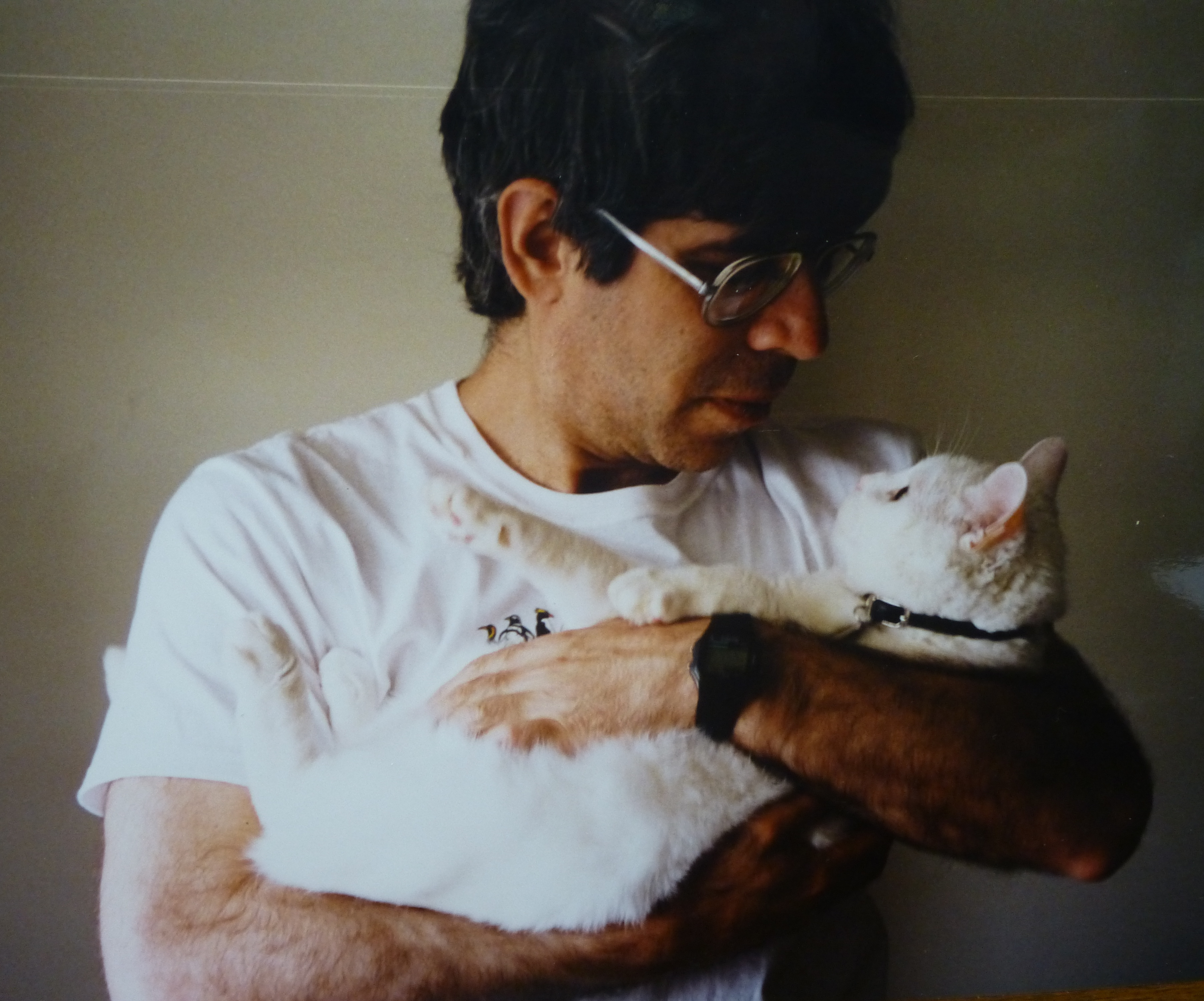
That corner-of-your eye happened to me, too, after I had to euthanize my beloved but lymphoma stricken white cat, Teddy. I haven’t had another cat since.  Here we are:

*******************

Lagniappe: I give the YouTube notes:

When Jessica Leatherman’s daughter went into first grade this year, she started riding the school bus. However, the girl has a special friend who makes sure she gets to school safely. It’s their family cat Craig.

h/t: Gravelinspector, Debra

Caturday felid trifecta: a very bad kitty; cat’s eye view of a cat-on-cat chase; goofy-looking cat’s popularity creates a shelter; and exciting cat-chase lagniappe

June 15, 2024 • 9:45 am

First, a very, very bad kitty! (But sometimes he’s a good kitty..) Perhaps he hates the vact that he’s named “Boobies.”

****************

Here’s a story that made the rounds a few weeks ago.

Click on the screenshot below to see Polish mountaineers scaling the country’s highest peak, only to find a cat near the top:

A tweet taken by Wojciech  Jabezynski and the “ginger legend”:

that ginger legend 😍🐈🐱🐈 told you so @lesliebialler @Rubicon1313 @lauraboerman @ButtersKatz one day they will rule the world 🌎 hopefully 🐱🐈 pic.twitter.com/CPPO7gkRyg

But what happened to the moggy? No worries: all went well.  The Daily Mail has an article; click on it to read:

From the article:

A Polish mountaineer who scaled his country’s highest peak was astonished to find a tabby cat had beaten him to it.

Wojciech Jabczynski could not believe his eyes when he saw the ginger tabby cat nonchalantly licking its paws on the summit of Rysy.

He filmed the animal with his smartphone at the mountain’s north-western peak which is 2,499 metres (8,199 feet) high.

Here’s Mount Rysy from Wikipedia; it actually has three summits and lies on the border between Poland and Slovakia

Krzysztof Dudzik (User:ToSter), CC BY-SA 3.0, via Wikimedia Commons

Here, from Unofficial Networks, is where the cat was found:

The footage shows the cat looking relaxed at the high altitude but unimpressed with the view as it sits on a rock overlooking a valley.

Mr Jabczynski said the cat did not appear to be afraid and readily approached him when he got out his lunch.

Here’s a selfie taken by Jabczynski:

It is not clear how the cat came to be at the top of the mountain although Mr Jabczynski has his own theory.

‘In my opinion, he came from a small hut for tourists under the Rysy peak on the Slovakian side of the mountain but this is just a hypothesis,’ he said.

The climber later shared his video and several photographs of the cat on social media.

One online commentator said it must have been a ‘snow leopard’, while another said it had the ‘soul of a chamois (mountain goat)’

But one more sober internet user added: ‘Death in these mountains awaits him, unfortunately. It would be nice if someone showed some empathy and common sense and tried to take the cat to shelter.’

I remember reading that the cat was taken down in a climber’s backpack and adopted by someone in a nearby village, but now I can find no indication of that on the Internet. If a reader finds any indication of the cat’s fate, please put it below.

Rysy is a mountain with three summits in the High Tatra Mountains on the border between Poland and Slovakia.

The north-western summit is Poland’s highest peak while the other two lie on the Slovak side of the border.

*****************

From Bored Panda, a goofy looking Russian cat named Fedja, which everyone loves. Click below to read, and I’ve illustrated the story with photos from Fedja’s Instagram page:

A few years back, we shared Fedya’s story on Bored Panda, and today, we would like to update you on his growing popularity.

Four-year-old Fedya, a gray cat, was rescued by Natalya. Since he was a very sick kitten, Natalya took him in to nurse him into the healthy and happy cat he is today. However, one thing did stand out from other cats – it’s Fedya’s face. You might say his facial expression gives him a permanently surprised look due to his unusual eye placement. Fortunately, that doesn’t negatively affect Fedya’s life; in fact, on the contrary, his unusual looks have gained him an astounding amount of 369K followers on Instagram.

So, without further ado, we invite you to read the story below and get to know Fedya – the cutest scaredy-cat on the internet – better.

Bored Panda once again reached out to Natalya, who told more about the challenges Fedya faced in the early days.

“In the first days, Fedya was very weak. He couldn’t find his mother on his own to suckle and eat. We fed him goat’s milk from a pipette. When he was one month old, he immediately understood the purpose of the litter box and went to the toilet not by the shortest route, but along the perimeter of the room, along the walls, turning at the corners. Perhaps the walls helped him orient himself in space. As Fedya grew up, he started trying to jump onto the windowsill to get out onto the street. But he couldn’t do it. He trained for almost a year before he could. He doesn’t know how to climb trees. For a long time, about a year, he couldn’t jump onto the bed – he climbed, digging his claws into the blanket.”

Fedya as a kitten:

Luckily, his current owner, Natalya, took Fedya in and nursed him back to health:

She also, via social media, made Fedja go viral:

We asked Natalya to share the moment when she realized that Fedya was getting famous.

“I realized that Fedya became an internet sensation when we gained thousands of subscribers in a few days and journalists from different countries started writing to us. And then our local journalists found out about us and started calling. It was amazing to me. I didn’t consider Fedya an exclusive cat; to me, he was just an ordinary cat, a bit strange and funny. As an introvert, I found popularity difficult to handle, but I was very pleased that my cat brought so much joy to people around the world.

Natalya also shared what it’s like to manage Fedya’s social media accounts.
“Managing a cat account is both easy and difficult at the same time. You can simply show Fedya’s life and his friends, and its endless content. But it can become boring for subscribers, so I try to make humorous videos. That’s how our activity started. If there’s any idea and I need to shoot a fictional story about cats, it’s difficult because cats see the situation very differently from me. However, they can transform any of my ideas even better than I imagined. So it often turns out to be fun because Fyodor’s facial expression always saves the situation.”


Two more photos/videos:

. . . and a funny one:

If you speak Russian, you can try ordering Fedja merchandise here.

********************

Lagniappe: A cat with a GoPro-like camera on its collar chases another one! A scuffle ensues and the miscreant appears to escape. What impresses me about this is how well the cat with the camera tracks the other one.

h/t: Brooke

Caturday felid trifecta: Rare “unicorn cat”; unsuccessful Danish postcats; man tries to drown kitten but he drowns and kitten swims back to shore; and lagniappe

June 1, 2024 • 9:45 am

Now from Cole and Marmalade we have a very rare “Unicorn Cat”. Click to read (see also Cheezburger.com and reddit)

The latest rare unicorn cat, a cat that almost doesn’t look real, is capturing lots of hearts online. Is this cat for real? Or is it an AI image? Who can tell anymore? It’s rapidly getting harder to say what’s artificial intelligence versus authentic these days. We see people believing in fakes so much, so it’s (unfortunately) a legitimate question in 2024.

However, this unicorn’s human promises he’s very much real, supplying more images.

Meet Bruce, a kitty so unusual that his mama has had to tell folks on Reddit, “He is real.” 


All photos from u/No_Secretary8854

According to the post, Bruce is a Minuet, a cross between a Persian and a Munchkin with shorter legs. But if so, he’s unlike any cat we’ve seen.

As you can see, Bruce appears to be Tuxie on his face but with the palest silvery blue eyes. That alone is unusual as most tuxedo adults will have a pale greenish or yellow eye color. Unfortunately, it suggests Bruce might be the result of the breeder’s efforts to produce cats with the “Dominant Blue Eye” trait. 

All photos from u/No_Secretary8854

. . . . Considering that it looks like Bruce is a combination of two cats, this unicorn kitty may be a genetic chimera. These cats, like the famous Venusthe two-faced cat, may have different eye colors and appear as two felines split right down the middle to make one animal!

Put very simply, a chimera has at least two different sets of DNA after the fusion of fertilized eggs or zygotes. They can sometimes be both male and female at once, leading people to speculate about Bruce’s gender, which could factually be ambiguous and nonbinary. Since the kitty seems to show the tortie or calico color (almost always female), it’s an added level of oddity that the name suggests he’s fully male too. It’s even rarer!

Whatever the case, Bruce is adorable and lovable and behaves like any cat being handled at the vet. Thus, we must acknowledge that the colors, however pretty or rare, don’t really matter at all.

But they do matter because these colors get the cat a lot of attention! Still, why don’t they say something about the secondary sexual characteristic of the cat? Does it have male or female genitals, for one thing?

All photos from u/No_Secretary8854

*********************

From Meowingtons.com we hear about cats that once delivered mail in Belgium. Bad idea! Click to read:


An excerpt:

Once upon a time in the Belgian town of Liège, the postal system was taken over, briefly, by cats.

, , , But as intelligent and skilled as cats are, we know that even our feline friends have their limitations. Which is why when a city in 1870s Belgium decided to use cats to deliver mail, a system that relies on a timeline that doesn’t exactly suit the ideal 17-hour sleep schedule of a cay … well, it should come as no surprise that it was relatively short-lived.

Nevertheless, in the 1870s, the city of Liège, Belgium hired a grand 37 cats to deliver mail. Messages were to be tied around the cats’ necks in waterproof bags to prevent any damage to the letters. The idea was to allow the citizens of Liège and surrounding villages to easily communicate with each other.

“Unless the criminal class of dogs undertakes to waylay and rob the mail-cats, the messages will be delivered with rapidity and safety,” The New York Times reported. One particularly dedicated feline delivered his letter safe and sound in less than five hours! However, the other felines took up to a day to deliver mail to their own homes, preferring a leisurely stroll and maybe a saucer of milk along the way.

Sadly, there are no photos of this horrible idea, but the BBC does have a section on Post Office Cats in its “working cats” post (more later). Excerpts:

In 1868 three cats were formally employed as mousers at the Money Order Office in London. They were “paid” a wage of one shilling a week – which went towards their upkeep – and were given a six-month probationary period.

They obviously did their job efficiently as in 1873 they were awarded an increase of 6d a week. The official use of cats soon spread to other post offices.

According to the Postal Museum, the most popular cat of all was Tibs. Born in November 1950, at his biggest he weighed 23lbs (10.4kg) and lived in the Post Office headquarters’ refreshment club in the basement of the building in central London. During his 14 years’ service he kept the building rodent-free.

Wikipedia has an article on “Tibs the Great” with a photo and more information:

Tibs worked at Post Office Headquarters in London for 14 years, and was officially employed and paid 2s 6d per week. He worked in the basement. He was cared for by Alf Talbut, cleaner at the church of St. Martin’s Le Grand, who had also owned his mother, Minnie.[4] During his 14 years, Tibs kept the Post Office headquarters completely free of mice.[1]

In 1952, there was “public outrage” that the cats had not had a pay rise since 1873, and the next year there was a question in the House of Commons, asking the Assistant Postmaster-General, David Gammans, “when the allowance payable for the maintenance of cats in his department was last raised?”[1]

Tibs died in December 1964; he had been suffering from oral cancer. He received obituaries in several newspapers. By the time of his death he had grown to 23 lb (10 kg) in weight, probably due to living in one of the staff dining rooms, rather than from eating rats.

. . . The last cat employed at Post Office headquarters was Blackie, who died in 1984, which coincided with cloth sacks being replaced with rodent-resistant plastic sacks.[2]

Here’s Tibs’s obituary printed in the Post Office Magazine:

********************

Also from Cole and Marmalade: Karma for an animal abuser (click to read):

Being cruel to animals or other people always comes back to bite the person doing the abuse. But so often, it seems Karma has extreme patience, and justice is not swift enough for our liking.

Well, for a couple of people who were abusive to animals, the trouble that came for them is all they may ever be remembered for. Over 75 years later, their stories are remembered as anecdotes shared all over the world. 

It’s amazing to think that this story from 1949 in France is still circulating around the world today. It’s all about the swift justice that came after a man named Henri Villette tried to drown a kitten. Who could have sympathy for what became of him?

Here are some news stories, with one in French:

Today, people remember Villette only as a sort of fable that tells a moral. Most versions are attributed to the Associated Press and appeared in newspapers in the United States, like the Gettysburg Times and the Ironwood Daily Globe from Michigan and the Des Moines Tribune from Iowa in 1949. The Daily Mirror in Sydney, Australia also shared the story as well as the Singapore Free Press.

More:

The story also appeared in TIME magazine, dating to October 3, 1949, with more interesting details.

“Cool and confident in his superior strength and wisdom one day last week, Henri Villette, a 67-year-old barrelmaker of Alencon, clapped an unwanted kitten into a musette bag and set out for the Sarthe River to drown it. On the river’s bank he slipped and fell. The kitten crawled to safety. Henri’s drowned body was found later by local firemen,” the story states.

There’s also a story of an abused d*g who was thrown into a well by an odious man, but the d*g lived seven months in the well, eating corpses thrown down by other people, before it was rescued. Here it is, but brush up on your French!

***************

Lagnaiappe: a physics cat (see here):

Here’s the story from Atlas Obscura, complete with a reprint of the paper, signed by both human and cat authors:

Jack H. Hetherington was a professor of physics at Michigan State University in 1975, when he finished what would become an influential and often-cited physics paper. The academic writing, entitled Two-, Three-, and Four-Atom Exchange Effects in bcc 3He, was an in-depth exploration of atomic behavior at different temperatures. It would have flown over the heads of most lay people, not to mention cats.

He was all set to send it to Physical Review Letters, which today describes itself as “the world’s premier physics letter journal.” However, before he dispatched it, Hetherington gave the paper to a colleague to get one last set of eyes on the piece. This is when he ran into a strange problem. Hetherington had used the royal “we” throughout the paper. As his colleague pointed out, Physical Review Letters generally only published papers using plural pronouns and adjectives like “we” and “our” if the paper had multiple authors.

. . .Hetherington wrote that after giving the issue “an evening’s thought,” he decided the paper was so good that it required rapid publishing. Unwilling to go back and replace the plural voice in the document, he did the next best thing and just added a second author: his Siamese cat, Chester. Of course just listing “Chester” as a co-author probably wouldn’t fly, so he invented the name F.D.C. Willard. The “F.D.C.” stood for “Felix Domesticus, Chester.” Willard had been the name of Chester’s father.

Portraying F.D.C. Willard as one of his colleagues at Michigan State, Hetherington submitted his paper, and it was published in issue 35 of Physical Review Letters.

Voilà!:

(from Atlas Obscura): The signed version of the paper. (Photo: More Random Walks in Science/Google Books)

That is a physicist after my own heart!

h/t: Debra, Stacy

Caturday felid trifecta: Cat rescued from hot car with fifty others becomes a Target model; collection of cute pictures of animals at the vet’s; Pennsylvania senate introduces anti-declawing bill; and lagniappe

May 25, 2024 • 10:00 am

The Washington Post recounts how a man was living in a car with 50–yes that’s right, 50–cats, and they were rescued from the car when it was left closed and overheated. One of the cats, named “Hercules”, was at death’s door, but they brought him back to become a model for Target’s store-brand kitty litter.

Click below to read, or go here to find the story archived for free.

The scene was heartbreaking: Nearly 50 cats were crammed into a hot car at a rest stop near Minnesota’s Twin Cities.

The cats were piled from floor to ceiling inside an SUV, and police soon learned that their owner had been living inside the car with them.

The owner agreed to surrender the cats to area animal shelters, but during the rescue, one of the cats escaped. Hercules, a gray and white feline, scampered off that sweltering day in June 2022, said Nicole Perreault, a veterinarian who runs Tuff Start Rescue, a Minnesota foster and adoption nonprofit.

Be sure to look at the photos of the cats in the car. It’s is indeed heartbreaking. But wait! There’s more:

Animal rescue volunteers searched for the cat for a month, she said, until Hercules was finally spotted sitting on someone’s doorstepin the area. His jaw was fractured, he was covered with maggots and his tongue was severely damaged, Perreault said.

The person who found Hercules outside brought the cat to the veterinary clinic.

Perreault said she suspected the cat was Hercules and contacted his previous owner, who confirmed it.

“This gentleman said he had fallen on hard times and had been evicted so he was staying in his car with all of his cats,” she said. “He was very polite, and it seemed he loved them very much. He was happy to know that Hercules had been found and was getting a lot of love.”

“We suspected he might have been hit by a car,” Perreault said of Hercules. “He was so near death that I wondered if it would be more humane to euthanize him.”

But then Hercules lifted his head and looked right at Perreault.

“I got the impression that he really wanted to fight,” she said.

Perreault and her team fed Hercules and cleaned him up, then gave him fluids through an IV and put him on pain medication. When the 6-year-old feline was strong enough, Perreault took him to an animal oral surgeon to have his jaw repaired.

Here are pictures of Hercules on Perreault’s FB page taken right when he showed up. He looks really awful! (You can donate there to help him, though he’s pretty good now):

Perreault said she posted a few photos of Hercules on her Facebook page to let people know the cat had been found and was gradually healing.

“He ripped my heart out when I saw him,” she wrote. “… I decided we owed it to him to give him every chance to recover from this horrible ordeal, so that hopefully he can experience the love and TLC that awaits.”

Jill LeBrun, a pediatric nurse from St. Paul who has fostered dogs and cats for Perreault’s rescue over the years, was immediately interested.

Last fall, LeBrun said, she was scrolling on social media when she came across a post from the Animal Connection, a pet talent agency in search of cats with unusual faces. It was scouting pet models for Target, which is based in Minneapolis.

LeBrun said the agency loved the photo she sent of Hercules with his tongue hanging out. She was asked to bring her cat to a studio for a photo shoot so his personality and star appeal could be assessed.

“Hercules did great — he’s a friendly cat and everybody loved him,” LeBrun said, noting that she was paid $100 to participate. “They told me his picture would appear on something for Target in early 2024.”

. . .In mid-March, when LeBrun still hadn’t heard back, she made a trip to her local Target and walked down the pet aisle.

When she came to a display of store-brand cat litter, she was stunned and delighted to see her cat’s image — with his dangling pink tongue — on every bucket of Up & Up Fragrance Free Clumping Cat Litter on the shelf.

And here’s a video about Hercules showing starring on the cat litter:

And there’s still more:

LeBrun said Hercules was recently called in for a second Target photo shoot, which means he’ll probably be appearing on other merchandise in a few months. The TV station Kare 11 recently reported on the cat’s sudden fame as a model.

Do watch the update on Hercules at KARE.

*********************

Bored Panda has a collection of 50 pets at the vet’s, and I’ll show just a few cat pictures with the credits:

********************

Here’s a still-active bill in Pennsylvania, sponsored by Carolyn Comitta (a good-hearted Democrat, of course) that bans the cruel declawing of cats. You can click to read the bill, or read a more recent update from the Animal Legal Defense Fund (ALDF):

I join the ALDF in supporting the bill. Their summary:

The Animal Legal Defense Fund supports this bill.

Sponsor: House Bill lead sponsor Rep Liz Hanbidge (D-61) and Senate Bill lead sponsor Sen Carolyn Comitta (D-19)
Introduction Dates:
House Bill: March 17, 2023
Senate Bill: April 22, 2024

This bill, H.B. 508/ S.B. 1178, would prohibit the declawing of cats unless the procedure is medically necessary for a therapeutic purpose and performed by a licensed veterinarian. Under this measure, declawing for cosmetic or aesthetic reasons, as well as for reasons of human convenience, would be strictly prohibited.

Declawing is an invasive surgical procedure in which the last bone of each toe is amputated, similar to severing a human finger at the last knuckle. The procedure is commonly performed for human convenience — often to protect furniture — rather than for the cat’s well-being. Declawing causes significant post-surgical pain and leads to a cat’s inability to scratch, eliminating a critical natural behavior. This can cause lifelong physical problems and lead to behavioral issues, such as biting and aggression, which the cat may resort to because they have been stripped of their primary defense mechanism.

Similar legislation has been enacted in three U.S. states — New York, Maryland, and Virginia — as well as numerous large cities that have jurisdictional bans such as Los Angeles, San Francisco, Madison, West Hollywood, Austin, Denver, Beverly Hills, and Berkeley. In Pennsylvania, communities such as Allentown, Easton, Etna, and Pittsburgh have successfully passed local laws to prohibit declaw procedures.

There’s no down side to this bill that I can see.  Saving a sofa (if no other scratching posts work) is less important than saving your cat’s feet and their ability to defend themselves.

**************

Lagniappe:  I can’t remember where I got this–probably on Facebook.

h/t: Divy, Barry, Ginger K.

Caturday felid triefecta: Silent film, “The Private Life of a Cat; cat accidentally gets shipped from Utah to California; cat jigsaw puzzle; and lagniappe

May 4, 2024 • 9:20 am

This lovely and relaxing 22-minute film. “The Private Life of a Cat“, was made in 1947 and is described as “Alexander Hammid’s intimate study of a female cat and the birth and maturation of her five kittens.” The YouTube video adds this (this version has sound, though the original was silent):

This film has four chapters. Chapter one contains footage of a cat giving birth. The original film has no audio. Picture contrast amended, score added. Chapters with music credits in brackets:

00:00 Intro (John Foxx & Harold Budd – ‘Raindust’)

6:57. Five of them! Now the family needs some food and some rest (Robin Guthrie & Harold Budd – ‘Brian’s Nightmare / The Unknown, Part One’)

11:04 After two weeks (Cliff Martinez – ‘Breaking The Waves’)

15:02 A better place for them to learn to walk (Harold Budd & Bill Nelson & Fila Brazillia – ‘Adrift Amidst Les Odalisques’)

One tabby that looks like mom, and four white ones that look like dad!

The Wikipedia entry for the film adds this (references omitted):

Synopsis:

The film is entirely silent and shot from the cat’s eye-level; “He”, an all white short-haired male cat, grooms “She”, a fluffier female. After two months they find a spot “for the family”, and soon after the mother goes into labour. The film shows graphically the kittens being born without the help of human hands, and then getting nursed and washed by their mother. The kittens grow, and the parent cats roam freely around their owners’ apartment (Hammid and Deren). The kittens learn how to walk and begin to get more active, playing with each other and clawing various furniture. The film then ends by showing the same scene from the beginning where “He” courts “She”.

Reputation:

Top Documentary Films rates The Private Life of a Cat 7.70/10 stars, saying that it is “very touching”, and that it is “[b]eautifully photographed and executed. With subtitles, no dialog, and a refreshing absence of human beings on screen.” Dangerous Minds wrote “[t]his beautiful 1944 silent film from husband-and-wife team Maya Deren and Alexander Hammid is quite possibly the only evidence we need that cats are the ultimate well-spring of creativity.”


*********************

Several readers sent me article and tweets about this incident, and I’ll put one article from boing boing here (there’s also a news report).

Click the headline to read. This is one reason that you should always microchip your cat, even if it’s an indoor cat:

A quick summary:

A Utah cat named Galena was playing in a large box, when suddenly things got dark.

Meanwhile, Galena’s human parents didn’t know where she was, and grew frantic as they looked everywhere for their pet. They even put up “missing” flyers and recruited their friends and family to help search the neighborhood for their lost kitty.

But it wasn’t until six days later that they got a text from Amazon in Riverside, California — more than 600 miles away — telling them that Galena had been found (thank goodness for microchips). Apparently, the couple had accidentally shipped their cat, along with five pairs of boots, in a large return package, which happened to be the box Galena had been playing in. (See video below, posted by CBS Miami.)

Miraculously, although the cat had no water or food for nearly a week, she somehow survived the long journey and was doing well.

A news video:

And a tweet. Look at that face!

***********************

Here’s a cat jigsaw puzzle from The Colossal Shop:

Thanks to Nervous System, herding cats is no longer guaranteed to be a catastrophic failure. This 224-piece jigsaw puzzle comprises 43 different felines as they lounge, stretch out their paws, and jump in the air, all based on photos of real cats submitted to the team. Try your hand at rounding up the rambunctious creatures by picking up one of the puzzles.

  • Technicolor cat artwork by Anne Sullivan
  • 224 pieces
  • Digitally painted on 4-millimeter maple plywood
  • Laser-cut in Palenville, New York

It’s not cheap at $75, but I suspect that the market is limited and it was hard to make. I suppose computers and 3D printing are necessary to make something like this. It’s now available if you want to treat a jigsaw-puzzling-loving ailurophile.

**********************

Lagniappe: A one-minute video of a kitten with paralyzed rear legs. The lovely woman who cares for it finally got it not only walking, but climbing! Everything always ends well in Dodo Land.

The notes from the video:

No one thought Milou would walk again, but Sandra wouldn’t give up on him ❤️ We spoke to her about how Milou changed her life!

h/t: Ginger K., Merilee, Jon