Why Evolution is True is a blog written by Jerry Coyne, centered on evolution and biology but also dealing with diverse topics like politics, culture, and cats.
Yep, my babies are trotting around in the snow. Fortunately, they have a kind patron who feeds them twice a day. Armon and Vashti are still here, and what reason would they have to go, given that they are fed two big square meals a day: nutritious duck pellets for main and tasty freeze-dried mealworms for dessert?
They are looking good, and Vashti seems positively plump.
It appears that the bonded pair of mallards at Botany Pond are here for the long term. Every morning they are waiting at the same spot for their breakfast, and in the afternoon they snooze on the rocks but swim to me for their late lunch when I whistle. Further, I saw two of our five red-eared slider turtles yesterday, swimming and sunning in the warmer weather. Here are a few photos and a video at bottom.
It seems that the ducks are residents now, and so it’s time to name them. As with last year, they appeared on the Jewish holiday of Purim and thus needed Jewish, Purim-related names. My friend Peggy Mason, co-duck-tender, scoured the Purim literature to give the ducks names (we don’t name them until we’re sure they’re going to hang around). The hen (not Esther, as I ascertained from photos published previously), is now called Vashti, named after a character in the Purim story:
Vashti (Hebrew: וַשְׁתִּי, romanized: Vaštī; Koine Greek: Ἀστίν, romanized: Astín; Modern Persian: وشتی, romanized: Vâšti) was a queen of Persia and the first wife of Persian king Ahasuerus in the Book of Esther, a book included within the Tanakh and the Old Testament which is read on the Jewish holiday of Purim. She was either executed or banished for her refusal to appear at the king’s banquet to show her beauty as Ahasuerus wished, and was succeeded as queen by Esther, a Jew. That refusal might be better understood via the Jewish tradition that she was ordered to appear naked. In the Midrash, Vashti is described as beautiful but wicked and vain; she is viewed as an independent-minded heroine in feminist theological interpretations of the Purim story.
That seems fairly appropriate given that there’s no other woman in the story save the heroine Esther, who saved the Jews.
A name for the drake was tougher, as the only other notable male in the Purim story is the wicked Haman, who tried to get the King to exterminate the Jews (Esther foiled that plot). And we can’t have a drake named after a genocidal maniac. Scouring the story and remembering her Hebrew, Peggy suggested the name Armon, which means “palace” or “fortress” in Hebrew. That’s where the whole Purim story took place. Fortunately, it’s also a Jewish man’s name, and short.
Ergo the hen and drake are now Vashti and Armon, respectively. I’ll have to do some explaining when visitors ask me the ducks’ names and how they got them. But it is cool that last year’s and this year’s ducks both arrived on Purim, though the holidays are two weeks displaced from 2025 to 2026.
Click the pictures below if you want to enlarge them.
Aaaaaand. . . here’s the pair together. I think they make quite the handsome couple:
The lovely Vashti, hopefully destined to produce this year’s brood of ducklings. Here she’s preening, sunning, and sleeping in the warm sun of Sunday:
And the regal Armon, swimming and napping:
We put five large red-eared slider turtles (Trachemys scripta elegans) into the pond last fall, and hoped they’d hibernate in custom turtle houses put on the pebble-y bottom. Apparently they did, as we’ve seen no bodies floating on the water. (These were five turtles saved and put in a southern Illinois pond when Botany Pond was renovated several years ago. I believe five more evacuees will come home again this Spring.)
It’s been too cold for them to show up, but yesterday I found a big one blithely sunning himself on a rock, stretching out his limbs to get the sun. (Turtles’ heads and legs are their solar panels, used to warm up the body.) Later I saw another one’s head above the water surface as it was swimming around. So we know we have at least two. Here’s the sunbather:
This is near the northern limit of the species’ distribution, as the eggs can’t survive very cold winters.
So we have our turtles and ducks: all is in place for a lovely Spring and Summer.
And a lousy movie of Armon and Vashti preening themselves after having lunch:
More good news: I’m told the duck camera, which has been re-installed, will be activated this week. Stay tuned for the link!
This morning a friend who works in the department office called me and said “there are two ducks in the pond.” I instantly knew that this would be a male/female pair of mallards scoping out the pond as a potential nesting and rearing site. Within one minute I grabbed my camera and my container of adult duck food (I saved it from last year; I have plenty and it’s still good), and ran down to the pond.
Sure enough, there was a pair of mallards at the far (south) end. Moreover, then swam near me when I whistled, though they didn’t come right up to me. This suggests that these are the mallards knew me, though, based on bill patterns in the hen, I don’t think they are Esther and Mordecai from last year.
Those ducks were named because they arrived on the Jewish holiday of Purim, and, sure enough, that holiday is tomorrow. These are again Jewish ducks and will have to be named accordingly.
I am so happy. There is no guarantee they’ll stay, but food is thin on the pond, and I am making sure they know it is a place to get a nice meal. After filling their tummies, they retired back to the south end for a rest.
Photos. First, the pair (name suggestions welcome, especially Jewish-themed names—but not Mordecai and Esther):
The hen:
The hen eating (out of focus). They were hungry!
The drake, dripping water from his bill after having eating a food pellet (I give them only the best):
The hen’s bill:
This is Esther from last year. The bill pattern of today’s hen is clearly different, so the hen we have now is not Esther. But there’s no guarantee that this one will breed here (remember, Esther was our first ground-nesting female). Note that today’s duck lacks Esther’s black markings on the top and tip of her bill, and those should have remained over a year.
Things are moving along at Botany Pond. Although the ducks have left (with only a few returning for a brief visit), six species of native fish have been introduced; a bunch of goldfish that people dumped in (probably from their aquariums) have been removed (none were killed; they are up for adoption and removed because we want only native flora and fauna in the pond); and five large “original” turtles, removed to another pond when Botany Pond was drained and fixed over the last few years, have been put back. This post documents the latest doings.
When 11 turtles were removed several years ago, they were marked by clipping off a bit of shell at the front, and then put for safekeeping in a large pond in southern Illinois. There were other turtles there, too, so to retrieve them for re-introduction to the pond, they had to be trapped, which took some time. One died in their “babysitting” pond, but there are five there, and we hope to get them next Spring.
But on October 2, the first three were released. All of the turtles were red-eared sliders (Trachemys scripta elegans), a species that is now native here, as the range has moved northward as the climate warmed. Again, these turtles must have lived in Botany Pond for a number of years when they were removed. Since it’s changed a lot since they lived here, I wonder if they remember it?
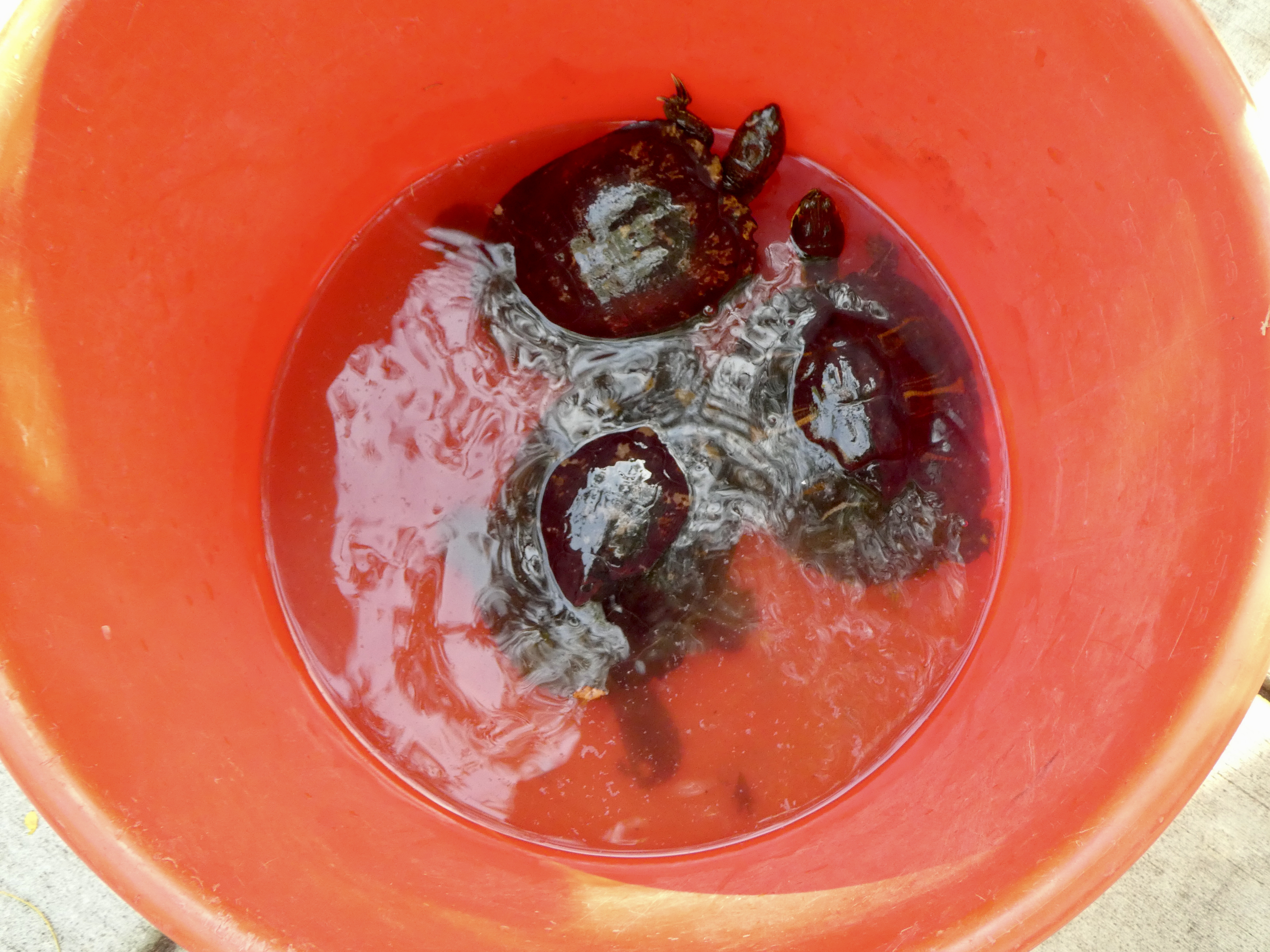
The first release. Here are the turtles in their bucket, restless and ready to go:
One just about to be introduced to the pond, hopefully her forever home. You can see a bit of the red stripe behind her eye.
The species is sexually dimorphic, with males having longer claws than females (they’re used to rake the female’s head before mating and then to hold onto her during the Act). These are short claws, ergo a female. We have at least two of each sex in the pond now, but breeding is unlikely as they bury eggs in the dirt near the pond, and those eggs have historically died during the cold winter. That’s why this is really the northernmost bit of their range.
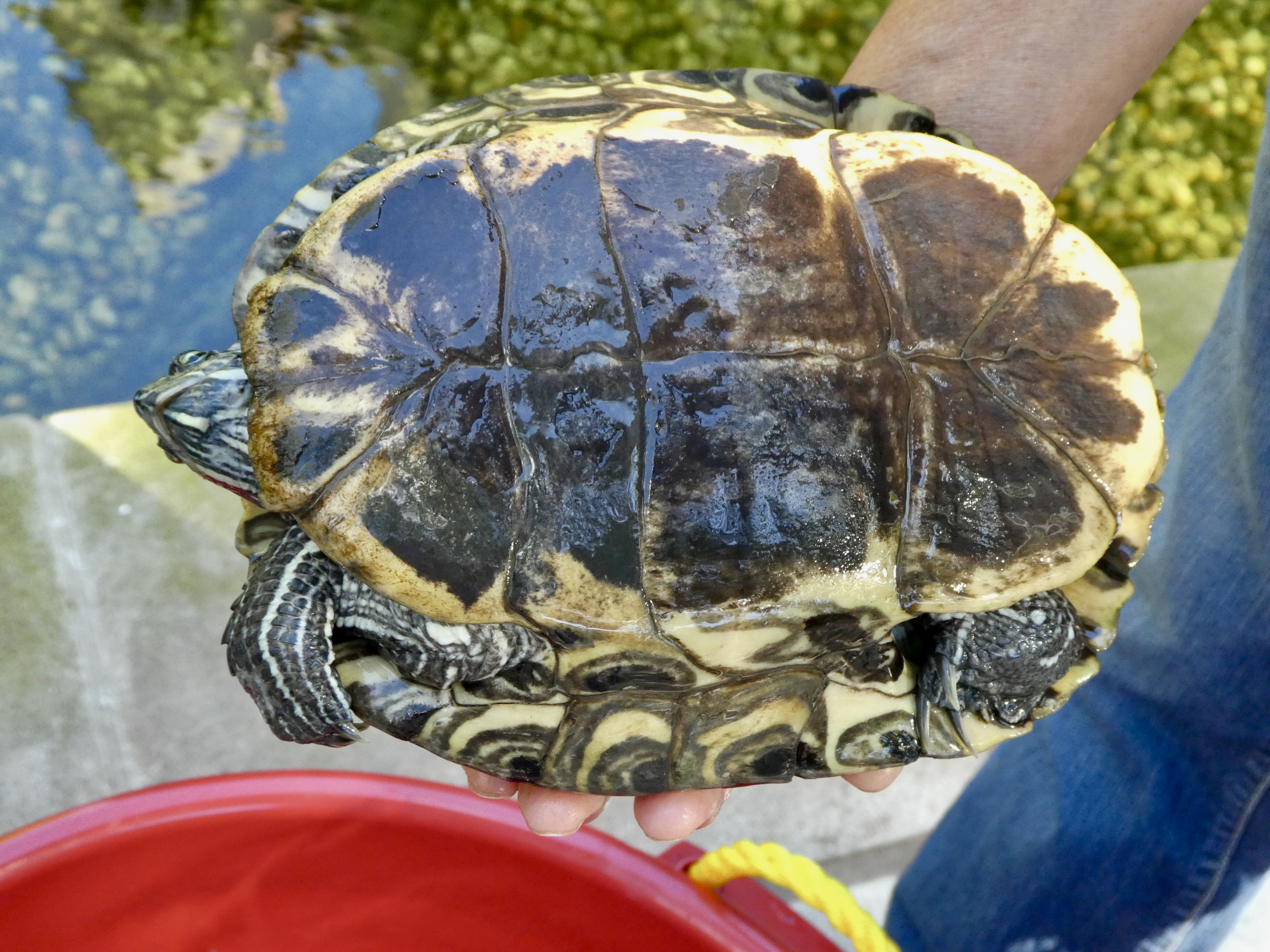
The bottom of the shell:
Head-on shot:
. . . and the head from below. These really are beautiful animals:
Here’s a video of the first release. You can clearly see the red stripe on the last turtle released.
They will spend the winter in hibernation; right now Facilities is feeding them frozen smelt, and they can also eat the minnows supplied in the second release (below). The turtles will spend the winter huddled in special “turtle caves” that Facilities has put on the rocky pond bottom (below); they can breathe from their butts (“cloacal respiration”) while hibernating. Here’s one of the turtle caves:
Between the first and second release, a fine pair of mallards came to the pond, but, sadly, flew away after a day when snorkelers (!) went into the pond to capture the goldfish. Ducks will not tolerate the presence of any humans in the pond.
I really, really miss the ducks, and almost none have stopped by the Pond on their way south. Here’s the handsome mated pair that we had for two days:
The second release of turtles was on Oct. 9.
The pair in their bucket, raring to go:
Note the red stripe on the head that gives this species its name:
Front view:
Bottom view. As you see, these turtles can be distinguished by the pattern on the bottom of their shells (compare to the ones above and below).
Big difference! The short claws indicate that this is another girl turtle:
The first released of two. They seem a bit flummoxed for a short while, and then they take off like a shot.
A close-up video of a released turtle. Note the longer claws: this is a male.
And the released minnows:
The turtles appear to have taken to their homes on the bottom lately (they can go several hours underwater without breathing), and I’ve seen them only rarely. They get their smelts twice a week and there is also dry turtle food (Mazuri Aquatic Turtle food) and the living minnows.
But I await the ducks next spring. There better be some!
The two mallard hens are still here at Botany Pond, and the new one has been named Dolores, with the last name del Estanque, making her name “Dolores of the Pond”, after the movie star Dolores del Rio.
They just had a huge breakfast, and one of them has been definitively identified as Hazel, the single hen who was here the other day. She brought a friend.
Here is Hazel’s bill (left side) from Saturday:
=
And here is one of the pair yesterday. It’s clearly Hazel:
They came together, and are clearly friends. They swim together, walk together, eat together, and hang out together. I’m very glad, as each has a friend and ducks are social birds who like company. Here are the two of them after a late lunch yesterday:
. . . and the new duck, Dolores del Estanque:
Let’s hope they hang around for a while. Everybody loves the ducks at the pond save one miscreant, but I won’t go into that.
And one water lily has bloomed, producing a beautiful flower:
As I wrote two days ago when posting two pictures, a new hen showed up in Botany Pond on Friday. It was very exciting, as we hadn’t seen any ducks in the pond since Esther and her babies left within a few days of each other over a month ago. The new hen was skittish at first, and afraid when food was tossed to her, but at least she learned that what I tossed was edible.
And of course I whistled as I fed her.
I decided that if the hen showed up yesterday, I’d name her. And, sure enough, she was there. Not only that, but she came swimming right at me for food. While she was still a bit skittish in the morning, eventually she swam slowly over to the edge of the pond by the bench on which I sat, and I fed her a little bit at a time. She was no longer afraid of food falling into the water, and she hung around after breakfast, apparently liking our company.
At lunch (she gets two meals per day) she again came swimming to me on my whistle, and was totally friendly: the tamest wild mallard I’ve known, and apparently able to recogize me. Besides duck pellets, she got mealworms, and loved them. Here she is (the poo behind her is not duck poo!)
One thing I realized is that the presence of even a single duck really enlivens the pond, and people came by to watch and photograph her. I’ve named her Hazel, by the way, taking the cue from her color.
Here she is resting on the bank on Day 1. As you see, she’s well fed. And she’s just molted, too, as her primary flight feathers are gorgeous and new. Two pair of people stopped and asked me lots of questions about the ducks. But the DuckCam appears to be gone. I will make inquiries.
After lunch yesterday, she continued to hang around the edge of the pond near me. Perhaps she’s lonely. I hope she brings a few friends with her. You’re luckless when you’re duckless.
Hazel is a very fastidious duck and spends a lot of time preening her new feathers.
Here’s a photo of the left side of her bill to help identify her if she returns next year. It’s a pretty identifiable pattern.
Finally, here’s a short video of Hazel doing some postprandial preening and swimming yesterday. Look at those gorgeous primary feathers (the big ones on the wing)! She’s also drinking to wash down the dry duck pellets.
She isn’t here this morning, and I fervently hope she comes back. Duckless is luckless.
UPDATE: Reader Nicole sent me this photo from the Duck Inn in Collegeville. PA. It sits by a pond full of mallards, and this machine is nearby. I WANT ONE!
The link to this “uchicago” Instagram post is here, and this lovely video highlights Esther and her brood, as they are the only brood the renovated pond has harbored. I’m sure this video was taken by the University photographer, who did a great job. I’m also delighted that the video (and thus the University) recognizes the value of the ducks to the pond and to the people who come to the pond to chill out.