Why Evolution is True is a blog written by Jerry Coyne, centered on evolution and biology but also dealing with diverse topics like politics, culture, and cats.
This is the second part of a batch of photos sent in by Neil K. Dawe from Vancouver Island, British Columbia. (His first batch, showing a visit to Darwin’s Down House is here.) Neil’s captions are indented and you can enlarge his photos by clicking on them.
The Eurasian Magpie (Pica pica) is a fairly common species in Britain. It was formerly considered conspecific with the Black-billed Magpie (Pica hudsonia) of North America and many authorities still consider them the same species. The magpie belongs to the corvid family, a group of some of the smartest birds including crows, ravens, and jays. The magpie is one of the few animals that is known to have self-awareness: an individual can pass the mirror test, recognizing itself in its mirrored reflection. Here’s a link to Ian Tyson’s descriptive song about this “pretty bird”:
The Eurasian Jackdaw (Coloeus monedula) is another member of the corvid family, a common species throughout most of Britain. Jackdaw means “small crow”:
The Eurasian Blue Tit (Cyanistes caeruleus) is common at feeders and was a familiar bird everywhere we went in Britain. It is known for its habit, first observed in the 1920s, of pecking through milk-bottle tops to sip the cream. Other blue tits quickly learned this behaviour through observation and by the 1950s most of Britain’s Eurasian Blue Tit population had learned this behaviour. However, with the advent of supermarkets and the stopping of doorstep milk delivery the habit has since died out. Interestingly, some European Robins (Erithacus rubecula) also acquired this behaviour but it never spread to the entire robin population as it did with the blue tits.
Blue Tit
The Great Tit (Parus major) was a common bird in most of the places we visited on our travels. Since spring temperatures have been increasing due to climate heating, a mismatch has occurred between the hatching of nestling tits and the peak caterpillar hatch, an important food for nestlings. This has caused a selection for earlier Great Tit egg-laying dates by up to 11 days and a shortening of the fledging period by 3–4 days. Second broods are also now more common:
The European Robin (Erithacus rubecula) gave its name to the American Robin (Turdus migratorius) whose reddish breast reminded early European Settlers of this familiar European bird:
The Dunnock (Prunella modularis), nicknamed the “hedge sparrow” has cooperative nesting behaviour, most often in the form of polyandry with two males and a female tending the nest and young. Polygyny has been reported to a lesser extent:
In Britain, males of the Common Chaffinch (Fringilla coelebs) tend to overwinter near their breeding areas while the females migrate further south, hence the male nickname “bachelor finch”:
The European Goldfinch (Carduelis carduelis) is a favourite cagebird in parts of its range. One study found it to be extinct or very scarce in the wild in much of Algeria and Tunisia but estimated a captive population of 15.6 million across the entire western Maghreb (Morocco, Algeria, and Tunisia). The practice of catching and keeping caged migratory birds is no longer allowed in Britain:
Today I’m putting up all the singletons and smaller batches sent to me. Readers’ captions and IDs are indented.
From Allen Jones (I don’t know the species). It’s in the UK; can readers help?
This was at a local bird of prey centre near Edinburgh. The eagle’s perched on me. The owner said that this boy or girl (not sure) would soon be the oldest eagle that had ever lived in the UK. He said it was around 50 years old.
From A. C. Harper:
Ordinary urban pigeons huddling together for warmth… but they are on a support of a bridge crossing an arm of the river Soar at Leicester. This was once open fields, then industry including extensive railway sidings, a foundry, a stone masons, several mills (afer canalization of this part of the river) and wharves for unloading coal. As you can see the industrial areas have now gone and are being replaced with houses and apartments. But the pigeons linger on ready for my cellphone, a Pixel 10 pro.
From Susan Harrison, who promises that there is more to come.
Thought you’d enjoy seeing this big Belizean kitty! He was lounging in the road last night as we drove into the Rio Bravo Conservation Area. He could not have cared less about us, which is always a nice thing to experience with wildlife. Anyway, this is just a teaser, and I’ll send a batch for RWP soon.
From Bryan Lepore.
These little Eastern cottontails [Sylvilagus floridanus] are in mid-ish Massachusetts outside of Framingham, and in my back yard. First photo June 26, second June 29:
From Nicole in Pennsylvania: A wild cottontail that comes to humans for apple slices. Her name is Petunia:
Convergent evolution, pictures by Martin Riddle.
The Hawk Moths, aka Hummingbird Moths [JAC: Family Spingidae] love the nectar in resident maintained gardens at Brooksby Village Peabody, Massachusetts:
We have a bunch of kangaroo photos from Scott Ritchie of Cairns, Australia. Scott’s captions are indented, and you can enlarge the photos by clicking on them. (His Facebook page is here.)
My last report from my Melbourne to Sydney trip. From Depot Beach New South Wales. It was epic. We stayed in a national park cabin that looked out over the ocean. And at 5 o’clock our front lawn became the bar for Eastern Grey Kangaroos [Macropus giganteus]. And in the morning, you could take pictures of the kangaroos watching the sunrise. What could be better for a boy from Iowa?
We had a ringside seat for roos. Would have been over a dozen here, not including joeys in the pouch:
The boys like a bit of rough and tumble:
They are smart to avoid those claws:
..just barely:
Squaring off:
I missed the kick shot. A sudden loud thump. Then the fight was over. One kick!:
Please send in your good wildlife photos (with “wildlife” construed broadly) if you have them. So far we can continue on.
Today’s bird photos are by Ephraim Heller, continuing with his pictures from the Pantanal wetlands of Brazil. Ephraim’s captions and IDs are indented, and you can enlarge his photos by clicking on them.
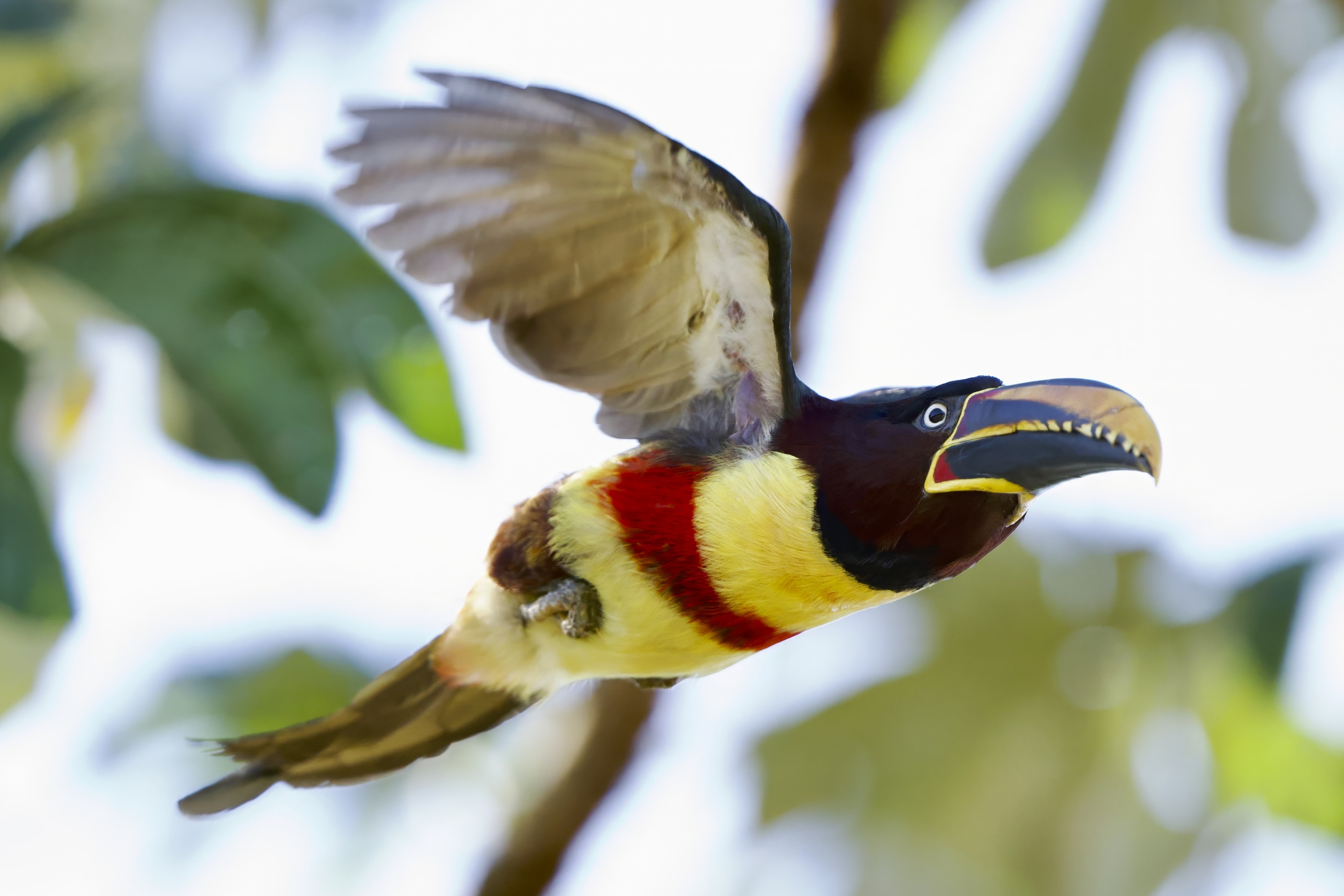
These photos are from my July 2025 trip to Brazil’s Pantanal, the world’s largest tropical wetland area and the world’s largest flooded grasslands. Today I have photos of a toucans, aracaris, woodpeckers, and “cardinals.” It’s a random assemblage of species, but all the adult males have at least some red feathers so I declare it to be a cohesive post.
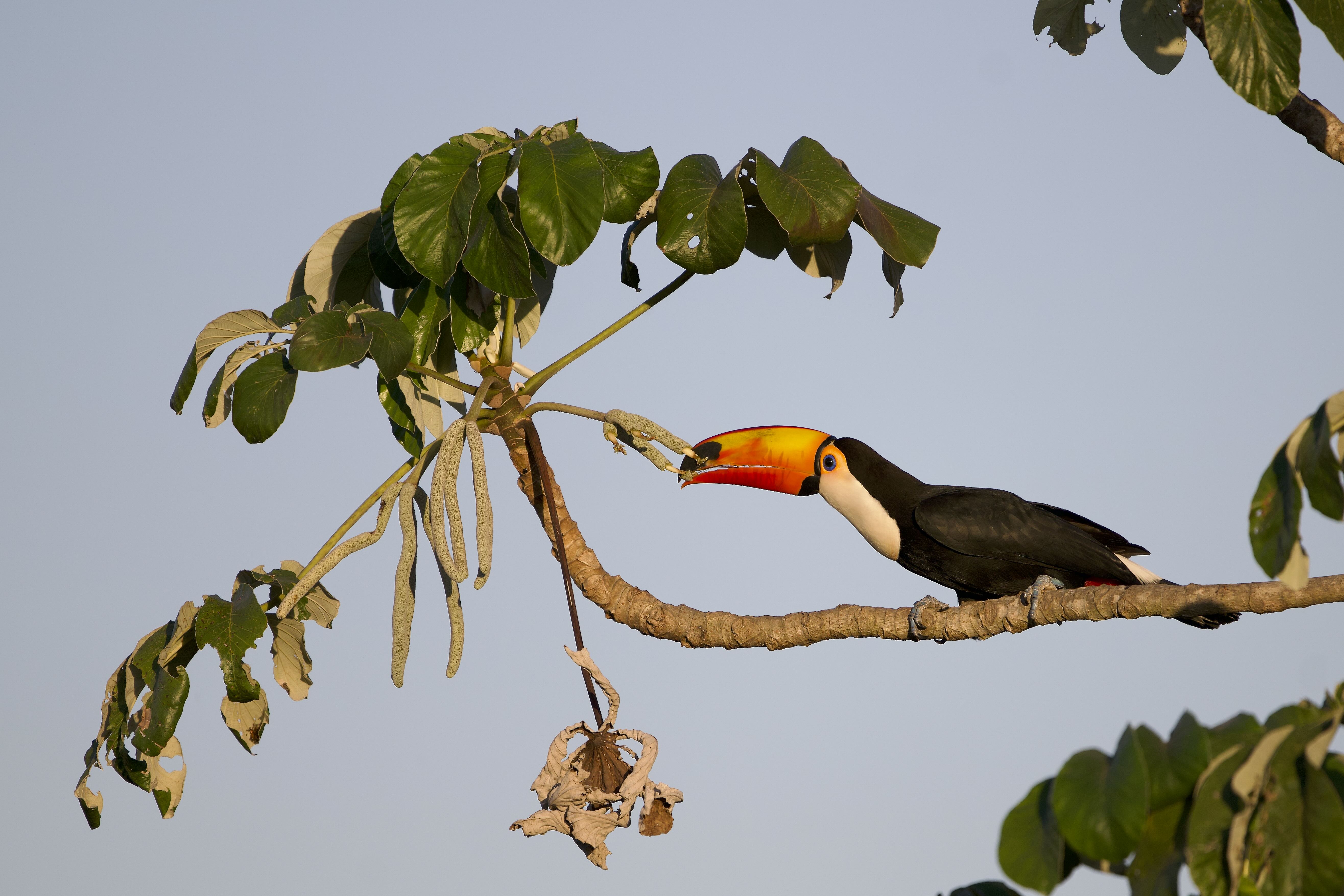
Toco toucan (Ramphastos toco). The largest and most recognizable toucan species. Despite its size, the bill is lightweight due to internal honeycomb structure. Per Wikipedia:
Research has shown that one function is as a surface area for heat exchange. The bill has the ability to modify blood flow and so regulate heat distribution in the body, allowing for the use of the bill as a thermal radiator. In terms of surface area used for this function, the bill relative to the bird’s size is amongst the largest of any animal and has a network of superficial blood vessels supporting the thin horny sheath on the bill made of keratin called the rhamphotheca. In its capacity to remove body heat, the bill is comparable to that of elephant ears.
This one kindly posed against the full moon before dawn:
The enormous beak helps the toco reach fruit on small branches:
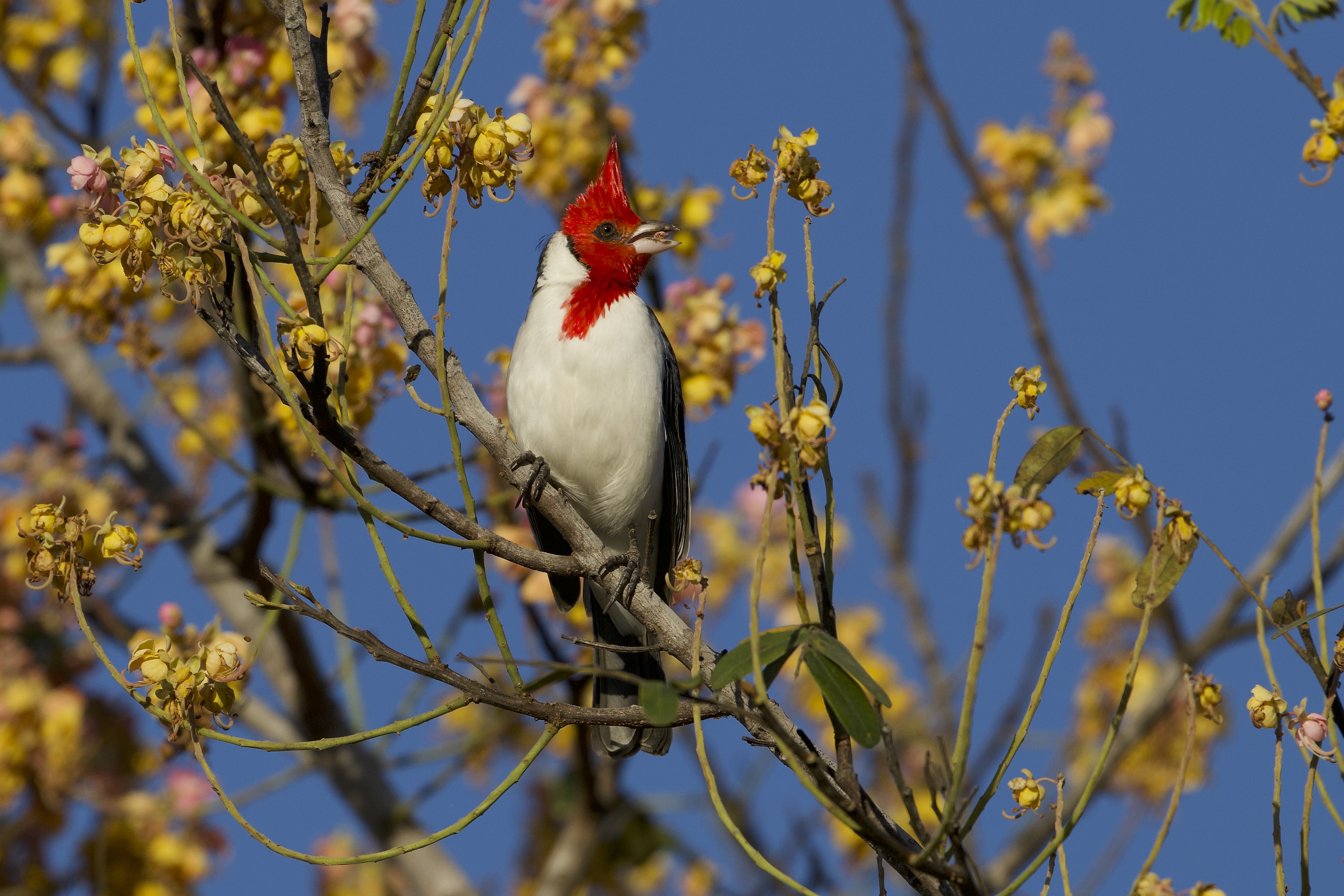
Now for the “cardinals.” Why the quotation marks? Because neither the yellow-billed cardinal nor the red-crested cardinal are true cardinals. Both belong to the tanager (Thraupidae) family, not the cardinal family (Cardinalidae). Now why would you go and call a tanager by the name cardinal? I’m outraged by it. How did the naming bodies allow this? In my opinion it puts all of science in a bad light with the general public, like cold fusion.
Today we have some lovely parrot photos by Scott Ritchie from Cairns in Oz (his Facebook page is here). Scott’s captions are indented, and you can enlarge his photos by clicking on them.
And on to New South Wales. First stop, Eden. This is at the southeaster-most point where Australia turns north. The first night we drove down to the end of the beach along an elevated ridge. There, I heard the unmistakable almost cat-like call, but softer, of the Yellow tailed Black Cockatoo [Zanda funerea]. Here are some images I got of this small group that was feeding in Banksia seeds along the road. I particularly like the yellow cheek and the nice soft masklike feathers around their beak. There’s a story to tell here that will be given in the photos below.
Yellow-tailed Black Cockatoos (YTBC), love Banksia seeds:
Indeed, they become single-minded in their pursuit of these seeds. Taste pretty good:
But while they’re chewing away, there could be danger about. Raptors could suddenly appear from the sky and clean them up. Have them for dinner, literally:
These are smart group, smart birds that travel in small parties—perhaps a family group. And they usually have a sentinel bird. This bird perches high in a tree, eyes peeled for signs of trouble. He called out my presence straight away. He’s often calling by chirping away to his mates. Everything’s fine. Enjoy your meal. I particularly like the cute little mask that they wear over the bill. Reminds me of the Covid mask, the P95:
Anyway, the Cockeys continue to feed:
And they are loving it!:
All of a sudden the sentinel urgently calls. You can see his mask, pulled up even higher, with urgent calls “Warning, warning. Incoming. Take flight now.”:
And sudden suddenly off they go, flying as one right over my head!:
And who should fly by, who may have had his eyes on the cockies, but a White-bellied Sea-eagle [Icthyophaga leucogaster]. He passes behind and flies down the beach:
And is chased by a Masked Lapwing [Vanellus miles] screaming “stay away stay away!” The YTBC warning system worked!:
We’ve known for a long time that sexual selection—ultimately caused by differences in gamete size—can produce marked differences in the appearance and behavior of males versus females within a species. Often males are more ornamented than females, with bright colors and long feathers or ornaments on the head. We also know that colors and ornamentation of males puts them at a disadvantage in certain respects, as they are more easily detected by predators than are the females, or have difficulty flying because of exaggerated feather displays. This disadvantage also applies to sexually-selected “weapons” like deer horns and moose antlers, which are shed and have to be regrown, at great metabolic expense, each year.
Perhaps the most famous of these features is the tail of the peacock, in which males have long, decorated, and spreadable tails that females lack. We are pretty sure that this difference is due to sexual selection because experiments show that the “eyespots” on the male tails attract females: the more eyespots you have, the higher chance you have of reproducing. Thus the genes for exaggerated tails accumulate via sexual selection by females.
Of course female preference plays a key role here, as that preference has to exist to give more elaborate males a reproductive advantage. We don’t fully understand, however, exactly why females prefer many exaggerated male traits. In some cases, like the orange-red color of the male house finch, we have an answer. As I said, there are also costs of sexually-selected male traits like big bodies (elephant seals) or antlers (moose), who use them to directly fight for access to females. (Darwin called this the “law of combat”.)
But in most cases we don’t understand why females prefer certain bright colors or long tails, though we have theories that are largely untested. This difference in patterning and color was called “the law of beauty” by Darwin, who was the first person to suggest the idea of sexual selection (1871).
Both forms of sexual selection show that this type of selection—really a subset of natural selection—involves tradeoffs. Males sacrifice flight ability, become more obvious to predators, and have to re-grow antlers and horns each year, which are considerable disadvantages. But those have to be more than compensated for by either the success in combat or the increased attractiveness to females of males with those traits—otherwise the exaggerated traits would not have evolved.
A new paper in Biology Letters (click title screenshot below) shows a novel form of tradeoff in pheasants, and the first such tradeoff known in any animal. In two species of pheasants, males have evolved “capes” around their neck that, when expanded, occlude the male’s visual field (but not the female’s), as well as head feathers that also appear to block the male’s vision. These are sexually selected traits. Noticing them, the five authors hypothesized the tradeoff: in the two species of pheasant with head and neck ornamentation (the Golden and Lady Amherst pheasant), they tested whether the male’s head feathers blocked part of his visual field compared to females in the same species. As a control, they used two pheasant species (Silver pheasants and Green pheasants), in which males don’t have head ornamentation that would block the visual field.
The authors then measured the visual field of males and females of all four species, and, lo and behold, males of the Golden and Lady Amherst’s pheasants did have a considerable blockage of the vertical field of vision compared to conspecific females, while there was little or no difference between the sexes in the two control species.
Click the title below to read the original paper for free, or find the pdf here. There is also a brief précis piece in Science if you want the abridged version. The quotes and figures below come from the original paper, while the six full-bodied photos of the pheasants come from Wikipedia (credits shown).
Bjørn Christian Tørrissen, CC BY-SA 3.0, via Wikimedia Commons
. . . and a female Golden pheasant. The sexual dimorphism is bloody obvious.
Photo produced by David Castor (user:dcastor)
The heads of males (l) vs. females (r) of the Golden Pheasant, taken from the paper itself. You can see how the male’s head feathers could occlude its vision.
The one other “experimental” species with male vision-occluding feathers.
And one of the two control species, the Green Pheasant, (Phasianus versicolor). First, a male, with vision not impeded by a crown. (The other control species, the Silver pheasant, Lophura nycthemera, isn’t shown.) Both of the control species show sexual dimorphism of color and plumage in the expected direction, but there are no feathers on the male’s head that could block his vision.
Alpsdake, Alpsdake, CC BY-SA 3.0, via Wikimedia Commons, via Wikimedia Commons
How did they measure the visual field of males and females? They simply put the pheasants in a padded box and fixed their heads firmly so that they could not move. (No pheasants were harmed in this study, which is excellent.) Then, to measure whether an eye could see at a certain angle, they shined a light on the eye. If there was a reflection from the retina at the back of the eye, that meant the bird could see the light from that angle. By performing many tests at various angles around the head, the researchers were able to judge the field of vision of each bird. They could also do this in pheasants whose heads were tilted up or down (see below).
The differences were most pronounced in the vertical line of sight. For example, as shown below, when the head is horizontal or looking down, the male of the Golden pheasant sees 30° less above his head than does the female. This would be a problem because, as the authors say, “Sexually selected traits such as feather ornamentation of male birds can act as an impediment to movement and predator detection.” When you’re a male pheasant busily foraging on the ground, which is how they eat, you may not see an approaching predator. That is the cost of the sexual selection that produced head and neck feathers. (The figure says this is a Lady Amherst’s pheasant but it is apparently a Golden pheasant.)
From the paper (Fig 1). Panels (C) and (D) show vertical cross-sections through the binocular fields in the mid-sagittal plane of the head. The head drawings represent typical resting postures for each species, based on photographs of birds observed in aviaries.Panels (I) and (J) display vertical sections of binocular fields when the birds focus on prey items on the ground during foraging
Here are all four species. The Lady Amherst’s pheasant has an even more severe impediment of vision in the male: he can see vertically a full 40° less than do conspecific females. In contrast, the sex difference in the control species is much less: a mere 5° reduction in males in the Silver pheasant and no difference in the green pheasant.
(From Fig. 2 of paper): Figure 2. Vertical sections through the binocular fields in the median sagittal plane of the head of four pheasant species. The line drawings of the heads of the birds show them in the approximate orientations typically adopted by the species when at rest, as determined from photographs of birds held in the hand in their aviaries. The left panel shows males and right panel females of (A,B) golden (Chrysolophus pictus), (C,D) Lady Amherst’s (C. amherstiae), (E,F) silver pheasants (Lophura nycthemera) and (G, H) green pheasants (Phasianus versicolor)
The figure below in the paper gives a three-dimensional depiction of a bird’s view, with males on the left and females on the right. You can see that the males are effectively blind (black area) over a much larger space than are the females, and that space is mostly above the bird’s head. Since pheasants are ground foragers, blacking-out of “down” vision would be a very serious impediment, making males unable to locate food. Blocking “up” vision would surely have a smaller cost.
(From paper, Fig. 1): Panels (K) and (L) provide perspective projections of retinal field boundaries from the bird’s own viewpoint, with blind sectors highlighted in black.
The upshot is that the authors’ hypothesis is supported: males but not females in the pheasants having feathers around their eyes appear to have occluded vision, mostly above their heads. Now we don’t know whether this occluded vision translates into a loss of fitness at all, much less a loss that is outweighed by the gain in fitness caused by the head and neck ornamentation. Trying to answer questions about fitness is nearly impossible, as you’d have to measure survival and offspring production of males who have bigger and smaller feathers within a species (would you have to give the birds a haircut?). But there is a period of moulting in which males lose their head and neck feathers, and at least researchers could measure the field of vision, and perhaps foraging efficiency, during that period. Nevertheless, I do suspect that occluded vision reduces fitness, and that the head ornamentation more than compensates for it.
Besides these results, the paper does show how natural selection and adaptation involves tradeoffs. There are usually no mutations that are “universally” adaptive in that they convey a benefit without any cost. As I said, natural selection will favor the increase in frequency of mutations that produce net reproductive benefits to the individual that outweigh the costs.
Here’s a lovely 52-minute PBS nature documentary that aired in 2011 (h/t Debi). Instead of thinking of turkeys as comestibles today, this will show you how they live real lives in the wild. It’s a wonderful video of a naturalist who, raising a passel of wild turkeys from eggs to adult, is allowed a fantastic and informative glimpse into the lives of birds that nobody thinks about.
After a local farmer left a bowl of eggs on Joe Hutto’s front porch, his life was forever changed. Hutto, possessing a broad background in the natural sciences and an interest in imprinting young animals, incubated the eggs and waited for them to hatch. As the chicks emerged from their shells, they locked eyes with an unusual but dedicated mother.
Deep in the wilds of Florida’s Flatlands, Hutto spent each day living as a turkey mother, taking on the full-time job of raising sixteen turkey chicks. Hutto dutifully cared for his family around the clock, roosting with them, taking them foraging, and immersing himself in their world. In the process, they revealed their charming curiosity and surprising intellect. There was little he could teach them that they did not already know, but he showed them the lay of the land and protected them from the dangers of the forest as best he could. In return, they taught him how to see the world through their eyes.
Based on his true story, My Life as a Turkey chronicles Hutto’s remarkable and moving experience of raising a group of wild turkey hatchlings to adulthood.
YouTube notes that “My Life as a Turkey” premiered on November 16, 2011. There’s more information on this page, inbcluding a Q&A with Joe Hutto.