
Today’s Jesus and Mo strip, called “tsar”, came with a clarifying note:
QED. The Free Speech Union has a pretty good write-up on this.
Here’s the gist of that article:
Last week the Government published its long-awaited official definition of Islamophobia — now repackaged as “anti-Muslim hostility” — and announced that it will appoint an “anti-Muslim hostility tsar”.
The proposal forms part of the Government’s new action plan, Protecting What Matters, which ministers say is intended to “strengthen social cohesion” and “tackle division”.
The Free Speech Union — which was not consulted despite raising serious concerns about the impact the definition could have on freedom of speech — is launching a legal challenge against the Government.
The FSU has long warned that the definition would have a chilling effect on free speech and revive Britain’s blasphemy laws.
In practice, the definition amounts to a Muslim blasphemy law via the back door — 18 years after Parliament voted to abolish such laws. Writing recently in The Times, the former chair of the Equality and Human Rights Commission, Baroness Falkner, described the proposal as “a two-tier policy — the enemy of equality and of community cohesion — in its purest form” and “a key step towards a blasphemy law”.
The definition is vague and subjective, and the Free Speech Union fears that it will be weaponised to silence legitimate debate about Islam, Muslims, and Islamic beliefs, practices and history.
Although the Secretary of State, Steve Reed, has insisted the definition will not have a chilling effect on free speech, early reactions suggest otherwise. Within 45 minutes of the announcement, the pro-Gaza independent MP Iqbal Mohamed asked whether the definition could be incorporated into the Seven Principles of Public Life — the standards that public office holders, including MPs, are expected to follow.
There are in fact no blasphemy laws in most of the UK. As Wikipedia notes,
Blasphemy laws dating back to the medieval times were abolished in England and Wales in 2008 and Scotland in 2021. Equivalent laws remain in Northern Ireland but have not been used for many years.
And here’s the official UK government definition of “Islamophobia”. Bolding of the problematic parts—parts that could chill anti-Islamic speech—is mine.
Anti-Muslim hostility is intentionally engaging in, assisting or encouraging criminal acts – including acts of violence, vandalism, harassment, or intimidation, whether physical, verbal, written or electronically communicated – that are directed at Muslims because of their religion or at those who are perceived to be Muslim, including where that perception is based on assumptions about ethnicity, race or appearance. It is also the prejudicial stereotyping of Muslims, or people perceived to be Muslim including because of their ethnic or racial backgrounds or their appearance, and treating them as a collective group defined by fixed and negative characteristics, with the intention of encouraging hatred against them, irrespective of their actual opinions, beliefs or actions as individuals. It is engaging in unlawful discrimination where the relevant conduct – including the creation or use of practices and biases within institutions – is intended to disadvantage Muslims in public and economic life.
Of course promoting criminal attacks against any religious groups should be illegal, but that is action, not speech. In the U.S., criticism of Islam, or even of Muslims because of their perceived beliefs, is legal under the First Amendment. In the U.S. you can, for example, say “Gas the Jews,” or “The Jews control the world”. Saying similar things about Muslims or members of other faiths is similarly legal. The only criticism of Jews, Muslims, Christians and the like that is prohibited in America includes words designed to immediately provoke predictable violence (whether that be personal “fighting words” or public proclamations), and defamation,
You can see where the definition shades into prohibiting criticizing the religion itself, and the problematic use of “inferring intent”. It’s a slippery slope, and I suspect that this law will have the opposite effect of strengthening social cohesion and reducing divisiveness in the UK. Importantly, since there are no equivalent laws for any other religious group (as far as I know), Jesus’s criticism is on the mark. This is what happens when a group demands special privileges for itself, and those privileges are granted because of fear of a hostile reaction if they’re not granted. Below, Mo shows precisely the kind of reaction that proponents of the law say will not happen:
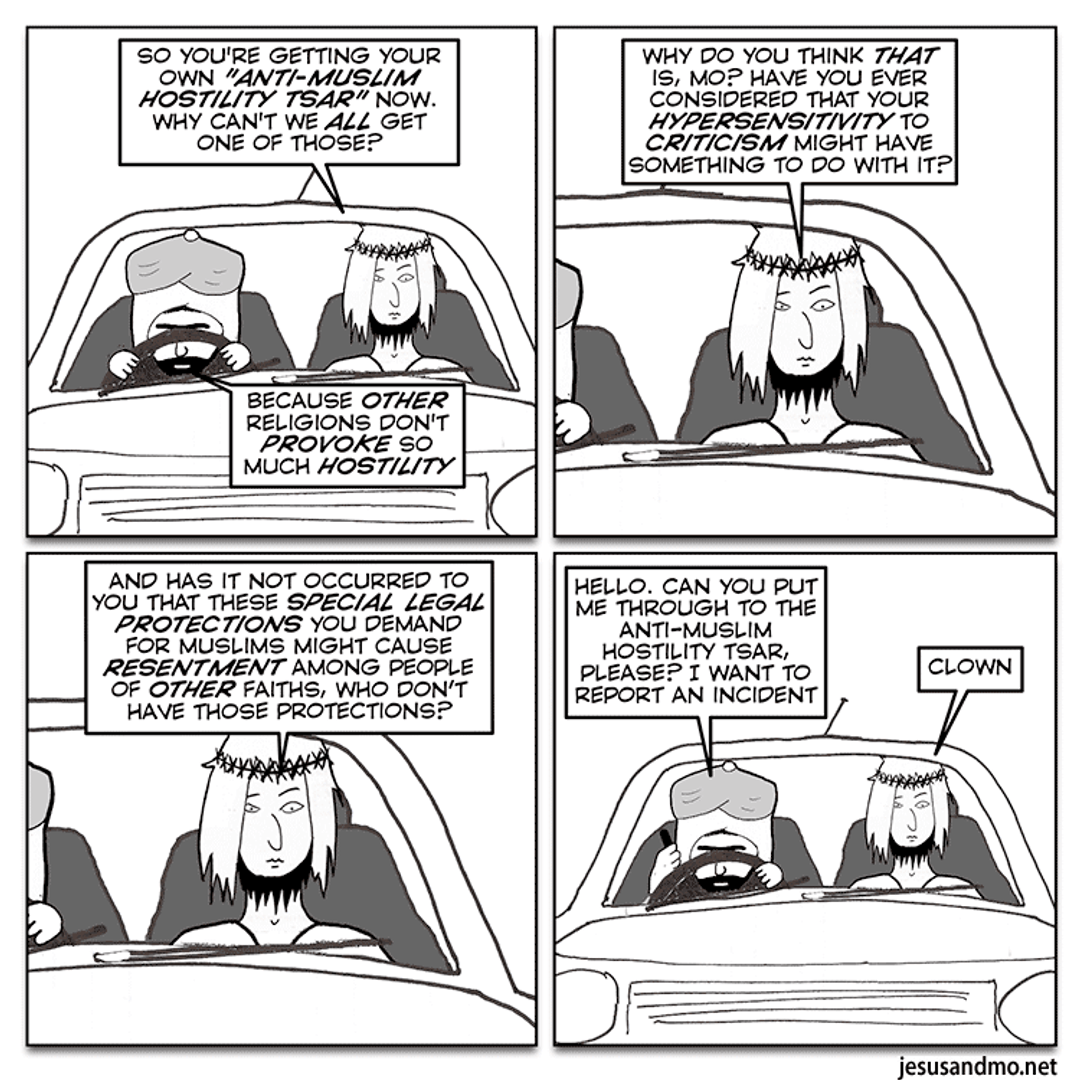
We’ll see what Charlie Hebdo makes of this.
The word “Anti-Muslim” fits the form of loaded language, or a thought-terminating cliché, as described in Chapter 22 of :
Thought Reform and the Psychology of Totalism — A Study of “Brainwashing” in China
Robert J. Lifton
W. W. Norton & Co., Inc., New York
1961, 1989 (UNC Press)
(PDF versions exist)
… most language inventions with “Anti-” in them are very effective at shutting down thought (“the language of nonthought” – per Lionel Trilling as quoted in Lifton) and getting the masses to go along with the program. Consider, “anti-littering”, “anti-Cancer”, “anti-bullying”, etc. “You wouldn’t want to be against those projects, would you? Join us – no? Oh look everyone – look who supports littering!” See how that works?
In the present case, it is extremely effective because it antagonizes by playing off a genuine and relevant “anti-” word that is substantially backed up with evidence across the centuries : Antisemitism.
The Gnostic parasitic relationship here is very clear (IMHO) – braiding a new ideology together with a firmly established idea.