
Today we have some photos of New Zealand’s forest birds from reader David Riddell. David’s captions and IDs are indented (don’t miss the informative text!), and you can enlarge his photos by clicking on them.
In previous batches of images I’ve posted here I’ve focused mostly on New Zealand’s water birds, and particularly the oceanic birds which are such a significant part of our avifauna. Compared to most similarly sized temperate countries New Zealand has relatively few indigenous land birds, partly a consequence of our isolation and partly due to the history of extinctions since these islands were first colonised by humans in the 13th century. On the other hand a high proportion of those birds are endemic, often with no close relatives elsewhere. Most of these photos are from a road trip our family did in October 2019, from our home in the central North Island down through the South Island to Stewart Island, the southernmost and by far the least modified of New Zealand’s main islands.
The first major destination on our trip was the Heaphy Track, in the north-west of the South Island, where we walked in to the first hut from the south-western end, and a short distance up the Heaphy River valley. The tui (Prosthemadera novaeseelandiae) is still quite common in many parts of the country, and in the last 15 years have re-established themselves in the area where I live in the rural, lowland Waikato region, but in the Heaphy we saw a flock of several dozen, which is still an unusual sight. They’re one of two New Zealand members of the honeyeater family, which are much more diverse in Australia. This one has a dusting of pollen on its face from feeding on New Zealand flax (Phormium tenax):

South Island tomtits (Petroica m. macrocephala) are a common and approachable bird throughout forested parts of the island and its outliers. Males have a yellow flush on the upper breast which the North Island subspecies lacks:

Weka (Gallirallus australis) are flightless rails about the size of a bantam hen, and are well-known for their bold and fearless nature – we often had them hassling us for food scraps as we went along the Heaphy Track. They seem able to handle most exotic mammalian predators, and are known to catch and eat rats, though they have disappeared from large areas of the country, possibly due to disease. In some areas, however, they are making a comeback and expanding into new territory:

There is another flightless rail in New Zealand which is even larger – in fact it’s the largest rail in the world – the takahe (Porphyrio hochstetteri). Four individuals were sighted in the latter half of the 19th century – and promptly “collected” – after which they were believed to be extinct, before being rediscovered in the remote south-west of the South Island in 1948. Intensive management has seen numbers slowly rise to about 300, with a couple of new populations established on the South Island mainland, as well as others on predator-free islands. These ones are on Kapiti Island, off the south-west coast of the North Island. There was also a North Island takahe species (Porphyrio mantelli, also known as moho), which was very similar, though taller and more slender, but now extinct. Both were originally classed in the genus Notornis, but molecular studies have revealed that they appear independently derived from flighted gallinules, known in New Zealand as pukeko (Porphyrio melanotus), colonising separately from Australia in a nice example of parallel evolution:

Our next stop after the Heaphy was Arthur’s Pass, one of the main routes across the Southern Alps which run along most of the length of the South Island. A special treat was the view we had out the kitchen window of our accommodation, where a pair of riflemen (Acanthisitta chloris) had their nest in a retaining wall just a few feet away. This is the male; riflemen (named for their bright green “jackets”) are New Zealand’s smallest bird, weighing only 6 grammes, and have extremely short tails. They’re reasonably common in larger, less disturbed forest areas, but always a delight to see. Their call is so high-pitched that many people can’t hear it at all. The family they belong to, the Acanthisittidae or New Zealand wrens, is the sister group of all other passerines, meaning they’re the most ancient of living families of perching birds:
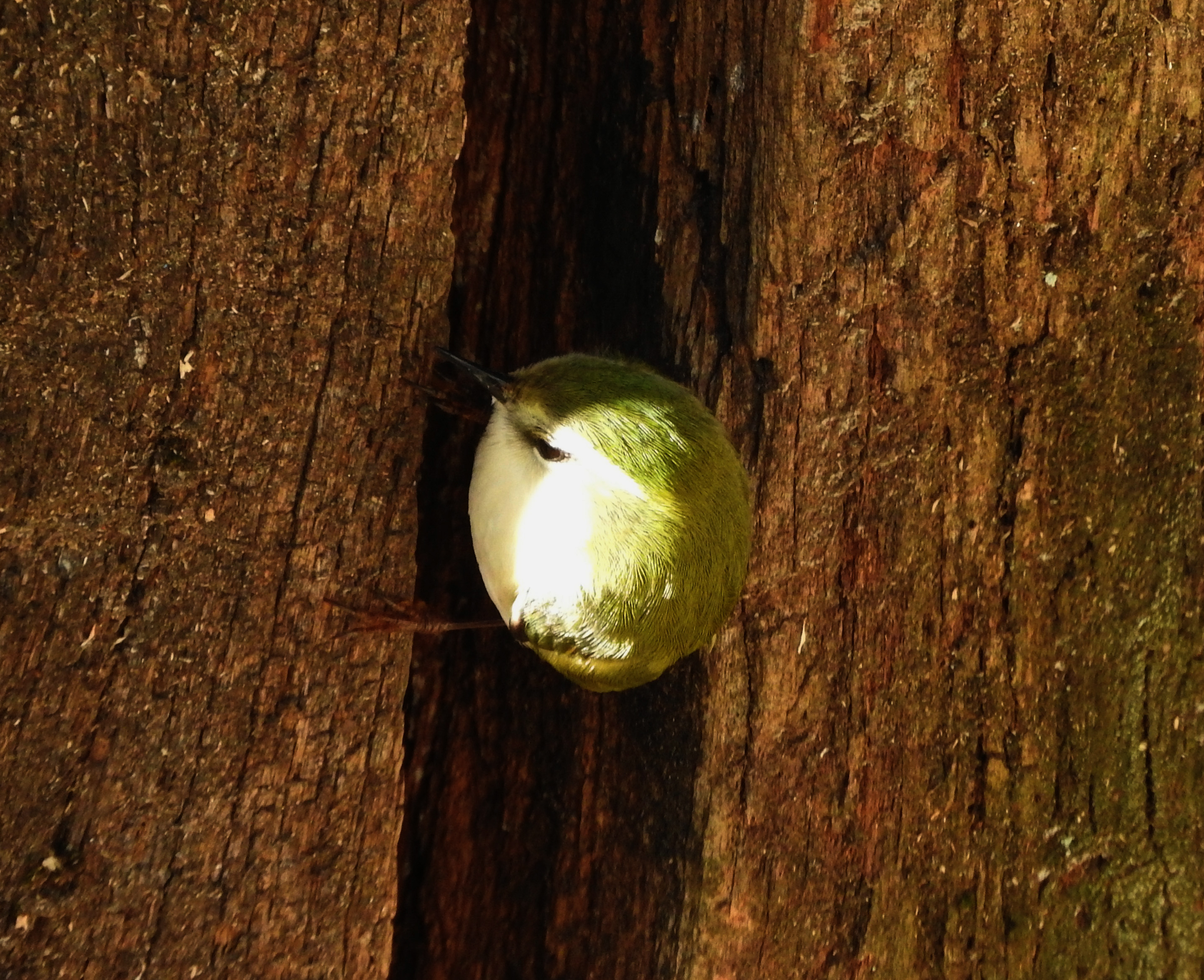
Only one other New Zealand wren species remains extant, the rock wren (Xenicus gilviventris). It’s much rarer than the rifleman, and is mostly confined to alpine areas above the bushline, where it spends the winters among rocks and low vegetation covered by snow. This one was at the head of the Otira Valley in Arthur’s Pass. The other four or five species in the family are now extinct; three are thought to have been flightless, an extremely unusual feature for passerines. The only one of these to have survived into the period of European settlement, the so-called Stephens Island or Lyall’s wren (Traversia lyalli), is often said to have been wiped out by a single cat (in some recent tellings given the name “Tiddles” or “Tibbles”), belonging to the lighthouse keeper, Lyall. In reality the island was overrun with feral cats (since eradicated), and the island’s population was a relict of a formerly widespread distribution throughout the country:

Most people think of parrots as warm climate birds, but one New Zealand species is quite at home in alpine areas, though it also occurs in lowland regions of the South Island. Kea (Nestor notabilis) are regularly seen around Arthur’s Pass, often scrounging for handouts, though feeding them is discouraged. They’re regarded as one of the world’s most intelligent birds, and the rubbish bins at Arthur’s Pass have to have special kea-proof catches. Some also figured out that they could hook their claws into the wool on sheep’s backs and peck at the fat around the kidneys, usually resulting in blood poisoning and the death of the sheep. Consequently there was a bounty on them for many years, though they’ve been fully protected since 1986, and changes in management practices since then have reduced conflicts. This one is looking rather bedraggled in the rain, about to turn to snow:

Kea have a close relative, the kaka (Nestor meridionalis) which is more common and widespread, though it has also declined significantly. On Stewart Island, where this one was, there are big numbers flying around Oban, the island’s only town (population c. 380). The flowers it’s feeding on are from a New Zealand flax (Phormium tenax), the plant responsible for the orange dusting on the tui in the first photo. It’s no relation of the plant that produces linen, but does produce a very coarse fibre which was once the basis for a substantial industry:

Last year we were delighted to have four kaka flying around our garden, an unusual sight in settled parts of the Waikato, though there seem to be more and more around here as the years go by. The tree it’s in is a kowhai (Sophora microphylla), whose flowering is a sure sign of the arrival of spring:

Perhaps not such a great picture, but this is completely unretouched! It’s a photo of an infra-red night vision viewer screen, pointed at a southern brown kiwi, or tokoeka (Apteryx australis). It was wandering around my feet, hence the foreshortened appearance and apparently small legs; I think the “eye” is a raindrop on the screen (it was raining lightly at the time, as it often does on Stewart Island). The photo was taken in pitch darkness at about 5.30 am on the rugby ground on the edge of the town. It’s known as a good spot for kiwi, but when we tried the previous night there was no sign of them, just a dozen or so people wandering round with torches covered in red cellophane, the recommended way to look for kiwi. On another evening we did see one wandering along the waterfront road under the streetlights, very close to our hotel:

Just off Stewart Island is Ulva Island, which was cleared of rats in 1997 (there have been occasional incursions since, but so far these have all been contained), and is now home to an excellent range of indigenous flora and fauna. Perhaps the most special is the South Island saddleback (Philesturnus carunculatus), which by the early 20th century was confined to a small island group off the southern end of Stewart Island. In 1962 rats got ashore and rapidly began eating their way through everything on the islands. An emergency rescue mission by the Wildlife Service captured 36 saddleback and relocated them to predator-free islands; without this action the species would certainly now be extinct. Other species weren’t so lucky, including the last population of a third acanthisittid species, the bush wren (Xenicus longipes). The South Island saddleback has a distinct juvenile phase, known as a jackbird, which is light brown, without the adults’ wattles, and no saddle. Their North Island counterpart (Philesturnus rufusater), sometimes regarded as a subspecies, lacks the jackbird phase, has a narrow gold band along the front edge of the saddle, and has a more complex song repertoire. In the final chapter of The Selfish Gene, Richard Dawkins uses the ability of saddleback individuals to learn new songs from each other as a non-human example of cultural (non-genetic) inheritance, a concept for which he coined the term “meme”:

Saddlebacks belong to an endemic family, the New Zealand wattlebirds, or Callaeidae. One species, the huia (Heteralocha acutirostris), is extinct, while another, the South Island kokako (Callaeas cinereus) may be, with the last probable sighting in 2007. The North Island kokako (C. wilsoni) has a few secure populations on predator-free islands, and slowly increasing populations in several closely managed reserves in the northern North Island. Ecologically they’re rather like squirrels (or perhaps flying squirrels), bounding through the trees on their long legs, eating mostly fruits and leaves, and flying very poorly. Their song is hauntingly beautiful – I have it as the ringtone on my phone. This individual, on Tiritiri Matangi Island, shows well the powerful legs and almost ridiculously small wings. Note also the blue wattles – they’d be orange on a South Island kokako:

Back on Ulva Island, the Stewart Island robin (Petroica australis rakiura) often follows human visitors quite fearlessly, looking for insects they might disturb as they walk along. They’re smaller than the South Island subspecies (P. a. australis) and quite scarce on Stewart Island itself, due to the presence of rats and cats:

Ulva Island is one of the few places it’s possible to see two of New Zealand’s parakeet species together. This is a red-crowned parakeet (Cyanoramphus novaezelandiae), which is very rare on the mainland, though it has several secure island populations:

This one is a yellow-crowned parakeet (Cyanoramphus auriceps), photographed on Little Barrier Island (I didn’t get any pictures on Ulva). They’re slightly smaller than their red-crowned cousins, with paler, lime-green plumage, and a chattering call that’s more high-pitched. They spend more time in trees and less on the ground, which makes them less vulnerable to mammalian predators and hence are more common on the mainland, though they require tall, well-established forests where predation is an issue:

Very nice,thank you.
What lovely photos.
I have never visited NZ, though I have several friends and colleges there, and it is about first on my list among places that I would like to visit. Among the reasons are the natural beauty and wildlife, and those pictures reinforce my ambition to visit.
One could easily imagine spending the rest of my days birdwatching with a pair of binoculars.
Thank you so much for the lovely photos and the avian tour though the islands of NZ!
Fantastic collection. So many of those birds are rare, which is sad. That Kea is one sinister-looking bird. Cover the area around your kidneys if you see one!
I thought that was a tennis ball wedged in a tree. 😉
Great pictures and very interesting descriptions. Thanks.
Interesting pictures and commentary! Thanks!
Excellent! Keas were always my favorite, as on the $10 bill there (that was).
Moa would be nicer, of course….
Always liked how you guys use entire islands (like Tiri Tiri) to work as rare bird and weta sanctuaries. Keep up the excellent photography, thanks!
D.A.
NYC (formerly of Remuera, AKL)
Wonderful pictures and descriptions, thank you! We visited NZ three years ago (North and South Island), and this took me right back. We saw many beautiful birds that we did not recognise, including shags and raptors. I’ll try to collect some pictures, and if we may put them up here, maybe you can help with identification…
Cool photos! Thanks!
Gorgeous photos. Thanks!
Jerry: the link to Ulva Island (right under the infrared photo) is to the Ulva Island in Scotland. Please correct it to the Ulva Island in New Zealand. Who knew that there was more than one Ulva Island?