
We have no more batches in the tank, so if you have photos, send them along. Thanks.
Today’s final tranche comes from reader Ephraim Heller, which will be in two parts. Ephraim’s captions and IDs are indented, and you can enlarge his photos by clicking on them:
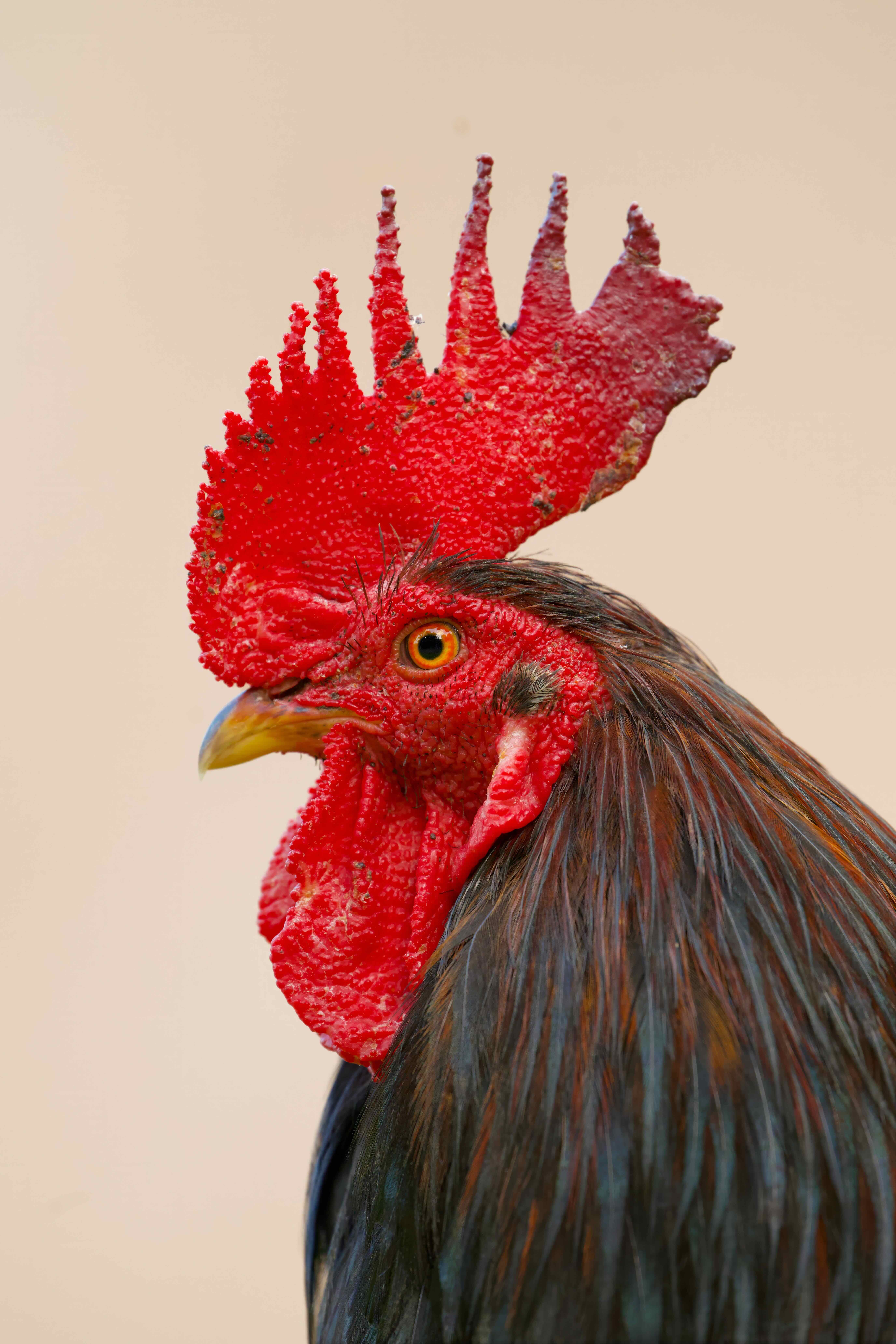
Q: Why do chickens (Gallus gallus domesticus) in Trinidad & Tobago cross the roads?
A: To eat the tarantulas.
During my recent visit to Trinidad and Tobago, a local birding guide explained that one of the reasons people commonly keep free-range chickens in their yards is to eat the tarantulas. This gave me a new respect for these domestic fowl, as I witnessed venomous tarantulas larger than my XXL-size hands, such as this female Trinidad chevron tarantula (Psalmopoeus cambridgei):

Trinidad harbors a diversity of arachnids that rivals anywhere in the Neotropics. On my night walks with my new macro lens I observed spiders (order Araneae) and harvestmen, also known as daddy long legs (order Opiliones). Both arachnids are eight-legged members of the class Arachnida, but they belong to entirely separate orders and are not closely related within that class.
Returning to the Trinidad Chevron tarantula: it constructs silken tube retreats in tree crevices, behind bark, and among epiphytic plants. It also readily adapts to human structures (e.g., tin roofs, metal pipes, and abandoned buildings) making it something of a synanthrope:

Females are large and fast-growing, reaching 18 cm (7 inches) in leg span, with striking chevron-shaped dark markings on the abdomen and green-brown coloration accented by red or orange flashes on the legs. Males are smaller, with a more uniform grey-brown appearance, and can mature in as little as one year. The species is notable for its broad diet: bats, frogs, lizards, grasshoppers, mice, and other insects have all been documented as prey.
Pharmacologically, the Trinidad chevron tarantula is of medical interest. Its venom is the source of psalmotoxin and vanillotoxin – inhibitor cystine knot (ICK) peptides that may have therapeutic applications in stroke treatment.
The pinktoe tarantula (Avicularia avicularia), is the most commonly encountered tarantula in Trinidad and Tobago. This arboreal species is named for the distinctive pink coloration on the tips of its legs in adults:
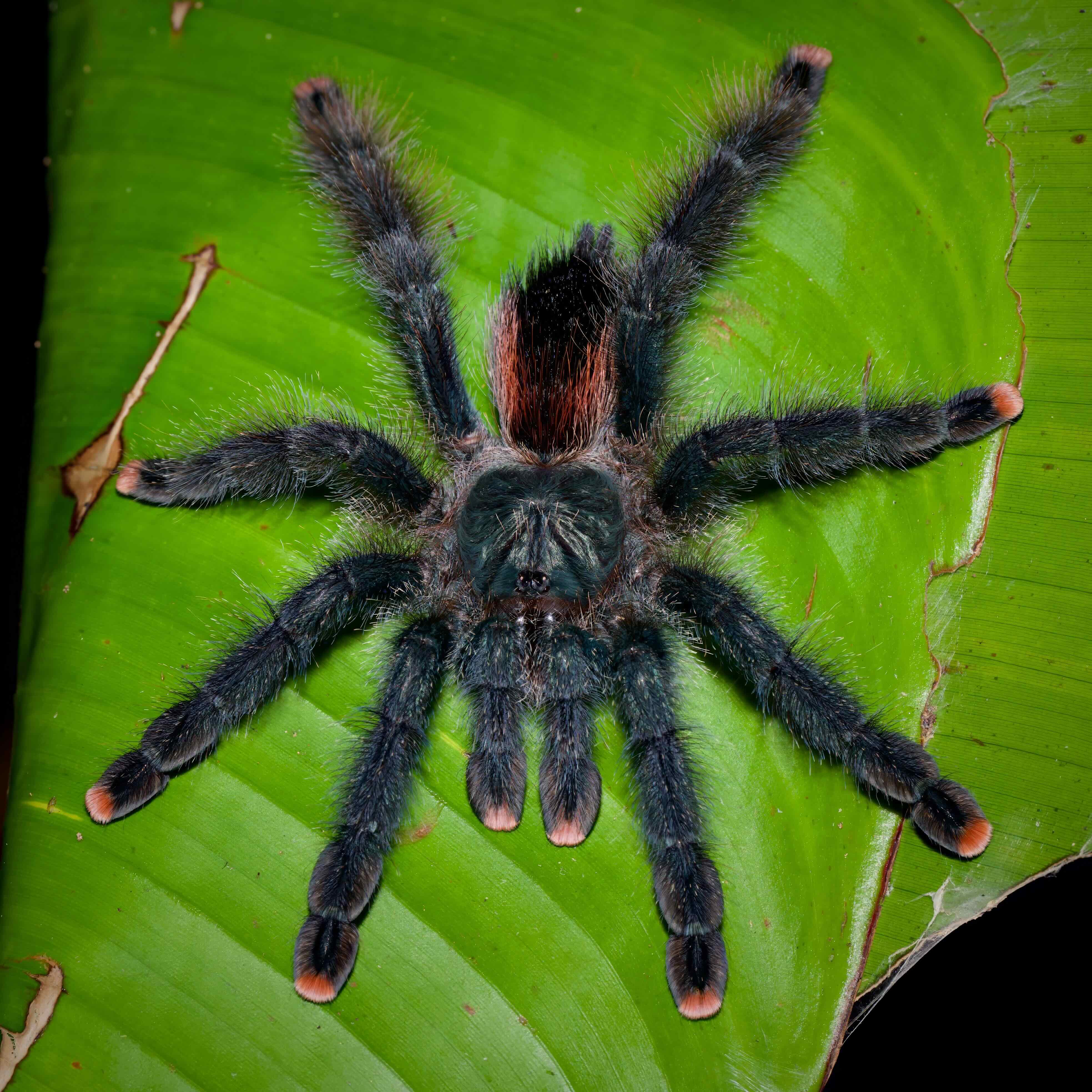
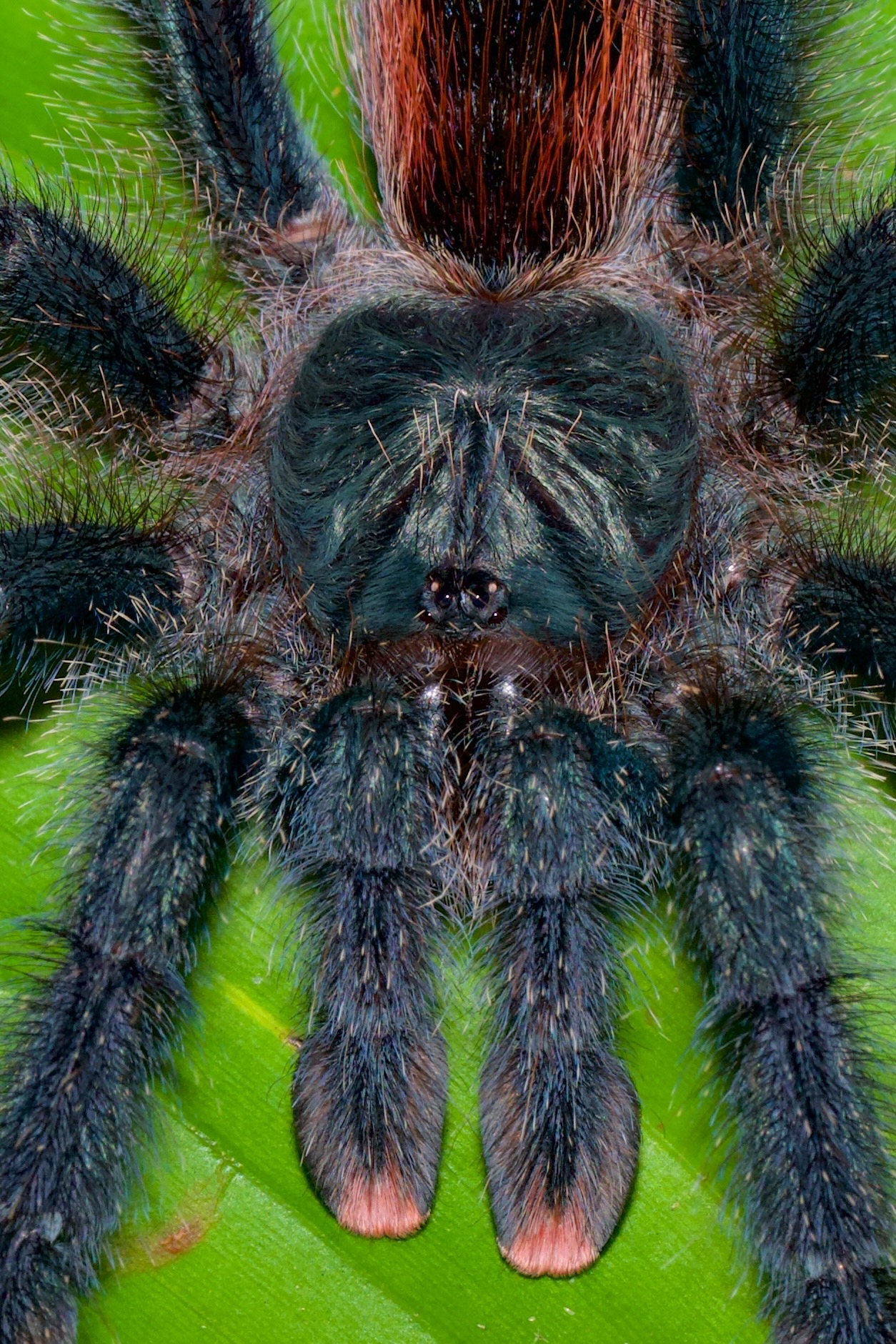
Adults reach about six inches in leg span. They are ambush predators that construct silken retreats and trip lines in tree canopies, using webbing as both trap and sensor. Unlike most tarantulas, pinktoes can jump short distances (3-4 cm), and their defensive repertoire includes propelling feces at threats, a behavior that, while unglamorous, is effective. Their venom is mild, even by New World tarantula standards. Here’s a closeup from the previous photo focused on the body:
The Giant Fishing Spider (Ancylometes bogotensis) is a semi-aquatic giant. Females reach roughly 26 mm in body length with an impressive leg span, while males are somewhat smaller at about 21 mm. These spiders walk on water using air-trapping hydrophobic hairs on their leg tips, much like water striders. When disturbed, they can dive below the surface and remain submerged for over 20 minutes by breathing air trapped in the hairs surrounding their book lungs. Their diet ranges from aquatic insects to small fish, frogs, lizards, and geckos:

Ancylometes bogotensis is sometimes confused with the infamous Brazilian wandering spider (genus Phoneutria, photo below): both are large, ground-active, nocturnal hunters with similar body plans. The name Phoneutria translates from Greek as “murderer,” and the genus has appeared in the Guinness World Records as containing the world’s most venomous spider. There are eight described species, found primarily in tropical South America with one extending into Central America.
Phoneutria species are best known for their potent neurotoxic venom, their characteristic threat display (raising the first two pairs of legs high to reveal banded leg patterns) and their wandering, non-web-building habits. They famously hide in banana bunches, boots, clothing, and dark shelters, which brings them into frequent contact with humans. Their venom contains a cocktail of neurotoxins, but fatalities are rare with modern medical treatment.
Though Ancylometes and Phoneutria were both historically placed in the family Ctenidae, Ancylometes was transferred to its own family (Ancylometidae) in 2025, reflecting the growing understanding that these semi-aquatic fishing spiders represent a distinct evolutionary lineage:

We now turn to a species of orb-weaver. The golden silk spider (Trichonephila clavipes) is one of the most conspicuous spiders in the Caribbean and Neotropical forests. Sexual dimorphism in this species is extreme: males are tiny (5-9 mm body length) and weigh roughly one-thousandth what a female does. Here is a female:

The silk itself is remarkable. It has a golden hue visible to the naked eye and is the strongest natural fiber known. Researchers have fully annotated the T. clavipes genome, identifying 28 unique silk protein genes. These spiders produce and utilize seven different types of silk. Their large, asymmetric orb webs can exceed a meter in diameter, and in the South Pacific, relatives of Trichonephila spin webs strong enough to be used as fishing nets by indigenous communities:

I try but can’t help myself being creeped out by those tarantulas. A college roommate once stepped on one barefoot in her Los Angeles drivewayShe said it was like mink and custard..🙀🙈
That is so gross, but interesting!
This reminds me of the infamous Far Side cartoon where the mammoth realizes that, at some point earlier in the day, he had stepped on a caveman and still had it on the bottom of his foot. “Well, what the…I thought I smelled something!”
😹😹
Mink and Custard would be a great band name. Or maybe Mink and Custard Tarantula.
Nice pictures and discussion!
Oh man, this is so awesome! I need to get me to Trinidad.
That is a beautiful picture of a rooster, but I will of course be rooting for the tarantulas who only want to live quietly in your shoe.
I was very careful to shake out my shoes every morning!
I second that.
I need to avoid Trinidad at all costs. 😱🫨 It is now firmly off my vacation list!
My post was NOT endorsed by the Trinidad and Tobago Tourism Bureau.
But when daylight come you’d wanna go home: A beautiful bunch of ripe banana…hide the deadly black tarantula! When daylight come you’d wanna go home 🙂
Lovely spider photos! thanks!
Pharmacologically, the Trinidad chevron tarantula is of medical interest. Its venom is the source of psalmotoxin and vanillotoxin – inhibitor cystine knot (ICK) peptides that may have therapeutic applications in stroke treatment.
Cool! Wasn’t expecting to run across anything about peptide toxin families in a Wildlife post. Those fascinating cone snails contain ICK toxins, too. A quick check reveals that these represent examples of convergent evolution.
Otherwise, with the golden orb spiders and the exceptional strength of their silk, it has recently been shown that cation-pi interactions are involved with silk formation. In cation-pi interactions, positively-charged amino acid sidechains (Lysine or Arginine) form ionic interactions with the negatively-charged electron cloud of aromatic residues (Phenylalanine or Tyrosine). There was a minor splash about this a dozen or so yrs ago that fascinated me, but the thought at the time seemed to be that they weren’t of much significance in protein structures. It was nice to see the reappearance of the phenomenon.
Fascinating about the convergent evolution in cone snails and spiders. I did not know that!
The cone snail toxin story is fascinating. The field was basically founded out of necessity by Baldomero Olivera who after his (IIRC Fullbright) Fellowship in the US returned to his native Philippines without much in the way of research infrastructure, and thought to investigate the toxins that he knew were present in the cone snails whose shells he had collected as a kid and which he knew to have caused human fatalities. Armed with an HPLC, some hardware cloth, surplus lab rats from the medical school and a stopwatch, he measured effects on rats injected with HPLC fractions.
I learned of the whole thing by accident at a Protein Society when I accidentally walked into the plenary session that I had decided not to go to but was hooked almost immediately. Probably the best lecture I’ve ever listened to.
Those findings landed him a junior faculty position with the chair @ U Kansas. When the chair moved to U Utah, Olivera followed. On getting off the plane, the chair said to him, “Well, Toto, we’re not in Kansas anymore.” Showing what a cool guy he is, he let the nickname stick, and everyone calls him Toto.
Seaerch cone snail toxins review olivera for at least three YT lectures and more.
I’d love to pick your brains – metaphorically – one day Mr. H. when you’re in NYC. I used to read about neurotoxins, sparked by growing up in Australia where as you know one can easily come to grief with the wildlife.
D.A.
NYC
ps – Love the tarantulas, they eat ’em in central America but I wouldn’t. One COULD keep them as pets, but I imagine its like fish – visual but not emotional. Taking my puppy to the vet’s today for his shots! That’s emotional for him 🙂
It would be fun, but it’s unlikely I’ll ever be in NYC again. Watch some of Toto’s lectures on YT. At least one of his toxins has become licensed as a sort of last-resort painkiller – Prialt – altho I don’t know the current status of it. I think there was at least one other in trials a long while ago.
Most WEIT readers probably know the answer to this, but I don’t and would rather hear your answer than Wikipedia’s: why are tarantulas so hairy? Is that a protective mechanism? Or camouflage?
Breathing the air trapped in their hairs when underwater as mentioned above seems like a compelling answer, but OTOH don’t they live in usually dry places. Maybe it’s to help them survive occasional heavy flooding in normally dry places.
What a wonderful collection of photos of and information about some amazing and beautiful spiders, and one chicken.
Fantastic pictures and commentary. When I put on boots that I haven’t worn for some time, I always check inside for any creatures. Western Black Widow spiders live in Washington State; fortunately, they are rare in western Washington. I wouldn’t want to step in my boot and land on one of the tarantulas you describe!
Excellent photos. Especially impressive is the close-up of the pinktoe tarantula. I hadn’t know that tarantulas can throw poop! I had only seen them throw their body hairs.
Thanks, I really learned a good deal about spiders. Beautiful photographs.
Thanks, I enjoyed being creeped out by the spiders, although I’d run a mile if I met one in real life.
Why did the chicken attend the séance? It wanted to get to the other side.
Well said!
Loved these.
Most insects creep me out (except for the small and “pretty” ones,) but I love spiders. Wonderful critters, spiders.