
This week’s Jesus and Mo strip, called “bells,” came with a comment: “Does she think they were born yesterday?”
Wikipedia tells us that another word for “conceptual conservatism” is “belief perseverance,” and characterizes it this way:
Belief perseverance (also known as conceptual conservatism) is maintenance of a belief despite new information that firmly contradicts it.[2]
Since rationality involves conceptual flexibility, belief perseverance is consistent with the view that human beings act at times in an irrational manner. Philosopher F.C.S. Schiller holds that belief perseverance “deserves to rank among the fundamental ‘laws’ of nature”.
The data adduced by the barmaid are under the heading “evidence from experimental psychology,” and she’s right, though it doesn’t cite “hundreds of studies”.
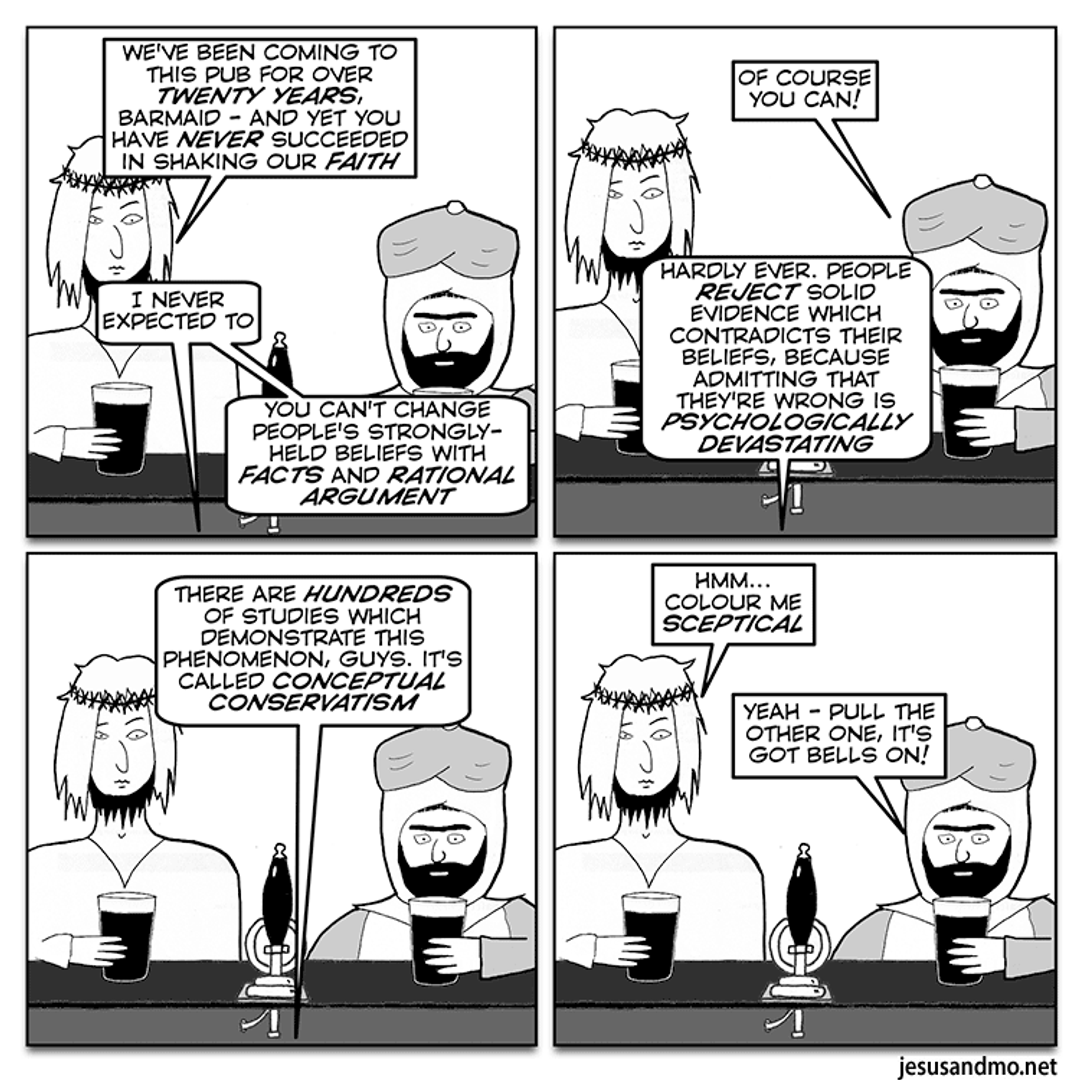
Another great Jesus ‘n’ Mo, and, as you pointed out on the earlier post about Jesse Singal’s piece in the NYT, very apposite.
“You cannot reason someone out of a belief that they did not reason themselves into.”
I was raised Catholic by parents who took it seriously. I was 17 when I first entertained doubts about it, and I didn’t fully reject it until I was in my 30s. I have thus experienced conceptual conservatism first hand. It takes a fairly substantial step to question what you’ve taken for granted since early childhood, and that gets even harder when you’re subject to the disincentives of ruptured family and social relationships. I understand how easy it is to keep clinging to those deeply rooted teachings.
In contrast, I’m totally baffled at how modern people can get sucked into a belief system that’s been fabricated from whole cloth right before their eyes. Why did the first Mormons believe Joseph Smith’s nonsense? More recently, why have people bought into gender ideology, with all its metaphysical concepts of “sex spectrum” and “the wrong puberty”?
Or am I being too lenient on myself in attributing my own gullibility to normal psychological and social processes, while holding others responsible for a folly that isn’t really that different?
It takes a substantial thwack to crack anyone’s shell of entrenched belief and open it up to some self-examination. Puberty is often such a thwack. Another is some intense dramatic experience, often involving loss. My recent such thwack was delivered by iDJT’s escalating outrages; which literally literally has changed my life for the better. Please do understand that what I now appreciate is the uninvited grief thwack, not iDJT or his outrages.
I used to debate with conspiracy theorists on social media. It didn’t take long to realise that you can’t change their minds with facts. I still continued to debate though, because onlookers to the conversations would sometimes chip in and ask for more information and I could help prevent new conspiracy theorists, even if I couldn’t fix the existing ones 😁
I think religion is a bit like a conspiracy theory, in that people believe it without any logical reason to and, as the barmaid says, you can’t talk someone out of an illogical belief with a logical argument.
I bookmarked the link below years ago, and still share it sometimes. It explains why some people need to cling on to ideas that make them feel ‘special’. I think this may be the same for religion as it is for conspiracy theories.
https://www.bps.org.uk/research-digest/believing-widely-doubted-conspiracy-theories-satisfies-some-peoples-need-feel
Thanks for this link. The article makes sense to me.
Depends on why the belief is strongly held … perhaps the belief is based on lots of sound evidence. Even if limited to beliefs based on flimsy foundation, are many strongly held beliefs (e.g., belief in God) easily refuted by “information that firmly contradicts” them or is determining the truth of beliefs complicated?
I have worked in the field of cognitive psychology since 1974, with a specialty in reasoning, and I did not recognize the term “conceptual conservatism.” Google AI reminded me that it was an idea of the philosopher W. V. O. Quine, who thought it was a Good Thing: Presented with new facts that disagree with your thinking, you should modify your views just enough to accommodate them–that is, make only conservative changes. The term isn’t used in psychology, and there are not “hundreds” of findings on it. See the Substack of the philosopher Dan Williams, Conspicuous Cognition, who argues that people are not as irrational as pop psych says.
Most “biases” deemed irrational are helpful more often than not in real life (in contrast to artificial laboratory situations/questions designed to make them falter).
Conceptual conservatism as described by you is probably one of them.
I think what we are talking about in the case of religion is the socio-emotional component that ccomes into play when beliefs/assumptions/opinions are strongly tied to one’s core self-image. One will then be reluctant to change them and will find lots of reasons why new contrary facts one learns either don’t count or can’t be true.
I have modified my opinion on lots of things during my life, and I am far less certain now of any opinions I do hold than I used to be at 18.