
Regular Mark Sturtevant (as opposed to Irregular Mark Sturtevant) has sent in some lovely insect photos to fill the nearly-empty reserve of pictures. Please send any good wildlife photos you have. Thanks!
Mark’s captions are indented, and you can enlarge his photos by clicking on them. Be sure to check out the female Tussock Moth caterpillar with vestigial wings (it’s the eighth photo).
Here is another dispatch of local insects and spiders, all photographed either in area parks near where I live in eastern Michigan, or as staged shots at home. Let’s start with a couple of dragonflies. First up is a Green Darner (Anax junius), which ranks pretty large among the dragonflies found here. As is almost always the case, this individual is a female, since they perch frequently and are much easier to approach than males, which I only rarely manage to photograph. Do you see the tiny yellow critter on the dragonfly? That is a Globular Springtail, and it must have walked or jumped onto the dragonfly from nearby foliage. There may be a few more of them in the picture as well, though I’m not certain. Springtails are tiny soil arthropods, and they are extremely abundant. When seen up close, Globular Springtails are arguably adorable, as you can see in the linked image. I’ve searched for them for some time but have only rarely encountered them, despite claims that they are exceedingly common. Perhaps our local species spends more time up on foliage rather than in the soil, meaning I’ve been looking in the wrong places!:

The next dragonfly is a male Skillet Clubtail (Gomphurus ventricosus), named for the large, pan-like club on the end of its abdomen. I have to drive a few hours south to a particular park to see them, and of course this one is perching on poison ivy which covers much of the area there. That park hosts 8 or 9 species of clubtails according to a dragonfly documentation site called Odonata Central. I’ve photographed most of those species with only two left to find:

A field near my workplace has a ridiculously high population of Chinese Praying Mantids (Tenodera sinensis). I suspect this is the lingering result of someone having released a large number of egg cases several years ago, combined with a robust population of grasshopper prey. Shown here is a young June nymph. I can return later in the summer to find several large adults in no time at all:

Next up are some lepidopterans. First is a Hackberry Emperor butterfly (Asterocampa celtis). They are often common along forest margins where their host Hackberry trees [Celtis occidentalis] are concentrated. Their caterpillars, however, seem to be quite secretive, as I’ve seen only a few of them:

Next is an inchworm caterpillar, though I don’t have an identification for it. Do you see the tiny mites?:

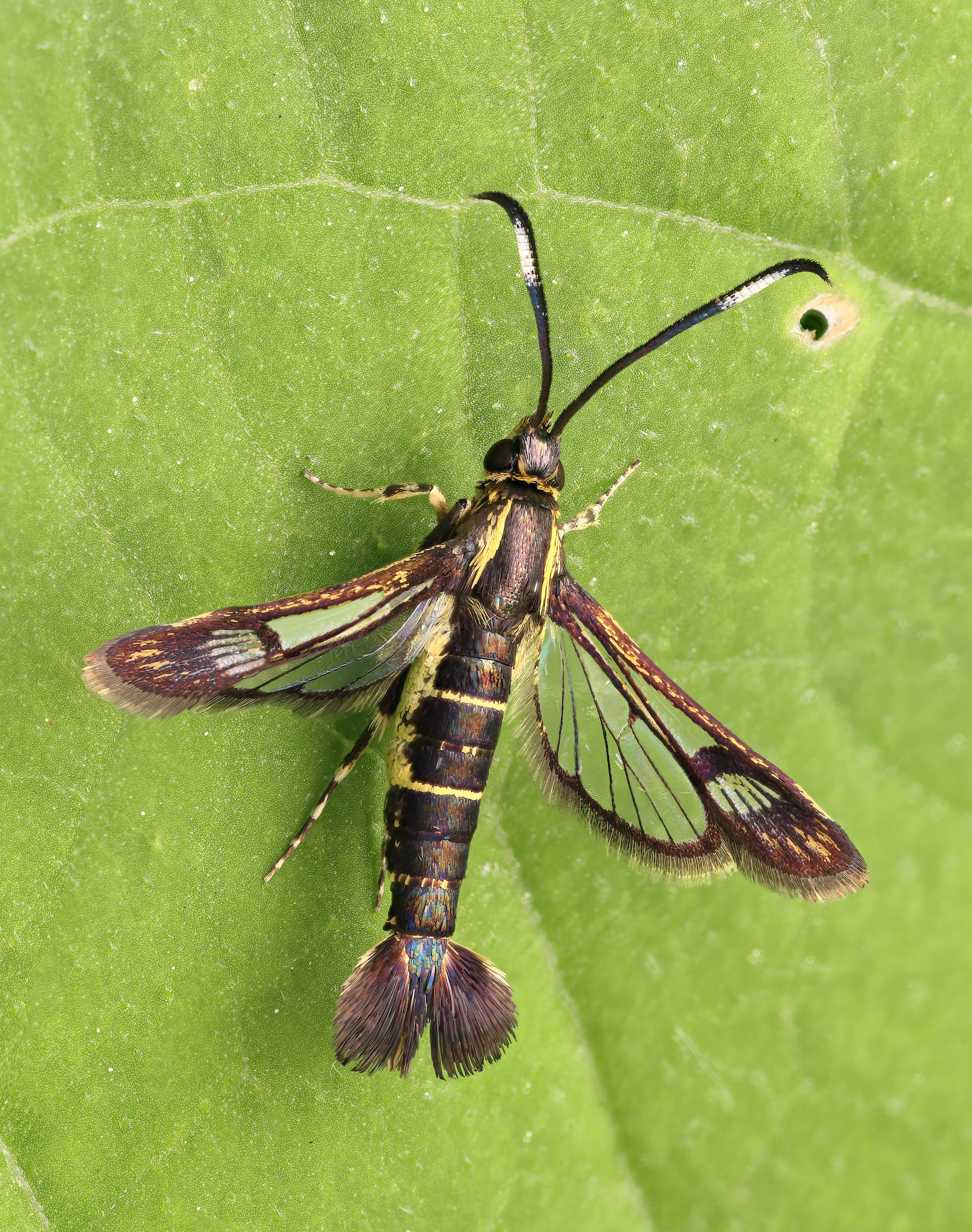
The insect shown next is a moth, although it makes a very convincing wasp mimic. This is the Eupatorium Borer Moth (Carmenta bassiformis). The larvae feed on the roots of Ironweed and Joe Pye Weed, both of which are highly valued native wildflowers because they are very much favored by butterflies:
The flamboyant caterpillar in the next image is a White-marked Tussock Caterpillar (Orgyia leucostigma). I’ve tried several times to get an acceptable focus-stacked image of one of these. What makes them difficult is the combination of all those oddly angled sticky-out bits, which challenge the shallow depth of field inherent in this kind of photography, along with the fact that these caterpillars absolutely will Not Hold Still. As a result, the stacking is done on the fly, followed later by long hours of manual reassembly of the jumbled focus stack. This image is by far my most successful attempt:

I kept this caterpillar in hopes that the moth emerging from the cocoon would be a female. Why? Well—check out what came out! It was a female! Females have barely visible vestigial wings, and I had never seen one before. She will sit here, unmoving, until a male finds her. This strategy saves a great deal of energy that can instead be used for laying eggs. The winged males are unremarkable, and while I’ve probably seen them, I don’t think I’ve ever photographed one:

Finally, here are three images of jumping spiders I’ve been wanting to share together for quite some time. The Dimorphic Jumping Spider (Maevia inclemens) is a species I regularly see around the outside of our house. The name refers to the males having two distinct color morphs. The images below are manual focus stacks, photographed in staged settings on the ‘ol dining room table. First is a female with long-legged fly prey, which conveniently provides a sense of scale since the fly is about the size of a mosquito:

Next are the two male color morphs. The first somewhat resembles the females, while the other is very different and comes with distinctive hair decorations. This is an older image, but I’m bringing it back so all three forms can finally be shown together. It’s surprising that they are all the same species!


I recently learned that the two male forms use different courtship displays for females, yet are considered equally successful in the mating game. I’m sure Jerry can steer things in the right direction if I am in error here, but having different male forms with different mating strategies does not seem unusual in the animal kingdom. Examples I’m familiar with include lizards, crustaceans, and fish, although in those cases the different males include those that are aggressive and territorial, and others that win by being sneaky. But here, I don’t see how either male is territorial, and apparently both have courtship displays for females.
One of my goals for next season will be to try to document their different courtship behaviors. That seems do-able, since I can expect to find several of them again next summer.
The WEIT Street Irregulars
(cf. The Adventures of Sherlock Holmes 🔎)
Incredible focus stacks, Mark. I’m impressed by both the beauty of the critters (how about that White-marked Tussock Caterpillar!) and the technical aspect of the photography.
Incredible detail. Thanks so much! I love the tiny critters on these insects. It’s astounding to be able to see these.
Thanks!
I was hoping for some spiders, so that’s good! Not that I don’t love all the pictures, but I have particular fondness for Professor Sturtevant’s spider pictures.
Beautiful Springtails picture—and of everything else as well. So many insects to photograph, so little time.
Thank you, Mark wonderful! I really need to look into focus stacking. The Hackberry Emperor Butterfly (what a name!) reminded me of our local European Paragare aegeria, which has the same habitat preference. Though both are Nymphalidae, which makes for some resemblance, I suspect the coloring to be homologous evolution. They are really well camouflaged in their environment, especially in sping.