
Welcome to the Cruelest Day: Tuesday, November 25, 2025. It’s two days until Thanksgiving in America as well as National Parfait Day, which is meaningless as nobody will think about them nor eat them today. Still, here’s the American version with fruit and layers of custard and other stuff.

It’s also National Blasé Day, International Day for the Elimination of Violence Against Women, and National “Eat with a Friend” Day. (Why the scare quotes? )Are you suppose to eat with someone whom you only pretend is a friend, or pretend to eat?)
Here’s a sign I pass every day on my way to work. Note the big error. Should I go in and get my hair desinged? It’s not singed in the first place! (Red box is mine.)

Readers are welcome to mark notable events, births, or deaths on this day by consulting the November 1 Wikipedia page.
Da Nooz:
*Obituaries first: Jimmy Cliff died at 81. From the NYT:
Jimmy Cliff, a onetime choirboy who emerged from the rough quarters of Kingston, Jamaica, riding a rebel spirit and a fierce sense of social justice to help make the supple, bobbing sounds of reggae a global phenomenon with songs like “You Can Get It If You Really Want” and “The Harder They Come,” has died. He was 81.
Mr. Cliff’s wife, Latifa Chambers, announced his death in an online post early Monday. She said the cause was a seizure followed by pneumonia. Fueled by his searing performance as a musician-turned-outlaw in the 1972 film “The Harder They Come,” Mr. Cliff became the first worldwide reggae star.
But he set his sights even higher. Over the years, his musical journey encompassed ska, rocksteady, pop, soul and other genres. “I didn’t really want to be known just as the King of Reggae,” he said in a 2004 interview with The Washington Post. “I actually wanted to be known as the King of Music!”
Among his signature songs are the gospel-inflected “Many Rivers to Cross,” the anthemic “Wonderful World, Beautiful People,” the feel-good tune “Reggae Night,” and “Vietnam,” which Bob Dylan deemed one of the greatest protest songs.
Here is Cliff singing “I Can See Clearly Now” on the Late Show. For many years I thought the first two lines were these:
I can see clearly now, the rain is gone;
I can see all the Popsicles in my way.
*The NYT “Morning Report” on Trump’s stupid peace deal for Russia and Ukraine:
The peace proposal released last week read like a wish list for Russia. It would require Kyiv to relinquish captured terrain and shrink its army. It would bar Ukraine from joining NATO and also prohibit foreign troops from coming to its rescue in a future conflict.
“Right now the American plan is devastating for Ukraine, weakening its ability to defend itself and providing few guarantees of its future,” Julian Barnes, a Times reporter who covers international security, told me yesterday.
The Ukrainians have been outraged, and Volodymyr Zelensky said the proposal was a choice between “losing our dignity and freedom” and losing U.S. support.
That could be changing. American and Ukrainian officials met in Geneva this weekend and began reviewing the plan point by point. Secretary of State Marco Rubio said they were “narrowing the differences and getting closer to something” that both Kyiv and Washington would be “comfortable with.” The head of Ukraine’s delegation said the officials had made “very good progress.”
They’re trying to reach a deal by Thursday, which is the deadline Trump has set for Ukraine to accept the proposal.
Trump’s Stance:
While the diplomats in Geneva have been seeking compromise, Trump has been lashing out. He posted that Ukraine’s leadership had “EXPRESSED ZERO GRATITUDE” for American military aid and support. (Zelensky posted his own message hours later, expressing thanks “for everything that America and President Trump are doing for security.”)
The exchange took us back to the start of Trump’s second administration, when he and Vice President JD Vance seemed more sympathetic to Russia and publicly berated Zelensky in the Oval Office.
Zelensky later adopted a more accommodating tone and signed a deal to give the U.S. some of Ukraine’s minerals. At the same time, Russia continued bombing Ukrainian civilians, which exasperated Trump. Soon, Trump pivoted and spent much of this year lamenting the obstinacy of Russia’s president, Vladimir Putin. He ripped Putin and praised Zelensky.
As the Washington Post reports, “. . . President Donald Trump faced mounting criticism from lawmakers and his own base over the proposal.”
A take on this deal posted by reader Pyers. Ukraine is getting screwed, or was in the last peace deal: losing land, not allowed to join NATO, having its military limited, and so on. More of Trump’s bluster, and I hope it doesn’t become reality. Still Ukraine is losing the war.

*Of course I’m going to read and report on a new essay by James Carville in the NYT: “Out with woke. In with rage.” I love that feisty old curmudgeon, even though he predicted that Kamala Harris would win last year. For he’s always argued that wokeness would hurt the Democrats, and on that he was right. Here’s his no-nonsense message:
We are not even two weeks from the government shutdown, and the public conversation on the matter has fled the building. This shows, no matter what you believe, there’s a simple truth. The shutdown will have zero lasting consequence for next year’s midterms. The only thing that will persevere is economic pain. And that’s exactly why Democrats won on Nov. 4.
Zohran Mamdani, Abigail Spanberger, Mikie Sherrill — even down-ballot Georgia Democrats — all won with soaring margins because the people are pissed. And the people always point their anger at the party in charge. Rent is out of control. Young people can’t afford homes or pay student debt. We’re living through the greatest economic inequality since the Roaring Twenties.
President Trump has done nothing to curb the cost of what it requires to take even a breath in America today, the centerpiece promise of his 2024 campaign. The people are revolting, and they have been for some time.
This offers Democrats the greatest gift you can have in American politics: a second chance. I am now an 81-year-old man and I know that in the minds of many, I carry the torch from a so-called centrist political era. Yet it is abundantly clear even to me that the Democratic Party must now run on the most populist economic platform since the Great Depression.
It is time for Democrats to embrace a sweeping, aggressive, unvarnished, unapologetic and altogether unmistakable platform of pure economic rage. This is our only way out of the abyss.
You know what he’s going to say next: “Don’t blow it Democrats: deep-six the wokeness.” And he says it:
Just as it was for the Mamdani campaign, raging against the rigged, screwed-up, morally bankrupt system that gave us the cost of living crisis must be the centerpiece of every Democratic campaign in America. Unless you’re the top 1 percent, this touches everybody. Even lifelong Republicans know this economy isn’t working.
We have to present ourselves as adamantly, even angrily, opposing the system that is preventing younger rural voters from buying homes, jacking up utility bills and keeping grocery prices at astronomical levels. It is vital that Democrats, with some big ol’ cojones, rail against the unjust economic system that has created these conditions. Otherwise, we will continue to be viewed as part of it.
For this to work, we can’t get sidetracked on our message. The Republican Party’s greatest weapon has always been its uncanny ability to turn us against one another. It cannot be said enough: The era of performative woke politics from 2020 to 2024 has left a lasting stain on our brand, particularly with rural voters and male voters. The term Latinx was despised even by many Latino people. Calling folks “BIPOC” should have never been a thing. “Defund the police” was a terrible idea. Polling shows that nearly 70 percent of Americans think the Democratic Party is “out of touch” and that it is more interested in social issues than economic ones.
. . .We can no longer be a party with a whiff of moral absolutism. We can correct this only by looking toward the future, always, in every situation possible, and pivoting to a form of economic rage as our response.
With all this rage, we must also have a bold, simple policy plan — one that every American can understand. In the richest country in the history of our planet, we should not fear raising the minimum wage to $20 an hour, which had a 74 percent approval rating in 2023. We should not fear an America with free public college tuition, which 63 percent of U.S. adults favored in a 2021 poll. When 62 percent of Americans say their electricity or gas bills have increased in the past year and 80 percent feel powerless to control their utility costs, we should not fear the idea of expanding rural broadband as a public utility. Or when 70 percent of Americans say raising children is too expensive, we should not fear making universal child care a public good. And darn it, we should not fear that running on a platform of seismic economic scale will cost us a general election. We’ve already lost enough of them by being afraid to try. The era of half-baked political policy is over.
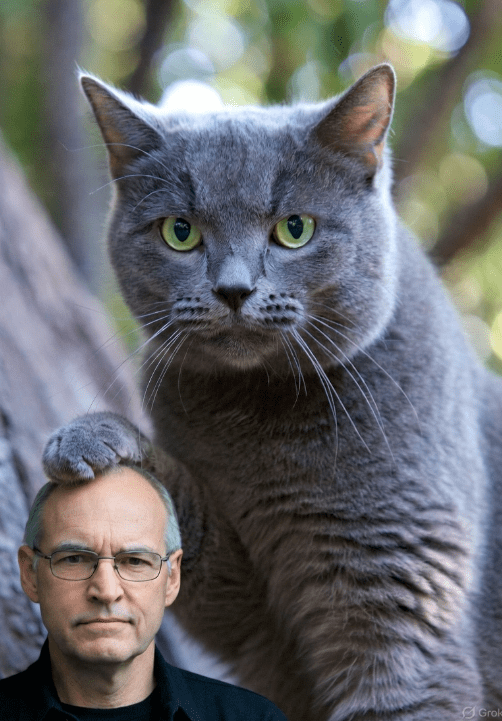
Sounds good, right? Yes, so long as the Democrats can keep away from the wokeness and stick to the concerns of ordinary people, which are not pronouns. I’m somewhat optimistic about this, because even the Squad might keep itself under control if they realize that, by concentrating on economics and inequality, their party can win. Remember Carville’s slogan for the Clinton campaingn in 1992: “It’s the economy, stupid“. Well, 33 years later, Carville’s back with the same message. Ceiling Cat bless him (image below, with Ceiling Cat blessing an AI-created Carville, made by Luana):
*A court in Northern Ireland has banned the religious curriculum in that province because it is taught as if Christianity were an absolute truth.
A court case that began with two parents concerned about the Christian teaching their daughter was receiving at school ended Wednesday with a landmark judgment that could transform the place of religion in schools in Northern Ireland.
The Supreme Court of the United Kingdom ruled that the religious curriculum in Northern Ireland’s public schools was unlawful because it promoted Christianity as an absolute truth and did not teach religion in an “objective, critical and pluralistic manner.”
The court said in its judgment that the curriculum breached the rights of the child, who is now 11, and of her parents, who had challenged the legality of religious education and collective worship at her Belfast elementary school.
The family, which was granted anonymity by the court, has no religion and is, “broadly speaking,” humanist in its outlook, the court ruling said.
The ruling will force the government in Northern Ireland to rethink the way that religious education is taught in public schools and ensure that the study of other faiths is included in elementary education.
The court said that its ruling was “not about whether Christianity should be the main or primary faith that pupils learn about in schools in Northern Ireland.” It acknowledged that, “historically and today, Christianity is the most important religion in Northern Ireland,” and that therefore it was within the Department of Education’s mandate to make knowledge of Christianity the focus of its curriculum.
It said, however, that the failure of the syllabus to teach children about other faiths, and to think objectively about religion, meant that it was in breach of the European Convention on Human Rights, which guarantees the right to freedom of religion.
Northern Ireland Humanists, a charity working on behalf of nonreligious people, called the judgment a “historic win.”
And get this:
For decades, all schools under the control of Northern Ireland’s Department of Education have provided religious education and a daily act of worship. According to the official curriculum, schools do not have to teach children about the existence of other religions alongside Christianity until they are between 11 and 14 years old.
If you want to see the syllabus up to now, go here. The first page starts with this:

I never learned religion in school, though I can see a weak case for teaching kids about the different faiths. But religion has historically been taught, as it was in N.I., as a form of proselytizing. It’s a good thing they just taught Christianity instead of either Protestantism or Catholicism, but I can’t imagine a kid in Belfast not knowing what Judaism is. At any rate, this is a good decision so long as they teach atheism alongside religion (I believe Dan Dennett made that point, alongside the claim that it would be very hard to teach religions like Islam because they are conflicting interpretations of what the religion says). I guess it’s best to leave it out given the varying interpretations of the faiths.
*I’ve noticed this as well as the WSJ: people in movies and videos are starting to smoke cigarettes again.
The stars are lighting up again.
“Need a cigarette to make me feel better,” crooned pop star Addison Rae on her 2025 single “Headphones On,” while Lorde sang “this is the best cigarette of my life” in her own 2025 release, “What Was That.” Sabrina Carpenter was recently photographed wearing a corset made of Marlboro Gold packages, and sells shirts with song names emblazoned on mock-ups of cigarette boxes and lighters.
On the silver screen, about half of all movies that made their debut last year included appearances of cigarettes, cigars and other tobacco products, up 10% from the previous year, according to a new report from public health nonprofit Truth Initiative and research organization NORC at the University of Chicago.
With more actors, pop stars and other celebrities spotted unapologetically smoking, the cultural taboo against it shows signs of ebbing. That worries antismoking advocates, who fear a reversal of the yearslong decline in U.S. smoking rates.
“I find that concerning, glamorous, attractive people smoking cigarettes,” said Ollie Ganz, an assistant professor at the Rutgers School of Public Health, whose research focuses on tobacco.
While U.S. smoking rates are hovering at their lowest level in decades, the Centers for Disease Control and Prevention has previously said that smoking in movies contributes to increased smoking rates among young people. “Youths heavily exposed to onscreen smoking imagery are more likely to begin smoking than are those with minimal exposure,” a 2019 CDC report found.
Roughly one in three cancer deaths in the U.S. are linked to cigarette smoking, according to the Centers for Disease Control and Prevention. Federal health officials have linked smoking to more than 30 diseases and health conditions, including heart disease, stroke and asthma.
Again, I can see the point of leaving smoking out of movies, but on the other hand people do smoke (about 12% of all Americans) and are we supposed to pretend they don’t? Should we also ban alcohol from movies? Or if they want to stop people smoking, why don’t they just ban cigarettes, or tax them at $50 per pack? I am not really keen on this kind of “leisure fascism,” and up to a few years ago I would smoke a few cigarettes per year (I have excellent self control). If I were at a bar with a beer and a shot right now, and someone offered me a (non-menthol) cigarette, I’d probably take it, except that you can’t smoke cigarettes in bars any more.
*From the AP’s reliable oddities section we hear about everyone’s worst nightmare: a Thai woman was found alive in a coffin, and knocking on its sides, when she was about to be cremated.
A woman in Thailand shocked temple staff when she started moving in her coffin after being brought in for cremation.
Wat Rat Prakhong Tham, a Buddhist temple in the province of Nonthaburi on the outskirts of Bangkok, posted a video on its Facebook page, showing a woman lying in a white coffin in the back of a pick-up truck, slightly moving her arms and head, leaving temple staff bewildered.
Pairat Soodthoop, the temple’s general and financial affairs manager, told The Associated Press on Monday that the 65-year-old woman’s brother drove her from the province of Phitsanulok to be cremated.
He said they heard a faint knock coming from the coffin.
“I was a bit surprised, so I asked them to open the coffin, and everyone was startled,” he said. “I saw her opening her eyes slightly and knocking on the side of the coffin. She must have been knocking for quite some time.”
According to Pairat, the brother said his sister had been bedridden for about two years, when her health deteriorated and she became unresponsive, appearing to stop breathing two days ago. The brother then placed her in a coffin and made the 500-kilometer (300-mile) journey to a hospital in Bangkok, to which the woman had previously expressed a wish to donate her organs.
The hospital refused to accept the brother’s offer as he didn’t have an official death certificate, Pairat said. His temple offers a free cremation service, which is why the brother approached them on Sunday, but was also refused due to the missing document.
The temple manager said that while he was explaining how to get a death certificate when they heard the knocking. They then assessed her and sent her to a nearby hospital.
The abbot said the temple would cover her medical expenses, according to Pairat.
I wonder if she’s going to be okay, as she sounded pretty sick before they put her in the coffin. Also, who verified that she was “dead” when they did that?
Meanwhile in Dobrzyn, Hili is taking care of Andrzej—or maybe she just wants a nosh (she’s making a blep).
Hili: Don’t you think it’s time for a break from work?
Andrzej: Maybe that’s a good idea.

In Polish:
Hili: Czy nie sądzisz, że to jest pora na przerwę w pracy?
Ja: Może to jest dobry pomysł.
*******************
From The Language Nerds:

From Stacy; an excellent meme, but it’s probably real given that it’s from Whole Paycheck:

From Cats, Coffee, and Chaos:

Masih is back with an excellent tweet:
She refused compulsory hijab.
They blocked her from going on stage.
Saba Taghavi accepted her award off stage anyway and the crowd backed her.Then something unexpected happened:
Male artists joined her in solidarity and took their awards off stage too.When people stop obeying… pic.twitter.com/984Ci2CPaV
— Masih Alinejad 🏳️ (@AlinejadMasih) November 24, 2025
From Emma, who reports on a schism:
There will not be enough popcorn in the world for the meltdown that will ensue from this. pic.twitter.com/N6Gs5XhnIf
— Emma Hilton (@FondOfBeetles) November 24, 2025
From Simon: a fake ad for Ricky Gervais’s vodka brand, which is real:
We had an official complaint from a lovely gentleman about this billboard. He claimed he'd seen it in a station and was absolutely disgusted and demanded it be taken down. We explained it was never up. Sometimes the complaints will be false.
— Ricky Gervais (@mrrickygervais.bsky.social) 2025-11-22T08:58:33.847Z
From Luana; how did the guy get that name?
🇳🇦 Adolf Hitler may win tomorrow’s upcoming elections in Namibia
The 59-year-old Namibian politician was first elected in 2020 with a large margin in the Omupanda constituency, receiving 85% of the vote.
Adolf Hitler Uunona represents the South West Africa People’s… pic.twitter.com/pu2gogoV30
— Visegrád 24 (@visegrad24) November 24, 2025
One from my feed; the marvels of static electricity:
😂😂😂 pic.twitter.com/YMdbYU3Tuu
— 🅶🅾🆁🅺 (@Raclure03) November 23, 2025
One I reposted from the Auschwitz Memorial:
This French Jewish boy was gassed to death as soon as he arrived in Auschwitz. He was about four years old, and would be 87 today had he lived. https://t.co/fHdFQdJD70
— Jerry Coyne (@Evolutionistrue) November 25, 2025
And two from Dr. Cobb. First, scallops escape a predatory starfish. Look at ’em go! I’ve put the YouTube video below:
About 2.5 minutes of SCALLOPS using jet propulsion to escape the predatory Coscinasterias muricata in Port Philip Australia! #molluscmonday youtu.be/qurS99FI210?…
— Chris Mah (@echinoblog.bsky.social) 2025-11-17T16:59:29.293Z
The video:
. . . and a Good Morning Duck:
Morning all, what’s occurring?#Duck #FarmLife #LittleFarm
— Annie Parker (@annieparker.bsky.social) 2025-11-21T21:30:49.210Z
A THOUGHT FOR TODAY:
We haven’t yet learned how to stay human when assembled in masses. -Lewis Thomas, physician and author (25 Nov 1913-1993)
James Carville is an example of an observation I made over the years, that, at some point, old men should just shut up. Minimum wage is the worst economic idea generally applied in the U.S. If you raise wages, you raise costs, and, therefore, prices. You cannot make groceries more affordable for low income earners by raising the minimum wage, because grocery stores, which have notoriously small profit margins, have to raise prices. Gavin Newsome raised the fast-food minimum wage in California to $20 and caused the loss of 18,000 jobs.
The pros and cons are definitely there, and I don’t know where to land on this one. But employees who stay on can have a marginal although living wage.
I’d seen these sorts of minimum wage jobs as being ideally for young people still living with their parents. But that is not the case so much now.
At what age should Trump (have already) shut up?
Should old women just shut up? When does one become “old”?
Is there a minimum age when juvenile human primates should just shut up? At what older age should they start not shutting up?
Getting rid of wokeness is not going to save the Democrats. They should still get rid of it though. It’s easy for Carville to gesture with comments like, “ morally bankrupt system that gave us the cost of living crisis”. It is very much harder to come up with actual working solutions. And the “morally bankrupt system” he is talking about, that’s capitalism. The stimulus spending done by Trump and then further by Biden likely played a very large part in the inflation situation we’re in now. So yeah, now housing costs are significantly worse. We could start instituting Carville’s plans to assist people. But…. to do that we need to raise taxes and people hate that. They hate it because it makes it harder to buy things and save money. I live in New York so maybe Hochul could raise property taxes even higher. I love paying a ton in taxes and getting squat for it. Carville doesn’t have the fix he thinks he does. I do think the New York state’s pension plan is a disaster for taxpayers as well as a lot of entitlement spending. If we got rid of the pension plan young people would not have to pay for retirees to sit around and contribute nothing. But this is kinda going in the opposite direction of Carville.
I guess you’re against Social Security too, as we retirees sit around and “contribute nothing”, but the government gives us a pension.
I think Social Security ought to be phased out, personally. And 401k/403b/IRA contribution limits increased accordingly.
A kindred spirit of Dubya, eh?
Just for that.
So basically, what you say is people who cannot hold paying jobs for most of their lives, or otherwise “beg, borrow and steal” their way to wealth, must become homeless at retirement.
Lucky are the people who were born with a golden spoon in their mouths, for they can have any predicament at all yet STILL get enough proceeds from their parents’ investment account(s) to continue being ne’er-do-wells and not having to face the music. Others have to muddle through life, somehow.
Some possible causes of low or no wealth at retirement age:
-being an unpaid caregiver for a handicapped child
-being addicted to drugs (or to losers, or unprofitable activities like making art)
-being a single parent
-having a criminal record
-having a disability that prevents one from holding a steady job
-being endowed with a low IQ, poor social skills, deficient impulse control etc.
-having rotten luck
-etc.
I’m saying Social Security is a pyramid scheme that depends on a constant birth rate or large influxes of immigrants. And never accounted for people living a really long time or the ridiculous cost of healthcare. It’s a burden on the young at the expense of the old.
Pensions are for people who worked substantially during their youth and middle age and built up pension entitlement through that work, Matthew. The groups you mention, including the trust-fund baby who never worked a day in her life, aren’t eligible for pensions now and wouldn’t be affected if Social Security (or the Canada Pension Plan) were to be abolished entirely.
Adrienne is referring to the difficulty of financing any kind of pay-as-you-go social spending aimed at the elderly when there are so damned many of them and not enough young workers, taxpayers, and consumers willing and able to shift dollars up the inverted age pyramid.
My ire is directed far more at New York. We have prison guards retiring at the age of 50 with full pensions. It’s not tenable for young people to foot the bill for all of these people. I guess anger can be too diffuse and I’m not insensitive to older people being able to live. I don’t think we should abolish assistance for the elderly. Especially biologists like yourself that make good book recommendations! I am VERY tired of the taxes I pay in this state though.
Fellow NYer, I hear you! NYC people (and to a degree upstaters) in the higher tiers pay more tax than…. any …. other Americans, bar none.
And more than all?most Europeans and Aussies. But whatchagonna do?
NY has a “Hotel California” problem: you can never leave!
best regards John,
D.A.
NYC
Well, if you believe Wikipedia (List of countries by tax rates), the US ranks 14th highest personal income rate. The first is the UK, followed by Belgium. Weirdly (to an ignoramus like me), folks in Aruba are third.
But that’s wikipedia. I don’t know what the true rank for the U.S. is, that’s what it says.
Hello David. I’m an upstater on the water. Definitely not nearly as punitive as NYC or as nice, but I’m still gonna cry about it. I’m posting too much, but Happy Thanksgiving!
I lean toward converting Social Security over time into a means-tested retirement safety net while sharply lowering employer and employee contributions. That would mean most of us with the means to take European vacations in retirement would have to look at our earlier Social Security payments as a form of insurance premium: sucks to pay it, but glad I never had to file a claim.
As things currently stand, the people who most need the money get the smallest monthly checks—and those who need it least get the biggest ones.
That last paragraph gets me too.
I know this is going to get me in trouble, but withholding for social security is capped, and that’s just another example of how being rich keeps other people poor. There should be no caps on social security withholding; it should be based on income.
But then the payouts would have to be uncapped, too, no? The current maximum benefit from Social Security reflects those capped contributions. In a private pension plan, the higher your salary the higher you (and your employer, which is you if you’re self-employed) contribute, and the larger your eventual pension will be (if the plan stays solvent.) Ditto, of course with private savings. If Social Security is a pension plan or forced savings scheme — I know it’s not, but let’s pretend — you can’t decouple contributions from payouts. If you’re running it as a social welfare redistribution scheme, then fine, do whatever you like. But then support for it will collapse, because old people and conservatives pretend it’s not welfare. Wanting to uncap contributions by young working people and not pay them a future benefit isn’t something you should get in trouble for. They just won’t let you.
The Canada Pension Plan is actuarially fully funded and pays a stingier benefit. Nice to have but not much to live on. We’re also wrestling with larger issues about how to stiff old people without seeming to, because we can’t afford to let them eat us alive, either. Watching with great interest and trying to learn. The welfare state in the infertile West is in deep trouble demographically. I’m hoping it was all down to chlamydia after The Pill enabled promiscuity and might rebound, but I’m not counting on it. (We get calls to loot the CPP for general welfare too.)
“But then the payouts would have to be uncapped, too, no? ”
I dunno but like Doug said, benefits would be means based. If you’re wealthy, you don’t need a big benefit, and, well, tough noogies if you feel short-changed. In theory, rich people pay more taxes too (may or may not be true) but get the same return of government services. They don’t need nor can they expect more government service than anyone else.
We are about to see to a huge cohort of retiring boomers who will be unable to support themselves even with social security. It’s just starting, and it’s going to be a disaster
I don’t think you can means-test a mandatory contributory program, Doug. It would be like paying fire insurance premiums on your house (as demanded by the mortgage lender) and then the insurance company telling you they won’t pay your claim after a fire because you earned too much money last year. People don’t resent paying fire insurance for decades and not making a claim. The benefit is the promise itself. But they sure would resent suffering a loss and having the claim denied. FWIW, Congress has never permitted Social Security to revoke a claim to benefits except once, when it defenestrated a Communist deported during the Cold War.
Means testing is for non-contributory programs like food stamps, general welfare, and Medicaid. People who don’t pay taxes are nonetheless indulged financial help from the state but only if they can prove they really deserve it.
The incentive if Social Security were confiscated would be to spend everything I earned (or give it to my children) so that when I stopped working I’d be poor enough to claim the full SS benefit. Or if I had large after-tax savings I could cannibalize these assets. That spending ability wouldn’t show up as income to trigger SS confiscation. With $1 million cash stuffed in my mattress earning no interest, I could spend $50,000 a year for twenty years and report zero income on my tax return from age 65. The pension confiscation enforcers would never be the wiser and would have to pay me a large pension based on my high pre-retirement SS contributions. Even if they had been “sharply” reduced over the years, I’d still get the maximum pension whatever it was despite the effort to deny it.
I think if you want to provide a means-tested generous welfare benefit restricted to poor elderly people, just pay it out of general taxes paid by all and be done with it. Canada does this for its supplementary welfare programs for elderly, but they aren’t very generous. The rich of course will pay most of that benefit. Then let everyone else invest for themselves. The catch is that taxpayers are stingy and won’t pay as much to means-tested poor people as they will to a program they themselves can benefit from, unless they can shift the tax burden up the distribution so they don’t pay it. Medicare is much more popular than Medicaid, right?
Maybe I think more about this than is healthy. I do agree with and learn from your views on just about everything you write about and I couldn’t resist engaging with you on this where I respectfully disagree. Entitlements for the elderly are a problem all over the western world and they will affect our readiness to deal with foreign adversaries not so encumbered if we can’t extricate ourselves from them. Some help will come from us Boomers simply dying off. At least we spend the money we get from pay-as-you go pension plans to keep it circulating, not hoarded. And the central bank can inflate the cost of the pension benefit down to nearly zero anyway.
Happy Thanksgiving.
Yes, Leslie, you think about it more than is healthy! I would change the nature of the program. Any program run by government will be inefficient, possibly ineffective, and prone to abuse. But the moderate side of me says you have to work from within the flawed system you have rather than blowing everything up and starting over. Whatever the solution, I am pretty confident it doesn’t involve continuing to give the largest SS checks to those who are well off and the smallest checks to those who are entirely dependent on the program.
Appreciate the holiday wish. Why am I here typing???!
May I presume to say that it is not something we’re “given.” it is an earned benefit – not an “entitlement” – that we have paid into. It and Medicare has been deducted from our paychecks.
That’s an impression the system was designed to give, like the so-call Trust Fund. The amount the average retiree receives is far greater than their total contributions, even adjusted for inflation.
A bit of both, earned plus given, hence the dispute. The pension benefit is paid partly from the invested contributions the now retiring worker and his employer put in during his working life, just like a private pension plan. Denying him any part of this earned benefit, as the “tough noogies” crowd want to do using the subterfuge of a means test, would be theft, just as if Matilda took your money and she ran to Venezuela with it. Legions of furious elderly voters and their adult children would vote out of office any politicians who tried to do that and would hang them by their necks from the lamp posts. Even if the government has to print money, which it will, it will not default on this earned invested benefit.
But SS is part Ponzi scheme, too. For many reasons, the invested statutory contributions have not built up enough capital to pay the legally stipulated pensions to all who want to claim them. (Too many beneficiaries die at 94 instead of 64.) The shortfall is met by drawing down the capital in the Trust Fund (i.e., other people’s future pensions) and by skimming money contributed by current workers directly into the bank accounts of current retirees, instead of investing it all for the future benefit of those current workers.
This becomes unsustainable as the dependency ratio* worsens because the young current workers, knowing that SS will likely be gone by the time they retire, want to hang on to their money and invest it for themselves, not pay it to current old people who haven’t done anything for them this week. And once their own parents die, these now 55-year-olds will be ruthless with the pensioners who remain.
This Ponzi part makes SS more like a general welfare scheme. I hope it’s what most people mean when they talk about means-testing. The currently retiring workers have not “earned” that money because it never passed through their hands in reward for work. It is the money of current workers being taken from them as tax and paid to strangers. Where we get down to brass tacks is figuring out just how much of a haircut current (and future) pensioners would take if their pensions were set by how much the Trust Fund can generate sustainably, and not the amount promised in SS legislation. Could be a lot. And the longer you put off the reckoning, the bigger the haircut will have to be.
(* Fully funded schemes like the Canada Pension Plan and even private investments are stressed by worsening dependency ratios, too. Any investment nest egg depends for its growth on young consumers spending their incomes to buy goods and services produced by the companies we invest in. As that number falls, they can’t buy enough stuff to make our portfolios thrive, especially if they themselves want to invest and not spend, or can’t spend because they’re house-poor. It’s gonna get ugly. We’ve got the votes but young people are better at violence.)
That’s right. Tough noogies. It’s time wealthy people understand that there are a great many people who are unhappy with the political system the wealthy have bought.
A reckoning is coming. We can all feel it.
As I’ve posted previously, the US SS Trust fund is in name only. It’s sole asset is paper IOUs¹ (special non-tradable bonds) issued by the US government. Every dime of SS contributions goes directly to the government’s general fund, but is deemed to be a “loan” from the “Trust Fund”. Smoke and mirrors — the net effect of this slight-of-hand is the same as if the government treated the SS contributions as ordinary taxes and the SS benefits as ordinary benefits, except that things are recorded “off the books”. The Trust Fund can never “run out” of real assets, since it has none and never will.
ANA accountant, but I do know that debits must always equal credits².
. . . . .
¹ Literally paper. There’s a special file drawer in which these precious IOUs are kept. Might as well be a shoebox under the bed.
² The Fundamental Theorem of Double-Entry Bookkeeping, as it were.
Re old people pretending Social Security is not welfare —
my stock reply to (rare) questions about the source of my retirement income is “welfare benefits and moneylending”, i.e. STFU.
You might not see this on the thread because it was too indented to reply to you. I had to reply to myself.
Thanks for coming up with gaZORninplatz. It’s actually searchable. After all these years.
“If we got rid of the pension plan young people would not have to pay for retirees to sit around and contribute nothing.”
Sitting around and contributing nothing is what retirees have always done, eh? (I occasionally substitute teach. Others volunteer, uncompensated like long-suffering housewives of an earlier time. Retired people – especially women – are caregivers for their older relatives.) Especially those who joined the military, potentially putting themselves in harm’s way to be either killed or maimed for life, putatively for the sake of their countrymen.
When these retirees were young they were in the same position as the current contemporary Younger Set. (Ought they have been no less resentful toward their elders?) As I have read over the years advertisers (corporate tyrannies) care only about the 18-49 age group, not those Oldsters sitting around and “doing/contributing nothing.”
I’m most grateful for the privilege of living as long as I have (my father having died at 36 of his second heart attack when I was age four). I reasonably assume that the Younger Set wants to reach a place/time in their lives when their noses are no longer constantly on the grindstone and can live at least as long as I have.
We lived in ta middle o ta road, and a grindstone would ha been a luxury.
I think it is a public good not to promote smoking in mass visual media. Kids immitate what they see and do not, in general, have PCC(E)’s level of self-control over a chemically addictive substance. In the late 80’s a couple of members of our school board publicly kicked around the idea of banning student smoking areas from our high schools. The superintendent opposed such a policy as many of his friends in the business and political community still smoked and he did not want to make waves with such a leftish idea as banning smoking. The board got encouragement though from an unexpected quarter: high school coaches. They asked the board to go further and ban all tobacco products from school board property (which included the sports stadium) as they were seeing their atheletes starting to chew tobacco at that time. So we did! We got an unexpected dividend in a lower group health insurance rate, cleaner schools, some angry faculty, but over time, I am convinced that a sign I recently saw proclaiming the Moose Hall, a place that was for many years as smokey as the Knights of Columbus Bingo Hall, had just gone smokeless. It took a generation, but those high schools kids of the 90’s eventually became the majority non-smokers of the Moose. Leisure fascism? Not if done voluntarily or by professional code rather than federal law.
I wouldn’t be surprised to find that the increase in tobacco imagery in pop culture is paid for by the cigarette industry. Good old fashioned product placement.
I think so too.
Yep. A prime example of tobacco industry product placement is visible in the old black and white Perry Mason reruns from the early 1960’s. Investigator Paul Drake and often Perry himself are hardly ever without a cigarette…allegedly strongly encouraged by their tobacco company show sponsors in those days.
Not just TV programs. In films of the 40s and 50s, everybody smokes cigarettes all the time—very striking from today’s perspective. One has to wonder how much of this was product placement, how much was just in the culture, and whether this is even a meaningful distinction.
My friends and I in high school were big fans of Humphrey Bogart and used to count the number of times people lit up a cigarette in his movies. I may be wrong but I think The Maltese Falcon held the record.
I was rooting for the starfish. Don’t starfishes get to eat?
Carville is great, a top brain for sure but I’ve never been wild about lefty economic policies. I was a Dem b/c it seemed like the kinder, smarter, more secular option. That theory is in ruins today and Carville might be wrong… in that woke isn’t a pendulum we can just push back – it is the air anybody under 30 breathes. We old guys and broads remember but the kids know no unwoke world.
I find the thought of a tipsy PCC(E) with a cigarette pretty funny. I smoked cigarettes ALL THE TIME for several centuries but switched to vapes about a decade ago. I hate movie type health fascism also. These scorns aren’t fighting for health they’re fighting their own satans.
D.A.
NYC
My school used to have a religious assembly every morning and classes about the bible etc. When I was around 10 I told my dad that I’m an atheist and asked to be excused the religious crap. He wrote to the school, and that was the end of my wasting time on an imaginary sky friend. I was able to do far more productive things when everyone was having a sing song or reading fairy stories. Thanks dad.
Personally, I think religious stuff should be kept outside school, but if it has to be there it should be necessary to opt in to it, rather than opt out.
A knowledge of the stories in the bible is useful for most of english language literature written before WW1. I go to a book group and a poetry group, and I notice that there is little understanding of the underlying religious references even in works written by atheists. It was such an ingrained part of life that it often provides an underlying context.
And much of the King James bible is just beautifully written.
I too was withdrawn from a religious assembly but still attended religious eduction classes and it was useful studying literature at undergraduate level.
A knowledge of the stories in the bible is useful for most of english language literature written before WW1. I go to a book group and a poetry group, and I notice that there is little understanding of the underlying religious references even in works written by atheists. It was such an ingrained part of life that it often provides an underlying context.
And much of the King James bible is just beautifully written.
I too was withdrawn from religious assembly but I went religious study classes, which was a great help when studying english literature at undergraduate level.
I love learning new things, but it is impossible to learn everything on the planet. I chose to drop religion from my studies, but that doesn’t mean I’m unaware of some of the stuff that’s been written about it. I think the bible is like Aesop’s Fables, but with a load of extra rubbish added on top.
I was enlightened recently to find out that the “servants” in the “Parable of the Talents” were actually slaves.
Comparative religion and/or the bible as literature — good.
Propaganda and/or indoctrination — bad.
And I strongly agree about the KJV.
I’m a little late here, but I would add Science and Religion. I taught such a course several times, and it was fun and often enlightening for the students. 😊
I was sent to Catholic school from Grade 2 to Grade 13 (Ontario) and we had ‘theology’ classes. Mostly this was Catholic theology but we were also taught the differences between Catholicism and other branches of Christianity, as well as understanding the main tenets of Judaism and Islam (I remember we touched on Buddhism but there wasn’t much about the non-Abrahamic religions). A rabbi came to one class and we had a ‘mock’ Seder meal where he explained the meaning of the ritual. I eventually lost my Catholic faith but the classes gave me an understanding of the followers of different religions.
I have a Jewish friend, dated a Muslim guy for several years, and had a dear friend who was in a very woowoo church, so I wouldn’t say I’m ignorant of religion, several in my family have suffered because of it, but as the (many) decades have gone by, the more I hear about religion, the less interested I am in it. It’s just not something I care about, I’m happy to defer to other skeptics who have studied the issue and want to debate it. There are many other things I prefer to dedicate what remains of my time to.
I wonder what would have happened had Trump proposed a reasonable settlement between Russia and Ukraine from the start. Would the war be over? Or would the two sides now be bogged down in minutiae?
Here in the real world, Trump’s proposal was outrageous. But by being outrageous, he got everyone’s attention and there may even be progress. I wonder if perhaps an outrageous starting point (like Trump’s) is more likely than a reasonable one to achieve a plausible result. His tactic has certainly gotten the sides to take notice. Carving the outrageous starting point into a reasonable proposal may lead to agreement without getting bogged down. Could this be Trump’s superpower at getting things done? I’m not saying that I like it, but this does seem to be his modus operandi.
Well, how about if he had started out with an outrageous proposal that favored Ukraine rather than favoring Putin?
Let’s see: Ukraine gets back the territory occupied by Russia, including Crimea; Russia pays massive reparations to Ukraine to enable it to rebuild; Ukraine gets to join the EU and NATO (with a NATO Article 5 guarantee until it does); the size of the Russian army is capped; Putin and his cronies are tried for war crimes; and sanctions are not lifted until all the above is accomplished. I’m sure I can think of something else outrageous given more time.
Sounds a whole lot better to me.
To ask again:
Do I correctly understand that the current situation in Ukraine is due to a Russia-led Warsaw Pact-like military alliance extending westward into Europe during the last three decades with Russia reneging on an agreement to not move westward “one inch” in exchange for agreeing to the reunification of Germany? That Russia (and/or China) has established a military alliance with and provided arms to one or more countries (Venezuela?) in the Americas, and seeks to maintain “Full Spectrum Dominance” in the New World (just as the U.S. seeks to establish and maintain “American Primacy” world-wide, the world being the U.S.’s “sphere of influence”)?
It is Trump’s mode to reset expectations by bidding low or pricing high. But it won’t work with Putin. People of a more liberal mindset—meaning most in the West—have a very difficult time understanding the Russian leader. That’s one reason why they lash out with insults and name-calling, directed both at Putin and at those who seek to understand him. A good place to start is to take Putin at his word: whether you accept it or not, he believes most of what he says about Ukraine’s place in Russian history. One would have found the same position taught in Russian schools and can still hear it echoed in Western history books written during Soviet times. I am not here to argue the history, only to point out that it is not simply conquest driving Putin: he has other reasons—be they true or false—that stiffen his resolve.
Moreover, Putin doesn’t care about Enlightenment values or toothless international law; he exercises power in a way that any Roman emperor would immediately recognize. He will not leave Ukraine unless he is forcibly evicted or exhausts his capacity to hold the ground. He chuckles when people say he was “allowed” to take eastern Ukraine, or that Trump would “allow” him to keep it. No, folks, he wasn’t “allowed”—he took it. If you want it back, you have to take it back. There is no EU Mommy and US Daddy coming to put the Kremlin chief in “time-out.”
The wolf took Red Riding Hood’s food because he wanted it—and she was incapable of preventing it. She didn’t “allow” anything. And the fact that she disagrees with his predatory behavior is entirely beside the point.
The Lumberjack – insisting on pressing eastward more than “one inch” into the Wolf’s sphere of influence – did not like the way Red Riding Hood was managing her and her grandmother’s domestic affairs – without the Lumberjack’s permission. Red Riding Hood at one time wanted both the Lumberjack and the Wolf to simply leave her alone so that she might remain neutral and not a pawn or a battering ram in the service of the Lumberjack’s foreign policy objective of diminishing and overthrowing the Wolf and dividing the Wolf’s territory. The Lumberjack fancies himself the only one worthy to have a sphere of influence. The Lumberjack sent his acolytes, junior lumberjack Victoria of the Nuland Comestibles and Geoffrey Pyatt, to persuade Red Riding Hood’s brethren to succumb to the Lumberjack’s blandishments.
“if they want to stop people smoking, why don’t they just ban cigarettes, or tax them at $50 per pack?”
For some, smoking is an addiction. I don’t know about the USA, but in the UK a lot of people who smoke are poor, so bumping up the price would hit the poor disproportionately.
I think cigarettes should be treated like other addictive drugs and only be available on prescription from a doctor.
That would hopefully stop a lot of people from acquiring the habit, but not punish the hopeless addicts. Having to report to your doctor for cigarettes may also be a good chance to intervene and help them wean themselves off.
Obviously a black market will develop with cigarettes imported from abroad, but I still think it will stop a lot of people from getting their hands on them, especially kids.
I seriously doubt that the big tobacco companies would allow this to happen.
Tobacco in North America is a Treaty good and therefore untaxed if it passes through aboriginal hands. The effect is to put a hard ceiling on what governments can impose in taxes because it is easy to obtain untaxed tobacco in unlimited quantities from Indian Reserves, if sometimes a bit of a drive, so use a cube van or a lorry. It is illegal for the rest of us to sell untaxed tobacco but various organized crime rackets make it available pretty much anywhere, and pocket the arbitrage. As you say, most smokers are poor, so if the government raided a corner store in a poor neighbourhood, where most of the tobacco goes, and busted it for tobacco with no excise stickers, the local poor people would have to do without.
Governments don’t want people to stop smoking entirely. The tax revenue (if not evaded) from tobacco more than pays for direct costs of smoking-related diseases, never mind the lower costs for pensions and chronic care for dementia owing to smokers’ shorter life spans.
Please don’t expect doctors to prescribe tobacco. That would gut our self-esteem after decades of doctors trying to get smokers to quit. You know the patient is just going to say, “Just give me the prescription, Doc. We’ll talk about quitting another day, OK?” Prescribing cannabis and genderwang was/is bad enough.
“Governments don’t want people to stop smoking entirely.”
That’s true here too, the economy would be a lot worse without the tax.
“That would gut our self-esteem after decades of doctors trying to get smokers to quit. ”
I agree that a lot of smokers wouldn’t want to, or wouldn’t be able to, quit, but the people getting prescriptions would be the people that doctors have already failed to persuade to quit, so there’s no dishonour there.
My prime concern is stopping it from getting into the next generation, and prescriptions would do that in most cases. Unlike there, we don’t have anywhere that can sell cigarettes without tax, and there are still limits on the amount that can be brought into the country from abroad (although there is still smuggling).
Yes, smokers can have shorter lives, but stopping people from smoking in the first place will give them longer and more healthy and productive lives paying taxes and with, hopefully, a lot less sickness.
Universal subsidized (or free) childcare is also a non-starter. Sullivan misunderstands what a public good is. It’s a good that can’t be priced, and whose utility isn’t reduced by sharing with others. Childcare has neither of those attributes. It will lead to expensive and rationed shortages as parents flood to avail themselves of a benefit. Of women who can do something else, not enough will want to be daycare workers unless the pay is raised to induce them. It won’t take long for parents of ordinary means to figure out that they could pay for better childcare out of their own pockets for less than they will have to pay in taxes for the government to provide it “free” to themselves and everyone else, especially if they are as worried about putting their children in “government daycare” as they are in government schools and want to opt out. Do they get a voucher, or are they stuck paying taxes? More subtly, it will disincent them from having an extra child, because they know their own taxes will go up if everyone else does, too, and will incent the wrong sort of people to have more. Non-taxpaying immigrants from Somalia with ten children, anyone? Call me racist but don’t ignore the fact that cultural diversity corrodes the social trust needed to expand the welfare state, just as it did in Sweden. That’s a plus for mass immigration, btw. It forces choices.
Then, once you’ve created a constituency for free childcare, it becomes politically impossible to cut the entitlement when costs run out of control or quality craters. At least with healthcare you can predict demand because at any given moment most people aren’t using the system and aren’t incented to get sick just to capture the benefit. But women can have as many children as they biologically can, especially when formula replaces breastfeeding, and every single one of them will be demanding free daycare.
But if the billionaires or the foreign creditors are going to be paying the shot, then shoot the works, I guess.
I like that popsicle Spoonerism.
One of mine is from the Beatles ; “The girl with colitis goes by”
😃
LOL!
Lucy in disguise with diverticulitis