
Welcome to Thursday, October 16, 2025, and National Liqueur Day. As always, I’ll put up my favorite liqueur, which is getting quite expensive. It’s said to be made (by monks!) using 130 plants, flowers, and herbs, and it tastes like it. The price increase may be explained by this Wikipedia note:
. . . . the Carthusian monks decided in 2019 to limit Chartreuse production to 1.6 million bottles per year, citing the environmental impacts of production, and the monks’ desire to focus on solitude and prayer. The combination of fixed production and increased demand has resulted in shortages of Chartreuse across the world.

It’s also World Food Day, National Learn a Word Day (how about “refulgent”?), World Bread Day, and, most important Global Cat Day. Here’s me with my last cat, my beloved Teddy, and probably the last cat I’ll ever be the staff of. He was a good boy. As you can see, this was some time ago. He was rescued from the street at about age 3, was FIV+. but we had some happy years together before he died of lymphoma (I had to have him euthanized; he died in my arms).

Readers are welcome to mark notable events, births, or deaths on this day by consulting the October 16 Wikipedia page.
Da Nooz:
*The Supreme Court argued yesterday about whether a state can gerrymander based on race (the case at hand involves creating voting districts weighted with minorities).. If it can’t the decision will have serious consequences for the 1965 Voting Rights Act, enacted to remove impediments to voting for racial minorities (“literacy tests”, etc.)
The Supreme Court is hearing a case on Wednesday whose outcome could cause congressional seats throughout the country to flip from blue to red to cement Republican control of Congress.
The case, a challenge to Louisiana’s congressional map, is a battle over whether states can use race as a factor in drawing electoral districts. But it could have much broader implications for the law, politics, and the remaining pillar of the Voting Rights Act of 1965.
The dispute centers on whether Louisiana lawmakers violated the Constitution when they adopted a new electoral map in 2024, creating the state’s second majority-Black district. If the justices decide that lawmakers cannot consider race in drafting maps, redistricting could follow. Those changes could allow Republican state legislatures to eliminate at least a dozen Democratic-held House districts across the South.
During the argument, Justice Brett M. Kavanaugh suggested that aspects of the 60-year-old Voting Rights Act might have an implicit sunset date. He is part of the court’s conservative supermajority and could be a key vote in the case.
Here’s what else to know:
Voting Rights Act’s impact: The 1965 law was adopted in response to discriminatory practices in southern states, but it has had effects nationwide. The part at issue, Section 2, has been used across the country, largely in cases in which people have claimed that they were discriminated against in voting laws or maps and that their voting power as members of minority communities was diluted.
Three groups of voters: This case reaches back to the 2020 census, which showed Black voters made up a third of the state. Lawmakers revisited the congressional map but maintained one majority Black district, out of the state’s six. Two groups of Black voters sued, arguing the map violated the Voting Rights Act. After another map was proposed including a second majority-Black district, a dozen white voters sued, arguing it was an illegal racial gerrymander.
According to an earlier NYT article, a Roberts court gutted the heart of the Voting Rights Act: a provision requiring federal approval of any changes in voting rules of states with a history of racial discrimination, but left in place the provision that lawsuits could challenge some changes, including re-drawing voting maps, but only after the changes have been made. If the court strikes down these suits, presumably all districts will be drawn using race-free criteria. They can still be drawn, though, with political considerations in mind, and since most blacks are Democrats, these have overlap. Various statisticians have suggested more neutral ways of drawing lines, based, as I recall, on population size alone.
Another NYT piece, “The Supreme Court case that could hand the House to Republicans” (it’s already in the hands of Republicans!), suggests that Democrats could lose a dozen districts in the South should race-base redistricting be banned (this would take some time, of coure). An excerpt and a map:
Republicans may not eliminate every Democratic-leaning district that they technically could (more on why later), but the party’s aggressive mid-cycle redistricting suggests they would eliminate enough to obtain a significant structural advantage. It’s not clear whether this would occur by next year’s midterm elections, with a court ruling likely next summer, but the new seats would eventually be enough to make Republicans favored to win the House even if they lost the popular vote by a wide margin.
With those new seats added to the ones Republicans already seem poised to gain, the House would not be competitive in most election years.

*According to several sources (here’s another and another), Hamas terrorists have begun mass executions of “criminals and collaborators with Israel”. The crackdown shows that Hamas is making a bid to remain The Law in Gaza, something that Israel will not tolerate in phase 2 of the cease-fire. There doesn’t seem to have been much reporting about this. On Tuesday afternooon, as I’m writing this, for example, I couldn’t find anything in the NYT or Washington Post about this. Quotes below are from From the WSJ link:
A U.S.-brokered cease-fire has hit pause on the war between Hamas and Israel. In its place, a fight between Hamas and other armed Palestinian groups in the Gaza Strip is now under way.
As Israeli troops pulled back last week to facilitate a deal that freed the living hostages still held in Gaza, Hamas surged security forces in behind them—a public assertion of authority intended to make clear the group remains the enclave’s governing power.
Those forces immediately began cracking down on rival militias controlled by prominent Palestinian families, engaging in firefights and conducting public executions that have spread fear and raised concerns that a spiral of internecine violence could bring new pain to a long-suffering population.
Clashes around a hospital in Gaza City on Sunday left dozens dead, according to the Hamas unit that conducted the raid and members of the family it was fighting. Videos that emerged Monday—verified by Storyful, which like The Wall Street Journal is owned by News Corp—show Hamas fighters dragging a number of men from the family into a public square in broad daylight, forcing them to kneel and executing them in front of a crowd of onlookers.
. . . .The violence points to the challenges ahead as talks around President Trump’s peace plan move beyond the hostage deal to the more complex task of disarming Hamas and replacing it with new administrative and security functions. The U.S.-designated terrorist group’s assertion of authority, if it persists, will be at odds with the requirements of Trump’s plan.
Israel, which has provided arms to some anti-Hamas groups, is closely monitoring the fighting to see how it develops, an Israeli official said.
“Hamas is re-establishing control,” said Hasan Abu Hanieh, an independent analyst based in Amman specializing in Islamist groups. “Hamas will be even more aggressive now to prove to the outside world that no one can remove them, that no force can challenge them.”
Trump was asked Monday about Hamas’s deployment of security forces and ongoing crackdown while traveling on Air Force One to tout his peace plan in Israel and Egypt. He said the group had understandably asked to be allowed to secure the devastated enclave. “They’ve been open about it, and we gave them approval for a period of time,” he said.
On Tuesday, Trump told reporters: “They’re going to disarm…and if they don’t disarm, we will disarm them.”
Here’s a tweet with a video of one of the executions, but ONLY WATCH IT IF YOU WANT TO SEE PEOPLE GET SHOT. Click on the screenshot to go to the video tweet. Shouts of “Allahu akbar” ring out after the executions. Hamas shows no signs of disarming, and I suspect that most Gazans want them to remain in power. This would be the provision that, if violated, is most likely to re-start the war.

*Below is a tweet from Brianna Wu, giving the platform of the Democratic Socialists of America on Israel and Palestine (h/t Scott). Remember that both AOC and Bernie Sanders, while they may not be official members of the DSA, are associated with it, although the DSA has at times pulled endorsements of AOC because she supports “Zionism” too strongly, she’s still endorsed by the NYC chapter, and the DSA has endorsed Sanders.
If the Democratic Party is going to survive, it must completely separate itself from the DSA like the cancer it is.
Read the statement they just put out. They are condemning the ceasefire and committing themselves to the destruction of Israel, which will lead to a second… pic.twitter.com/hxm0OBlaHx
— Brianna Wu (@BriannaWu) October 14, 2025
The statement is below (click to enlarge) Scott Aaronson says, “It endorses Al-Thawabit, i.e. violent resistance, and an unlimited ‘right of return’ (of course, no right of return for the Jews who came to Israel because they were expelled elsewhere). Israel would no longer exist. I’ll grant that it stops one step short of explicitly calling for the genocide of Israel’s Jewish inhabitants, even if that would be the probable outcome for those who didn’t manage to flee.”

The statement is hard-core pro-Hamas rhetoric, including assertions about Israel’s genocide and its apartheid nature. The statement also argues that Israel will not abide by any negotiated agreement. That’s a laugh in the face of the facts, at least as things stand now. Israel is honoring the agreement, but Hamas is not, and by that I don’t just mean a failure to return the bodies of Israeli hostages, but its absolute refusal to disarm or take any steps towards that end. If there is an interim government monitored by other Arab states, they’re going to have to fight Hamas, too. Democrats should, as Wu said, immediately distance themselves from association with the DSA.
*Medical research continues to take from us one pleasure after another. Do you have one or two drinks per day, even of wine? Well, you’re elevating your risk of dementia. I thought that one or two drinks were good for you!
Excessivealcohol consumption — more than 12 drinks per week — and alcohol use disorder have long been linked todementia, an umbrella term for different types of progressive cognitive impairment, including Alzheimer’s disease.
But the science on an occasional glass of wine or beer had been more rosy. One influential study published in 2003 seemed to suggest that people who had one drink a day were actually less likely to get dementia than those who didn’t drink at all.
“For a long time we thought that the healthiest way to approach drinking and brain health was to take about a drink a day,” said Joel Gelernter, a professor of psychiatry, genetics and neuroscience at Yale University School of Medicine and senior author of the study.
Gelernter himself would regularly have one drink a day because the data suggested that was a sweet spot for cognition.
But the accumulating new evidence has caused him to avoid alcohol more than he used to, he said.
Well, there’s more to life than longevity, and although I’m temporarily off wine because it disturbs my sleep, I fully intend to go back to my regiment of of about 8 glasses of wine per week. But oy—dementia!!!??
*From the AP’s reliable “oddities section”; click to read. HOW IS THIS A PROBLEM???

Officials in Cyprus, the small island nation in the eastern corner of the Mediterranean, estimate there is roughly one feral cat for every one of its 1 million inhabitants — though activists contend the actual population is hundreds of thousands higher.
In late September, the island’s parliamentary committee on the environment was told that an existing sterilization program is too limited to contain the burgeoning cat population.
“It’s a good program, but it needs to expand,” said Environment Commissioner Antonia Theodosiou, noting that the program conducts only about 2,000 sterilizations annually on a budget of just 100,000 euros ($117,000).
While there is no official comparative data, Theodosiou said Cyprus has gained a reputation for having a cat population that is exceptionally large relative to its human inhabitants.
Well, yes, it is a problem. Cyprus isn’t Turkey:
hange might be on the way, but funding alone won’t solve Cyprus’s cat problem.
Appearing to heed calls for more funding, Environment Minister Maria Panayiotou announced on Oct. 4 — World Animal Day — that the government would raise cat sterilization funding to 300,000 euros annually. The decision was hailed as a significant step forward.
However, Charalambos Theopemptou, chairman of the Parliamentary Environment Committee, warned against relying on money alone. “There has to be a plan,” he said. “We can’t just go ahead with sterilizations without having a plan,” he said.
Given cats’ predatory nature, a large population not only has the potential to wreak havoc with the island’s ecosystem, but it could cause undue suffering for feral felines roaming car-choked streets in search of food and shelter.
Maybe they could turn it into a tourist attraction, as it seems to be now:
Cyprus has a long history as a cat-loving nation where cat food dispensaries and clusters of tiny houses are a regular sight along popular footpaths.
Two decades ago, French archaeologists unearthed what they believed to be the earliest evidence of a domesticated cat in a 9,500-year-old neolithic village. They found the bones of a cat close to the skeletal remains of a human, suggesting that they were buried together.
Adding to this long history of human-feline connection is the 4th century legend of Saint Helen who, after finding the True Cross in the Holy Lands, brought over a couple of boatloads of cats to deal with a snake infestation. A monastery that serves as a feline safe haven, St. Nicholas of the Cats, still exists today.
With tourism a key economic driver for Cyprus, the island’s cats have become a major attraction for the millions of vacationers who descend on the island every year. The well-fed felines are a common sight, often seen feasting on leftovers provided by visitors at the plethora of restaurants where they like to hang out.
They’re gonna kill the cats instead of sterilizing them; I just know it! Here’s a short video:
Meanwhile in Dobrzyn,
Hili: Why are you laughing?
Andrzej: Because I’ve just heard an ethical sermon from a moral impotent.

In Polish:
Hili: Z czego się śmiejesz?
Ja: Bo wysłuchałem wykładu moralnego impotenta o etyce.
*******************
From Cats that Have Had Enough of Your Shit:

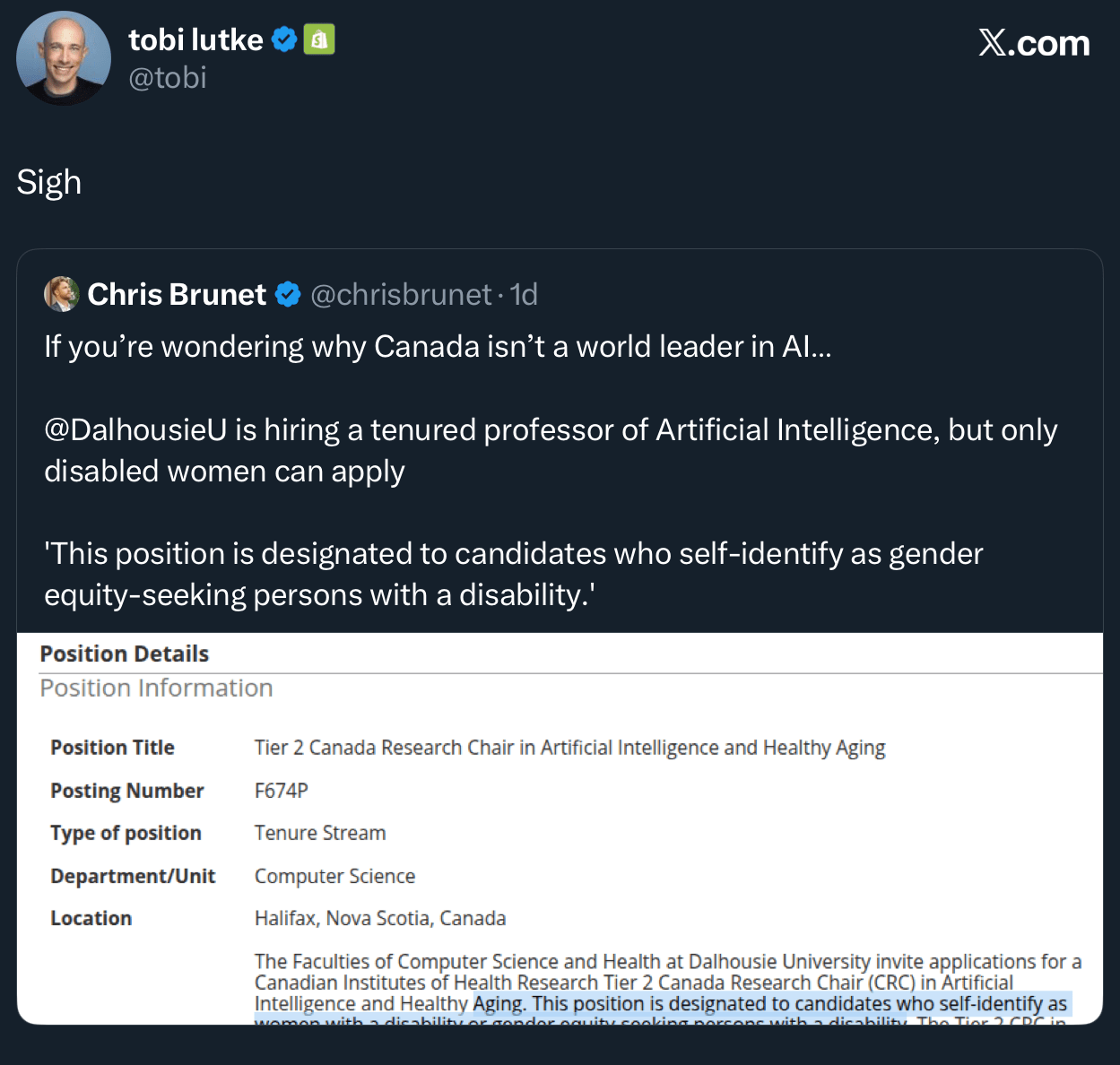
From Anna Krylov; O Canada!
From CinEmma:

Masih is quiet but we have JKR today. Presumably Dr. Roberts agrees that trans-identified males are women, but I haven’t followed that:
Woman who argued men could be women is upset a woman is being overlooked. The woman is herself of course. pic.twitter.com/jZ6ajANBR3
— Malcolm Clark (@TwisterFilm) October 14, 2025
From Ricky Gervais, a scene from “After Life” (a fantastic series) when he asks PHILOMENA who her dream dinner guests would be:
Who would your 5 dream dinner guests be? pic.twitter.com/wYaNKUr4vB
— Ricky Gervais (@rickygervais) October 12, 2025
From Malcolm; mother cats teaching their babies:
Mother cats teaching their babies
pic.twitter.com/3n2NzTGgM2— Science girl (@gunsnrosesgirl3) August 20, 2025
Two from my feed. First, Bill Maher calls attention to the mass slaughter of Christians in Nigeria by Boko Haram:
The fact that this issue hasn’t gained public attention is amazing. pic.twitter.com/dMXQ96q6H3
— Bill Maher (@billmaher) October 14, 2025
A photographer feeds a hungry red squirrel. Isn’t is a lovely creature?
A red Squirrel came to the photographer and asked for something to eat. pic.twitter.com/sJot5UpqTF
— The Figen (@TheFigen_) October 15, 2025
One I reposted from the Auschwitz Memorial:
A French Jewish girl was gassed to death as soon as she arrived at Auschwitz. She was seven years old.
— Jerry Coyne (@evolutionistrue.bsky.social) 2025-10-16T10:37:27.888Z
Two posts from Dr. Cobb, who’s still in Shanghai. First, the famous “rat hole” in a Chicago street seems to be not the impression of a rat, but of a a squirrel who fell into wet cement and survived. I’m still dubious, though. The tracks may have been an AI photo. A new paper in Biology Letters of the Royal Society, using biometric data, suggests strongly that this is the impression of a squirrel (h/t Anthony).
Glad to see the "Chicago rat hole" (rodent-body imprint) of January 2024 Internet fame was studied more, but just to add my $0.02: Many folks missed the tracks leading away from the body imprint, meaning the squirrel (not rat) fell & splatted in wet concrete, but then walked it off. 🧪🐿️🐾
— Anthony (Tony) J. Martin (@ichnologist.bsky.social) 2025-10-15T01:13:42.763Z
And a groaner:
"I've just come from Timbuctoo on my horse, Rumpelstiltskin.""Your horse is called Rumpelstiltskin??""That's right. I've been through the desert on a horse with gnome-name."
— Adam Roberts (@adamroberts.bsky.social) 2025-10-12T12:50:28.964Z
A THOUGHT FOR TODAY:
Truth, in matters of religion, is simply the opinion that has survived. -Oscar Wilde, writer (16 Oct 1854-1900)
Like the opinion of Athanasius 🙂
Love Andrzej’s sense of humor this morning.
Apologies this is a bit long but it is on point with the Hamas rule consequences, were they to have won and overtaken Israel. It is what “River to Sea” looks like.
From my own article:
“The answer was in September 2021 at the Commodore Hotel in Gaza City where the entire leadership, the big wigs of Palestine had a conference called The Promise of the Hereafter, detailed here.
In essence the plan is for “when we win” and its first imperative is to kill any Israeli citizen (Jew or Arab) who has served in the IDF ever. Israel has compulsory conscription for men and women so that’d kill about 80% of the population.
Survivors of this aspirational cull would be given the offer of exile. Except…. for those with sufficient tech, scientific or military skill and value who will be forbidden from leaving until they repay their debt/reparations to Palestine.
The conference wasn’t some propaganda LARP, indeed it was barely reported. But Sinwar et al went to considerable effort to analyze and define new land uses, names of roads and towns, new legal codes (all Sharia all the time) and diplomatic relations for the grand victory plan.
Make no mistake this is exactly what they’ve been murdering, hijacking and self-exploding for for over 70 years. Are our low-mate-value campus chicks on board with the execution of millions of Jews and their Arab “collaborators”? You know, I bet they are. Is Ireland? Norway? The DNC?”
https://themoderatevoice.com/so-what-of-gaza-trumps-plan-and-some-context/
D.A.
NYC
“Do you have one or two drinks per day, even of wine? Well, you’re elevating your risk of dementia.”
This is bad reporting by the media. EVERYTHING you eat probably has some tiny positive or negative effect on one or another of the human health problems that exist. And any effect, no matter how small, can reach whatever statistical significance level you choose, if the sample is large enough. P-values of 0.00001 are always possible if sample size is large enough, no matter how trivial the magnitude of the effect.
When faced with a claim like this, we should always ask not “Is there an effect” but rather “What is the size of the effect?”, as measured by some direct non-scaled measure of the effect size. This meaningful estimate of the size of the effect should be qualified by a confidence interval.
Almost always, real biology should not use the null-hypothesis-testing paradigm but the parameter-estimation paradigm.
I have not looked at the original studies; I suspect that they did give a measure of the effect size somewhere. But usually the scientists authoring a study and the reporters who publicize it do not emphasize this effect size, probably because it is trivially small, undercutting the imagined importance of the study.
I agree with you that one always needs to consider effect size, and that most media reporting doesn’t. So I went and looked at the paper to find out (and you can somewhat excuse the media since the authors don’t make it easy):
“A 1 SD increase in log-transformed drinks per week was associated with a 15% dementia increase (inverse-variance weighted (IVW) OR 1.15, 95% CI 1.03 to 1.27)” where it seems that such an increase amounts to: “For example, an increase from one to three DPW (or five to 16 DPW) …”.
Translation:
“Tripling your alcohol intake (for example going from 1 to 3 drinks per week, or from 5 to 16 drinks per week) most likely increases your risk of dementia by somewhere between 3% and 27%.”
Thank you very much for the effort! That is typical; effect sizes are obscured or over-transformed in most research.
The confidence interval almost includes zero effect! That means their research can just barely exclude the possibility that there is no effect at all. Of course they can’t come out and say that or no one would pay attention to their study.
Yes. And, IIRC, the 2 SD increased effect was almost no different than the 1 SD effect, so no linearity.
You’re moving the goalposts, Lou. Under your previous post demanding confidence intervals, you ought to have been satisfied that the 95% confidence interval didn’t include 1. 1.03 as the lower bound is greater than one. Therefore the study proves its point for an estimate of effect size whose midpoint is 15%, a non-trivial effect for a disease as common as dementia.
A properly done study will be no larger than the sample size needed to have an 80% (usually) chance of detecting a clinically relevant effect size, if one exists. Narrowing the confidence interval to, say, 1.11 to 1.19 would be wasteful of resources because the sample size would have to be be much larger. A wider CI with smaller lower bound gets the job done as long as it is > 1. The study would have been called negative if the lower bound of the CI had been 0.99. We wouldn’t have called it “almost positive.” Indeed, RCTs have stopping rules that call for the study to be stopped early (so the treatment can be applied to all sooner, or harm avoided) if interim analysis detects that the CI has probably crossed 1, even if only barely. If a study’s CI is too narrow, or too much > 1, it means the study was too big and could have been done more cheaply or put fewer subjects at risk from having been randomized to receive the inferior treatment.
Non-experimental studies like this one looking at alcohol and dementia have all sorts of risks for bias that motivated reasoners can cheerfully attack. Or the effect size can be judged to be too trivial to justify behavioural change. One can say one wouldn’t stop drinking unless the risk of dementia was doubled. Fine. But statistically the study has made its case.
Thanks Coel!
As I said, the 95% confidence interval almost includes zero effect. A 99% confidence interval could include zero effect. Regardless, my main point was that the estimated effect size (with confidence interval) should be the main reported result. Simply reporting that drinking rate increases the chance of dementia is uninformative and potentially misleading.
There are regular stories about what causes dementia. Research is advancing, but I think it will be a long time before we get a cure. I was at a lecture on the topic recently and there are glimmers of possibilities, but the people there said it could be at least a decade.
One thing that has been proved with statistics, is that the shingles vaccine reduces your chance of getting dementia. As the vaccine fights the varicella-zoster virus, it raises the question of whether dementia is sometimes caused by a virus. This has triggered some interesting research, but any outcome will be too late for me.
https://med.stanford.edu/news/all-news/2025/03/shingles-vaccination-dementia.html
Mamdani, who favors getting rid of guns, declined to say that Hamas should disarm yesterday.
I don’t understand why he’s so popular, including amongst many Jews.
Hamas is not going away on its own, as it is again consolidating power, this time through intimidation. (Public executions aren’t part of the agreement, are they?) It will need to be removed by force at some point. Who will step up to do the job?
I have zero doubt that they will disarm and step down. Zero.
It was a nice moment! But back to war in a matter of days or weeks.
I do hope that the IDF wired the tunnels with remote explosives, with eaves-dropping microphones, and made them undetectable.
A possible answer just showed up at the TOI:
Trump:
“If Hamas continues to kill people in Gaza, which was not the deal, we will have no choice but to go in and kill them.”
It looks like the President read my post, above.
https://www.timesofisrael.com/liveblog_entry/trump-if-hamas-doesnt-stop-killing-gazans-we-will-have-no-choice-but-to-go-in-and-kill-them/
Any voting system in which the results depend on district borders is deeply undemocratic as a matter of principle. Thus, any discussion regards only what is perhaps slightly less bad than total stupidity. As far as drawing districts to benefit certain races goes, that in itself is deeply racist, because it assumes that all or at least most people of a given race vote the same way. Even if true historically, that can change, and should change if, as MLK said, skin colour should matter as little as eye colour.
There is a solution: proportional representation. Get x% of the vote, get x% of the seats in Congress. There are too many advantages to list here. Some complain that then one no longer has a “personal” representative. Not necesarily true. (Of course, most people vote along party lines anyway and don’t know their representatives personally.) One can have a ballot with ALL the candidates on it, from all parties. Proportional representation still holds, but those candidates from given party who get the most votes are the ones who enter the parliament. Or one can have a system in which a fraction of the seats are selected via a first-past-the-post system (though even here (instant) runoff would be better) but those count towards each party’s quota as determined by proportional representation.
I agree, but a 5% threshold, as in Germany, would be desirable. In two weeks time we have a general election in the Netherlands and we run the risk of getting 10+ political parties with 3% or less of the votes in parliament and only 5 with more than 9%. That will make any formation of a government very difficult. (It does not help that everyone excludes the right wing populists, who make up the biggest political group in parliament).
That’s a common request, but is it really the case? Often when there are many parties they correspond to branches of bigger parties in other countries. It might even be easier with several parties because then there is an official coalition contract.
Of course, with 150 seats in the Tweede Kamer, there is already effectively a threshold of 2/3%.
A threshold is OK perhaps, but it has a disadvantage: votes for parties which don’t cross it are essentially wasted. So many people don’t actually vote for their first choice. The solution is to rank parties. If the first-ranked party crosses the threshold, it’s like a normal vote. If not, then that person’s vote goes to the second party on the list, and so on. Sort of like instant runoff. It would benefit the smaller parties because people wouldn’t avoid voting for them so that their vote is not potentially wasted. It would also benefit the larger parties since they get the votes for those parties which don’t cross the threshold.
Meanwhile the Republicans are openly working to steal elections over the country, and they might succeed given their tireless work to find technical loopholes in laws that were intended to stop this very thing. They will control just about everything, with little leverage to stop them, for who knows how long.
I can not speak for other states but I know that in South Carolina the super majority of Republicans hand the task of redistricting to the Democratic Party every time. Look at Representative Jim Clyburn’s district if you want evidence of this.
I find one of the most frustrating aspects of this to be seeing how Democrats regularly redistrict with the goal of giving as many minority communities a voice in state/federal government as possible. This is done despite Democratic leadership knowing the result will be fewer Democratic officials being elected but a homogeneous district will give more voters a voice that supports their views is how that argument plays out.
The Republican leadership has been very aware for decades that accusations of gerrymandering will be caste with great effect unless they continue giving the task to the state Democratic Party.
I get it is frustrating, but I think it is important to recognize the correct target.
Technically that is correct, since any X in which the results depend on Y is deeply Z as a matter of principle, depending of course on the principle.
But seriously, as a dabbler but not an expert in Social Choice theory, there are plenty of highly-democratic reasons to have some local representation. And pure proportional systems (like Israel’s, IIRC) have their own amply-demonstrated problems.
In summary, decision making is tricky for individuals, and much more so for large groups.
Note that I mentioned two methods for local representation in my original comment. Many who attack proportional representation don’t know how such systems actually work in practice.
Scotland uses the d’Hondt PR system. Many complain about it, but I think it is fair as it gets the political spread in the government very close to the political spread of the votes cast.
Philip Helbig, the 15th Amendment was added to the Constitution for a reason, and the Civil Rights Movement in the 1960s was necessary for a reason.
White people today are ignorant of history as they buy into the fake logic John Roberts, and libertarians, give for reinstating the antediluvian South.
Being in Wisconsin in 2010, I know what Republicans do when they get power: whatever they want.
The 15th amendment allowed former slaves to vote. And you are somehow equating that with opposition to what is clearly a fairer system, as opposed to drawing district lines to get the desired result? Give me a break. Civil Rights legislation was intended to end obviously racist practices. No, the answer to racism is not to be racist, not to be anti-racist in the sense of DEI or gerrymandering or whatever.
And are you assuming that I am white and ignorant?
Note that the Democrats are also guilty of doing what they want when they get power, even if most of their voters disapprove. Witness the whole woke stuff which understandably cost them the last election. Yes, it’s sad that Trump is the alternative, but that’s what you get if you want a two-party system rather than proportional representation. It would be hard to find more absurd examples of a party doing whatever it wants than some of the absurd überwoke Biden appointees whom Jerry has criticized here.
Note also that you didn’t address my two primary criticisms: district-based voting means that the results depend on how the districts are drawn, and on who draws them; assuming that all or even most members of a given group vote the same is morally wrong.
I expect you are aware that there are various algorithmic ways of dividing an area into districts that use objective population numbers and distances to produce not-unfair boundaries. The devil is in the fact that the current system’s winners can usually block attempts to change the system that benefited them.
Define fair and please point me to such a description. Of course if one has districts they should be the same size and not some special shape. But that is a slight improvement on a concept which is wrong in principle. The whole concept of one representative for a district is just wrong. A two-party system is very close to a one-party system.
I try to say what I mean and mean what I say — in this case “not unfair” was a deliberate choice over “fair”, which is abstract and has no easy definition. “Unfair” however is something that we all have our own direct experiences of, and so intuitively know that it’s personal not objective. IMO the best we can hope for is a system that seems “not unfair” to most people.
“Wrong in principle” (depending of course on the principle) and “just wrong” are even more abstract and variable than “fair”. It’s the territory of moralists, and I choose not to play there.
I do agree with you that an effective duopoly has very much in common with a monopoly.
The US Founders did not foresee the rise of political parties, and that this would endanger the separation of powers. IMO the biggest problem with a proportional list system is that that it further empowers the party leaders, who get to determine the list ranking (and often who gets on the list at all). The history of Party General Secretaries has not be a happy one. There are various proposed solutions to this in Social Choice theory; but putting such things into practice, ay, there’s the rub.
One definition of “fair” is that all the political parties have input into, but not control over, a process run by an independent commission using methods that Barbara alludes to, to re-draw constituency (“riding”) boundaries to reflect changing population distribution. That’s what Canada does. No one ever litigates it, even if one party feels it got short-changed on Gander-Twillingate. Then it is up to the parties and their local candidates to figure out how to try to win enough of them to form a government. What works in one riding won’t necessarily work in another even though the national platform of each party is out there before all the voters.
I have no idea what the American 15th Amendment has to do with PR. I sympathize with Philip that the poster raising it seems to be saying that gerrymandering to elect more black Congressmen is obligatory under the Constitution, which seems absurd. Surely rigging the vote to give them electable black politicians is not necessary to fully enfranchise black people, even if they do stay home on Election Day if none of the candidates is black.
PR being European is obviously, as you say, “morally” superior by definition. However, like passenger trains, communist parties, coalitions, expensive green electricity, and morality itself, it has little traction in the Anglosphere. Two provincial referenda in Canada on PR failed. When Trudeau’s Liberals were in Opposition, he campaigned on a promise to institute PR. Upon being elected with a majority under FPTP he promptly reneged on it. (Ironically, in the 2019 and 2021 elections, which the Liberals won, the Conservatives got more popular votes. Liberal strategists were actually gloating that they were able to form a leftist government with so little broad popular support.) Our politics is unstable enough as it is without trying to institute a new representational system no matter how much better it would be. We’re all stuck with what we have. Changing to PR, even if we wanted to, would be like re-negotiating a 20-year-old marriage contract. By the time you’d done it, you’d just want to get divorced because you would both lose trust in the other side’s intentions.
Re the perils of re-negotiating —
(1) Ouch.
(2) But under some circumstances, rolling the dice looks to be the best available alternative. At least there’s a chance of success.
We talked about this before but the Dalhousie job posting is not likely open to women unless no trans-identified man (who identifies as a woman) applies. The university is clearly trying to address the critical shortage of transgender computer-science professors. (In this posting. In other postings they are addressing the critical shortages of black and indigenous STEM professors.) Women as such, even lesbians, aren’t considered an oppressed group any more, even if they “identify” as women. (I’m not even sure that women identifying as men are gender-equity-seeking, either. They are just considered men, right? If at first glance they appeared to casual observers to be men, where would be the diversity value in hiring more of them?)
Why would a trans-identified applicant always be taken over an actual woman with this wording? Because the trans applicant, male or female, can almost always tick some sort of self-identified mental health box — it goes with the territory —, where the woman will have to have some more visible and compelling disability like MS, paraplegia, or morbid obesity limiting her mobility to be considered.
Let’s not be too hard on the university. The federal government sets the criteria for hiring into these federally funded “research chairs”. The university just wants the money. The program is explicitly DEI discrimination over merit which is perfectly legal here. Indeed it has been expressed as a foundational Canadian value….pretty cool considering it was copied directly from the United States.
The successful candidate was supposed to start on 1 July 2025, but when I checked the faculty list there does not appear to be anyone who clearly filled this position.
A job description such as that reminded me of the occasional position description we would encounter that was obviously written with a specific person in mind…. There is a longer story about how that backfired at Harvard, but it’s probably best left for another exchange.
Halifax is a long way from everywhere, and many disabled trans people use a cane or wheelchair, so it’s likely the candidate will only make xir way to Dalhousie very slowly. /s
VERY noticeable, Mike. If you do an image search on trans rts activist demos: they’re disabled b/c cross sex hormones bugger their bone density, which is incredibly important.
Their demos are full of the halt, lame, caned and wheelchair bound. Cross sex hormone usage is like putting diesel in a gasoline vehicle and the results are similar: they don’t run. Or walk well.
keep well Mike.
best,
D.A.
NYC
Maybe the key phrase is “identify as”. If a woman “identifies as” a woman perhaps she could be eligible?
Sure, she’d be eligible (provided she was also disabled) but she won’t tick as many boxes as a man (with a disability) who identifies as a woman because the man is, by definition, a gender-equity-seeking person while the woman is not. Since truth be told there aren’t really very many trans people, they are probably going to be stuck hiring a disabled woman unless they can keep the competition open long enough for a trans-identified man (with a disability) to show up.
That’s how the Toronto Symphony Orchestra runs its mentorship program for young female conductors. Open to conductors who identify as women or non-binary, the program says it is addressing the critical under-representation of transgendered conductors. Most years they will be stuck enrolling women, but if a trans guy shows up, he’s in, as long as he knows which end of the baton to hold.
Ok, which end of the baton to hold…are we going out on that one? 🙂
These two women
https://x.com/HoyEnRD07/status/1837688835443921126
pretending to be men pretending to be women caused quite a stir before their twitter account was suspended. This is the kind of “identifying” that can get one in trouble.
Maybe a proper woman (I hate the term “cis” in this context) should identify as a transwoman. Doubters should prove that she is not a transwoman, using only the criteria they accecpt for evaluation of men who claim to be women.
Phillip click the link above!
Perhaps a circumgender woman would be accepted?
Circumgender woman: a woman who identifies as a transwoman, ie as a woman.
Yes, some exist.
https://x.com/ripx4nutmeg/status/1155021191305994240?lang=ar-x-fm
Re actual women needing some visible and compelling disability to be considered, does ‘chronic explosive inability to suffer fools gladly’ qualify?
😂👍
(A fellow sufferer, I see 🙂).
And is there any non-clunky non-gendered substitute for “fellow” in this context? “Companion”, “peer”, and “comrade” just don’t cut it.
I usually refer to it as ‘ being sane’. 😈
A thesaurus offered up ‘compeer’, which I had to look up and found it means “person of equal rank, status, or ability” or “a person who is of equal standing with another in a group”. Maybe we could appropriate that word 😁
Jerry’s note, “It’s National Learn a Word Day (how about ‘refulgent’?)” brought to mind this story: An uilleann piper and musical hero of mine, Benedict Kohler, once heard an Irish singer reciting the 19th century poem, “Napoleon’s Farewell to Paris.” But the poem’s florid language plus the singer’s thick Irish accent made it indecipherable. Where one verse is, “Where Phoebus each morning shoots forth REFULGENT beams,” …. Benedict heard, “Where they feed us each morning, shoots of pork and pungent beans!”
You don’t have to live like a refulgee.
It may be out of fashion these days, but Drambuie is a liqueur with one valid use: pour over ice with an equal part of scotch whisky, and you have a Rusty Nail. The most lethal cocktail known to mankind.
I prefer my Drambuie straight up in a snifter. Same way I drink my B&B
Regarding cats on Cyprus — trouble brewing.
There are two open access articles detail a recent development: the emergence of a new Coronavirus — FCoV-23 — a highly pathogenic FCoV–CCoV recombinant responsible for a rapidly spreading outbreak of feline infectious peritonitis (FIP) originating in Cyprus. Infection has rapidly spread, infecting cats of all ages.
The first paper describes the emergence of the virus and maps the recombination event: https://www.nature.com/articles/s41586-025-09340-0
The second paper is a structural work on the spike protein and may concern adaption to and pantropism in cats: https://www.nature.com/articles/s41586-025-09155-z
In the past few years there has high quality work regarding Coronavirus recombination and host range switching, published in open access literature. I find it to be intellectually interesting and directly relevant to current events, especially with regard to recent emergence of pandemic or epidemic Coronavirus in wildlife, livestock, and humans.
“The statement also argues that Israel will not abide by any negotiated agreement.”
When the Palestinians conducted the massacre of October 7, is was they that were breaking a negotiated cease-fire, and not Israel.
The gall of these people.
And notice I wrote “Palestinians” and not “Hamas”. Since the majority of Palestinians seem to support Hamas, I don’t draw any distinction.
Yes. Pretending that Israel is shady, conniving, and untrustworthy is obligatory. After all, Jews are involved.
Why is no one talking about the genocide in Nigeria? Bill Maher answered that himself, no Jews are involved so nobody knows which side to hate.
More on Trump approving (admiring, lauding?) “anti-gang killings” via SimpleJustice blog,
“Trump on Hamas: They did take out a couple of gangs that were very bad. They did take them out and killed a number of gang members. That didn’t bother me much to be honest with you. That’s okay. A couple of very bad gangs.”
https://x.com/i/status/1978166354936287305 for more even worse commentary
(I accidently posted this to another WEIT post – I don;t know how- and deleted it there. But it if wasn;t deleted; this is a repeat. Apologies). I read the BMJ article and it doesn’t say what we’re all going to be hearing. I predict the following headlines;’ Scientists say even one drink will give you dementia”!
In fact they found that different analysis of the same data gave conflicting results. While “observational phenotype” analysis (comparing alcohol consumption with dementia symptoms) produced a “U-shaped” curve for risk with those with no alcohol consumptions having a higher risk of dementia than those consuming small amounts, but that as alcohol consumption goes up so did the risk of dementia. Hence a “U-shaped” curve.
However, a different “Mendelian randomisation genetic analysis identified a monotonic increase in dementia risk with greater alcohol consumption”. This method suggested that there was a steady increase in dementia risk with alcohol consumption, with no “U” shape.
So they are perplexed and concluded this;
“While correlational observational data suggested a protective effect of light drinking, this could be in part attributable to reduced drinking seen in early dementia; genetic analyses did not support any protective effect, suggesting that any level of alcohol consumption may contribute to dementia risk. ”
Basically, the’re saying, “we don’t know. We tested it two ways and came to two different conclusions. So we’re sticking with one of them. Because that’s what we do; ambiguity is NOT allowed”.
Which means the MSM will be screeching about how horrible alcohol is. The Democrats will want to ban it and call any one who wants a sip of wine “literally Hitler”. The Republicans will demand that alcohol be served to all public school students because of libtards or something. Just another bit of ugliness coming our way.
Coffee was good. Coffee was bad. Coffee, eggs, whole milk bad, now good, now bad, now not so sure. Stupid studies. Moderation in all things, always good.
Can’t buy the “everything in moderation” label for alcohol. Alcohol is a known neurotoxin with no nutritional value and there was never any credible evidence that any quantity of it was good for your health. It would be irresponsible to advise moderate drinking (up to 8 drinks a week) with the claim that it would improve health, the way we now encourage moderate consumption of highly nutritious eggs. Especially should we not encourage non-drinkers to take it up, ever. There are some people who should never drink at all, and you don’t know who those people are until they become refractory problem drinkers. (RFK Jr has said that no Kennedy — I think he was referring to his mother’s genes, though — should ever drink, and Drew Barrymore has said the same about her family. “Moderate” drinking shows a survivorship bias.) People bristle if they infer that we think they drink too much, so we mutter and mumble that “moderate” drinking is probably OK, even though we’d be more healthy as a society if we didn’t drink at all. It seems unfair to ask the health science establishment if drinking is healthy, and when it tells you it isn’t, to grumble that there’s more to life than health. OK, true, but that wasn’t the question you asked. You wanted some reassurance that alcohol was good for you, or at least not harmful, and we can’t give you that.
People drink alcohol because their brains like it enough that they will pay high prices and taxes for it, and will revolt if they are kept from having it. It’s here to stay, except in tee-total religions, but anyone contemplating drinking less should be strongly encouraged to. Their health will not suffer and they’ll certainly save money.
I know, I’m a blast at parties.
Like Reginald Dwight, all the science I don’t understand; it’s just my job five days a week. I don’t doubt all you say is prudent, yet I speak for only myself. Sex, coffee, wine, chocolate, cursing, work–they all work for me in moderation. Everyone else is on his/their own.
Hey, Leslie I would want to attend a party where you are a guest.
That’s really very kind of you, Peter. Thanks.
“Those forces immediately began cracking down on rival militias controlled by prominent Palestinian families”
I wonder if any of those groups brandishing Palestinian flags and attacking Israel will now accuse Hamas of genocide? I won’t hold my breath.
Folks wonder why the mainstream media is no longer trusted. The following statement says it all “According to an earlier NYT article, a Roberts court gutted the heart of the Voting Rights Act: a provision requiring federal approval of any changes in voting rules of states with a history of racial discrimination”.
The Roberts court did not gut the VRA. The core provisions of the VRA have never been challenged, much less overturned. According to Google AI “The Voting Rights Act (VRA) of 1965 was responsible for outlawing discriminatory voting practices, providing federal oversight of elections, and significantly increasing minority voter registration. The act was passed to enforce the 15th Amendment and dismantle Jim Crow-era restrictions that had disenfranchised African Americans for nearly a century.”